






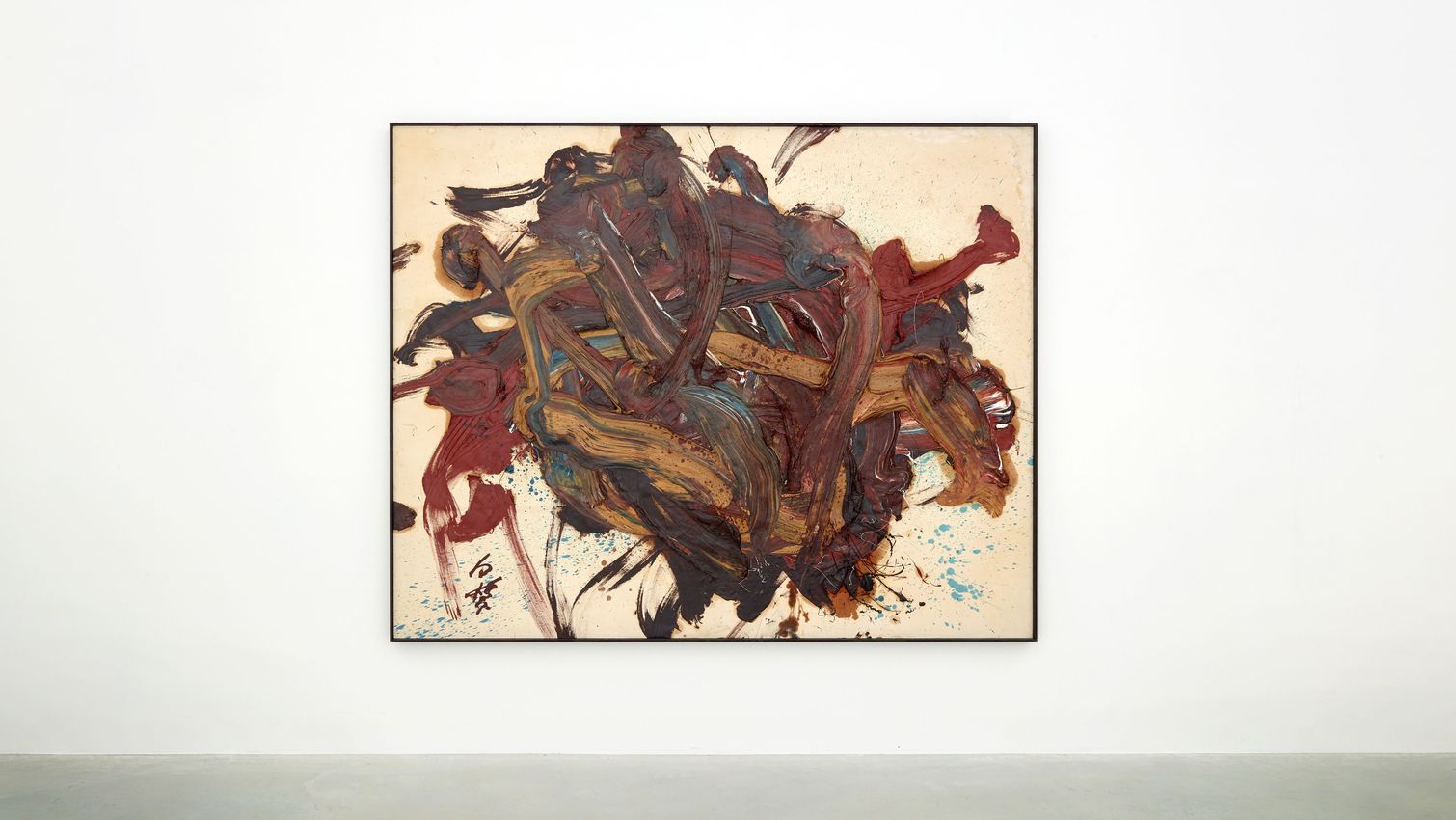
KAZUO SHIRAGA
1924-2008, JapanKazuo Shiraga initially studied nihonga in Kyoto but was discontent with its traditional style and materials. He began experimenting with painting using his fingers, and found he preferred the thick tube-based oil paints to the thin ink-based paint of his studies. In 1952 he co-founded the Zero Society (Zero-kai) with Saburō Murakami and Akira Kanayama.
Gutai
Soon after that he joined Gutai Art Association. Gutai emerged out of a Japan torn apart by the atomic bombing of Hiroshima and Nagasaki, the loss of World War II and the American occupation of Japan. Postwar Japan was facing an identity crisis—a struggle between tradition and modernity that was reflected and expressed in the art of Gutai. The artists of Gutai were in the throes of an unimaginably new era. Jiro Yoshihara, a leader of the group, reacted by telling the group to ‘make something that has never existed’.
Style and technique
In his art, Shiraga reflected the emerging new sense of the relationship between body and earth, or an artist and his materials. In works such as Challenging Mud (1955) he wrestled with a mud mixture, in doing so forming it into sculptural and painterly shapes. While Yoshihara saw physical remnants of a performance as residue, Shiraga valued each part equally. Shiraga knew of Jackson Pollock and Abstract Expressionism, but sought something beyond what Abstract Expressionism could provide.
Foot painting
Shiraga is perhaps best known for the foot paintings that he began creating from the 1950s. To make these paintings, he would flick or shovel oil paint from a bucket onto large sheets of paper or canvas that were placed on the floor. He would then move the paint around with his feet while holding onto a rope on the ceiling. Shiraga’s method was initially a logical solution to the problem of working with a large canvas on the floor (to avoid dripping) and being unable to reach the very middle. To reach this unreachable centre, Shiraga decided he must ‘get inside the canvas.’ In this collaborative relationship with his medium, Shiraga created a range of strikingly textured large-scale paintings.
Performance
The process of Shiraga’s paintings was initially performed to an audience (from around 1957), but eventually became a private aspect of the creation. Shiraga’s performances were pre-Happening-era Happenings. Allan Kaprow himself, the father of the Happening, acknowledges the debt of his Happenings to the Gutai performances he had seen in New York.
Legacy
In 1971 Shiraga entered the Buddhist priesthood of the Enryaku-ji Monastery of Mount Hiei, where he continued to paint under his monk name (Sodo) until his death in 2008. Shiraga enjoyed much acclaim in Japan and Europe over the course of his life, but it was not until after his death that his work flourished in the USA.
Exhibitions
Shiraga’s work part of major art collections worldwide, including the Museum of Modern Art, New York; National Museum of Modern Art and the Hara Museum of Contemporary Art, Tokyo; Dallas Museum of Art; Walker Art Center, Minneapolis; and the Centre Pompidou, Paris. Notable exhibitions of Shiraga’s work include:
- Destroy the Picture: Painting the Void, 1949-1962, The Museum of Contemporary Art, Los Angeles (2012)
- Gutai: The Spirit of an Era, The National Art Center, Tokyo (2012)
- Tokyo 1955-1970: A New Avant-Garde, The Museum of Modern Art, New York (2012)
- Gutai: Splendid Playground, Solomon R. Guggenheim Museum, New York (2013)
- Between Action and the Unknown: The Art of Kazuo Shiraga and Sadamasa Motonaga, Dallas Museum of Art (2015)
- Into the Unknown World – GUTAI: Differentiation and Integration, National Museum of Art and Nakanoshima Museum of Art, Osaka
Kazuo Shiraga FAQs
What is Kazuo Shiraga best known for?
Kazuo Shiraga is best known for his ‘foot paintings’—dynamic, abstract works created by suspending himself from a rope and using his feet to manipulate oil paint across canvases laid on the floor. This innovative technique, developed in the 1950s, positioned him as a central figure in Japan’s Gutai Art Association, a postwar avant-garde collective that sought to break traditional artistic boundaries.
Where can I view Kazuo Shiraga’s artworks?
Shiraga’s works are held in major public collections worldwide, including the Centre Pompidou in Paris, the Dallas Museum of Art, the Walker Art Center in Minneapolis, and the National Museum of Modern Art in Tokyo . His art has also been featured in significant exhibitions, such as ‘Gutai: Splendid Playground’ at the Solomon R. Guggenheim Museum in New York.
Did Kazuo Shiraga engage in performance art?
Yes. Beyond his ‘foot paintings’, Shiraga’s oeuvre includes notable performance pieces like ‘Challenging Mud’ (1955), where he physically engaged with a mixture of mud and cement, leaving behind a sculptural residue. These performances were integral to Gutai’s emphasis on the physical act of creation.
How did Kazuo Shiraga’s practice evolve over time?
Initially trained in traditional Japanese painting (Nihonga), Shiraga transitioned to more experimental methods in the 1950s, embracing action painting and performance. In the 1970s, he became a Buddhist monk, which influenced his later works that often incorporated spiritual themes and a more restrained palette.
Ocula | 2025




Explore Kazuo Shiraga's Exhibitions








Explore and Follow Artists Shaping Contemporary Art
A respected voice in contemporary art discourse.
Focusing on ambitious storytelling and insightful art-world commentary. Ocula Magazine publishes in-depth interviews, critical essays and timely analysis on the artists, exhibitions and ideas driving the global art world.
Learn more about Ocula Magazine
Showcasing the best of the art world.
Ocula partners with galleries from around the world to highlight their artists, artworks and exhibitions. Gallery membership is by application and invitation, with each member vetted by an independent panel.
Learn more about Ocula Membership
Specialises in the sale of major artworks.
Led by a team with deep ties to the world’s leading auction houses, galleries and collectors. Ocula’s advisory team offers bespoke services to high-net-worth clients from around the world who are looking to acquire the best of contemporary and modern art.
Learn more about our team and services