





PAOLA PIVI
b. 1971, ItalyPaola Pivi is an Italian artist known for turning the world upside down—literally and metaphorically—by displacing familiar objects, animals and situations into improbable settings that feel at once comic, uncanny and purposeful. Working across sculpture, photography, installation and performance, she stages encounters in which airplanes flip over, polar bears grow candy-coloured feathers, and wild animals inhabit meticulously choreographed tableaux, inviting viewers to test the limits of what they consider possible.
A defining early milestone in Pivi’s career was Italy’s receipt of the Golden Lion for Best National Participation at the 48th Venice Biennale (1999), awarded for a presentation in the Italian Pavilion that included her installation Untitled (airplane) (1999), an inverted Fiat G-91 fighter jet shown alongside works by Monica Bonvicini, Bruna Esposito, Luisa Lambri and Grazia Toderi. Since then, she has developed a wide-ranging international career, presenting ambitious solo exhibitions at institutions including Rockbund Art Museum, Shanghai; The Bass Museum of Art, Miami Beach—where the survey Art with a view (2018–19) transformed the museum into an immersive, hyper-saturated environment—MAXXI – Museo nazionale delle arti del XXI secolo, Rome; and the National Gallery of Victoria, Melbourne.
Most recently, major presentations such as Come check it out (Contemporary Calgary, 2024–25) and Paola Pivi – I don’t like it, I love it (Art Gallery of Western Australia, Perth, 2025–26) have brought together her iconic feathered polar bears, large-scale kinetic and sculptural installations, and new commissions, marking some of the most expansive projects of her nearly three-decade practice. Pivi has lived in many unexpected places in the world, including the remote island of Alicudi in southern Italy, India, Anchorage in Alaska, Shanghai and, more recently, the Island of Hawai’i, with these shifts in geography feeding directly into the nomadic character of her work.
Early Life and Formation
Born in Milan in 1971, Pivi initially set out to become an engineer before gravitating toward art in her twenties. She is said to have enrolled at the Accademia di Belle Arti di Brera in Milan almost by chance, encouraged by a teacher to pursue art full-time, and began to cultivate a practice grounded less in formal training than in an acute responsiveness to images and situations that appeared in her subconscious. She has described paying attention to visions of ordinary things in impossible places, treating these mental pictures as prompts for real-world experiments that would test both material limits and viewers’ expectations.
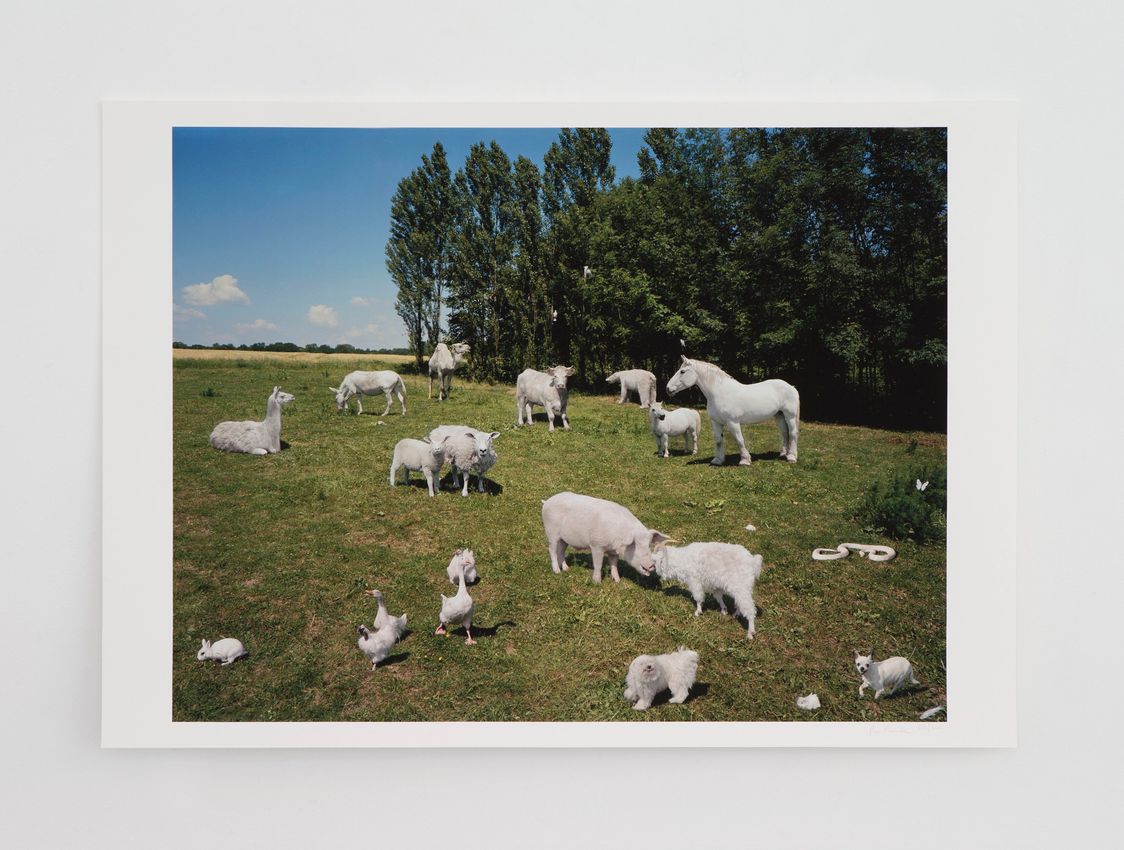
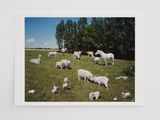
This early period coincided with her immersion in Arte Povera and the industrial landscape of northern Italy, sharpening her interest in turning utilitarian objects into charged sculptural presences. The image of Jannis Kounellis‘s Untitled (1969), with twelve live horses tethered inside Galleria L’Attico in Rome, echoes in Pivi’s installation Interesting (2007), where white horses, rabbits, llamas, doves, cows, geese and peacocks wandered through an abandoned warehouse in Milan. A similar impulse underlies her photographic series Yee-Haw (2015), which captures purebred horses running across the platforms of the Eiffel Tower in Paris. Rather than a strictly conceptual or minimalist language, Pivi embraces an exuberant, rule-breaking sensibility that treats risk, humour and spectacle as core tools of inquiry.
Turning things upside down
Pivi’s first exhibited works in the late 1990s announced her commitment to pushing what she has called “things that people think can’t be manipulated” into new physical and imaginative territories. In the large-scale installation Camion (1997), she overturned a full-size 18-wheel transport truck onto its side, transforming an emblem of industrial power and mobility into a precarious monument to stillness and vulnerability. Her first exhibition at Galleria Massimo De Carlo, Milan, in 1998 featured 100 Cinesi (1998), a living sculpture comprising 100 adults of Chinese origin lying together on the floor in identical grey sweaters and black trousers.
The installation Untitled (airplane) (1999), presented in the Italian Pavilion at the 48th Venice Biennale, saw a Fiat G-91 fighter jet flipped upside down and brought to a disorienting standstill, contributing to Italy’s Golden Lion for Best National Participation that year. This logic of inversion continued with How I Roll (2012), a public artwork commissioned by Public Art Fund and installed in Doris C. Freedman Plaza, Central Park, New York, in which a Piper Seneca aircraft rotates endlessly on its axis so that it appears suspended between flight and collapse. Her approach often combines exacting technical collaboration with an almost childlike insistence on seeing what happens if an idea—however improbable—is pursued to its furthest conclusion.
Animals, Fantasy and Kinship
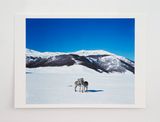
Since the early 2000s, animals have become key protagonists in Pivi’s work, functioning as surrogates, mirrors and foils for human behaviour. The photographic work Untitled (ostriches) (2003) marked the beginning of a series of staged images in which live animals appear in unlikely scenarios. Untitled (zebras) (2003), a surreal image of zebras standing on a snow-covered mountaintop, was later realised at large scale on the 25-by-75-foot High Line Billboard at West 18th Street in New York, turning a piece of urban infrastructure into a portal to another world. Untitled (leopard) (2003) shows a leopard prowling among thousands of plastic cappuccino cups, while Untitled (donkey) (2003) depicts a solitary donkey adrift in a small, weathered blue motorboat on the Mediterranean Sea, a scene exhibited at the 50th Venice Biennale (2003).
Another key film work, I wish I am fish (2009), documents a performance made for the One Day Sculpture project in Auckland, in which 84 goldfish in bowls occupied the seats of a passenger airplane flying over New Zealand, turning the banal spectacle of air travel into a deadpan fantasy of species displacement. These images and films are realised through carefully orchestrated live events—often involving complex logistics and animal handlers—then crystallised as large-scale photographs or time-based works that preserve the tension between tenderness, absurdity and latent danger.
For Pivi, such works tap into what she describes as a deep, shared memory of a time when humans were more closely connected to animals, before modern regimes of control and exploitation took hold. Her animals frequently appear uncannily human, their poses and situations hinting at anthropomorphism, yet this resemblance underscores the violence of the separation that culture has constructed between human and non-human life. The resulting images oscillate between daydream and nightmare, prompting viewers to confront their own projections as they negotiate the boundary between enchantment and unease.
Bears, Bodies and Power
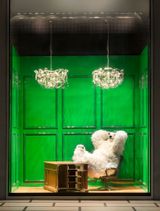
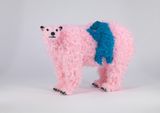
Among Pivi’s most recognisable works are her sculptural polar bears—life-sized and baby-sized forms in urethane foam, covered in dense, brightly coloured synthetic feathers and posed in activities that range from yoga-like stretches to acrobatic balances. Works such as the installation Mama no more diapers, please (2013), first presented at Galerie Perrotin, New York, present these feathered creatures as both charismatic and disquieting, their playful surfaces shadowed by associations with taxidermy, extinction and spectacle. At once seductive and grotesque, the bears visualise what the artist has called a “forced dominance”, an emblem of how humans turn other species into décor or trophies in an attempt to neutralise fear and maintain control.
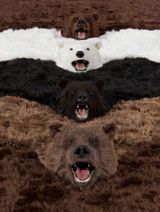
This concern with domination and vulnerability appears elsewhere in Pivi’s practice, from splayed fake bear-skin rugs in the installation What goes round—art comes round (2010), first exhibited at Galleria Massimo De Carlo, Milan, to choreographies of bodies and objects that stage power as something negotiated rather than fixed. Recent presentations such as C_ome check it out and Paola Pivi – I don’t like it, I love it_ gather multiple generations of polar bears—often including dozens of fluorescent baby bears—into expansive, immersive environments, underscoring both their crowd-pleasing charm and their unsettling, totemic presence. While her installations are often exuberant and accessible, they carry an undercurrent of critique, subtly exposing the ways in which aesthetic pleasure, consumer desire and systemic violence intertwine.
Material excess and Sensory urges
Pivi’s practice is equally attentive to materials and textures, often mobilising opulence, repetition and scale to provoke visceral responses.
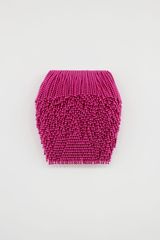
- The installation Thank You ocean (2003), composed of cascading, multi-layered strings of pearls inspired by a period the artist spent living in Shanghai and first shown at Galleria Massimo De Carlo, Milan, transforms a symbol of wealth and luxury into an enveloping environment that solicits a nearly infantile urge to touch, grasp and explore.
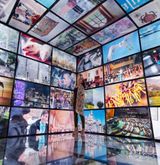
- Her large-scale media installation Lies (also titled Lies, Lies, Lies, 2014–16) consists of dozens of television screens displaying more than 40,000 images from around the world in rapid succession, while a sound system plays a continuous litany of recorded lies ranging from the banal to the politically charged; the work has been exhibited at venues including the Anchorage Museum, Alaska. Conceived during a protracted legal battle over the adoption of her son, Lies reflects Pivi’s heightened awareness of the role of deception in law, politics and everyday life, and foregrounds her interest in how images and language can be used as instruments of control.
- For the exhibition World record (MAXXI, Rome, 2019), Pivi created a monumental installation of more than 100 white mattresses arranged in two horizontal planes—one above the other—to form a padded tunnel or cave that visitors are invited to crawl through, exploring what the artist calls the “space in between”.
- In 2022, High Line Art, New York, commissioned You know who I am (2022–23), a 23-foot bronze replica of the Statue of Liberty wearing a series of emoji-like masks based on the faces of individuals chosen for their pursuit of freedom, extending her longstanding interest in icons, anonymity and projection into the realm of public monuments.
Across her work, Pivi resists digital manipulation, preferring analog photography and physical fabrication in order to capture the precise, unrepeatable moment when an idea takes form in the world. This emphasis on real, staged events allows the viewer to sense the weight, risk and labour involved, even when the resulting images and objects hover at the edge of believability.
Exhibitions, Travel and Context
Pivi’s work has been widely exhibited in major museums, biennials and public spaces. Significant solo exhibitions include I did it again (2010), Witte de With Center for Contemporary Art (now Kunstinstituut Melly), Rotterdam; You started it...I finish it (2014), National Gallery of Victoria, Melbourne; Ok, you are better than me, so what? (2014), Galerie Perrotin, Paris; and I am tired of eating fish (2014), Museo d’Arte Contemporanea Donnaregina (MADRE), Naples. She has also presented large-scale projects such as Art with a view (2018–19) at The Bass Museum of Art, Miami Beach; World record (2019) at MAXXI, Rome; Come check it out (2024–25) at Contemporary Calgary; and Paola Pivi – I don’t like it, I love it (2025–26) at the Art Gallery of Western Australia, Perth.
Her work has appeared in international survey exhibitions including the 48th Venice Biennale (1999), the 50th Venice Biennale (2003), the 27th São Paulo Biennial (2006) and the Yokohama Triennale 2001 at Yokohama Museum of Art, among others.
Collections and Legacy
Pivi’s works are held in prominent public collections including the Solomon R. Guggenheim Museum, New York; Centre Pompidou, Paris; MAXXI – Museo nazionale delle arti del XXI secolo, Rome; the National Gallery of Victoria, Melbourne; and others. Her collaborations with leading galleries such as Perrotin and Massimo De Carlo have supported a steady programme of exhibitions and commissions, situating her practice at the intersection of institutional discourse and a roader public imagination.
Over almost three decades, Pivi has developed a body of work that is both immediately legible and conceptually layered, folding together slapstick inversion, meticulous staging and an acute awareness of ecological and social stakes. By insisting that the impossible can be made temporarily real—whether in the image of a plane spinning in a park or a bear dancing in neon plumage—she offers a space in which viewers can reconsider the limits they place on objects, animals and themselves.
Paola Pivi FAQs
Who is Paola Pivi?
Paola Pivi is an Italian contemporary artist best known for her surreal installations, photographs and sculptures that place everyday objects and animals in highly unexpected situations, from inverted airplanes to feathered polar bears.
What is Paola Pivi famous for?
Paola Pivi is most famous for her colourful feathered polar bear sculptures and large-scale installations involving live animals, which combine playful spectacle with pointed reflections on power, nature and human behaviour.
Why are Paola Pivi’s polar bear sculptures important?
Paola Pivi’s polar bear sculptures—life-size forms covered in bright synthetic feathers—have become icons of her practice, symbolising the tension between cuteness and threat, and highlighting how humans aestheticise and control animal bodies.
What are Paola Pivi’s most significant artworks?
Some of Paola Pivi’s most significant artworks include Camion (1997), an overturned truck; Untitled (airplane) (1999), an inverted fighter jet; Untitled (zebras) (2003); the pearl environment Thank You ocean (2003); her feathered polar bear series; the installation Lies; and recent works like You know who I am on New York’s High Line.
What was Paola Pivi’s Golden Lion at the Venice Biennale for?
Paola Pivi was part of Italy’s presentation at the 48th Venice Biennale in 1999, where the Italian Pavilion—featuring her work Untitled (airplane) among others—received the Golden Lion for Best National Participation, a key early milestone in her career.
What themes does Paola Pivi explore in her art?
Paola Pivi’s art explores themes such as the relationship between humans and animals, freedom and control, truth and deception, spectacle and vulnerability, and the way power operates through images, objects and institutions.
Where has Paola Pivi exhibited her work?
Paola Pivi has presented major solo exhibitions at institutions including MAXXI in Rome, Rockbund Art Museum in Shanghai, the National Gallery of Victoria in Melbourne, The Bass in Miami Beach, Contemporary Calgary and the Art Gallery of Western Australia, as well as repeated appearances at the Venice Biennale and other international biennials.
Where can I see Paola Pivi’s artworks in museum collections?
Paola Pivi’s artworks are held in prominent public collections such as the Solomon R. Guggenheim Museum in New York, Centre Pompidou in Paris, MAXXI in Rome, the National Gallery of Victoria in Melbourne and several other leading museums and foundations worldwide.
Ocula | 2026

View Paola Pivi's Artworks





















Explore Paola Pivi's Exhibitions







Explore and Follow Artists Shaping Contemporary Art
A respected voice in contemporary art discourse.
Focusing on ambitious storytelling and insightful art-world commentary. Ocula Magazine publishes in-depth interviews, critical essays and timely analysis on the artists, exhibitions and ideas driving the global art world.
Learn more about Ocula Magazine
Showcasing the best of the art world.
Ocula partners with galleries from around the world to highlight their artists, artworks and exhibitions. Gallery membership is by application and invitation, with each member vetted by an independent panel.
Learn more about Ocula Membership
Specialises in the sale of major artworks.
Led by a team with deep ties to the world’s leading auction houses, galleries and collectors. Ocula’s advisory team offers bespoke services to high-net-worth clients from around the world who are looking to acquire the best of contemporary and modern art.
Learn more about our team and services