





Frieze Viewing Room: Five Artwork Highlights

Shirazeh Houshiary, Esker (2019). Pigment and pencil, on black aquacryl on canvas and aluminium. 120 x 120 cm. Courtesy the artist and Lehmann Maupin, New York, Hong Kong, and Seoul.
Born in 1955 in the Iranian city of Shiraz, Shirazeh Houshiary arrived in London in 1974 to study at the Chelsea College of Art. Since the 1980s, her practice has encompassed painting, installations, animation, and virtual reality, with her monochromatic paintings capturing her interest in the constantly shifting nature of the universe. Through washes of pigment applied to the canvas, Houshiary then inscribes words and patterns in fine detail to their surface, creating an ebb and flow of information.

Henry Taylor at Hauser & Wirth
Henry Taylor sifts through history, media, and his personal life to create intimate portraits such as this one, interrogating the human condition through flat and saturated swathes of acrylic paint. In the making of his distinctive style, the Los Angeles-based artist rendered his early works on materials including shoebox lids, furniture, and cereal boxes, paving the way for potent paintings that address themes of class, homelessness, politics, and racial and economic disparity in the United States, focusing predominantly on African American life.

Chung Chang-Sup at Axel Vervoordt Gallery
Born in 1927 in Cheongjiu in South Korea, Chung Chang-Sup is a prominent figure of the 1970s Korean Dansaekhwa movement. With a limited palette of earthy shades, characteristic of work by Dansaekhwa artists, Chung’s practice incorporated paper pulp from the inner bark of Korean mulberry tree. Known as tak, the natural bark fibre is massaged and kneaded with water before it is applied directly to the canvas. After four decades of mastering this technique, Chung began his ‘Meditation’ series in the 1990s, of which this work is part.
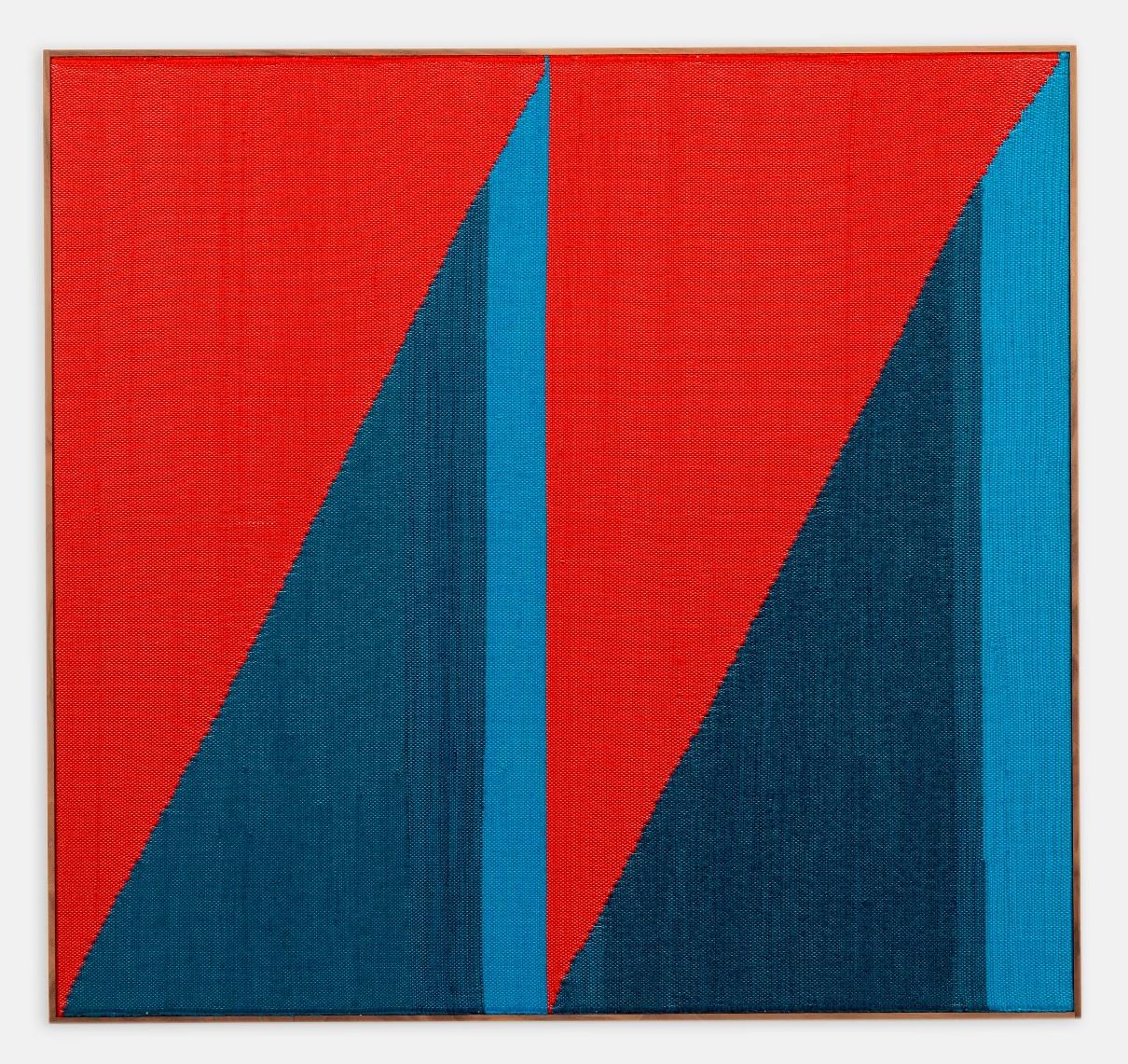
Brent Wadden, Untitled (2019) at Pace Gallery
Canadian artist Brent Wadden blurs the boundaries between craft and fine art, marrying hard-edged geometric abstraction with folkish textile art. Situating hand-craft processes in the history of Modernist painting, Wadden creates hand-woven textiles made from natural and synthetic fibres, rejecting the impatience of modern Western society and consumerist notions of cheap and instant means of gratification in art. His textile works have a painterly quality, playing with the contrasts of light and dark, as seen in this work.

Adrian Ghenie, Study for Collector 1 (2008) at Galerie Thaddaeus Ropac
Adrian Ghenie borrows from the history of art and cinema to explore themes of power. Painting with a palette knife and stencils, Ghenie’s work reimagines important historical figures such as Hermann Göring in this painting, a powerful member of the Nazi Party who owned a sizable art collection. Other figures who appear frequently in his work include Darwin, the physician Josef Mengele, and Marcel Duchamp, creating richly layered works that reveal the paradoxes within history. —[O]
Main image: Shirazeh Houshiary, Esker (2019). Pigment and pencil, on black aquacryl on canvas and aluminium. 120 x 120 cm. Courtesy the artist and Lehmann Maupin, New York, Hong Kong, and Seoul.




A respected voice in contemporary art discourse.
Focusing on ambitious storytelling and insightful art-world commentary. Ocula Magazine publishes in-depth interviews, critical essays and timely analysis on the artists, exhibitions and ideas driving the global art world.
Learn more about Ocula Magazine
Showcasing the best of the art world.
Ocula partners with galleries from around the world to highlight their artists, artworks and exhibitions. Gallery membership is by application and invitation, with each member vetted by an independent panel.
Learn more about Ocula Membership
Specialises in the sale of major artworks.
Led by a team with deep ties to the world’s leading auction houses, galleries and collectors. Ocula’s advisory team offers bespoke services to high-net-worth clients from around the world who are looking to acquire the best of contemporary and modern art.
Learn more about our team and services