




ADRIAN GHENIE
b. 1977, RomaniaAdrian Ghenie is a contemporary artist celebrated for his haunting, textured paintings that blend figuration and abstraction, often exploring themes of history, memory, and trauma. Known for representing Romania at the Venice Biennale in 2015, Ghenie has become one of the most sought-after painters of his generation.
Early Years
Adrian Ghenie was born in Baia Mare, Romania, in 1977, during the final years of Nicolae Ceaușescu’s regime. He studied at the University of Art and Design in Cluj, graduating in 2001. Ghenie remained in Cluj for several years, where he co-founded Galeria Plan B in 2005, an important artist-run space that gained international attention for showcasing Romanian contemporary art. He currently divides his time between Berlin and Cluj.
Artworks
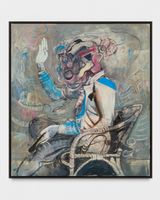
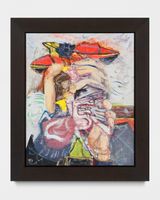
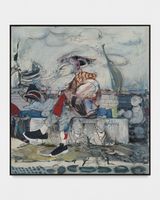
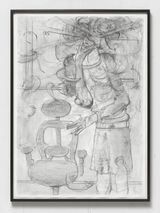
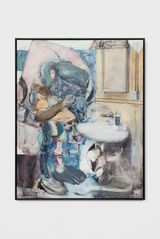
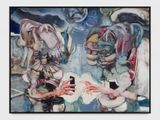
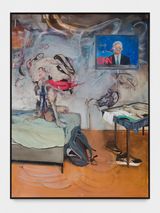
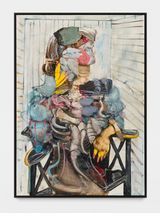
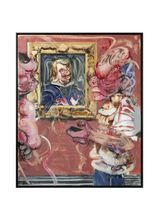
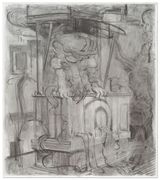
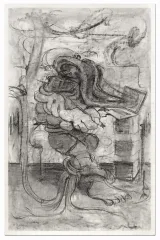
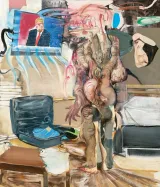
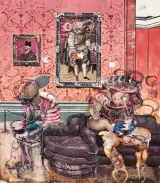
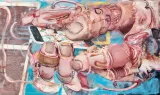
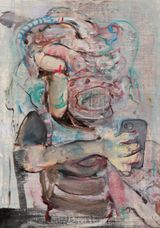
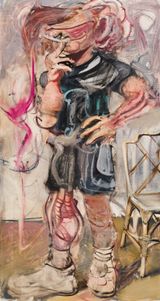
Ghenie’s artworks are characterised by richly textured surfaces, expressive brushwork, and a unique synthesis of abstraction and figuration. His paintings frequently engage with themes of historical trauma, the psychology of power, and the legacy of 20th-century politics.
Early Works: Exploring History and Memory
Ghenie first gained international recognition for works addressing the darker chapters of European history. Paintings like Pie Fight Interior (2008) and The Trial (2010) reference both the absurdity and horror of historical violence, drawing on the aesthetics of slapstick and the architecture of power. The artist often uses historical figures—such as Charles Darwin and Joseph Stalin—as proxies to reflect on collective memory.
What are Adrian Ghenie’s influences?
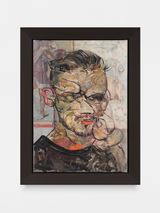
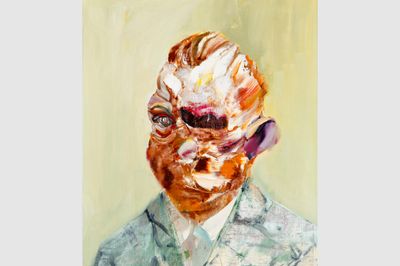
In his more recent series, such as the Self-Portrait as Vincent van Gogh works (2012–2014), Ghenie has turned his focus inward, exploring the figure of the artist as a symbol of creativity, vulnerability, and isolation. By channelling van Gogh—a figure emblematic of both artistic genius and personal struggle—Ghenie reflects on the myth of the tortured artist and the pressures of artistic legacy. His portraits are fractured and layered, often blurring the line between representation and dissolution, echoing the fragility of identity.
Ghenie has also expanded his engagement with art history, drawing on figures like Marcel Duchamp and themes from the Dada movement, as seen in his Duchamp series. These works continue his investigation into the forces that have shaped modernity, whether political, social, or artistic. More recently, his paintings have taken on an increasingly abstract quality, with dense compositions and heightened attention to surface and materiality, reflecting his ongoing interest in the tension between construction and destruction. Through these evolving approaches, Ghenie continues to probe the anxieties of the contemporary moment, while grounding his work in the enduring questions of memory, power, and artistic identity.
What is Adrian Ghenie’s process?
Adrian Ghenie’s process is highly physical and experimental, combining classical oil painting techniques with methods such as palette-knife scraping, stencilling, and collage. He often builds up thick layers of paint, then partially removes or distresses them, creating textured, eroded surfaces that evoke decay and fragmentation. This approach allows Ghenie to balance chance with control, introducing an element of unpredictability that mirrors the instability and complexity of his historical and psychological themes. His practice draws on both art history and contemporary image culture, often using photo-collage as a starting point before translating it into paint.
Awards and Accolades
- Represented Romania at the Venice Biennale (2015)
- Winner, Fondation d’Entreprise Ricard Prize, Paris (2009)
Exhibitions
Adrian Ghenie has been the subject of both solo and group exhibitions at important institutions.
Solo Exhibitions
- Battleground Studio: Adrian Ghenie – Works on Paper, Staatche Kunstsammlungen, Dresden (2025)
- Adrian Ghenie: Shadow Paintings, The Albertina Museum, Vienna (2024-2025)
- drian Ghenie: The Fear of Now, Palazzo Cini, Venice (2022)
- “I have turned my only face...” Paintings by Adrian Ghenie, The State Hermitage Museum, St. Petersburg (2019 - 2020)
- Adrian Ghenie: Darwin’s Room, Romanian Pavilion, 56th Venice Biennale (2015)
- Adrian Ghenie, Museum of Contemporary Art, Denver (2012)
- Adrian Ghenie, Stedelijk Museum voor Actuele Kunst (S.M.A.K.), Ghent (2010)
Group Exhibitions
- Something Living, Art Gallery of New South Wales, Sydney (2017–2018)
- Tr_è_s Traits, Fondation Vincent van Gogh Arles, Arles (2016)
- Six Lines of Flight: Shifting Geographies in Contemporary Art, Francisco Museum of Modern Art (2012)
- Contemporanea Strozzina, Fondazione Palazzo Strozzi, Florence (2012–2013)
- The World Belongs to You, Palazzo Grassi, François Pinault Foundation, Venice (2011)
- Mircea Pinte Collection, Museum of Art Cluj, Cluj (2010)
Ghenie’s Instagram can be found here.
Critical Reception
The artist’s practice has been covered in leading magazines, including Ocula, Artnet, and The Brooklyn Rail.
Adrian Ghenie FAQs
Who is Adrian Ghenie?
Adrian Ghenie is a contemporary painter born in 1977 in Baia Mare, Romania. He is known for his textured paintings that blend figuration and abstraction. He currently lives and works in Berlin, Germany, as well as Cluj and London.
What themes does Adrian Ghenie explore in his paintings?
Adrian Ghenie’s paintings often explore themes of history, memory, trauma, and political power. He frequently references historical figures and events, combining personal memories and broader historical narratives to create works that reflect on human vulnerability and the distortion of history.
What is distinctive about Adrian Ghenie’s painting technique?
Adrian Ghenie is known for his visceral, textured surfaces created through a physical process of layering, scraping, smudging, and blurring oil paint. He uses palette knives, stencils, and controlled drips to produce complex surfaces where figures are often partially abstracted or distorted, emphasising the tension between form and formlessness.
Where can I see Adrian Ghenie’s artwork?
Adrian Ghenie’s works are held in major museum collections worldwide including Tate Modern (London), Centre Pompidou (Paris), San Francisco Museum of Modern Art, and The Metropolitan Museum of Art (New York). He also has exhibited in galleries such as Pace and Thaddaeus Ropac, as well as the Galeria Plan B in Cluj which he co-founded. You can follow Adrian Ghenie on Ocula to keep up to date with his upcoming exhibitions.
What do paintings by Adrian Ghenie cost?
Adrian Ghenie’s paintings command high prices due to a combination of strong demand by collectors, critical acclaim, representation by prestigious galleries, and their inclusion in major museum collections. You can enquire about buying Adrian Ghenie’s work by contacting his representative galleries or Ocula’s art advisory team.
What is a record for one of Adrian Ghenie’s most expensive paintings?
In May 20222, Adrian Ghenie’s painting Pie Fight Interior 12 sold at Christie’s Hong Kong for HKD 81.06 million (approximately USD 10.4 million), becoming at that time the most expensive Adrian Ghenie painting. The sale set a new auction record for Ghenie, surpassing previous sales of his works such as Degenerate Art, which sold for around USD 9.28 million at Sotheby’s, and Sunflowers of 1937, which sold for over USD 4.5 million at Sotheby’s London. Ghenie’s auction market has consistently set new records due to strong collector demand and critical acclaim for his painterly approach to history and portraiture. Contact Ocula Advisory for more information on buying and selling work by Adrian Ghenie.
What is Adrian Ghenie’s net worth?
There is no reliable, public estimate of Adrian Ghenie’s personal net worth. While his paintings have cumulatively sold for tens of millions of dollars at auction, artists only receive the initial sale price and do not profit directly from subsequent resale values unless by prior agreement or participatory resale rights in some jurisdictions. Ghenie is often cited as one of the highest-valued living artists of his generation, but his personal financial details remain private, and net worth figures occasionally circulating online are speculative and not verified by credible art market or financial sources.
Ocula | 2025

View Adrian Ghenie's Artworks




















Explore Adrian Ghenie's Exhibitions






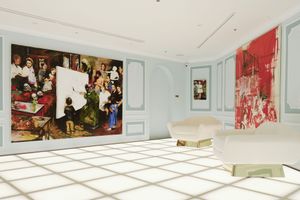
Adrian Ghenie in Ocula Magazine









Explore and Follow Artists Shaping Contemporary Art
A respected voice in contemporary art discourse.
Focusing on ambitious storytelling and insightful art-world commentary. Ocula Magazine publishes in-depth interviews, critical essays and timely analysis on the artists, exhibitions and ideas driving the global art world.
Learn more about Ocula Magazine
Showcasing the best of the art world.
Ocula partners with galleries from around the world to highlight their artists, artworks and exhibitions. Gallery membership is by application and invitation, with each member vetted by an independent panel.
Learn more about Ocula Membership
Specialises in the sale of major artworks.
Led by a team with deep ties to the world’s leading auction houses, galleries and collectors. Ocula’s advisory team offers bespoke services to high-net-worth clients from around the world who are looking to acquire the best of contemporary and modern art.
Learn more about our team and services