David Zwirner is pleased to present its first exhibition with American artist Lisa Yuskavage in its Paris location. Rendez-vous will be the artist’s eighth solo show with the gallery.
One of the most original and influential artists of the past three decades, Yuskavage creates works that affirm the singularity of the medium of painting while challenging conventional understandings of genres and viewership. At once exhibitionist and introspective, her rich cast of characters and their varied attributes are layered within compositions built of both representational and abstract elements, in which color is the primary vehicle of meaning.
For this exhibition, Yuskavage presents new large-scale paintings, each set within an imagined artist’s studio. Saturated in deep, jewel-like pigments, these works form part of her ongoing exploration of the processes and complexities of art making. The studios become stages where characters from her oeuvre are intertwined, and where time moves backward and forward.
The “rendez-vous” of the show’s title alludes to the unique way in which painting allows for different moments in time to coexist in one space simultaneously. The works establish a dialogue between personal iconography and a tradition of studio portrayals by artists as varied as Gustave Courbet, Henri Matisse, Georges Braque, and more contemporary figures like Philip Guston and Bruce Nauman. Yuskavage’s frequently ignoble and distinctively American subjects contrast with her original approach to color and light, inviting connections with earlier painterly traditions, such as color field painting, impressionism, and postimpressionism.
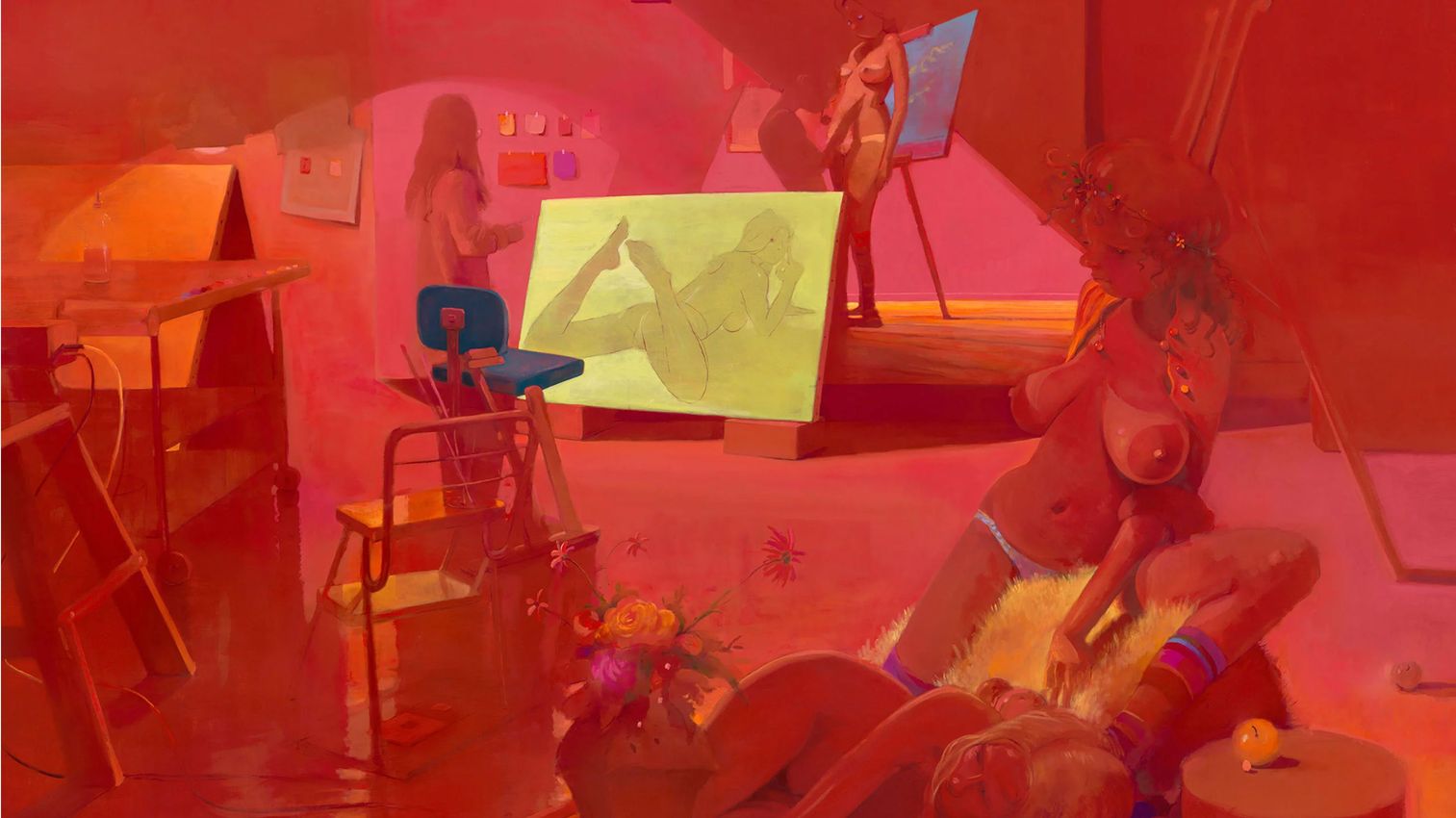
The Artist’s Studio (2022) is a kaleidoscopic composition featuring depictions of Yuskavage’s artworks within a barn-like studio. An urchin-like artist in front of a green, luminous painting-within-the-painting is a character from one of Yuskavage’s earliest and groundbreaking works, The Ones That Don’t Want To: Bad Baby (1991). Her presence in the foreground conflates different realms and moments in time, while also complicating the idea of self-portraiture, a genre Yuskavage has not engaged with fully until now. The furniture, fence, ladders, and still-life arrangements dispersed within the studio add their own symbolism, as does the presence of Yuskavage herself, posing in the background as a model. Together, these layered references recall the often-playful tradition of artists examining their own presence as creators within a work of art.
In Rendez-vous (boschmademedoit) (2023), a play appears to be taking place on a stage or tilted tabletop. The major elements comprise a cropped rendition of Yuskavage’s painting Bonfire (2013–2015; The Metropolitan Museum of Art, New York) and a pair of models posing as figures from Hieronymus Bosch’s The Garden of Earthly Delights (1590–1610). The Dionysian desire and virtuous restraint in the Dutch painter’s work are paralleled in the duality that exists in Yuskavage’s depicted studio setting, where an arrangement of a plank, sledgehammer, cables, beads, and other objects crowd the foreground as props for potential violence.
The studio as a proscenium is particularly apparent in Golden Studio (2023), which features a fecund model on a shallow stage in front of a wall of paintings and color studies, wearing a shrug and beaded panties—both the woman and her attire are familiar from Yuskavage’s oeuvre. Like an abstract pattern, the arrangement on the wall depicts selected works by Yuskavage along with a multihued stack of empty canvases. A large, luminous mirror or painting, propped up to the right, appears like a mirror or window interrupting the golden space. Depicting the artist as a young woman, the painting references one of Yuskavage’s only two designated self-portraits before this exhibition (Self Portrait, 1983), and circuitously makes the model in the studio the object of her gaze. Used prominently by painters such as Diego Velázquez and Jan van Eyck to symbolize the world outside of the illusory work of art, the mirror here offers a symbolic contrast to the many duplicated artworks in the multidimensional composition, emphasizing their hyperreality.
In Big Flesh Studio (2022), Yuskavage depicts herself facing her work in progress, Night Classes at the Department of Painting Drawing and Sculpture (2018–2020; Art Institute of Chicago). About to apply the most important final touches, she has turned her back to two models in the foreground, but her own view is partially obstructed by a yellow painting. Seamlessly integrating older, newer, and unrealized works and recombining them with real and imaginary characters and settings, the paradoxical studio setting emerges like a theater of the imagination, highlighting the unique ability of a painting to compress time and space.
Also on view is a selection of recent, smaller paintings relating to the theme of the artist’s studio (2016–2023). While some are studies or sources of inspiration for the works in the show, others revisit the large canvases, and yet others are one-of-a-kind compositions that only exist on an intimate scale. As places for exploring color, form, and characters, as well as a variety of supports, these small paintings play a remarkably dynamic and protean role within Yuskavage’s oeuvre, continuously inspiring new pictorial developments.
Born in 1962 in Philadelphia, Lisa Yuskavage received her BFA from the Tyler School of Art in 1984 and her MFA from the Yale School of Art in 1986. Since 2005, the artist’s work has been represented by David Zwirner.
In 2015, the Rose Art Museum at Brandeis University in Waltham, Massachusetts, presented Lisa Yuskavage: The Brood, a major solo exhibition spanning twenty-five years of the artist’s work. The show traveled to the Contemporary Art Museum St. Louis in 2016. A large-scale, comprehensive publication by Skira Rizzoli, published on occasion of the exhibition, created in close collaboration with Yuskavage, includes texts by renowned art historians, curators, and writers, including Christopher Bedford, Suzanne Hudson, Catherine Lord, and Siddhartha Mukherjee, as well as an interview with the artist by Katy Siegel.
Yuskavage’s work has been the subject of solo exhibitions at institutions worldwide, including the Institute of Contemporary Art, University of Pennsylvania, Philadelphia (2000); Centre d’Art Contemporain, Geneva (2001); Museo Tamayo Arte Contemporáneo, Mexico City (2006); and the Royal Hibernian Academy, Dublin (2011; organized as part of Dublin Contemporary 2011).
Lisa Yuskavage: Wilderness was on view at the Aspen Art Museum in 2020 and the Baltimore Museum of Art in 2021.
Museum collections which hold works by the artist include the Art Institute of Chicago; Hammer Museum, Los Angeles; Hirshhorn Museum and Sculpture Garden, Washington, DC; Institute of Contemporary Art, Boston; Long Museum, Shanghai; The Metropolitan Museum of Art, New York; The Museum of Contemporary Art, Los Angeles; The Museum of Modern Art, New York; Philadelphia Museum of Art; Rubell Museum, Miami; San Francisco Museum of Modern Art; Seattle Art Museum; Walker Art Center, Minneapolis; and the Whitney Museum of American Art, New York. Yuskavage lives and works in New York.
Widely associated with a re-emergence of the figurative in contemporary painting, Lisa Yuskavage has developed her own genre of portraiture in which lavish, erotic, vulgar, angelic women (and more recently men) are cast within fantastical landscapes or dramatically lit interiors. Seamlessly blending pop cultural imagery, color theory, and psychology, Yuskavage draws on classical and modern painterly techniques and, in particular, marshals color as a conduit for complex psychological constructs. As Christopher Bedford describes, Yuskavage’s paintings “are disarmingly present, even naked in their address, laying themselves bare for inspection not because they are exacting and slavish in their depictions, but instead because they hold little if anything back. Yet for all their nakedness, the worlds depicted are just that—worlds—and they are fundamentally distant from our own. The strength of the invitation to look at these paintings and what, in turn, they extend in exchange is exactly as forceful as the world of meaning and implication that is palpable in every brushstroke, yet just slightly out of reach. This collision of clarity of presentation and elusiveness of meaning constitutes [their] central, beguiling axis.”¹


A respected voice in contemporary art discourse.
Focusing on ambitious storytelling and insightful art-world commentary. Ocula Magazine publishes in-depth interviews, critical essays and timely analysis on the artists, exhibitions and ideas driving the global art world.
Learn more about Ocula Magazine
Showcasing the best of the art world.
Ocula partners with galleries from around the world to highlight their artists, artworks and exhibitions. Gallery membership is by application and invitation, with each member vetted by an independent panel.
Learn more about Ocula Membership

Specialises in the sale of major artworks.
Led by a team with deep ties to the world’s leading auction houses, galleries and collectors. Ocula’s advisory team offers bespoke services to high-net-worth clients from around the world who are looking to acquire the best of contemporary and modern art.
Learn more about our team and services