






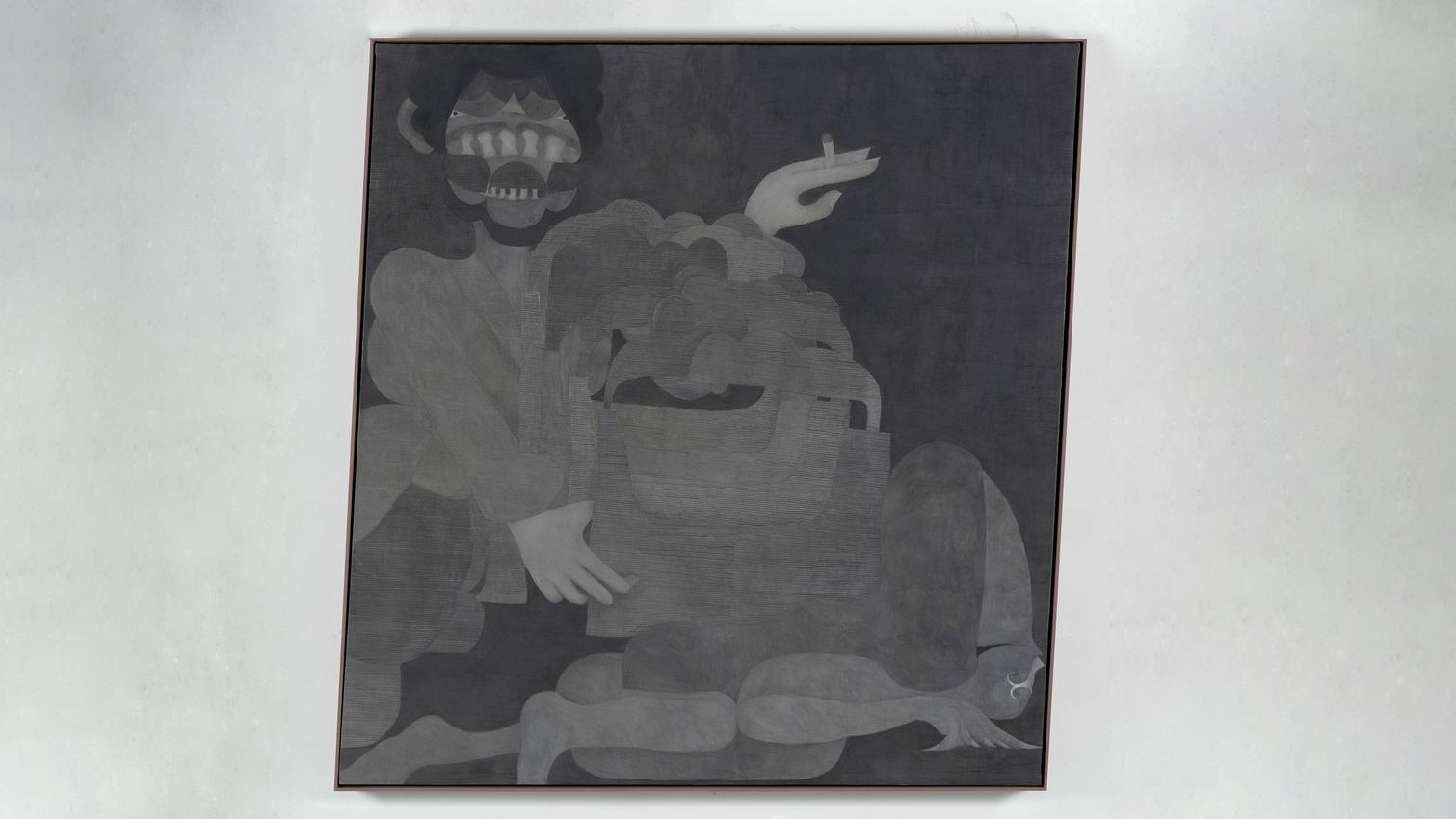
KAI ALTHOFF
b. 1966, GermanyMysterious, theatrical, and emotionally charged, Kai Althoff’s immersive installations and expressive paintings place him among the most enigmatic and visionary figures in contemporary art.
Early Years
Kai Althoff was born in Cologne in 1966 and has remained closely connected to Germany throughout his life, though his career has taken him internationally. Largely self-taught, he emerged in the 1990s Cologne art scene—alongside artists like Rosemarie Trockel and Cosima von Bonin—where his ability to combine painting, music, craft, and fiction attracted early attention.
Althoff has consistently resisted formal categorisation and public persona-building. His practice reflects a deep engagement with German romanticism, Catholicism, countercultural aesthetics, and post-war German identity. He currently divides his time between Germany and New York.
Artworks
Althoff’s artworks span painting, drawing, sculpture, textiles, video, and sound, often combining them in densely layered installations that evoke dreamlike narratives and intimate psychological states.
Early Paintings and Installations
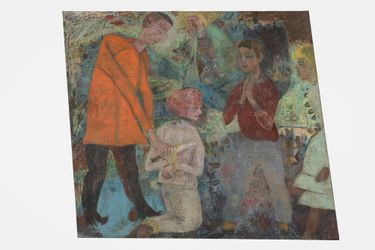
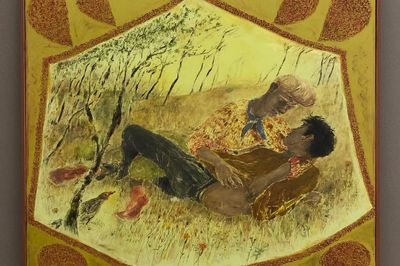
Kai Althoff’s early paintings from the 1990s marked a return to expressive figuration at a time when conceptual art dominated the German scene. His canvases—filled with elongated, androgynous figures—draw heavily from German Expressionism and Symbolism, referencing artists like Ludwig Kirchner and Egon Schiele. These psychologically intense works suggest scenes of religious ecstasy, adolescent longing, or social outcasts at the edge of breakdown. Rendered in washed-out hues or dense impasto, the paintings reflect a world caught between spiritual yearning and moral collapse. From the beginning, Althoff’s practice signalled a rejection of irony in favour of emotional authenticity.
Collaborative Worlds: with Isa Genzken and Fanal
In the mid-1990s, Althoff’s practice expanded through collaboration, particularly with the experimental band and art collective Fanal, co-founded with Justus Köhncke. Their live performances blurred the boundaries between punk music, ritual, and installation, setting a precedent for Althoff’s later gesamtkunstwerk (total artwork) approach. Around the same period, his dialogues with Isa Genzken—who shared an interest in disruption, fragility, and breakdown—produced a cross-pollination of styles. These collaborative projects established Althoff’s lifelong tendency to resist the singular artist persona, instead embedding his identity within a broader constellation of aesthetic references, spiritual affinities, and interpersonal dynamics.
Dramatic Installations and Environments
Althoff’s mid-career installations increasingly resembled mise-en-scènes from a private dream or memory. His 2016 solo exhibition at the Museum of Modern Art in New York, Kai Althoff: and then leave me to the common swifts, epitomised this direction. Visitors encountered a domestic interior filled with dolls, vitrines, paintings, and religious artefacts—many handmade—arranged in a choreographed disorder. The exhibition was conceived not as a display of discrete artworks but as a self-contained world, saturated with allegory and ritual. Althoff’s staging challenges museum conventions, shifting the viewer’s role from spectator to witness, emotionally implicated in a fragile and fragmentary narrative.
Spiritual Introspection
In recent years, Althoff’s work has become increasingly introspective, drawing more explicitly on Catholic iconography, devotional craft, and spiritual symbolism. His 2020 exhibition at Whitechapel Gallery, Kai Althoff goes with Bernard Leach, paired his own paintings and objects with works by the pioneering British potter. This unlikely pairing offered a meditation on tradition, fragility, and the handmade. Althoff’s works—whether stitched from felt, painted on raw board, or crudely sculpted—suggest a mystical practice rooted in vulnerability and reverence. Through their imperfection and theatricality, they express a longing for grace in a secular world, evoking both sacred ceremony and private confession.
Exhibitions
Kai Althoff has been the subject of both solo exhibitions and group exhibitions at important institutions. A selection of important exhibitions are provided below.
Solo Exhibitions
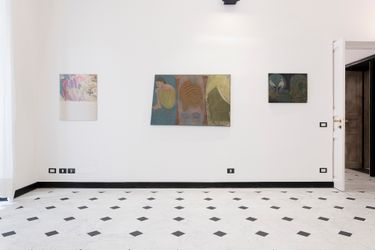
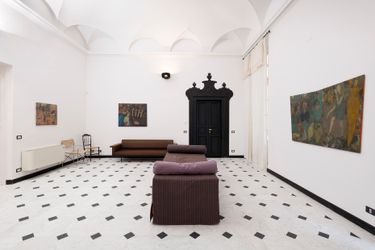
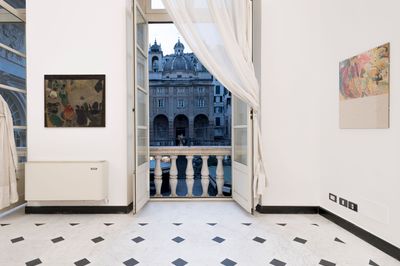
- Kai Althoff: di costole, Nervi delle Volpi, Genoa (2024)
- Kai Althoff goes with Bernard Leach, Whitechapel Gallery, London (2020)
- Kai Althoff: And then leave me to common swifts (und dann überlasst mich den Mauerseglern), Museum of Modern Art, New York (2016)
- Kai Althoff, Vancouver Art Gallery, Vancouver (2008)
- Kai Althoff: Ich meine es auf jeden fall schlecht mit ihnen, Kunsthalle Zurich, Zurich (2007)
- Kai kein Respekt, Institute of Contemporary Art, Boston; Museum of Contemporary Art, Chicago
- Immo, Simultanhalle, Cologne (2004)
Group Exhibition
- Paraventi: Folding Screens from the 17th to 21st Centuries, Fondazione Prada, Milan (2023)
- No Dandy, No Fun, Kunsthalle Bern, Bern (2020)
- Film screening: Nocturnal Creatures, Whitechapel, London (2018)
- Eternal Youth, Museum of Contemporary Art, Chicago (2017)
- Avatar and Atavism: Outside the Avant-Garde, Kunsthalle Düsseldorf, Düsseldorf (2015)
- The Whitney Biennial, Whitney Museum of American Art, New York (2012)
Critical Reception
Kai Althoff’s complex practice has been widely discussed in leading publications.His work has been featured in Apollo, Flash Art, and The Brooklyn Rail.
Kai Althoff FAQs
What are the recurring themes in Kai Althoff’s art?
Kai Althoff’s art is infused with recurring themes of spiritual longing, psychological unrest, and interpersonal complexity. His artworks often explore religious mysticism—particularly Catholicism—alongside motifs of adolescence, queerness, alienation, and memory. Figures in his paintings frequently appear androgynous or ambiguously aged, caught in scenes that evoke ritual, confession, or emotional rupture. Nostalgia, guilt, ecstasy, and shame swirl together in these dreamlike tableaux. Althoff also engages deeply with ideas of cultural identity and displacement, especially within the context of post-war Germany. His theatrical installations and crafted environments often serve as psychological landscapes—part shrine, part stage—for reckoning with the inner self.
What are Kai Althoff’s influences?
Althoff’s influences span a rich spectrum—from German Expressionist painters like Emil Nolde and Ernst Ludwig Kirchner to outsider artists such as Henry Darger. His works also absorb the mystical sensibilities of Hilma af Klint and the intimate materiality of Joseph Beuys. Beyond fine art, Althoff draws inspiration from music, craft, and spiritual traditions. His collaborations with the band Fanal reflect a deep engagement with punk aesthetics and ritual performance. Religious iconography—particularly Catholic devotionals and medieval painting—features prominently in his visual vocabulary. Althoff’s handmade approach, including textiles and found objects, channels both folk traditions and the anti-aesthetic ethos of Arte Povera.
What is significant about Althoff’s MoMA exhibition?
Althoff’s 2016 solo exhibition at the Museum of Modern Art, and then leave me to the common swifts, marked a pivotal moment in his career and challenged institutional conventions. Rather than presenting discrete artworks in a linear display, Althoff transformed the gallery into a deeply personal, immersive environment. The exhibition resembled a spiritual and domestic interior, filled with handcrafted furniture, textiles, dolls, and paintings, arranged with deliberate disorder. MoMA granted the artist full curatorial freedom, resulting in a poetic, unsettling installation that blurred the lines between art, life, and theatre. It affirmed Althoff’s singular voice in contemporary art, highlighting his resistance to categorisation and commitment to emotional and spiritual depth.
Ocula | 2025



Representative Artworks
View story





Explore and Follow Artists Shaping Contemporary Art
A respected voice in contemporary art discourse.
Focusing on ambitious storytelling and insightful art-world commentary. Ocula Magazine publishes in-depth interviews, critical essays and timely analysis on the artists, exhibitions and ideas driving the global art world.
Learn more about Ocula Magazine
Showcasing the best of the art world.
Ocula partners with galleries from around the world to highlight their artists, artworks and exhibitions. Gallery membership is by application and invitation, with each member vetted by an independent panel.
Learn more about Ocula Membership
Specialises in the sale of major artworks.
Led by a team with deep ties to the world’s leading auction houses, galleries and collectors. Ocula’s advisory team offers bespoke services to high-net-worth clients from around the world who are looking to acquire the best of contemporary and modern art.
Learn more about our team and services