





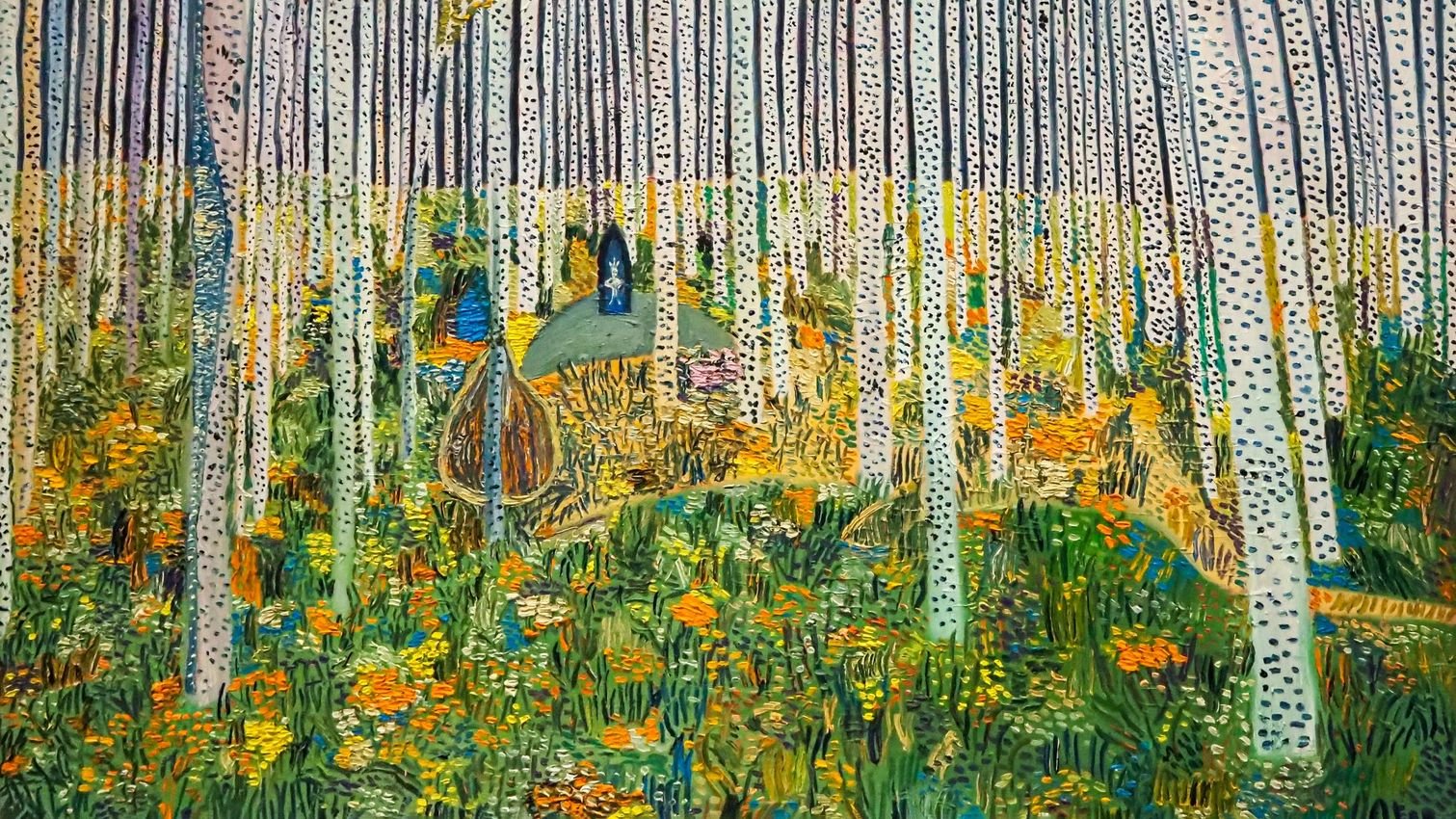
MATTHEW WONG
b. 1984, CanadaMatthew Wong was a self-taught Canadian artist whose luminous, melancholic landscapes captivated the contemporary art world before his untimely death in 2019. Blending elements of Post-Impressionism, Fauvism, and East Asian art, Wong’s paintings evoke solitude, memory, and longing through radiant colour and intricate mark-making. In just a few years, he garnered critical acclaim, with exhibitions at prominent galleries such as Karma, New York, and representation by David Zwirner.
Early Years
Matthew Wong was born in Toronto, Canada, in 1984. Diagnosed with autism spectrum disorder as a child, Wong spent his formative years between Canada and Hong Kong. He earned a Bachelor’s degree in Cultural Anthropology from the University of Michigan in 2007, before completing a Master of Fine Arts in Photography at the City University of Hong Kong in 2012.
Wong began painting in 2013, teaching himself through rigorous experimentation and study of art history. His early experiences with photography and Chinese ink painting shaped his keen sense of composition, line, and texture. He lived and worked primarily in Edmonton, Alberta, until his death in 2019.
Early Paintings: Developing a Visual Language (2013–2016)
Wong’s earliest works reflect an experimental approach as he transitioned from photography to painting. Using acrylics, watercolours, and ink, he explored motifs of trees, rivers, and isolated figures. Works such as Untitled (Garden) (2014), Untitled (Mountain Scene) (2015), and Snowfall (2016) demonstrate his evolving style, combining delicate, calligraphic lines with densely patterned surfaces influenced by traditional Chinese landscape painting. During this formative period, Wong established a distinctive mark-making technique and a visual vocabulary that would later appear in his large-scale landscapes.
Breakthrough Works: Blue Night and Atmospheric Landscapes (2017–2019)
Wong’s breakthrough came with large-scale paintings characterised by saturated colours and densely patterned surfaces. Works such as Blue Night (2018) and The Realm of Appearances (2018) exemplify his mature style—expansive nocturnal landscapes filled with stylised trees, winding paths, and distant lights. These paintings evoke introspection and solitude, balancing bold brushwork with meticulous mark-making.
Influenced by Vincent van Gogh, Henri Matisse, and Chinese literati painters, Wong created compositions that fused Western modernist and Eastern aesthetic traditions. His use of colour, from electric blues to glowing yellows, infused familiar landscapes with otherworldly intensity.
In his later works, Wong deepened his exploration of mood and atmosphere. Paintings such as See You on the Other Side (2019) and River at Dusk (2019) present haunting, meditative scenes that reflect his ongoing struggle with depression. His visual vocabulary—lone figures, empty chairs, winding paths—convey a profound sense of yearning and existential reflection.
Who influenced Matthew Wong’s work?
Matthew Wong drew inspiration from Vincent van Gogh’s emotive brushwork and vibrant colour, Henri Matisse’s bold compositional simplicity, and Egon Schiele‘s expressive line. Wong was also deeply inspired by traditional Chinese landscape painting, particularly the ink paintings of the literati tradition.
He cited the works of Shitao and Bada Shanren as early influences, alongside contemporary painters such as Yayoi Kusama and Pierre Bonnard. This blending of Western modernism and Eastern aesthetics shaped his singular approach to painting.
Exhibitions
Matthew Wong has been the subject of both solo and group exhibitions at important institutions.
Solo Exhibitions
- Matthew Wong l Vincent van Gogh: Painting as a Last Resort, Van Gogh Museum, Amsterdam; Kunsthaus Zürich, Zürich (2024)
- Matthew Wong: The Realm of Appearances, Museum of Fine Arts, Boston; Dallas Museum of Art, Dallas (2023)
- Blue View, Art Gallery of Ontario, Toronto (2021)
- Chapter One, Cuiheng Art Museum, Zhongshan (2014)
Group Exhibitions
- To Be Determined, Dallas Museum of Art, Dallas (2020)
- Trance Curated by Albert Oehlen, Aishti Foundation, Beirut (2018)
Critical Reception
Wong’s practice has been featured in leading publications including Ocula, The New Yorker, and The New York Times.
Matthew Wong FAQs
Where can I see Matthew Wong’s artworks?
Matthew Wong’s paintings are held in major museum collections and have been exhibited internationally. Notable recent exhibitions include Matthew Wong | Vincent van Gogh: Painting as a Last Resort at the Van Gogh Museum in Amsterdam and Kunsthaus Zürich, as well as Matthew Wong: The Realm of Appearances at the Museum of Fine Arts, Boston, and the Dallas Museum of Art. His work has also been exhibited at the Art Gallery of Ontario in Toronto and remains in the collections of several leading institutions and private collectors.
What is Matthew Wong best known for?
Wong is renowned for his luminous and melancholic landscapes, which blend elements of Post-Impressionism, Fauvism, and traditional East Asian art. His signature style is marked by radiant colour, intricate mark-making, and motifs of solitude and longing-often featuring nocturnal scenes, winding paths, lone figures, and glowing lights.
Who and what influenced Matthew Wong’s art?
Wong drew inspiration from artists such as Vincent van Gogh, Henri Matisse, Egon Schiele, and Pierre Bonnard, as well as Chinese literati painters like Shitao and Bada Shanren. His work reflects a synthesis of Western modernist painting and Eastern ink traditions, resulting in a unique visual language that bridges cultures and histories.
What is Matthew Wong’s record price at auction?
Matthew Wong’s paintings have achieved significant results at auction. In October 2022, his painting Night Crossing (2018) sold for USD 5.9 million at Sotheby’s Hong Kong, setting a record for the artist and reflecting his growing stature in the contemporary art market.
How did Matthew Wong’s background shape his art?
Largely self-taught, Wong’s early training in photography and his experience with Chinese ink painting informed his approach to composition, line, and texture. Diagnosed with autism spectrum disorder, Wong’s sensitivity to solitude and introspection is deeply embedded in his work, contributing to its emotional resonance and universal appeal.
How has Matthew Wong’s work been received by critics?
Wong’s art has been widely acclaimed in publications such as Ocula, The New Yorker, and The New York Times. Critics have praised his ability to evoke mood and memory through colour and mark-making, with The New Yorker describing his paintings as “luminous portals into a world of solitude and longing.”
Michael Irwin | Ocula | 2025



Matthew Wong in Ocula Magazine







Explore and Follow Artists Shaping Contemporary Art
A respected voice in contemporary art discourse.
Focusing on ambitious storytelling and insightful art-world commentary. Ocula Magazine publishes in-depth interviews, critical essays and timely analysis on the artists, exhibitions and ideas driving the global art world.
Learn more about Ocula Magazine
Showcasing the best of the art world.
Ocula partners with galleries from around the world to highlight their artists, artworks and exhibitions. Gallery membership is by application and invitation, with each member vetted by an independent panel.
Learn more about Ocula Membership
Specialises in the sale of major artworks.
Led by a team with deep ties to the world’s leading auction houses, galleries and collectors. Ocula’s advisory team offers bespoke services to high-net-worth clients from around the world who are looking to acquire the best of contemporary and modern art.
Learn more about our team and services