






Lee Bae
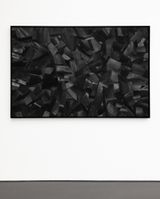
b. 1956, South KoreaLee Bae’s artistic practice embraces the many facets of the colour black, using drawing, painting, sculpture and installation to explore the intensity and depth of the shade. He originally created assemblages and sculptures using his own charcoal, but has since used carbon black and charcoal ink.
Early Years
Lee Bae was born in Cheongdo, Korea in 1956. He gained his BFA from Hongik University in 1981 and his MFA from the same institution in 1986, studying under Park Seo-Bo. He travelled to cities around the world including Los Angeles, London and Berlin before moving to Paris in 1990, working as an assistant for Lee Ufan. (He now divides his time between Paris and Seoul.)
Lee Bae: Artworks
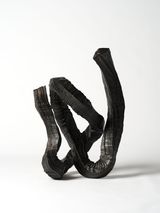
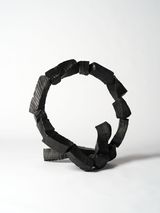
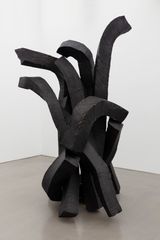
Lee Bae began making sculptures in charcoal in 1991—the first piece was a birdhouse made from a log of charcoal carved into a round shape with a hole in it. In 2019, he said that when he arrived in Paris, he wanted to make art but it was too expensive to paint, so he bought a pack of barbecue charcoal from a petrol station to draw with and from which to assemble works. “I wanted to show the properties of this pure and infinite material through my sculptures,” he said. He has described charcoal as a light-reflecting material but with “infinite hues” of black, including cold black, warm black, clear black, cloudy/dense black, deep black, shallow black and transparent black.
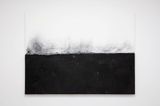
His original pieces used the energy of the charcoal to produce bold strokes and jagged lines, combined with softer areas. In more recent years, he has used carbon black—a more engineered form of soot—and charcoal ink, using elemental gestures to record time and movement.
- Lee Bae’s 2019 Promenade installation in New York City installed charcoal throughout Perrotin’s gallery space. Inspired by dolmens in Cheongdo, he created 24 pieces of pine wood, baked into charcoal, symbolising the Earth and the chaos of nature.
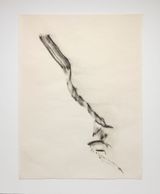
- He started the Brushstroke series in around 2020, taking inspiration from East Asian calligraphy and ink-wash painting. When creating the works in the series, Lee Bae hardly changes the movement of his brush.
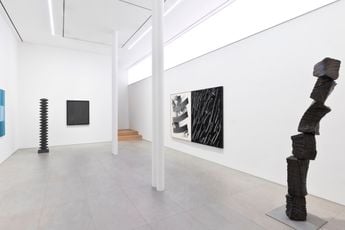
- The 6.4-metre stacked charcoal sculpture Issu du Feu was installed at the Rockefeller Centre in New York City in 2023, making Lee Bae the first Korean artist to show a public artwork in the landmark’s Channel Gardens.
Lee Bae: Select Awards
- Artist of the Year, National Museum of Contemporary Art, Gwacheon/Seoul (2000)
- Artist of the Year, Korean Cultural Centre, Paris (2009)
- National Association of Art Critics Prize, South Korea (2013)
- Chevalier de l’Ordre des Arts et des Lettres, France (2018)
- Republic of Korea Culture and Arts Award (2023)
Lee Bae: Select Exhibitions
Select Solo Exhibitions
- A Dance for the Prayer, He Art Museum, Foshan (2026)
- En attendant, Abbaye de Beaulieu-en-Rouergue, Ginals (2026) (and touring)
- Between, Perrotin, New York City (2024)
- Lee Bae—La Maison de la Lune Brûlée, Wilmotte Foundation, Venice (2024)
- Lee Bae, Gallery Johyun, Busan (2023)
- Souffle d’Encre, Perrotin, Shanghai (2022)
- Lee Bae, Indang Museum of Daegu (2021)
- Union, Phi Foundation, Montreal (2021)
- Venice Wood Water, Wilmotte Foundation, Venice (2019)
- Plus de Lumière, Fondation Maeght, Saint-Paul-de-Vence (2018)
- La Cohue, Musée des Beaux-Arts, Vannes (2016)
- Issu du feu, Domaine de Chaumont-sur-Loire (2016)
- Suspens, Domaine de Kerguéhennec, Bignan (2016)
- Carte Blanche à Lee Bae, Musée National des arts Asiatiques, Paris (2015)
- Fernet Branca Fondation, Saint-Louis (2014)
- Holly Hunt, New York City (2013)
- RX Gallery, Paris (2011)
- Today Art Museum, Beijing (2009)
- Hakgojae, Seoul (2007)
- Kwafune Gallery, Tokyo (2005)
- Johyun Gallery, Busan (2003)
- Cigong Gallery, Daegu (1999)
- Willy d’Huysser Gallery, Brussels (1996)
- Espace Artseanal, Issy-les-Moulineaux (1993)
- Soo Gallery, Seoul (1988)
Select Group Exhibitions
- 10 Years, Perrotin, Seoul (2026)
- Un siècle d’échecs, Perrotin, Paris (2026)
- Winter 2026, Esther Schipper, Berlin (2026)
- Group Show, Perrotin, Paris (2025)
- Light of Winter, Perrotin, New York City (2024)
- Pacific Abstractions, Perrotin, Los Angeles (2024)
- Resonance, Horim Museum, Seoul (2021)
- Overstated and Understated, Paradise Art Space, Incheon (2018)
- Gwangju Biennale (2016)
- International Drawing Exhibition, National Museum of Contemporary Art, Rijeka (2013)
- Artist of the Year, 1995–2010, National Museum of Contemporary Art, Gwacheon (2011)
- Look on Korean Contemporary Art, Gallery Jean Fournier, Paris (2006)
- Nature in Modern Art, Museum National d’Histoire Naturelle, Paris (1999)
- Another Dimensions, Espace Artesanal, Issy-les-Moulineaux (1995)
- Young Artist, Centre for Korea Culture, New York City (1991)
- The Korean Young Artists, National Museum of Contemporary Art, Gwacheon (1987)
Further Reading
- Lee Bae’s official website
- Lee Bae’s Instagram
- Review of Lee Bae’s exhibition at the 2024 Venice Biennale from the Observer
- 2019 conversation in Sculpture magazine
- Artist profile page at Perrotin
- Artist profile page at Esther Schipper
Lee Bae FAQs
What is daljip taeugi/Moonhouse Burning?
The centuries-old ceremony of daljip taeugi celebrates the first full moon of the lunar calendar and is practiced in Korean communities including Cheongdo, where Lee Bae is from. A house- or cone-shaped fire made from rice straw and pine branches is burned, and the ashes are used as fertiliser. Lee Bae’s 2024 exhibition at the Venice Biennale, La Maison de la Lune Brûlée, referenced daljip taeugi, reconstructing its symbols and significance through sound, painting, sculpture and installation.
Does Lee Bae make his own charcoal?
Yes, Lee Bae has made his own charcoal—the colour varies according to the type of wood he burns. He makes a furnace from ochre soil (clay earth coloured by iron oxides) and burns the wood in an igloo-shaped ceramic oven for around 15 days, then lets it cool for another 15 days.
Is Lee Bae in the Dansaekhwa movement?
Lee Bae is considered second-generation Dansaekhwa, following the minimalist spirit of the original monochromatic painting movement, but developing his own visual language.
Ocula











Explore Lee Bae's Exhibitions







Explore and Follow Artists Shaping Contemporary Art
A respected voice in contemporary art discourse.
Focusing on ambitious storytelling and insightful art-world commentary. Ocula Magazine publishes in-depth interviews, critical essays and timely analysis on the artists, exhibitions and ideas driving the global art world.
Learn more about Ocula Magazine
Showcasing the best of the art world.
Ocula partners with galleries from around the world to highlight their artists, artworks and exhibitions. Gallery membership is by application and invitation, with each member vetted by an independent panel.
Learn more about Ocula Membership
Specialises in the sale of major artworks.
Led by a team with deep ties to the world’s leading auction houses, galleries and collectors. Ocula’s advisory team offers bespoke services to high-net-worth clients from around the world who are looking to acquire the best of contemporary and modern art.
Learn more about our team and services