





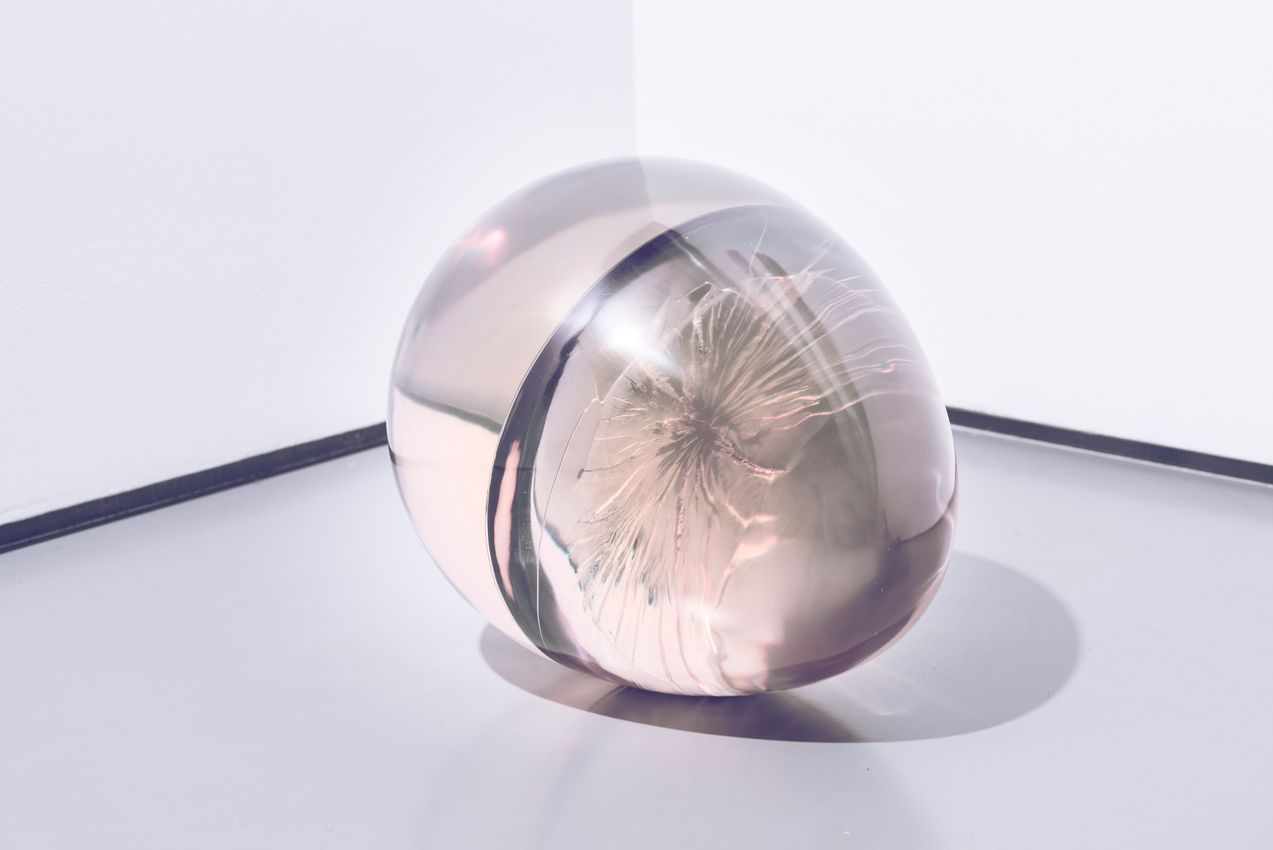
RACHEL ROSE
b. 1986, United StatesRachel Rose is a contemporary artist whose immersive video installations and experimental films explore the intersections between history, ecology, mortality, and the evolution of human perception through time.
Early Years
Born and based in New York City, Rachel Rose studied humanities at Yale University, later earning her MFA from Columbia University in 2013. Initially interested in painting, her trajectory shifted during graduate school when she began working with digital video and archival footage.
Her background in art history and literature—alongside influences ranging from Romantic painting to experimental cinema—continues to inform her conceptually rigorous and visually rich artworks. Rose lives and works in New York, where she often draws from the city’s history and architectural idiosyncrasies in her films.
Artworks
Rachel Rose’s artworks use moving image, sound, and installation to investigate human perception, mortality, and the shifting boundaries between nature, culture, and technology in contemporary art.
Vision, Perception and the Limits of the Body
A consistent thread in Rose’s work is her interest in the physical and psychological edges of experience. In Everything and More (2015), perhaps her most widely recognised artwork, the artist uses disorienting footage of liquids, fabrics, and vacuum chambers to simulate the sensory void of space, overlaid with audio from astronaut David Wolf. Projected at room-filling scale, the video creates an immersive environment where the body feels untethered—heightening awareness of breath, gravity, and vision.
Earlier video pieces like Sitting Feeding Sleeping (2013) and A Minute Ago (2014) similarly use montage and layered sound to probe the limits of perception. In the former, filmed at cryogenic labs and zoos, Rose explores blurred boundaries between life and suspension; in the latter, she splices a sudden hailstorm video with images of Philip Johnson’s Glass House, creating a meditation on architectural fragility and the unpredictability of nature.
History, Enclosure and the Control of Land
Several of Rose’s later works examine historical moments when land and labour were redefined—often through force. Wil-o-Wisp (2018) and Enclosure (2019) are set in rural England during the Enclosure Acts, when communal land was seized for private use. Wil-o-Wisp follows Elspeth, a mystic healer accused of witchcraft, while Enclosure tracks a troupe of thieves using pseudo-spiritualism to manipulate rural families.
Blending lush cinematography, costume drama, and speculative narrative, these contemporary artworks consider how power, class, and magic intersect—highlighting the consequences of institutional control over both land and knowledge.
Animation, Childhood and Isolation
In Lake Valley (2016), Rose turns to animation, constructing a world from hand-cut illustrations sourced from historic children’s books. The story follows a pet left home alone, tracing the theme of abandonment across time and image. The film loops endlessly, with shifting palettes and subtle mutations, offering a melancholy reflection on solitude and emotional development. Like much of Rose’s work, it draws on archival material to bridge personal emotion with collective memory.
Materials and Immersive Installation
Beyond narrative, Rose’s works are distinguished by their tactile attention to material. Her videos often feature analogue processes: liquids filmed in aquariums, hand-rendered animation, or footage shot through glass and atmospheric distortions. She frequently installs works in custom-built environments, extending the screen into physical space—an approach that transforms viewing into a multi-sensory encounter.
Exhibitions
Rachel Rose has been the subject of both solo and group exhibitions at important institutions. A selection of important exhibitions is provided below.
Solo Exhibitions
- Rachel Rose: The Last Day, Luma Westbau, Zurich (2025)
- Rachel Rose: The Last Day, LUMA Arles, Arles (2023)
- Rachel Rose, SITE Santa Fe, Santa Fe (2203)
- Lake Valley, Springfield Museum of Art, Ohio (2022)
- Rachel Rose, Lafayette Anticipations, Paris (2020)
- Enclosure, LUMA Foundation, Arles (2019)
- Wil-o-Wisp, Philadelphia Museum of Art, Philadelphia (2018)
Group Exhibitions
- Summer is Over, Fondation Beyeler, Basel (2024)
- The Infinite Conversation, Beijing Biennial, Beijing (2022)
- To Begin Again: Artists and Childhood, ICA Boston, Boston (2022)
- One Day at a Time, Museum of Contemporary Art, Los Angeles (2018)
- Take Me (I’m Yours), Pirelli HangarBicocca, Milan, (2017)
- Viva Arte Viva, 57th Venice Biennale, Venice (2017)
- Incerteza viva [Live Uncertainty], 32nd Bienal de São Paulo, São Paulo (2016)
Critical Reception
Rachel Rose’s work has been widely discussed in leading publications including ARTnews, The Financial Times, and The New Yorker, In a feature for Ocula Magazine, Rachel Rose says: ‘Since having kids, the mundane tasks of family life have become a basis and fountain for my work. I look for the sublime within the everyday. In the evenings, I work at home once they go to bed. Seeing them grow so quickly has put into focus that my time is precious, so I try to use it wisely.’
Rachel Rose FAQs
What themes does Rachel Rose explore in her art?
Rachel Rose explores how shifts in history, science, and society shape human perception and mortality. Her contemporary artworks often probe themes such as the fragility of the body, ecological crisis, childhood solitude, and land ownership. Using experimental video techniques, animation, and sound design, Rose interrogates moments when personal and collective experience collide. Whether drawing on outer space exploration, the English Enclosure Acts, or early childhood psychology, her art asks what it means to be alive and aware across time.
What is Rachel Rose best known for?
Rachel Rose is best known for her immersive video installations that merge original footage, archival material, and speculative storytelling to explore philosophical and sensory thresholds. Her breakout artwork Everything and More (2015) simulates the experience of being in outer space using abstract visual textures and audio from astronaut interviews. She is also acclaimed for Lake Valley (2016) and Enclosure (2019), which showcase her signature technique of layering narrative with visual experimentation, establishing her as a vital voice in contemporary video art.
What are Rachel Rose’s influences?
Rachel Rose’s influences span literature, architecture, philosophy, and art history. She has cited the Romantic sublime, Russian filmmaker Andrei Tarkovsky, and the transparency of Philip Johnson’s Glass House as formative references. She draws from archival sources—children’s books, scientific documents, historical records—and recontextualises them within highly aestheticised visual narratives. Her use of sound and texture reflects the influence of experimental cinema, while her thematic concerns with perception, mortality, and nature place her in dialogue with broader currents in contemporary art and ecological thought.
Ocula | 2025
View Rachel Rose's Artworks




















Explore Rachel Rose's Exhibitions













Explore and Follow Artists Shaping Contemporary Art
A respected voice in contemporary art discourse.
Focusing on ambitious storytelling and insightful art-world commentary. Ocula Magazine publishes in-depth interviews, critical essays and timely analysis on the artists, exhibitions and ideas driving the global art world.
Learn more about Ocula Magazine
Showcasing the best of the art world.
Ocula partners with galleries from around the world to highlight their artists, artworks and exhibitions. Gallery membership is by application and invitation, with each member vetted by an independent panel.
Learn more about Ocula Membership
Specialises in the sale of major artworks.
Led by a team with deep ties to the world’s leading auction houses, galleries and collectors. Ocula’s advisory team offers bespoke services to high-net-worth clients from around the world who are looking to acquire the best of contemporary and modern art.
Learn more about our team and services