The art world in focus
Subscribe to our newsletter for news and insights on artists, galleries and exhibitions.
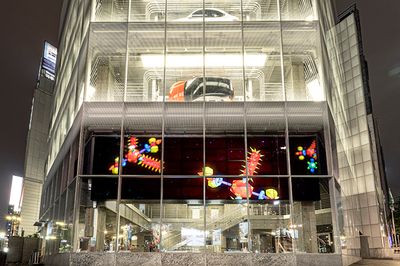
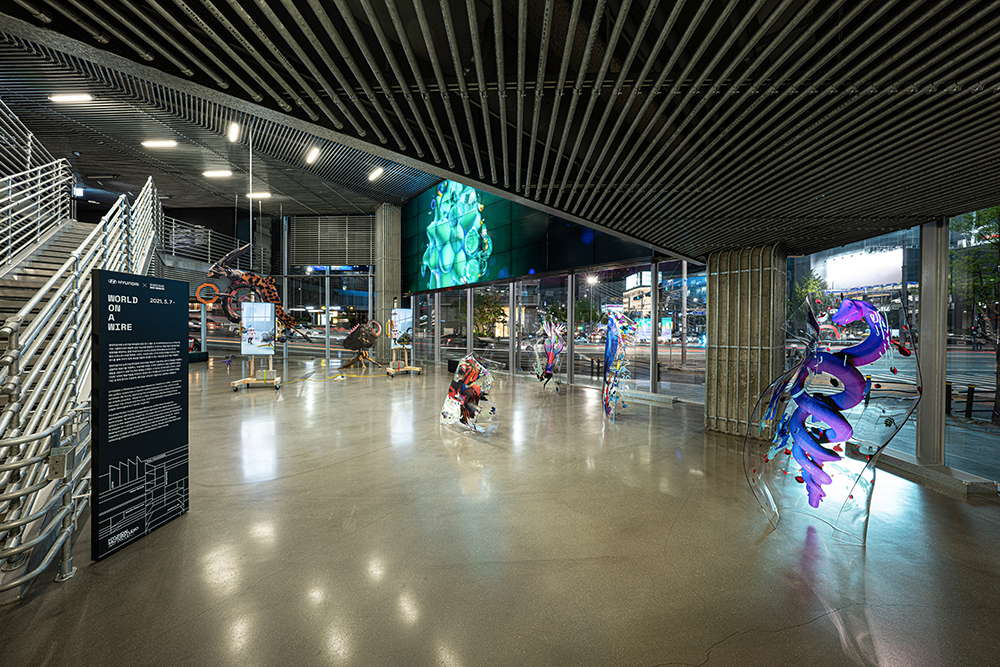
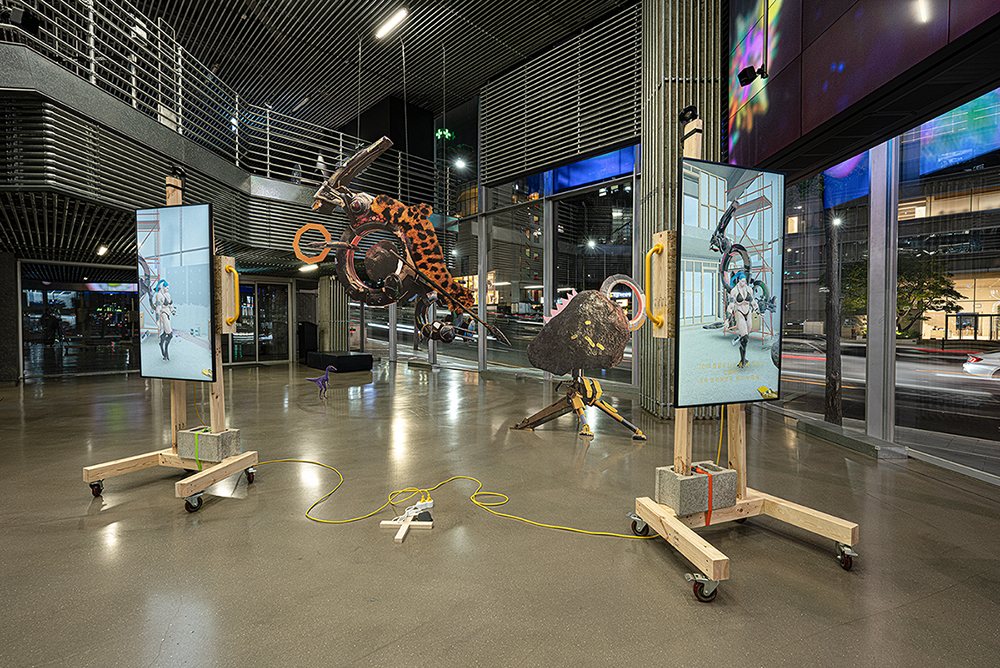
Exhibition view: World on a Wire, Hyundai Motorstudio, Seoul (7 May–8 August 2021). Courtesy Hyundai Motorstudio and Rhizome.
Launched in early 2021, Hyundai Motor Company’s partnership with Rhizome, affiliate in residence at the New Museum in New York, will see an array of innovative digital projects presented through 2022.
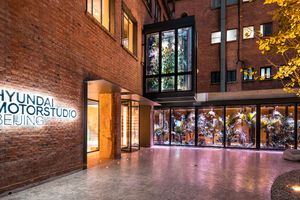
Among them, World on a Wire is an international digital art exhibition showing online and at Hyundai Motorstudio in Beijing (28 January–5 April 2021), Seoul (7 May–8 August 2021), and Moscow (September 2021).
Described by DooEun Choi, Art Director of Hyundai Motor Company as ‘a kind of hybrid-reality terrarium,’ the exhibition ‘contains artist-made synthetic life forms that explore the possibilities and poetics of computational simulation.’
Artworks on view were created using both analogue and digital technologies, incorporating augmented reality (AR), digital and practical animation, infinite simulation, artificial intelligence (AI), and gaming. With seven new commissions, the exhibition has been launched both on and offline; an approach that ‘offers the viewers an unconventional way of experiencing digital art and connects them with an inspiring cultural experience that expands beyond physical exhibitions,’ explains DooEun Choi.
In this conversation, Rhizome’s Executive Director, Zachary Kaplan, Artistic Director Michael Connor, and DooEun Choi trace the exhibition’s conception and some of the highlights on view.
{ZK} We developed this partnership to showcase digital art globally—to build the kinds of platforms innovative works composed of and created in relation to new digital tools and networks deserve.
Rhizome and the New Museum are longstanding champions of digital art, having given first presentations to many essential software, web-based, VR, and AR works through online and gallery exhibitions.
In Hyundai Motor, which has likewise given visionary support to art and tech practices, we found a partner to create new digital and physical exhibition experiences, and circulate those experiences through their established global network of exhibition venues—Hyundai Motorstudios—in China, Korea, and Russia.
For each presentation, we endeavoured to ensure local participation and representation, and for China, our longtime colleagues at the Central Academy of Fine Arts were perfect partners.
{MC} World on a Wire was developed for the Hyundai Motorstudio spaces, which are cultural venues with a special focus on art and technology. Following the Beijing exhibition, it will tour to Motorstudios in Seoul and Moscow as well.
The Beijing space is one of the largest spaces and most well-suited to mixed-reality installation; but beyond this, it’s also relevant that many interesting artists working around the theme of simulation can be found in Beijing and the surrounding region. Meanwhile, many cultural venues in New York have had considerable uncertainty in their schedules due to mandated closure and new regulations over the past year, so Beijing was a natural first stop.
{DC} Hyundai Motor expects that this unique approach offers the viewers an unconventional way of experiencing digital art and connects them with an inspiring cultural experience that expand beyond physical exhibitions. An online exhibition in this time of social distancing is uniquely meaningful, providing an escape to a new world. It compels artists to experiment with new visions and engages the minds of audience with a new, evolving art form during a time when so many feel disconnected.
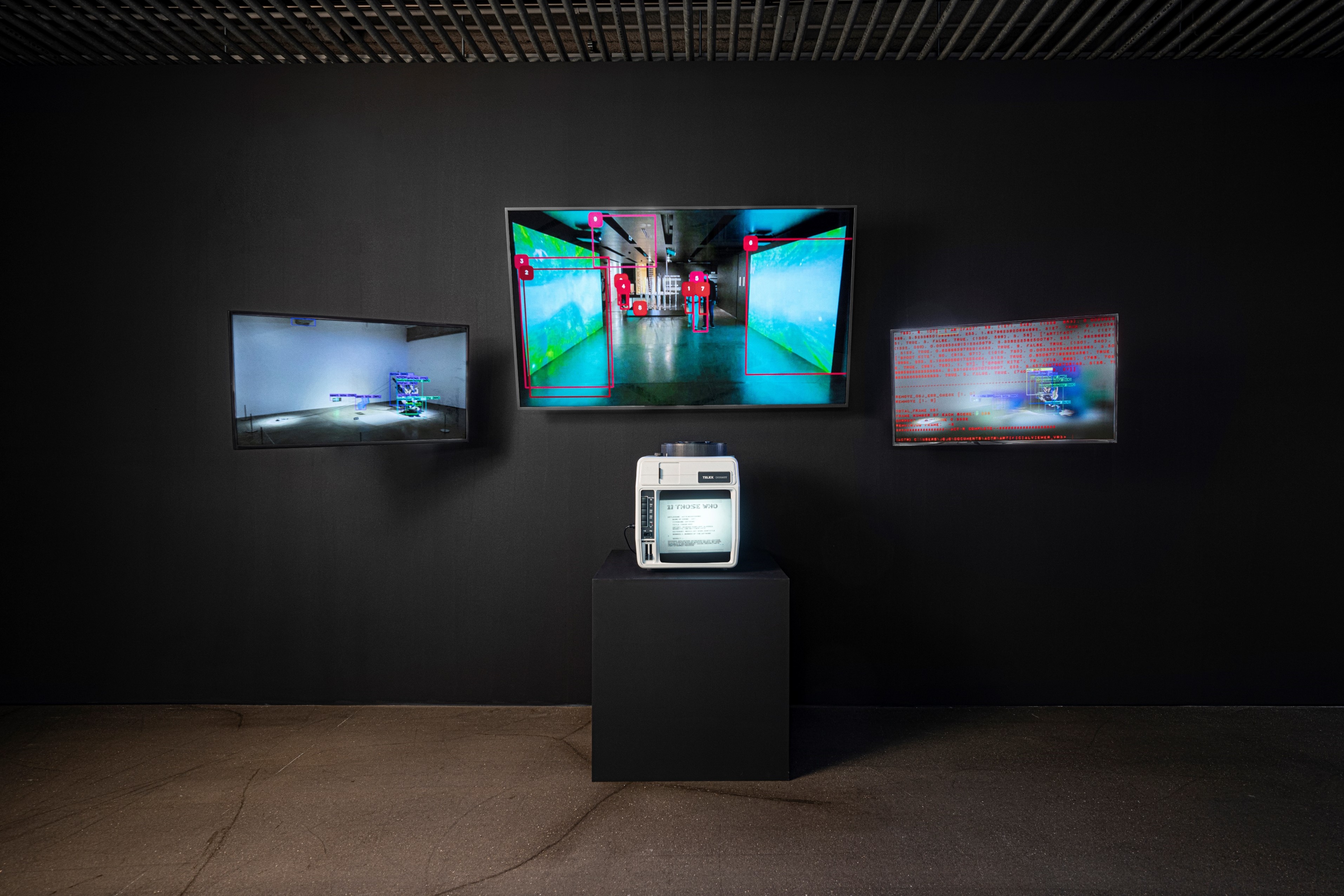
{ZK} With the partnership of Hyundai Motor, we could realise important new bodies of work to artists’ ambitious specifications. These works ran the gamut from an extensive set of new sculptural works with AR interaction by Rachel Rossin (I’m my loving memory, 2020–2021), to Pete Jiadong Qiang’s installation bringing together VR, web-based work, painting, and the artist’s own fandom archives (Dungeon: Maximalism HyperBody, 2021), and ZZYW’s first online-accessible version of their infinite AI simulation, ThingThingThing (2019).
I was also thrilled that we were able to create such an in-depth online exhibition experience, where many of the works on view in Beijing and elsewhere will be accessible into the future—and which is itself a gorgeously designed generative piece by Yehwan Song.
{MC} There were several new commissions as part of this exhibition. Rachel Rossin’s I’m my loving memory is a sculptural installation derived from abstract virtual environments that the artist creates as experiments in embodied digital experience. She takes graphics from these environments and prints them onto human-sized Plexiglas panels, which she then melts and shapes to the contours of her body.
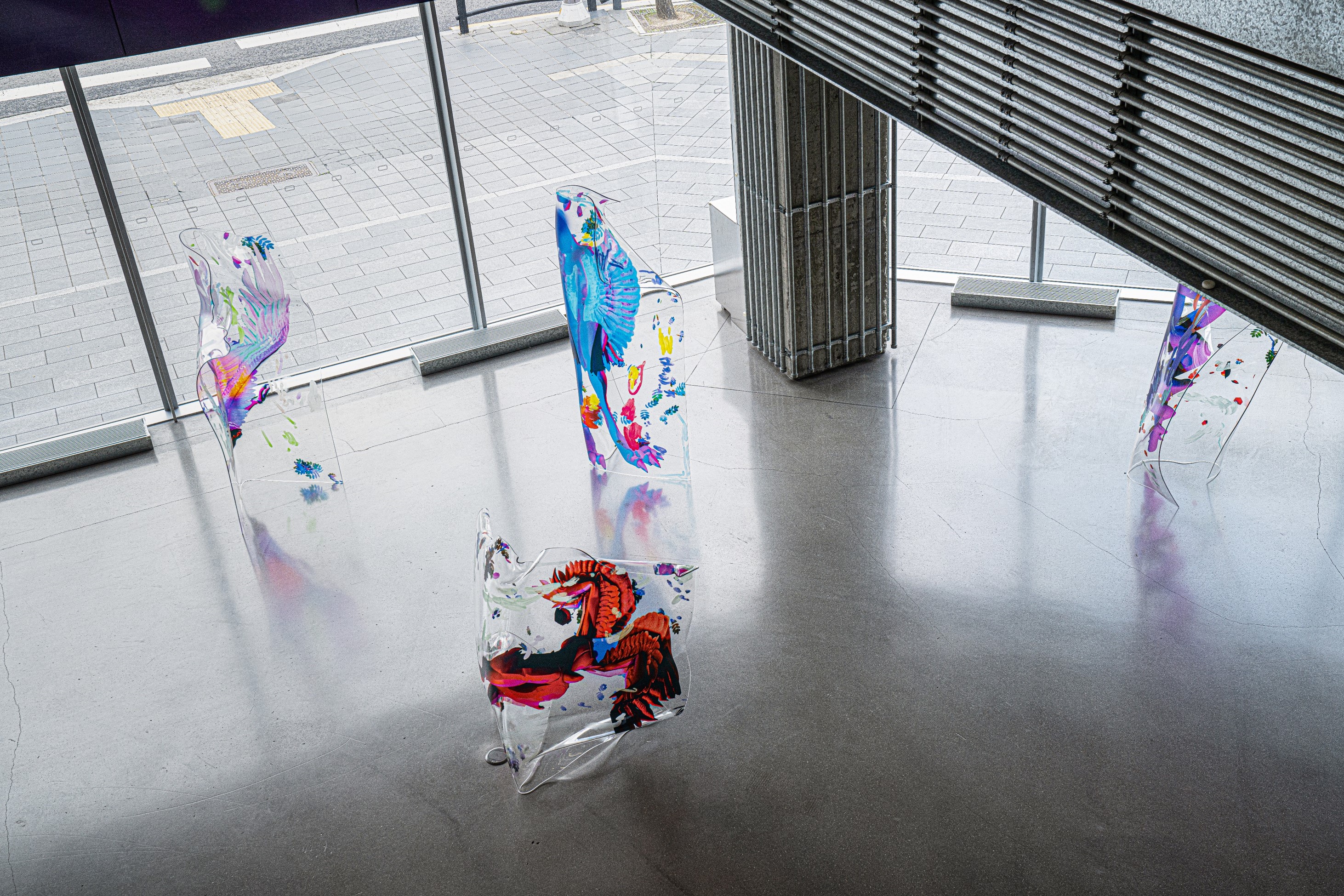
The sculptures can be viewed through an associated augmented reality app, as well. So there is a combination of physical media forms, VR—as a behind-the-scenes tool—and AR in this work.
Another new commission was Pete Jiadong Qiang’s Dungeon: Maximalism Hyperbody (2021), which is part of a much larger body of work exploring modes of fluid group identity that form through online fan culture. As part of our collaboration, Pete presented three levels of a much larger series of VR games exploring this environment, and constructed an installation onsite that transposed elements of this videogame context to the physical environment.
Our focus was not necessarily on the newest technology, but on exploring simulation from a variety of artistic perspectives, with critical rigueur. Another work, ZZYW’s ThingThingThing, was also further developed as part of this exhibition.
The work is a generative virtual world inhabited by semi-abstract entities that follow a set of rule-based behaviours to create a lifelike situation. These entities are generated as part of workshops that are hosted by the artists.
What’s really innovative about this project is not that it uses the most up-to-date technology, but that it manages to make a technology of simulation transparent and approachable, and to put it into people’s hands.
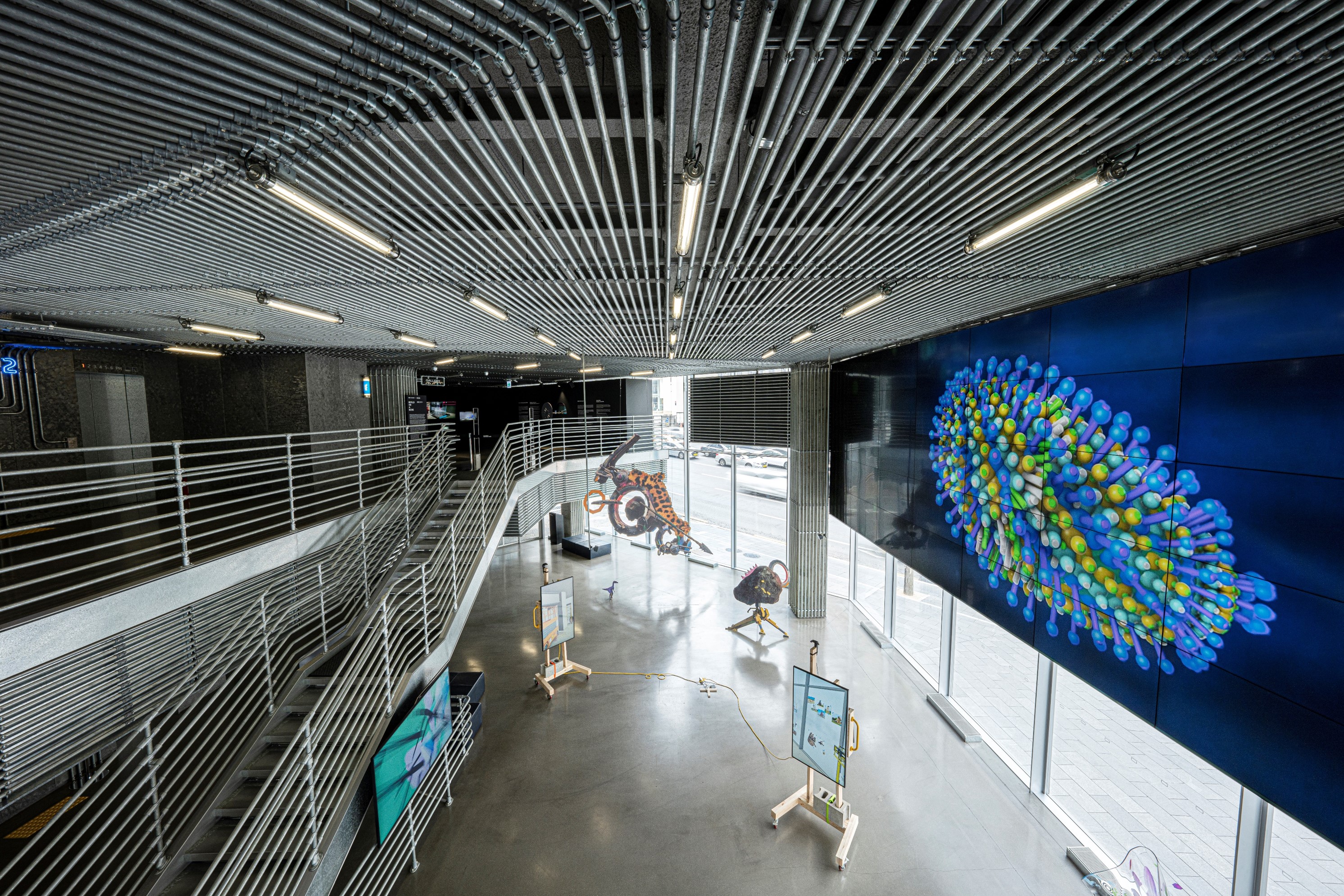
{MC} Because the ongoing pandemic means that many audiences will not be able to travel to China, our goal was to make the online exhibition a primary experience in its own right.
Instead of imagining what it’s like to be in the exhibition space, they are presented with versions of the work that are intended to be experienced online. I haven’t been able to see the show in person, so I can only imagine what kind of slippage takes place between the two versions of the show, online and off.
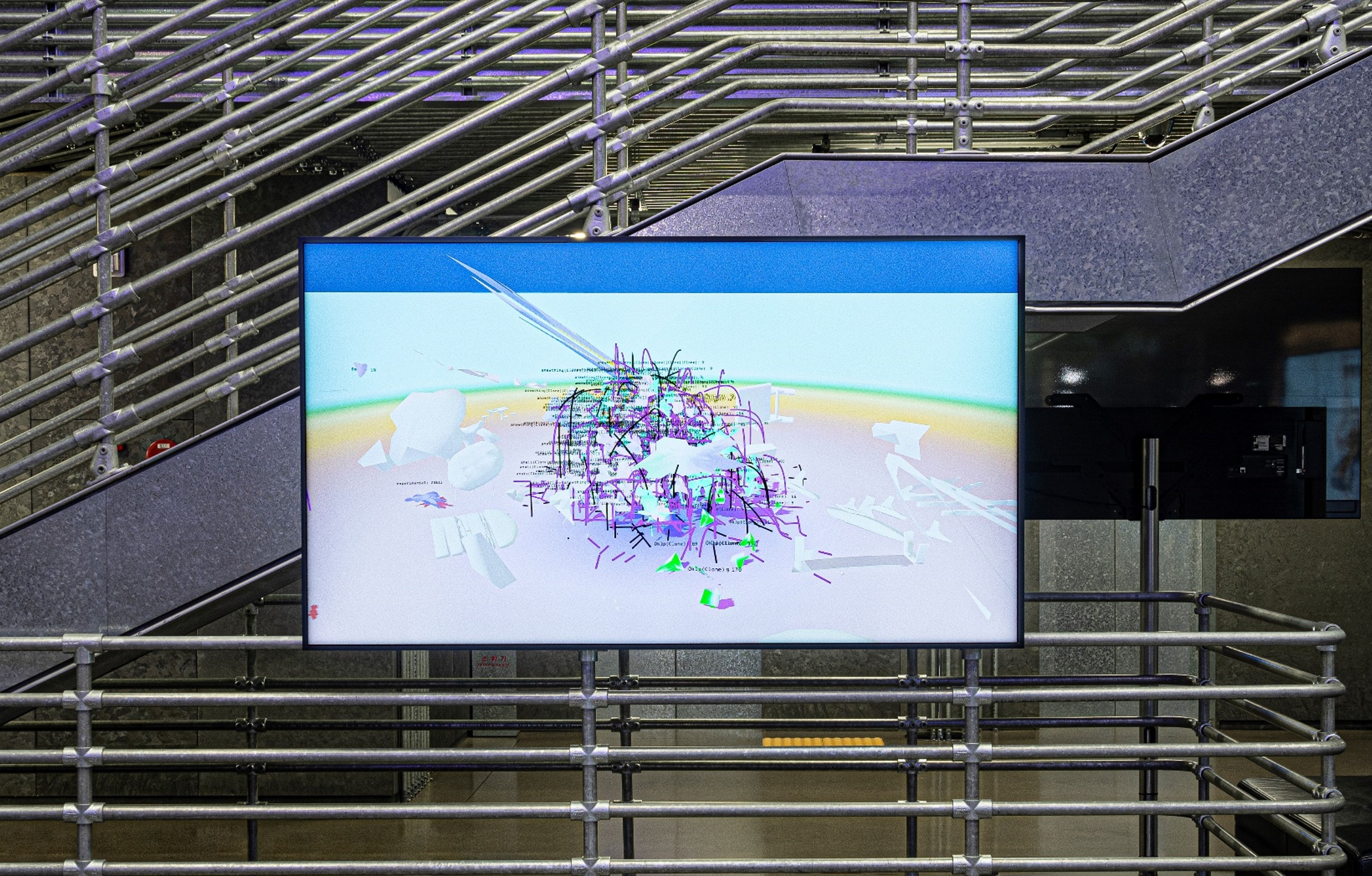
{MC} One of my questions in approaching this show was, what is the relationship between what we think of as simulation today, and older forms of representation in art, such as sculpture and painting?
There are certainly distinctions between computer simulation and, say, a painting by Georgia O’Keeffe or a Greek sculpture, but there are commonalities as well, and for this reason the exhibition repeatedly gestures toward longer-standing art historical references. —[O]
A respected voice in contemporary art discourse.
Focusing on ambitious storytelling and insightful art-world commentary. Ocula Magazine publishes in-depth interviews, critical essays and timely analysis on the artists, exhibitions and ideas driving the global art world.
Learn more about Ocula Magazine
Showcasing the best of the art world.
Ocula partners with galleries from around the world to highlight their artists, artworks and exhibitions. Gallery membership is by application and invitation, with each member vetted by an independent panel.
Learn more about Ocula Membership
Specialises in the sale of major artworks.
Led by a team with deep ties to the world’s leading auction houses, galleries and collectors. Ocula’s advisory team offers bespoke services to high-net-worth clients from around the world who are looking to acquire the best of contemporary and modern art.
Learn more about our team and services