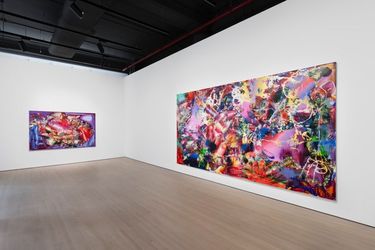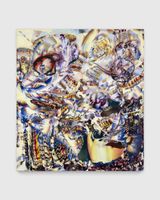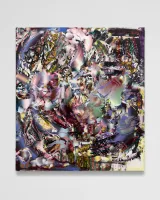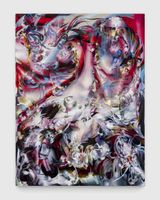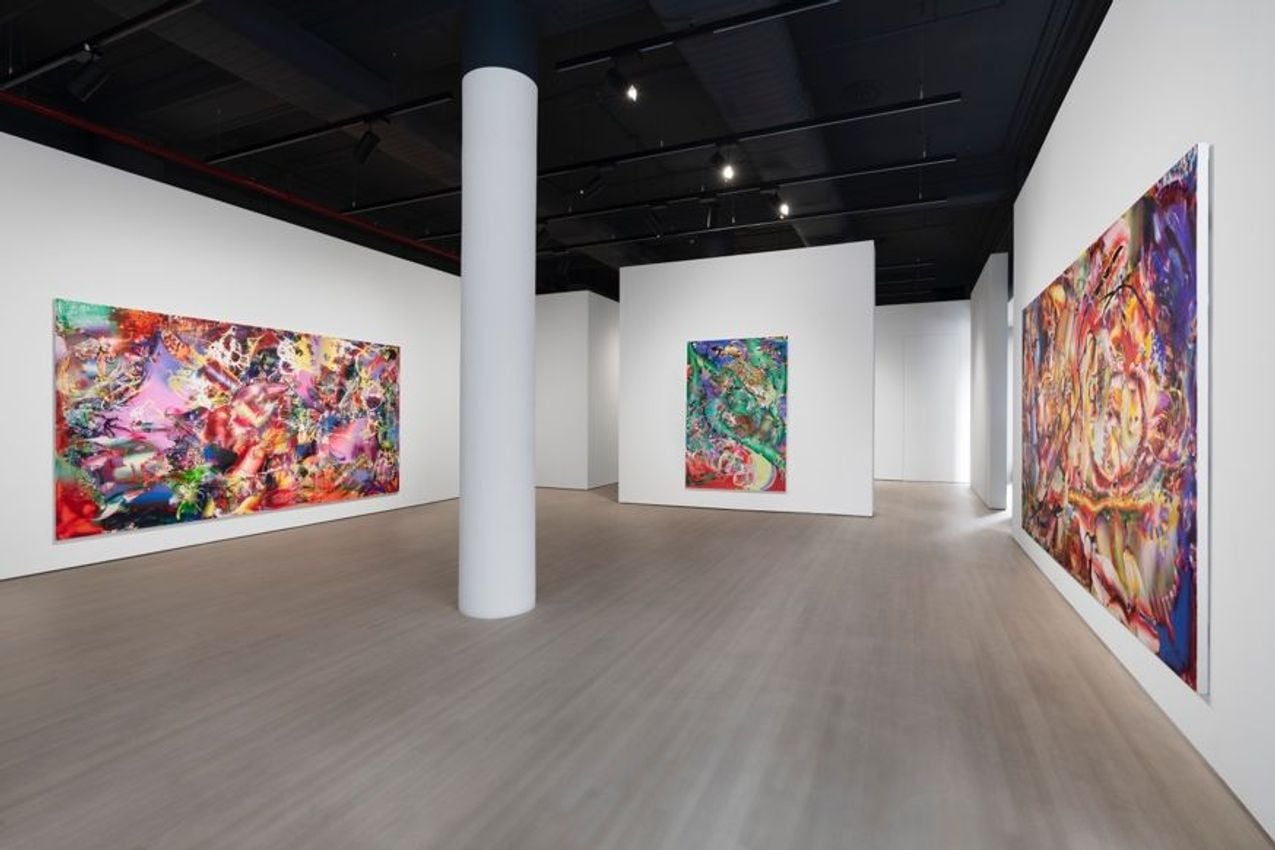
125 Newbury presents Lauren Quin: Logopanic, an exhibition of new paintings by the Los Angeles based Quin. The show, which will take place at 125 Newbury’s location at 395 Broadway in Tribeca from May 3 until July 12 of 2024, will be the artist’s first solo exhibition in New York.
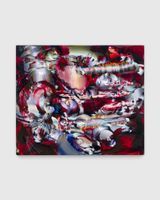
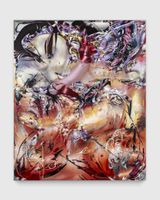
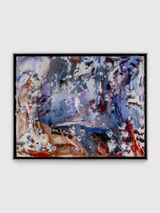
In Lauren Quin’s paintings, form occupies a fugue state. Quin builds her compositions methodically, layer by layer, only to scrape through them, carving channels that spiderweb across the picture. Her paintings are palimpsests; past and present mingle in a single surface, interrupting one another. Both sedimentary and archaeological, the works are as much excavated as painted. Constructed from an arsenal of recurring gestures and techniques, Quin often makes use of marks she refers to as ‘tubes’, together with skeins and filigrees of colour that she monoprints directly onto a work’s surface.
‘The ambition of Lauren’s work is astonishing to me,’ says Arne Glimcher, founder of 125 Newbury. ‘When I walked into her studio for the first time, it was a blast of fresh air. The environment her paintings created was electric. I immediately felt that here was an artist ready to take on the world. I was instantly captivated.’ For Quin, the act of painting involves the risk of getting lost. To paint is to give up a fixed location – in space but also in language. The exhibition’s title suggests an anxiety or instability around words and images. From the Greek logos (meaning ‘word’) and penia (meaning ‘poverty, absence, or lack’), logopenia refers to a type of aphasia, a condition characterised by a progressive loss of the faculties of speech.
In the colloquial sense, a logo is a visual and symbolic metonym – an image that stands for something else. ‘Logo panic’ evokes a sense of unmooring from such systems of signification. Quin orients her practice around an archive of drawings, prints, and carvings, which contain an ever expanding collection of symbols. A hand, a spider, a vulture, a needle, a skull, the sun—for Quin, these symbols function in myriad ways. At times, they provide the starting point for a painting; at others, Quin prints the symbol onto the surface of an existing composition – or carves it directly into the painted surface – disrupting or inflecting its evolution. Often, she will transfer a symbol onto the verso of a canvas, where it remains hidden from the viewer, but available to her as she works.
The drawings act as anchorages, providing fixed reference points as a composition unfolds, and linking one painting to the next. These drawings are always evolving and bleeding back into her larger repertoire, seeding new possibilities for paintings. Shadows and traces of imagery ebb and flow across Quin’s canvases, caught in relentless currents of form, refusing solidification or coherence. Quin’s tubes are tools for abstraction, but they are also tunnels, pathways, furrows, or mouths. A swirl of paint is at once a sun and a cymbal and also asymbol. Her paintings are constantly digesting her symbols, subsuming and transforming them wholesale, eroding contours and allowing form to diffuse in suspended animation. ‘I think of the symbols as windsocks,’ explains Quin of her drawings, ‘They are not as important as the direction of the wind, or the wind itself.’ What results from Quin’s process are manifolds of chromatic and temporal counterpoint paintings that hold space for a matrix of internal struggles: between the solid and the ephemeral, image and non image, symbol and cymbal. In this way, Quin is involved in charting a new and deeply self reflexive mode of abstraction. Skirting the edges of signification and eschewing fixity, Quin’s paintings quest for what words cannot contain, circling around meaning rather than seeking to touch it directly.

Lauren Quin is a contemporary American painter acclaimed for her kaleidoscopic abstractions, distinguished by layered mark-making that channels the rhythms of today’s digital age. Quin’s dynamic approach, which is represented in major museum collections, orchestrates color, pattern, and recurring symbols, cultivating a vibrant ambiguity between real and pictorial space.
Pace is a global art gallery of and for the future, modeled on a set of core values established during its founding in 1960 and designed to serve its artists, estates, and collectors in a way that is focused, responsive, and aligned with its enduring mission.

A respected voice in contemporary art discourse.
Focusing on ambitious storytelling and insightful art-world commentary. Ocula Magazine publishes in-depth interviews, critical essays and timely analysis on the artists, exhibitions and ideas driving the global art world.
Learn more about Ocula Magazine
Showcasing the best of the art world.
Ocula partners with galleries from around the world to highlight their artists, artworks and exhibitions. Gallery membership is by application and invitation, with each member vetted by an independent panel.
Learn more about Ocula Membership

Specialises in the sale of major artworks.
Led by a team with deep ties to the world’s leading auction houses, galleries and collectors. Ocula’s advisory team offers bespoke services to high-net-worth clients from around the world who are looking to acquire the best of contemporary and modern art.
Learn more about our team and services