Press Release

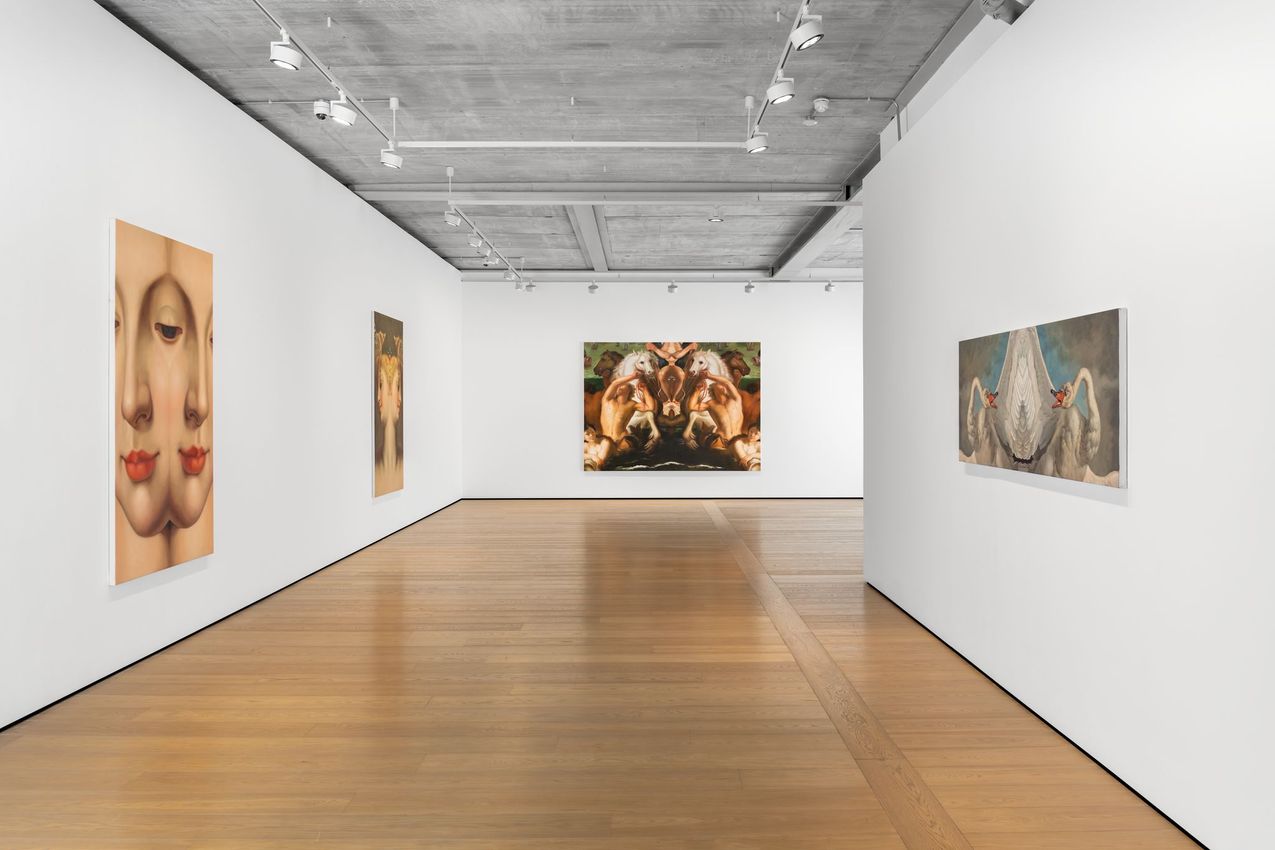
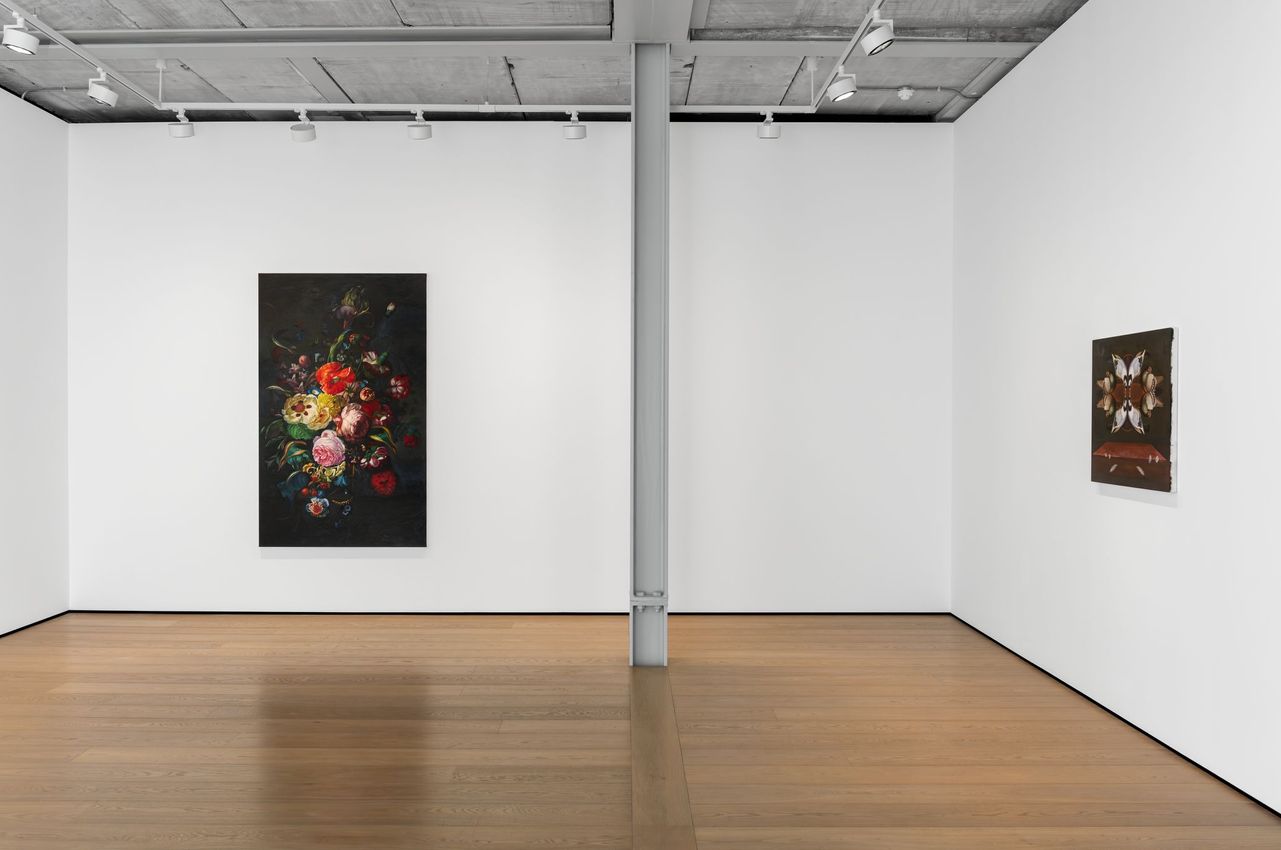
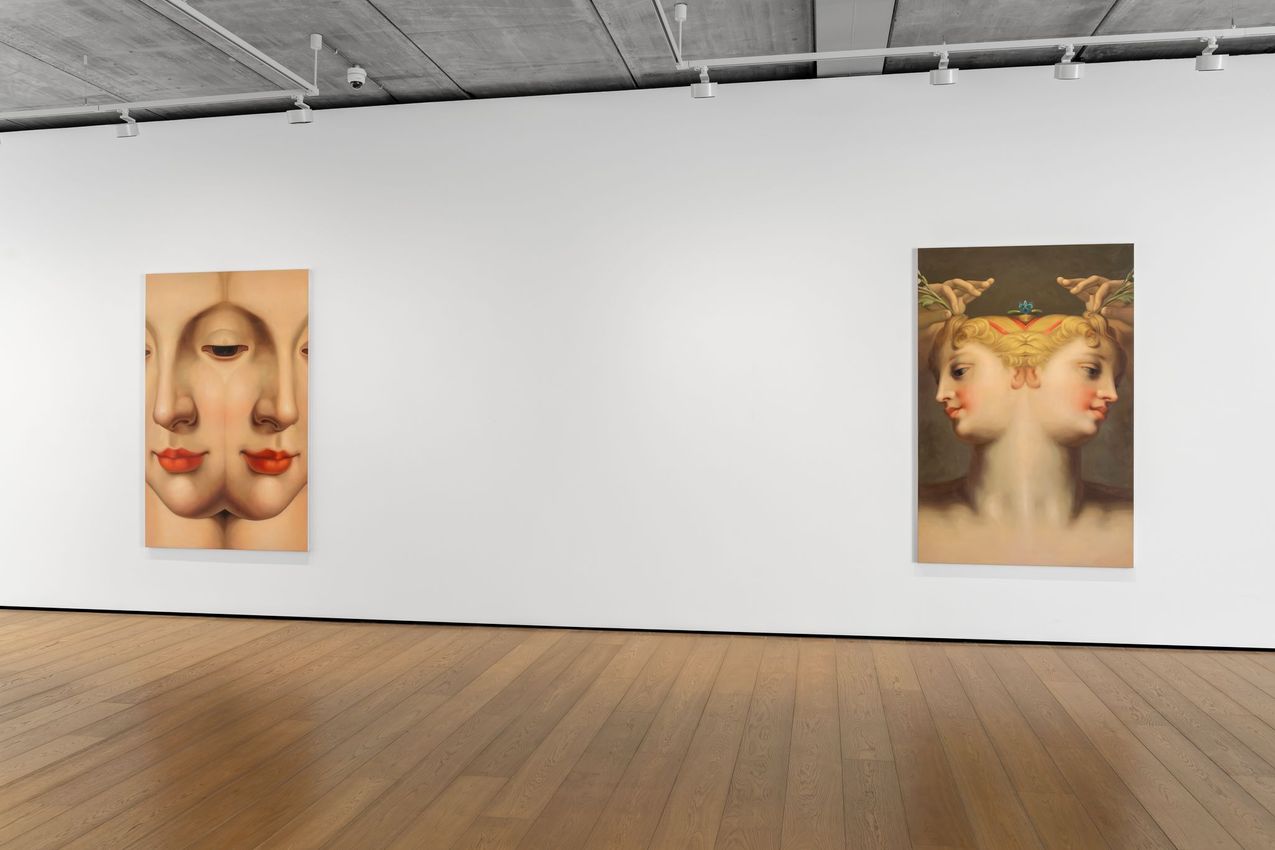
Mirrors can be portals to other realms. In Irish folk tradition, reflectivesurfaces are covered at a wake for fear that the soul of the deceasedmight otherwise slip through. In “Snow White”, it is before her ownreflection in a glass chalice that the queen transforms into a witch.Such surfaces have long appeared in mythology and throughout arthistory as points of revelation and metamorphosis. In Never Odd orEven, Ted Pim’s paintings map out the anatomy of transformationusing mirror image as a central motif. At the heart of the exhibition isthe idea that transformation is not something that requires newmaterial, but instead is an altering of what we already have. To thisend, Pim segments and repurposes Old Masters paintings. Some areabstracted via a duplication that sees identical forms mirrored as theymerge or collide on either side of a central axis. These images areformed from fragments of Renaissance and Baroque paintings pairedwith imagery from fashion magazines and Irish mythology. Theirsymmetry echoes the cyclical structure of existence, hinting at anunderlying message of the exhibition that as much as we transformhistory always repeats.

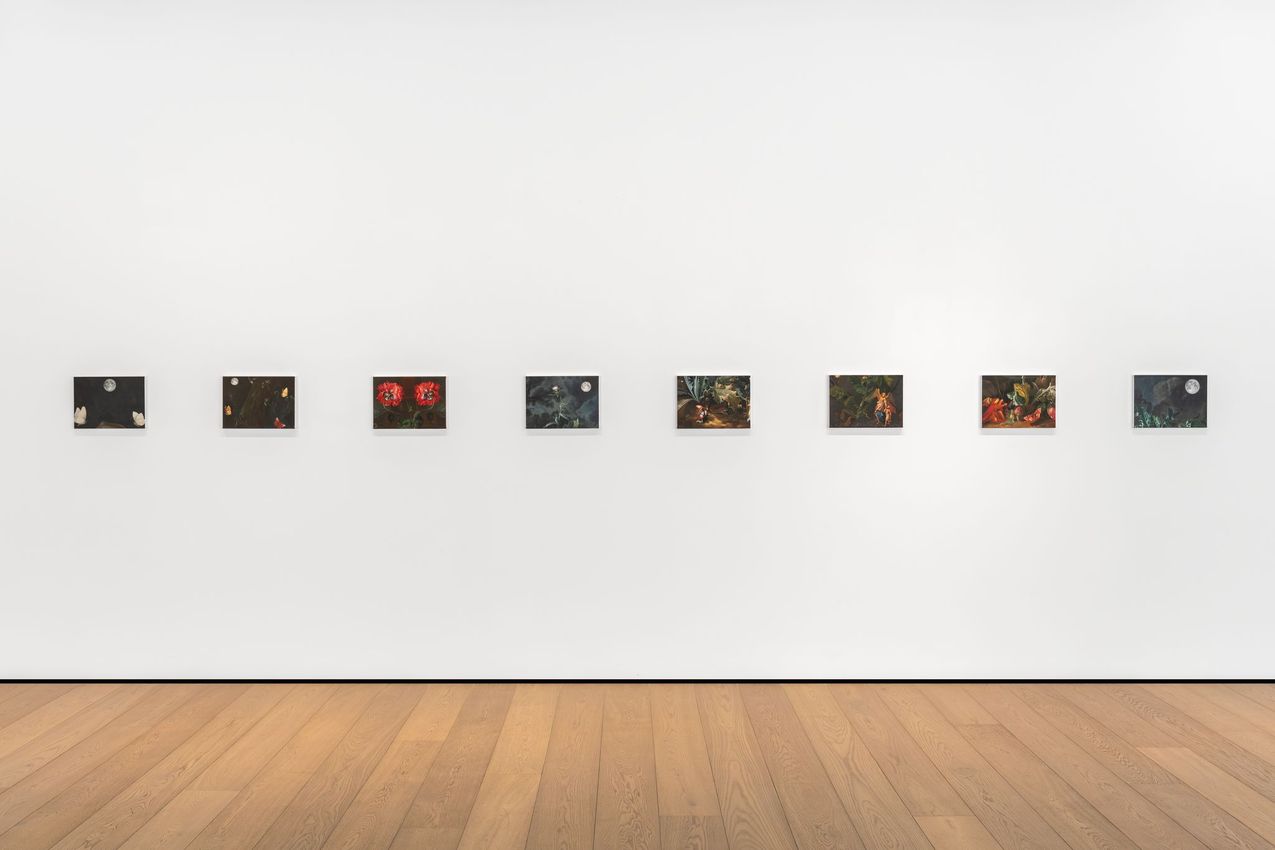
These paintings can be read as documenting a splitting of the self, themoment of transformation where both our past and present statescoexist. In these snapshots of an in-between realm, kaleidoscopicarches appear that join the two sides of a mirror. A woman’s face,doubled and inverted, gives birth to architectural form as the contoursof her brows meet and curve into archways. In another, the wings oftwin swans collect into a feathered crest, their necks crooking back tomeet the other’s horrified gaze. Here, as history repeats, it looks uponits own image with dismay. Swans appear as a reference to the Irishmyth ‘The Children of Lir’, in which four children are transformed intothe creatures, able to take on human forms only under the moonlight.References to this myth appear throughout the exhibition as swan-likefigures extend into or out of swan-hood. The direction is unclear. Theforms in these paintings appear at once pulled into and expelled fromthe central reflective axis. This ambiguity of movement leaves Pim’simages endlessly oscillating between expansion and contraction suchthat the walls of the gallery appear to breathe with life.

In other works we find Renaissance figures tucked under fauna, visibleby the light of a full moon, a reference to the Irish tradition of callingforth transformation with a New Moon cycle. As Pim layers imageryfrom the covers of high fashion magazines and opulent masterpieces,his works inevitably develop a familiar beauty.

His paintings are intricate, with an emphasis on the detail, texture andtangibility of the objects portrayed. In the artist’s source paintings,these techniques were largely used to emphasise and celebratewealth and to intertwine nobility with the virtues of the gods. Thesesame ideas are found echoed in the pages of fashion magazines but,whereas oil paintings have historically celebrated material wealth,these pages manufacture enviable lives that might only be obtainedthrough wealth. In Pim’s hands, however, their meanings are obscuredand transformed. Through the dual process of decontextualisation andduplication, images are severed from their original function. In thisway, Pim repurposes their symbolism and, as a result, reimagines thehistorical role of the oil painter.

This appropriation thus injects the imagery with new meaning. ForPim, images like these have a deeper relevance, reflecting throughtime familial stories and collective histories of Ireland. The exhibitionis deeply nostalgic, recycling imagery from both the Irish myths Pimheard as a child and the religious iconography that hung on the wallsof his childhood home in Belfast, as well as from the homes of manyothers in his working-class Catholic neighbourhood. Hence, theevocative imagery Pim uses becomes symbols of a world very differentfrom what his source images intend to describe. Even the finery andopulence in the fragments of Old Masters paintings can be traced toPim’s grandmother who, during the height of The Troubles, worked asa dressmaker for Belfast’s upper classes. In Pim’s images, opulencepays homage to her work. A chain of reflection emerges that isemblematic of history both repeating and transforming across time.The aesthetics of his late grandmother’s garments, found mirrored inOld Masters paintings and fashion magazines, finally, reflect back intoher artist grandson’s paintings decades later, as he reappropriates thesame imagery.

While Pim’s twin images extend out on either side of his canvases,expressing some of the symmetry of clothing, they also morph andalter their original meaning thereby disrupting the historical class andpower dynamics that have surrounded art creation. In one of hispaintings, the artist zooms in on a small segment of Antonio Verrio’s17th century masterpiece Sea of Triumph, which was commissionedby and depicts King Charles II with the Roman god Neptune. In Pim’sversion the god and king are missing, instead torsos stretch down oneither side like two hanging arms. The art critic John Berger noted thatmythological paintings such as this one can act ‘like a garment heldout for the spectator-owner to put his arm into and wear.’ In this case,however, it is the artist himself who wears the garment as Ted Pimtransforms Verrio’s imagery to tell the story of his own history.— Sophie Naufal, Arts Journalist

Press release courtesy Almine Rech

Read More

Installation Views

About the Artist

Irish artist Ted Pim uses darkness as a tool to portray a moody and even macabre ambience throughout his works. Often in a manner that is subversively ominous, through the darkly lit canvases he emphasises the focal points of his work which are most notably beautiful assortments of flowers and baroque figures.

View Artist Profile

Also Exhibiting at Almine Rech

About the Gallery

Almine Rech London will showcase curated presentations of works by artists from the 20th and 21st centuries and will be open Tuesday through Friday, from 10am to 6pm, with Monday and Saturday visits available by appointment.

View Gallery Profile
Address
11 St George Street
Hanover Square
London
United Kingdom
Opening Hours
Tuesday – Friday
10am – 6pm
The gallery will be open on Mondays and Saturdays by appointment only
(1)
London 11 St George Street, Hanover Square
Almine Rech
11 St George Street, Hanover Square, London, United Kingdom
+44 207 287 3644
http://www.alminerech.com

Opening hours
Tuesday – Friday
10am – 6pm
The gallery will be open on Mondays and Saturdays by appointment only
The art world in focus