





SALVO
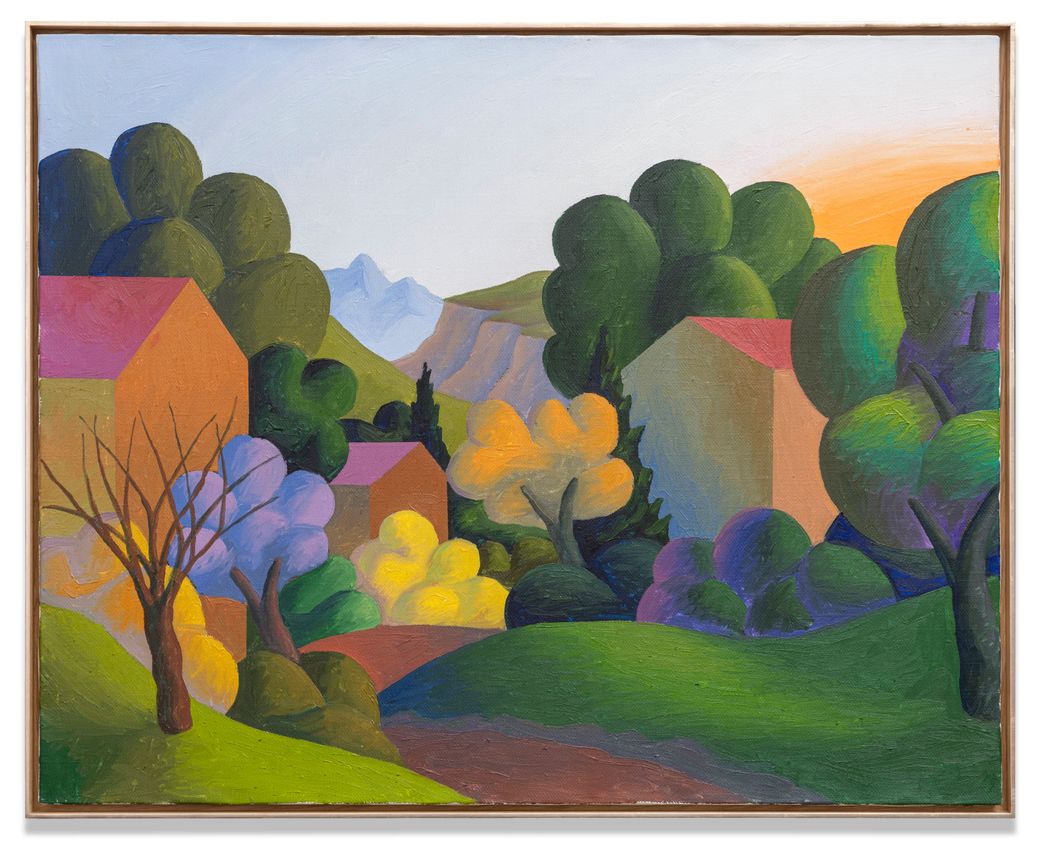
1947-2015, ItalySalvo (1947–2015) was an Italian artist whose career began in conceptualism but shifted to figurative painting during the early 1970s, influenced by the aesthetics of traditional art and creating artificial landscapes and city views using bright colours and flat geometric forms.
Early Years
Born Salvatore Mangione in Leonforte, Sicily in 1947, Salvo moved with his family to Turin in 1956. It has been reported that the first picture he remembered seeing as a child was a Raphael self-portrait. His talent for creating art was encouraged at school, and by 16 his charcoal sketches were being exhibited in Turin. During the late 1960s, he encountered the Arte Povera movement (a group of avant-garde artists using everyday, humble materials as a reaction to modern art’s love of technology) and moved into the studio of Alighiero Boetti. His works from this period were rooted in postmodern experimentation, including text engraved into marble, and self-referential photographs.
Salvo: Artworks
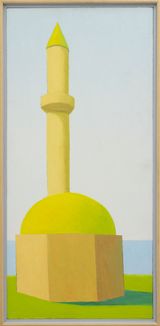
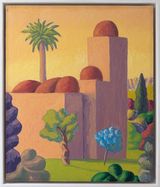
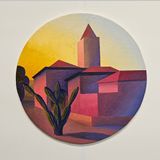
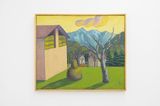
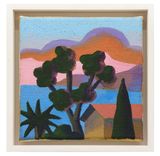
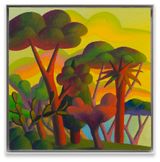
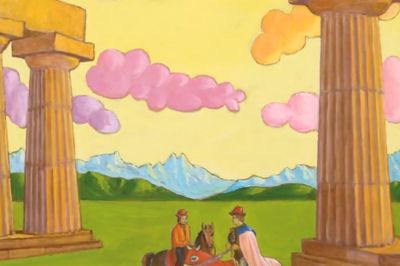
As the 1970s dawned, Salvo switched his focus and embraced painting. He used ideas from historical genres to create stylised works that twisted the traditional classical aesthetic and injected it with vivid colour, including pink, green and mauve. His visual language hinted at nostalgia, but also at artifice. Into the 1980s, Salvo concentrated on landscapes and ruins, bringing his vibrant colour palette to palm beaches, city streets by night and buildings (the church of San Giovanni degli Eremiti in Palermo features more than once). As his practice developed, his paintings took on more of a fantastical quality, with surreal colours, lush trees and circular clouds. The brightness of his palette encouraged viewers to linger and contemplate the scene.
- 1970’s Autoritratto (come Raffaello) (Self-Portrait (as Raphael)) encapsulates the self-referential style of Salvo’s early work, restaging the Renaissance artist’s early-16th-century oil painting.
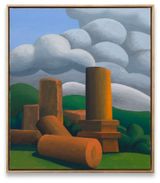
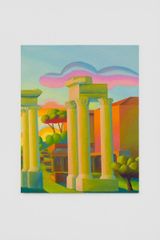
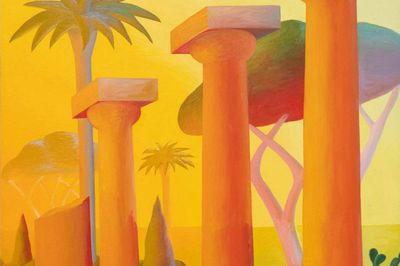
- Paesaggio con Colonne (1989) echoed the style of Giorgio de Chirico, although in brighter colours. de Chirico was also inspired by art history and painted Romanesque buildings. Salvo’s 1989 painting combines pastel-shaded trees and warm orange pillars.
- Cloud-like trees, a yellow-rimmed sun and candyfloss pink plants all appear in the 1994 work Il Mattino (The Morning), which sold for $8.7 million HKD at Christie’s in Hong Kong in 2023.
Salvo: Select Exhibitions
Select Solo Exhibitions
- Salvo, Sprüth Magers, Berlin (2026)
- Salvo, In Viaggio, Gladstone Gallery, Seoul (2025)
- Capricci, Gladstone Gallery, Brussels (2023)
- Salvo, Sant’Andrea de Scaphis, Rome (2023)
- Salvo. Sicilie e città (Salvo. Sicily and cities), Dep Art Gallery, Milan (2022)
- Mitologie Domestiche (Domestic Mythologies), Norma Mangione Gallery, Turin (2022)
- Autoritratto come Salvo (Self-portrait as Salvo), Museum of Contemporary Art Rome (2021)
- Autogrill, Galerie Mehdi Chouakri, Berlin (2020)
- Salvo, en las Islas Canarias (Salvo in the Canary Islands), Fundación Cristino de Vera, San Cristobal de la Laguna, Tenerife (2019)
- Boetti/Salvo. Vivere Lavorando Giocando (Boetti/Salvo. Living by Working and Playing), LAC Lugano Arte e Cultura, Lugano (2017)
- Salvo è vivo—an homage, Mehdi Chouakri, Berlin (2016)
- Omaggio a Salvo, Galleria Civica d’Arte Moderna e Contemporanea, Turin (2015)
- Fiori di Maggio, Galleria Zonca & Zonca, Milan (20112)
- Favole di marmo, Cà di Frà, Milan (2010)
- Questo treno ferma a Tucumcari (This train stops at Tucumcari), Museo Civico Torre Viscontea, Lecco (2007)
- Cucina crudele (Cruel Cuisine), Giampiero Biasutti Arte Moderna e Contemporanea, Turin (2003)
- Opere su carta (Works on Paper), Galleria L’Occhio, Venice (1999)
- Archeologie del future (Archaeologies of the Future, Galleria dello Scudo, Verona (1992)
- New Paintings, Barbara Gladstone Gallery, New York City (1986)
- Bilder 1973–1982 (Paintings 1973–1982), Kunstmuseum Luzern, Lucerne (1983) (and touring)
- Sei Nature Morte (Six Still Lifes), Galleria Massimo Minini, Milan (1980)
- Variazioni sul Tricolore 1971–1973 (Variations on the Tricolour 1971–1973, Galleria Banco, Brescia (1975)
- Galleria Sperone, Turin (1970)
Select Group Exhibitions
- 20 Years, Dep Art Gallery, Milan (2026)
- Salvo, Andreas Schulze, About Painting, Sprüth Magers, Los Angeles (2025)
- The love of art comes first. Art and Project at the Kröller-Müller Museum, Kröller-Müller Museum, Otterlo (2023)
- Landscape From Memory, Althuis Hofland Fine Arts, Amsterdam (2021)
- Salon, Art Berlin (2018)
- In Retrospect: Good and Plenty, Galerie Mehdi Chouakri, Berlin (2016)
- Il Grande Gioco—Forme d’Arte in Italia 1947–1989 (The Great Game—Art Forms in Italy 1947–1989), Galleria d’Arte Moderna e Contemporanea, Bergamo (2010)
- First, Galleria Dep Art, Milan (2006)
- Private/Corporate, DaimlerChrysler Contemporary, Berlin (2002)
- Scripta manent, Esso Gallery, New York City (1999)
- Quasi per gioco (Almost a game), Neue Galerie, Graz (1990)
- Das Licht von der anderen Seite—I. Malerei (The Light from the Other Side—I. Painting, Galerie Monika Sprüth, Cologne (1988)
- Mixed Pickle, Galerìa Leyendecker, Santa Cruz de Tenerife (1985)
- Linee della ricerca artistica in Italia 1960–1980 (Lines of Artistic Research in Italy 1960–1980), Palazzo delle Esposizioni, Rome (1981)
- Lives, Fine Arts Building, New York City (1975)
- Formulation, Addison Gallery of American Art – Phillips Academy, Andover (1971)
Further Reading
- The official Salvo Archive
- Artist page at Sprüth Magers
- Ocula story about a 2023 exhibition in Brussels Christie’s collector’s guide (2025)
Salvo FAQs
How were colour and light important to Salvo?
Salvo’s super-bright colour choices have been compared to Pre-Raphaelite paintings, but may also have been influenced by the advent of colour television and Aldous Huxley’s The Doors of Perception (1954). His borderline-fluorescent palette took in pinks, yellows and lavenders. The illuminated quality of Salvo’s paintings may have been amplified because he painted by electric light.
Did Salvo travel around the world?
Yes, Salvo travelled to many countries, including to Afghanistan with Alighiero Boetti, and later with his wife Cristina Tuarivoli to China, Thailand, the Middle East and North Africa. As his health deteriorated, he painted places that were important to him, including Sicily, Iceland and Oman.
Did Salvo write a manifesto?
Yes, in 1986 he produced a 238-point manifesto called On Painting, in part inspired by Wittgenstein’s Tractatus Logico-Philosophicus (1921). Salvo aimed to identify the relationship between art and reality, while Wittgenstein looked at the relationship between reality and language.
What was Salvo’s final work?
Salvo died in 2015. He had made a marble gravestone in 1973 with “Salvo è vivo” (“Salvo is alive”), which upon his death was turned over to reveal “Salvo è morto”.
Ocula


Works at Dep Art Gallery








Works Elsewhere













Explore and Follow Artists Shaping Contemporary Art
A respected voice in contemporary art discourse.
Focusing on ambitious storytelling and insightful art-world commentary. Ocula Magazine publishes in-depth interviews, critical essays and timely analysis on the artists, exhibitions and ideas driving the global art world.
Learn more about Ocula Magazine
Showcasing the best of the art world.
Ocula partners with galleries from around the world to highlight their artists, artworks and exhibitions. Gallery membership is by application and invitation, with each member vetted by an independent panel.
Learn more about Ocula Membership
Specialises in the sale of major artworks.
Led by a team with deep ties to the world’s leading auction houses, galleries and collectors. Ocula’s advisory team offers bespoke services to high-net-worth clients from around the world who are looking to acquire the best of contemporary and modern art.
Learn more about our team and services