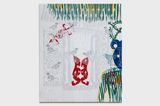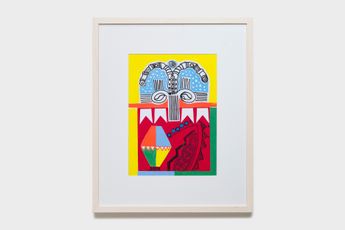


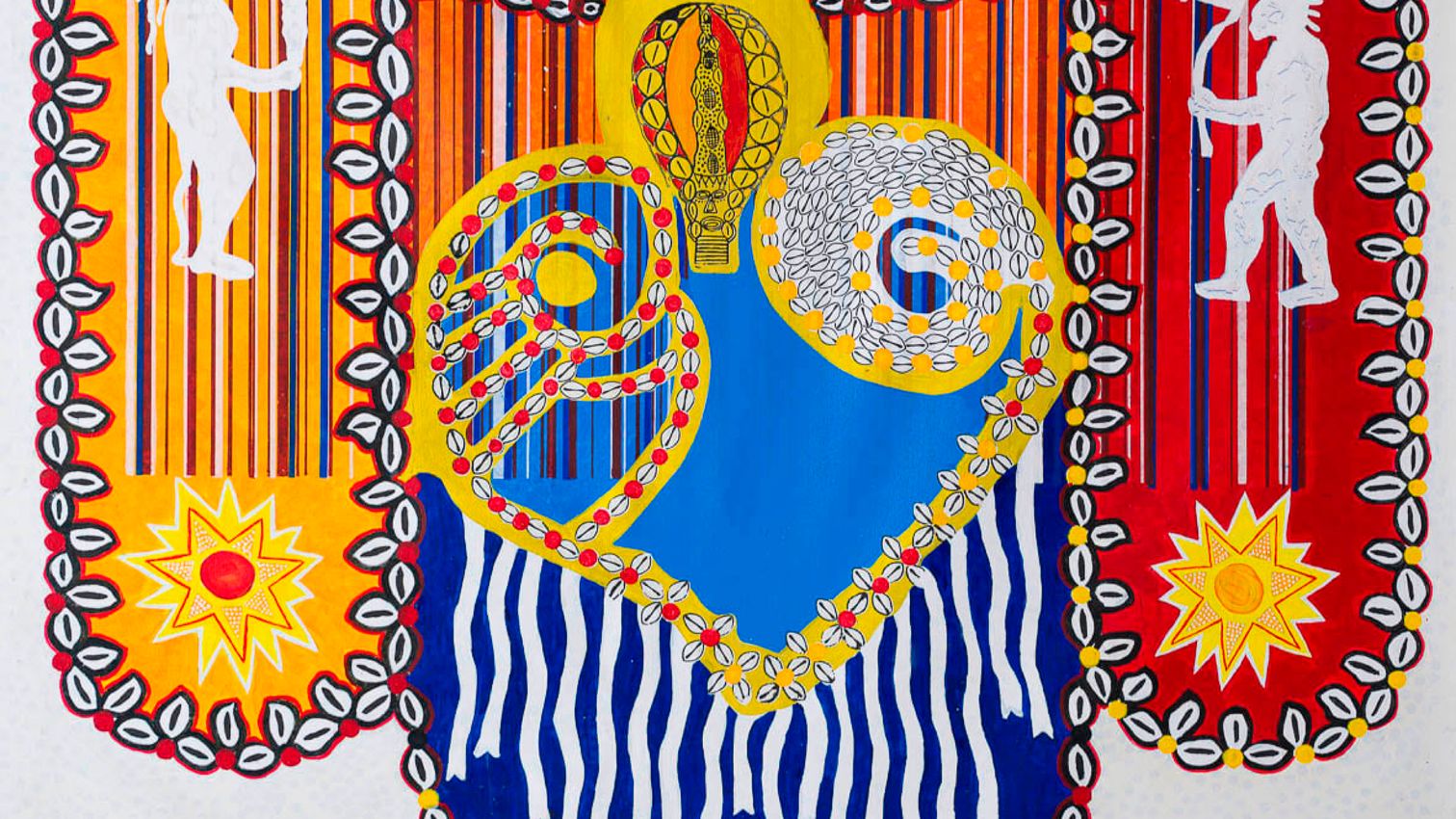
Nara Roesler is pleased to present an exhibition of two outstanding artists focusing on the diversity of the AfroBrazilian cultural legacy: Alberto Pitta (b. 1961, Salvador, Brazil) and Elian Almeida (b. 1994, Rio de Janeiro, Brazil). Curated by Luis Pérez-Oramas, the show will propose two major counterpointing visual arguments bridging, on one hand, symbolic-religious Afro-Brazilian ornamental patterns on painted fabrics, signature of Alberto Pitta’s production, and, on the other hand, historical-narrative painted scenes by Elian Almeida based on Afro-Brazilian identities and anecdotes.
Over the course of more than four decades, Alberto Pitta has developed a distinctive visual trajectory, characterized by a dialogue between Afro-Brazilian cultures, spirituality, and graphic experimentation. His artistic practice is directly tied to his personal history, first as the son of Ialorixá Mãe Santinha de Oyá, an important religious leader who introduced him to fabrics– initially through intricate richelieu embroidery and later through the screen printing and textile patterns he began developing in the 1980s for the Carnival in Salvador, one of the biggest popular festivals in existence today and a vehicle for bold visual experimentation ino which Alberto Pitta is a major, referential figure. A major presence in the recently inaugurated 36th São Paulo International Biennial, Alberto Pitta’s production has never been the object of a full, embracing presentation in the U.S.
Alongside the works of Pitta, the show will feature a selection of paintings by Elian Almeida, an artist belonging to a new generation of creators whose works reassert protagonism to agents and bodies that have been traditionally marginalized in our society and in the history of art. Elian Almeida addresses decolonialism, exploring the experience and performativity of the black body in contemporary Brazilian society, through a process of recuperating elements from the past – images, narratives, characters – as a means of contributing to the process of empowerment and dissemination of Afro-Brazilian historiography.
In the paintings chosen to be installed vis-à-vis Alberto Pitta’s work, Almeida offers a fresh perspective on how these stories can be told, exploring memory and ancestry not merely as the past, but as present and living subjective dimensions. This conceptual approach seeks to uncover alternative meanings within the painting.
During a recent trip to Salvador, Bahia, Almeida visited Alberto Pitta’s studio, where he was inspired to experiment with screen printing—a medium he had encountered in college but revisited under the guidance of the master of screen printing and textiles. The use of serigraphy and stencils allowed him to achieve volumes and textures that a brush alone could not produce.
Pitta’s work is organized in the set of patterns and colors that reinterpret the Yoruba worldview, the reading, on the other hand, concerns the relationship established in the contact between bodies in movement, when the city streets become a terreiro. Through the folds of the fabrics that cover the revellers runs an alphabet of letters and affections, mobilized by music and dance: it is in the body of the other that the text that completes us is read.”
Alberto Pitta has participated in important exhibitions in Brazil and internationally. His solo shows include Outros Carnavais, at Nara Roesler Rio de Janeiro (2024), Brazil; Mariwó, at Paulo Darzé Galeria (2023), in Salvador, Brazil, and Eternidade Soterrada, organized by Carmo & Johnson Projects (2022) in São Paulo, Brazil. His group exhibitions notably include: Joie Collective – Apprendre a flamboyer, at Palais de Tokyo (2025), Paris, France; 24th Biennale of Sydney (2024); Lélia em Nós: Festas Populares e Amefricanidade, at Sesc Vila Mariana (2024), São Paulo, Brazil; Stirring the Pot, at Casa da Cultura da Comporta, Portugal; O Quilombismo: Of Resisting and Insisting. Of Flight as Fight. Of Other Democratic Egalitarian Political Philosophies, at Haus der Kulturen der Welt, in Berlin, Germany (2023); Encruzilhada, at the Salvador Museum of Modern Art (2022), in Salvador, Brazil, and Um Defeito de Cor, at the Rio Art Museum (2022), Rio de Janeiro, Brazil. His work is included in institutional collections such as: Museu de Arte do Rio, Rio de Janeiro, Brazil and Museu de Arte Moderna da Bahia, Salvador, Brazil.
Courtesy Nara Roesler


Founded in São Paulo in 1989, Galeria Nara Roesler is a leading Brazilian gallery dedicated to showing the work of contemporary Brazilian and international artists. The gallery established another branch in Rio de Janeiro in 2014, followed by its first international outpost in New York City in 2015.

A respected voice in contemporary art discourse.
Focusing on ambitious storytelling and insightful art-world commentary. Ocula Magazine publishes in-depth interviews, critical essays and timely analysis on the artists, exhibitions and ideas driving the global art world.
Learn more about Ocula Magazine
Showcasing the best of the art world.
Ocula partners with galleries from around the world to highlight their artists, artworks and exhibitions. Gallery membership is by application and invitation, with each member vetted by an independent panel.
Learn more about Ocula Membership

Specialises in the sale of major artworks.
Led by a team with deep ties to the world’s leading auction houses, galleries and collectors. Ocula’s advisory team offers bespoke services to high-net-worth clients from around the world who are looking to acquire the best of contemporary and modern art.
Learn more about our team and services