Nara Roesler São Paulo is pleased to present Blue Blood, a solo exhibition by Marcos Chaves (b. 1961, Rio de Janeiro), featuring new tapestry works alongside three objects, two of which date back to the 1990s. The exhibition builds upon an intervention the artist carried out in 2013 at the Eva Klabin Foundation in Rio de Janeiro, where Chaves presented rugs that were photographic replicas of fabric details from the foundation’s collection.
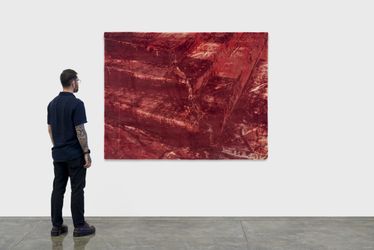
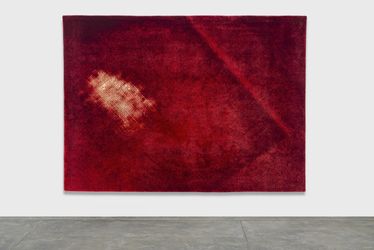
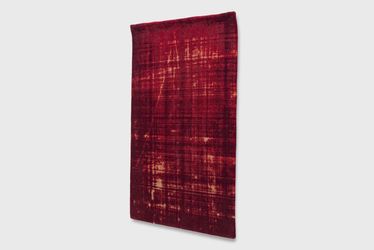
In Blue Blood, Chaves displays the new red-toned tapestries on the walls—works that reproduce photographs taken by the artist of carpeted floors in historic European locations such as Palazzo Doria Pamphilij, built in 16th-century Rome; the staircase leading to Napoleon Bonaparte’s (1769–1821) only surviving throne, at the Château de Fontainebleau in France, which dates back to the early 12th century and served as a residence for French royalty; and the Opéra Garnier, designed during the reign of Napoleon III (1808–1873), the thirteenth palace to house the Paris Opera, founded by Louis XIV. On the floor of one of the gallery’s rooms, the artist will cover the entire surface with a large-scale version of the rug that initiated this research in 2013.
“I’m really drawn to the idea of gradient—of a colour fading—and also to its French meaning: dégradé, something worn, decayed. Over time, you can see the many layers in these European carpets: the weave becomes prominent, forming a kind of grid. You also see the marks left by weight on the floor where the carpet lies, forming low-relief patterns. That sense of wear and the geometry that emerges are what I like about this work, which ends up being almost an homage to painting—as if I were painting with photography and the carpet’s pile,” says Marcos Chaves. Some works create a reversed perspective, like Fontainebleau I and II, which depict the steps leading up to Napoleon’s throne.
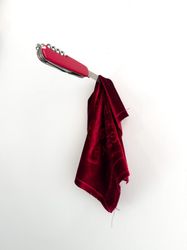
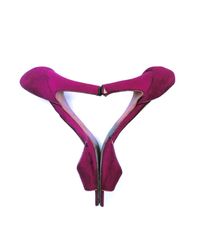
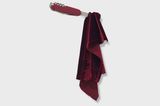
The show also includes three object-based works—also in red—one of which is a new piece titled MessAge 2, featuring a Swiss army knife that pins a piece of velvet to the wall, embroidered with the phrase “Our love will grow vaster than empires,” by English poet Andrew Marvell (1621–1678). The other two are readymades from 1992: Jaws, a handbag; and an untitled pair of high heels arranged to resemble either a heart or a fallopian tube.
Ginevra Bria, curator and author of the exhibition’s critical text, emphasises that ”_Blue Blood_interlaces photography, installation, and sculpture.” She continues, “Photography serves as the exhibition’s backbone, borrowing titles from the contradictions inherent to noble supremacy, politics, and historically strategic unions—referencing power sites such as Fontainebleau, Pamphilij, and Garnier.”
In Blue Blood, Chaves does not aim to attribute symbolic value to materials, forms, or colours; in his work, these elements gain a language of their own. Bria further notes that “between the slow fading of vertical and horizontal dimensions, each represented or enlarged element is hypostatised in a temporal movement, while the noble dynamism of reds is timeless. And ennobled.”


Marcos Chaves’ has deserted from a generation of Brazilian artists that were looking into painting during the 1980s, with a production characterised by the use of diverse mediums including photography, installation, video, texts and sound. His use of various media does not obstruct the coherence of his production, and dialogues with his profoundly critical work, allowing for open-ended interpretations all while maintaining an underlying tone of humour and irony.
Founded in São Paulo in 1989, Galeria Nara Roesler is a leading Brazilian gallery dedicated to showing the work of contemporary Brazilian and international artists. The gallery established another branch in Rio de Janeiro in 2014, followed by its first international outpost in New York City in 2015.

A respected voice in contemporary art discourse.
Focusing on ambitious storytelling and insightful art-world commentary. Ocula Magazine publishes in-depth interviews, critical essays and timely analysis on the artists, exhibitions and ideas driving the global art world.
Learn more about Ocula Magazine
Showcasing the best of the art world.
Ocula partners with galleries from around the world to highlight their artists, artworks and exhibitions. Gallery membership is by application and invitation, with each member vetted by an independent panel.
Learn more about Ocula Membership

Specialises in the sale of major artworks.
Led by a team with deep ties to the world’s leading auction houses, galleries and collectors. Ocula’s advisory team offers bespoke services to high-net-worth clients from around the world who are looking to acquire the best of contemporary and modern art.
Learn more about our team and services