Gazing towards the concrete, uncanny horizons
and the land where waters
flow backwards
My fingertips follow the line that consists of
an infinite number of points
...
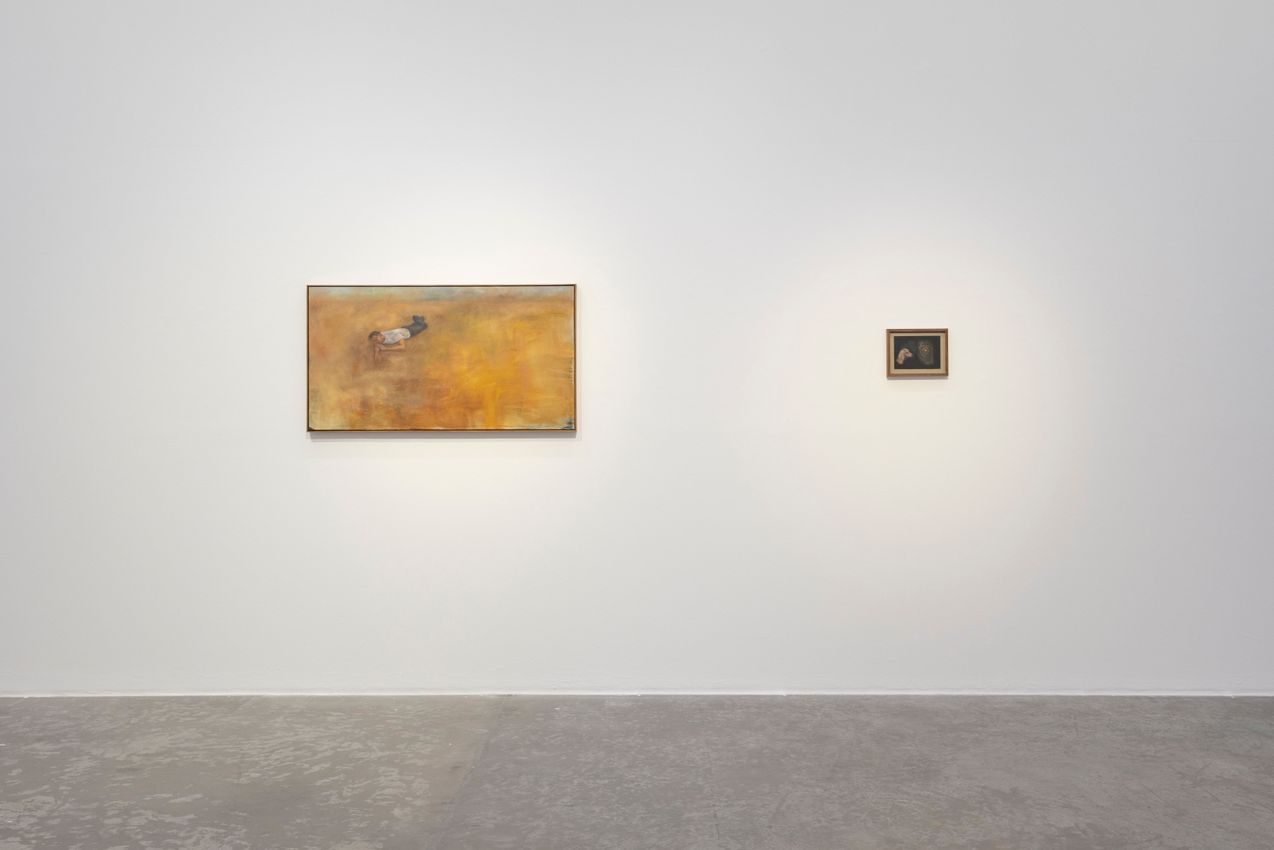
How do landscapes (both territorial and cultural) shift as carriers of cyclical time? Can we translate volatile geographies into architectures of memory? These are amongst the concerns Hera Büyüktaşcıyan delves into in her exhibition On Stones and Palimpsests, marking her second solo at the Gallery. Looking at territorial divisions and historical ruptures in different cities across time, she unravels these unstable spaces across a series of drawings, sculptures and video.
Buildings, stones, city maps, and objects are brought to life in Büyüktaşcıyan’s work. She is interested in how our senses can connect to the personal and collective recollections of spaces we haven’t encountered, spaces that bear witness to violent eradication. For her, the built environment, in its lines, cracks and tears, and embossed, fossilized forms, is akin to a living organism; it charts an archaeology of identity.
Her work is often focused on silenced histories, and their re-tracing within architectural memory. In acts of map-making and mark-making, she creates a materiality of space. Exploring notions of representation through the contradictory relationships between erasure and reconstruction, past and present, the imperceptible and the material, the artist evokes images that defy the very disappearance she is questioning. This encompasses the destruction of whole environments, communities and cultural heritage, which she reconstitutes in architectural forms, topographic drawings and aerial views.
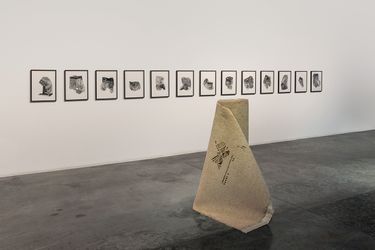
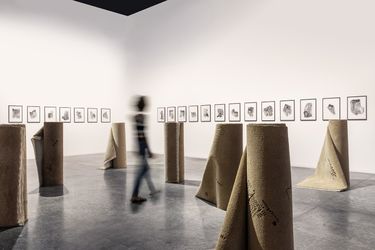
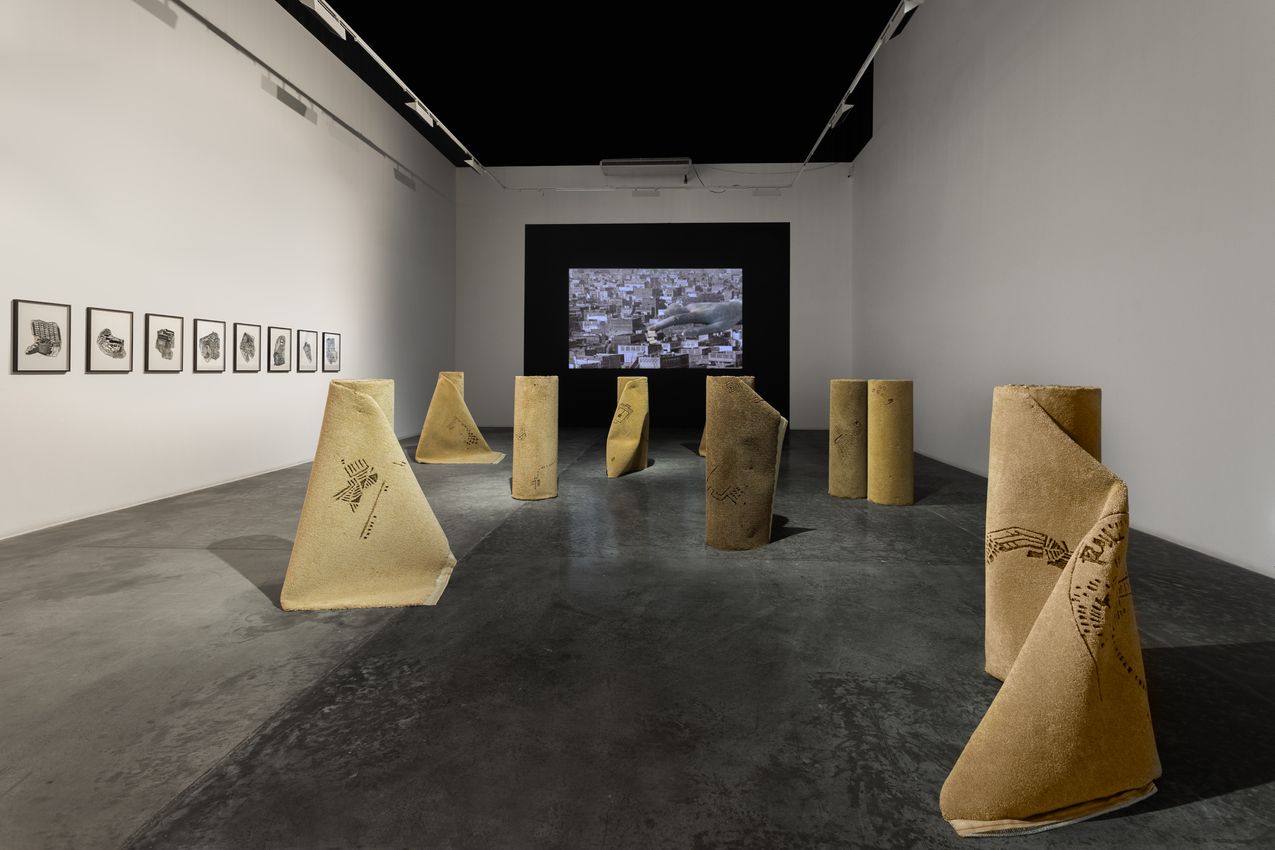
Büyüktaşcıyan digs into the depths of terrestrial imagination by unearthing different historical narratives and timelines. A case in point is the sculptural installation Reveries of an Underground Forest, placed at the heart of the gallery space, which was first shown at the 2019 Toronto Biennale. Referencing the forests and riverbeds of the indigenous peoples that were destroyed and forgotten in the construction of the city of Toronto in the early 1800s, the work alludes to the lumber used by migrant workers to support urban infrastructure. Like amputated tree stumps, these foundations stand in columns of rolled (and unraveling) industrial carpets, parts of their epigraphic surfaces relaying intricate cartographies of land and urbanity. Their designs are composed from Indigenous and Punjabi (Phulkari) textile patterns and aerial city maps, accentuating the artist’s interest in other contested lands across time. The pillars are symbolic witnesses of the past and the present resurfacing from the ground; their imprinted forms occupy a space before language – part musical annotation, coded symbols of collective loss, part unbounded geographies situated between place and displacement.
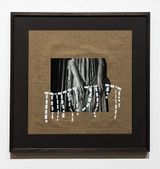
The artist’s link to Punjab’s cultural history is further brought out in her video Infinite Nectar*, in which Büyüktaşcıyan traces various Sikh heritage buildings that were abandoned during the 1947 Partition between Indian and Pakistani Punjab; spaces that bear the imprints of adversity, power shifts and urban transformations over time. Through the layered histories and conflicts of the Punjab region, she explores the reconfiguration of territory and how it impacts the sociopolitical realm. In poetic vignettes that mirror the lost and found elements of space, she brings the voice of the exiled queen Maharani Jind Kaur back to the city in which she couldn’t die, through a tactile yet marble hand. The artist’s voice casts a ghostly presence. It becomes the channel of an ethereal existence, an alienated past, the sound of an artefact that creates as it destroys. Fingers dig into the terrain, feeling fissures and filling gaps with mosaic-like stones placed in moving paths to form rivers or the flow of time. Here, Büyüktaşcıyan’s reading is topographic, her vision a palimpsest, and her vocalization a form of lithic verse.
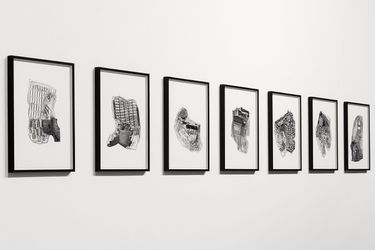
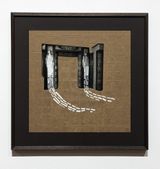
Linking contemporary and prehistoric timelines, Lithic Verses is a series of drawings that incorporate archival photographs from archaeological excavations of Pergamon, the pre-Hellenistic city that was destroyed, raided and rebuilt many times across history. In this exploration between power and architecture, scale and representation, the artist references how the German archaeologists employed the local villagers as a source of measurement, their existence invisible, yet evoked in architectural fragments. Büyüktaşcıyan expands the archive using paper cutouts to trace barely visible outlines in graphite frottage against white backdrops.
Throughout the artist’s work, imprints of time and space are uncanny, re-formed and abstracted in suspension, emblematic of both solid presence and near-absence. In her language of material forms, she challenges monochrome readings and voices histories of trauma through cracks and unseen layers. In this hyper-representation of objecthood, stones and palimpsests become tectonic images that speak.


In her multidisciplinary practice, Hera Büyüktaşcıyan uses the notion of absence and invisibility, in order to anchor memory through unseen and forgotten aspects of time & space and architectural memory in reference to ruptures in socio-political histories. Through her sculptures, site specific interventions, drawings and films, Büyüktaşcıyan dives into terrestrial imagination by unearthing patterns of selected narratives and timelines that unfold the material memory of unstable spaces.
Green Art Gallery is a contemporary art space featuring a multi-generational mix of artists whose practices are rigorously researched, idea-led, and representative of our current moment. The gallery now represents a multi-generational mix of artists from the Middle East, North Africa, South Asia and beyond, including Turkish artists Hale Tenger and Hera Büyüktaşcıyan; Iranian artists Kamrooz Aram and Nazgol Ansarinia; and Shadi Habib Allah, Seher Shah, and Alessandro Balteo-Yazbeck, who are Palestinian, Pakistani and Venezuelan respectively. In this geographic mix, the gallery reflects Dubai’s position as a cosmopolitan—as well as artistic—entrepôt, even as it boasts of a strong parallel Arab Modernist program.

A respected voice in contemporary art discourse.
Focusing on ambitious storytelling and insightful art-world commentary. Ocula Magazine publishes in-depth interviews, critical essays and timely analysis on the artists, exhibitions and ideas driving the global art world.
Learn more about Ocula Magazine
Showcasing the best of the art world.
Ocula partners with galleries from around the world to highlight their artists, artworks and exhibitions. Gallery membership is by application and invitation, with each member vetted by an independent panel.
Learn more about Ocula Membership

Specialises in the sale of major artworks.
Led by a team with deep ties to the world’s leading auction houses, galleries and collectors. Ocula’s advisory team offers bespoke services to high-net-worth clients from around the world who are looking to acquire the best of contemporary and modern art.
Learn more about our team and services