Victoria Miro is delighted to announce an exhibition in Venice of new paintings by Celia Paul.
The exhibition coincides with the publication of a new book by the artist, Objects of Desire: An Artist in Venice, a painter’s memoir of obsession, loss and creation during a residency in Venice.
The pivotal subject of both the book and the exhibition is Giorgione’s La Tempesta (1503–1504), on view in the Gallerie dell’Accademia, which interested Paul because of the dynamic between the figure of a man and a breastfeeding woman. In 2023, Paul painted an interpretation of La Tempesta, which she titled That Obscure Object of Desire, the same title as Luis Buñuel’s 1977 surrealist film, noting how the film and the painting share dreamlike qualities and are rich with symbolism. This exhibition continues her fascination with the complex relationship between the observer and the observed.
Commentary below is written by the artist.
This painting directly relates to Giorgione’s famous masterpiece La Tempesta which hangs in the Accademia and forms the pivotal theme to my book of the same title: Objects of Desire: An Artist in Venice. When I did my first artist’s residency in Victoria Miro’s glorious studio space overlooking the Giudecca Canal, my obsession with La Tempesta affected everything I saw and felt. The painting has always held a particular significance for me but here, in Venice which is so full of everyone’s memories and dreams, it made me question again what this painting meant to me.
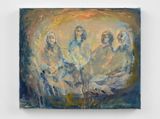
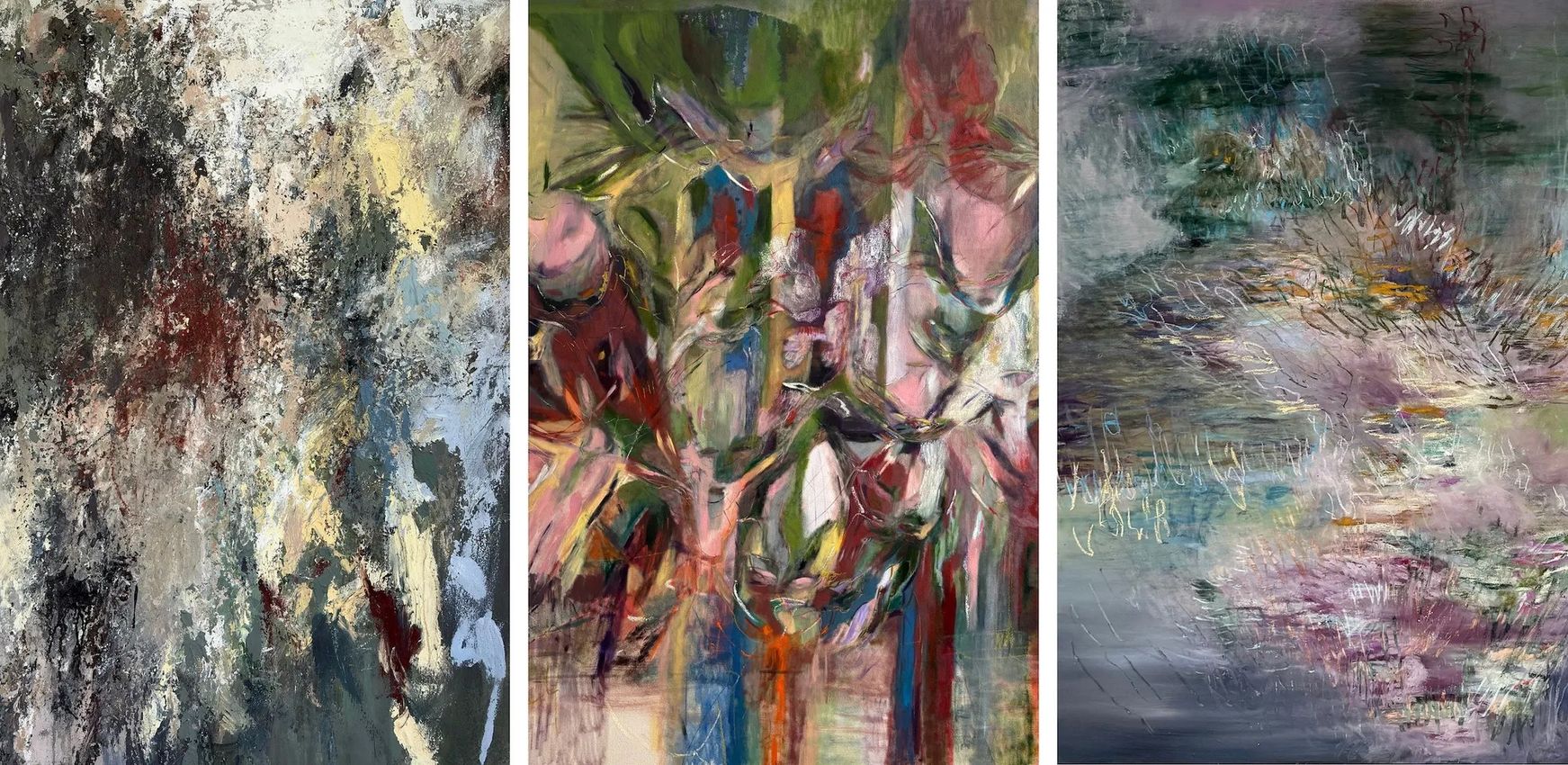
The first painting I made from it I titled That Obscure Object of Desire, a reference to Buñuel’s great surrealist film, because I felt that Giorgione’s painting is teeming with dreamlike references to the subconscious: the phallic broken twin pillars next to the standing man which correspond to the vagina-like cleft of the muddy mound on which the breastfeeding woman is sitting. The two figures – the man and the woman – are separated by a patch of water; this division adds a quality of yearning. In this most recent painting, I wanted to explore the dynamic between a man and a woman, in a more general sense, within the context of the natural forces which surround and control them.
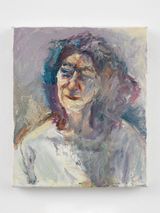
‘Tramonto’ means sunset in Italian. I have based this self-portrait on the depiction of me by Lucian Freud in his painting Painter and Model. The composition of Freud’s painting echoes that of La Tempesta: a clothed standing figure on the left-hand side of the canvas who is observing a naked, or partially naked, figure on the right. Both Freud’s and Giorgione’s paintings are about looking and being looked at. In my sunset self-portrait, I seem to be looking back in time to my young self.
In this painting I have referenced an ink and wash self-portrait by Gwen John in which she is sitting on her bed waiting for a visit from her lover, the sculptor Auguste Rodin. I wanted to show that a young female artist can be both the object of another’s gaze and her own subject. I intended the painting to be a reference to my adolescent self, when I was first becoming aware of my artistic vocation and its challenges.
In this painting I wanted to demonstrate the unseen forces of nature that guide us. It has always seemed very mysterious to me that the moon is the invisible magnet drawing up waves out of still water. Just as with the moon and water, the unseen charisma passing between people who are attracted to each other, seems mysterious.
In Seated Painter I have represented myself sitting on a bed which is the same green as the water of a Venice canal. I look at home here. I appear to be holding the sunset fire in my lap. It is a peaceful painting, I hope. I seem to have made peace with myself and with my surroundings.
Courtesy Victoria Miro


Celia Paul’s art stems a deep connection with subject matter and is quiet, contemplative and ultimately moving in its profound attention to detail and deeply-felt spirituality. She makes intimate depictions of people and places she knows well. From 1977 to 2007 Paul worked on a series of paintings of her mother, and since then she has concentrated on painting her four sisters, especially her sister Kate, as well as a number of portraits of close friends. She has also produced a large number of evocative self-portraits over the course of her career. Paul’s self-portraits open up a painterly and conceptual dialogue between the dual role of subject and artist – caught between self-possession and self-scrutiny – as well as offering an extended consideration of the essential dualities of the medium – its ability to capture qualities of form, light and atmosphere, and its material presence.


Since Victoria Miro founded her eponymous gallery in Cork Street, Mayfair, in 1985, the gallery has grown to represent over 40 artists and estates. With a reputation for presenting ground-breaking artworks from around the world, Victoria Miro has exhibition spaces in Mayfair and Wharf Road in London, and a further gallery space in Venice.

A respected voice in contemporary art discourse.
Focusing on ambitious storytelling and insightful art-world commentary. Ocula Magazine publishes in-depth interviews, critical essays and timely analysis on the artists, exhibitions and ideas driving the global art world.
Learn more about Ocula Magazine
Showcasing the best of the art world.
Ocula partners with galleries from around the world to highlight their artists, artworks and exhibitions. Gallery membership is by application and invitation, with each member vetted by an independent panel.
Learn more about Ocula Membership

Specialises in the sale of major artworks.
Led by a team with deep ties to the world’s leading auction houses, galleries and collectors. Ocula’s advisory team offers bespoke services to high-net-worth clients from around the world who are looking to acquire the best of contemporary and modern art.
Learn more about our team and services