






FAN HO
1931-2016, ChinaCharacterised by their use of shadow and light, the black-and-white street photographs of Fan Ho (1931-2016) brought drama and atmosphere to images of mid-20th-century Hong Kong. Dubbed “the Cartier-Bresson of the East”, Fan Ho’s work shone a light on ordinary lives during a period of political and social change, as well as documenting the city itself.
Early Years
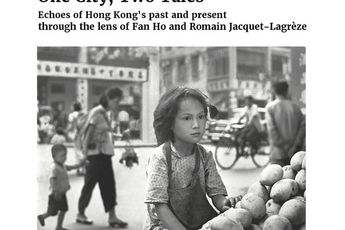
Born in Shanghai in 1931, Fan Ho became interested in photography when his father gave him a Kodak Brownie camera. Later, his father gave him a twin-lens Rolleiflex K4A, the camera he would use during the rest of his photographic career. The family moved to Hong Kong in 1949 and Fan Ho began to explore the city, capturing candid images of street traders, children and city life while around him, Hong Kong was shifting from trading port to bustling metropolitan centre.
In 1959, aged 28, Fan Ho wrote Thoughts on Street Photography, a book featuring his own work, as well as different approaches to the medium.
Fan Ho was also a film actor and director. He joined Shaw Brothers film studio in 1961 as a continuity assistant on the movie The Swallow (1961), but moved into acting, notably playing Monk Tang Xuan Zang in the Journey to the West series (1966–1968). He then went on to direct short and feature-length films, up until the early 1990s.
Fan Ho: Artworks
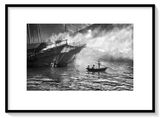
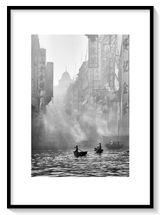
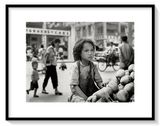
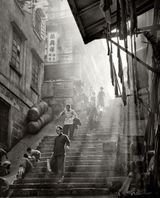
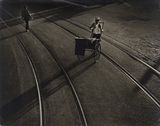
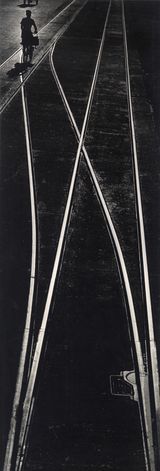
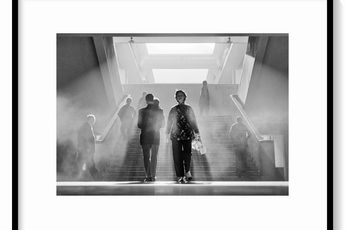
Fan Ho’s photography was known for its light and shadow—he often shot pictures when the sun was low in the sky, adding to the drama. Geometry also played a role in his compositions, as did contrasts between the old and the young, or modern and traditional Hong Kong. He often photographed children, showing their lives unfolding against the backdrop of an evolving city.
His use of light, dark and geometry mean Fan Ho’s photographs are often associated with the Bauhaus movement. Narrative is created through the grainy quality of the images, as well as smoke and light. While each photograph was rooted in reality, abstraction makes an appearance: the idea of figures drifting or floating through the pictures creates the idea of suspension (a concept actually realised in 1966’s Man on the Rope).
- Approaching Shadow (1954) is a monochrome photograph showing Ho’s cousin leaning against a wide wall, approached from the profile, eyes cast downwards. To the picture, Ho added a diagonal shadow cutting through the background, alluding to the fading away of her youth.
- In Journey to Uncertainty (1956), an elongated person walks away from the viewer, bag and cane in hand. The figure is shown travelling through a narrow back alley, away from cobblestone pavement, towards the aftermath of development.
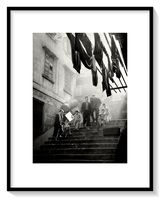
- Similarly, Children’s Paradise (1959) is set in the backstreets of Hong Kong. The monochrome photograph shows three children running from the camera, framed by lines of laundry from above. The light catches on the white garments and falls over the figures. In the lower-right corner, an elderly man and four other children rest seated on wooden crates, three facing the photographer. They look into the camera, unbothered.
Fan Ho: Exhibitions
Select Solo Exhibitions
- Fan Ho. Photography. My Passion, My Life, Blue Lotus Gallery, Hong Kong (2022)
- Rediscover and Restructure, Art and Sensuality in Fan Ho’s Cinema, Blue Lotus, Hong Kong (2021)
- Portrait of Hong Kong, Blue Lotus Gallery, Hong Kong (2019)
- Fan Ho: Visual Dialogues | Hong Kong through the lens of Fan Ho, Sotheby’s Hong Kong (2017)
- On the Stage of Life, M97 Gallery, Shanghai (2016)
- A Hong Kong Memoir, Modernbook Gallery, San Francisco (2015)
- Hong Kong Yesterday, SFO Museum, San Francisco Airport (2015)
- The Living Theatre, Modernbook Gallery, San Francisco (2009)
- Hong Kong 1952–1964, Laurence Miller Gallery, New York City (2006)
Select Group Exhibitions
- Whisper, 10 Chancery Lane Gallery, London (2025)
- Unseen 2024, Blue Lotus Gallery, Hong Kong (2024)
- The Streets of Hong Kong, Blue Lotus Gallery, Hong Kong (2023)
- Hong Kong Calling, Blue Lotus Gallery, Ghent (2022)
- Without a Word, The Polygon Gallery, Vancouver (2017)
- Afterwork, Para Site, Hong Kong (2016)
- 10th Angkor Photo Festival (2014);
- 5th Daegu Photo Biennale (2014)
- Thirty Years, Laurence Miller Gallery, New York (2014)
- Licht-Schreiben, Forum for Photography, Cologne (2009)
Further reading
- Fan Ho biography at Blue Lotus Gallery
- Fan Ho’s Hong Kong in pictures from the Guardian (2022)
- Official website of the Fan Ho Estate and Trust
- South China Morning Post interview from 2012 (updated posthumously) (behind a paywall)
Fan Ho FAQs
What camera did Fan Ho use?
Fan Ho shot the vast majority of his work using a Rolleiflex 3.5A (type K4A), although online sources differ as to when he obtained it. The official website of the Fan Ho Trust and Estate says he acquired the camera as a gift from his father when he was 18, having begun his photography with his Kodak Brownie when he was 14. However, Fan Ho’s Wikipedia page suggests that the Brownie was left behind when Fan Ho’s parents were stranded in Macau during the Second Sino-Japanese War, and his father gave him the Rolleiflex when he was 14.
What were the main themes in Fan Ho’s work?
Fan Ho documented Hong Kong life, notably during the 1950s and 1960s as the city evolved from a port to a metropolis. He used light, dark and geometry to capture images of the people of Hong Kong, whether traders, children playing in the street or pedestrians, creating a record of the soul of the city.
Did Fan Ho win any awards?
Yes, Fan Ho won more than 280 awards during his life and career, and lectured about filmmaking and photography at 12 universities in Taiwan and Hong Kong. He is a fellow of the Photographic Society and the Royal Society of Arts in the UK, and an Honorary Member of the Photographic societies of Singapore, Argentina, Brazil, Germany, France, Italy and Belgium. He won a lifetime achievement award in 2015 from the Chinese Photographic Society.
Ocula

Works at Blue Lotus Gallery







Recently Exhibited




Explore and Follow Artists Shaping Contemporary Art
A respected voice in contemporary art discourse.
Focusing on ambitious storytelling and insightful art-world commentary. Ocula Magazine publishes in-depth interviews, critical essays and timely analysis on the artists, exhibitions and ideas driving the global art world.
Learn more about Ocula Magazine
Showcasing the best of the art world.
Ocula partners with galleries from around the world to highlight their artists, artworks and exhibitions. Gallery membership is by application and invitation, with each member vetted by an independent panel.
Learn more about Ocula Membership
Specialises in the sale of major artworks.
Led by a team with deep ties to the world’s leading auction houses, galleries and collectors. Ocula’s advisory team offers bespoke services to high-net-worth clients from around the world who are looking to acquire the best of contemporary and modern art.
Learn more about our team and services