






Up For Crabs
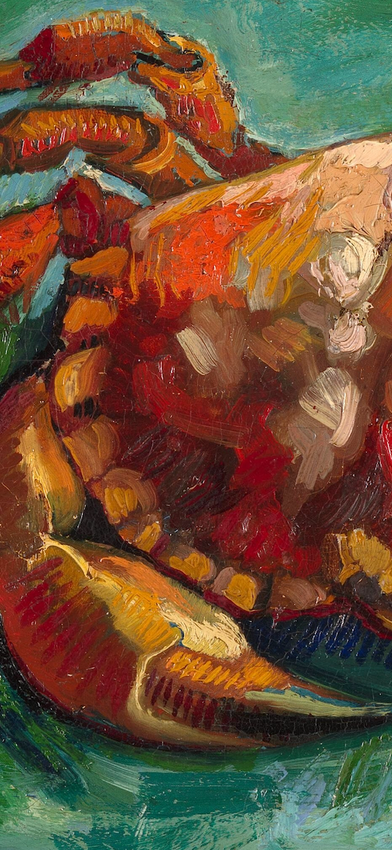
In the third of our series about learning to look at paintings, artist Mohammed Z Rahman recalls how a childhood visit to the National Gallery and hours spent helping his mum in the kitchen taught him to understand the context of colour. Save to My OculaWhen I was a tween, my sisters took me to the National Gallery in London. There, with a sidelong gaze, I came to Two Crabs (1889) by Vincent Van Gogh. At that age, I had a dim awareness of the artist. I mistook him for the patron saint of men who daylighted as charming eccentrics and were abusers behind closed doors. See, my biological dad, who lived with us at the time, was a hobbyist painter who loved Van Gogh. He even wore awful straw hats to emulate him—a quirk that was endearing in a parallel universe where he was not violent.
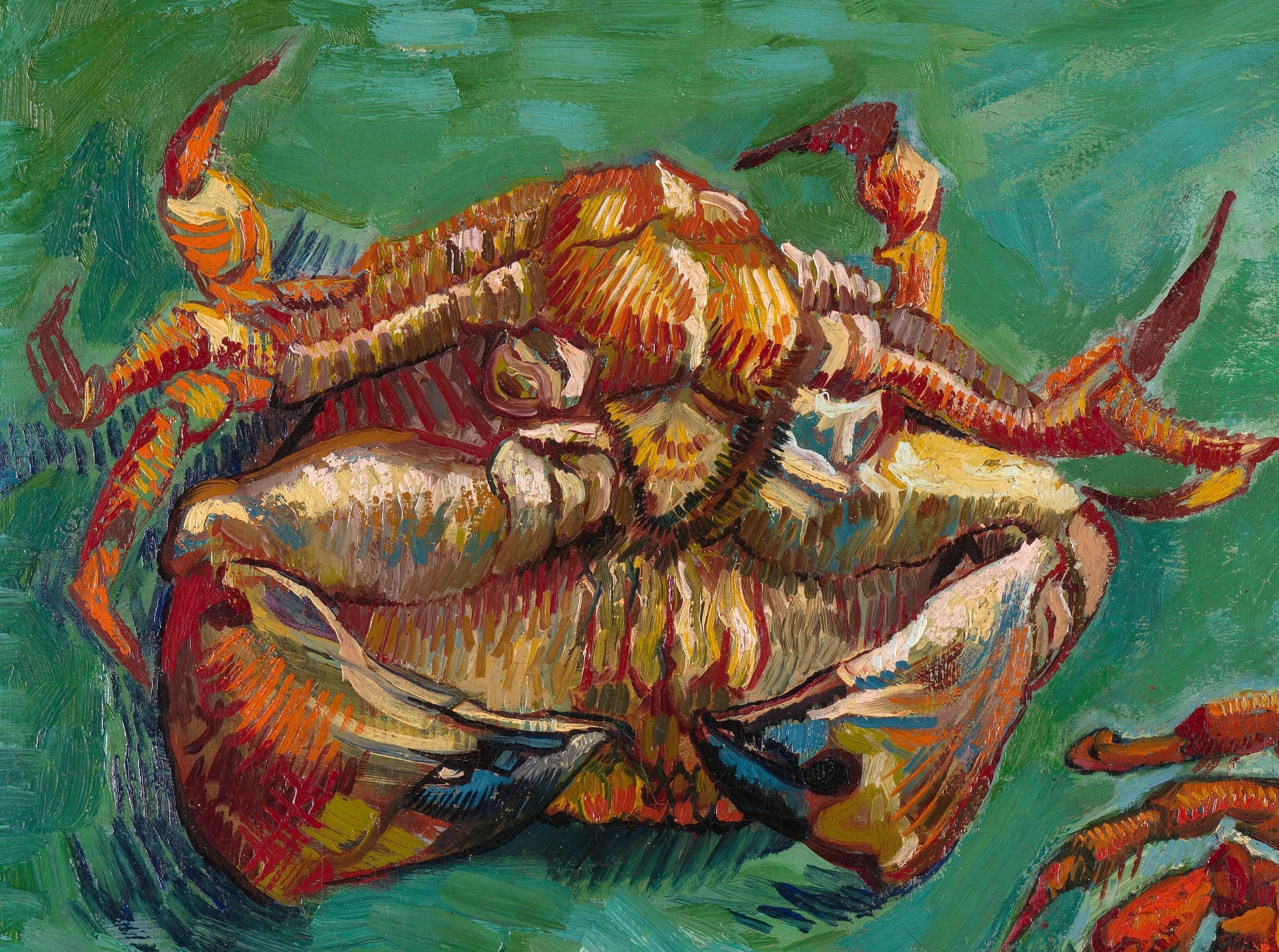
But seeing those crabs, even under the heft of the allegation, I couldn’t look away. I was absorbed by their sleight of hand and needed to know how the artist had brought them into being. As I was forced to wrestle aside my prejudiced associations, the world of painting came out of a fetid shadow and into possibility. My eyes snagged on how flashes of grey-purple made the orange hues oranger. I was puzzled by the accents of lime green on the red carapaces; how, if isolated, they would be totally out of place.
Van Gogh was inspired in this by the colour theory of Eugène Delacroix, who is credited with teaching the younger artist this technique for contrast.
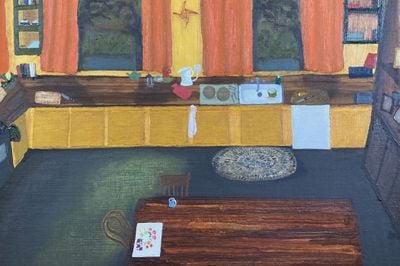
Van Gogh gave me the preamble. It was at home, though, that I really began to understand it in my mother’s kitchen. My ma was both breadwinner and householder. Despite being short on time, she insisted on traditional Sylheti fare, which involves three hobs at any given moment. And there I was, fascinated by the chemistry and the skill of it. Radicalised by my sisters’ politics, I knew that boys who consider themselves seriously against patriarchy don’t shy away from housework.
Under my mother’s tutelage, I moved beyond the dogsbody pounding of garlic and ginger and was initiated in the alchemy of a good moshla and the esoteric ratios of fresh and savoury in a satni. In time, she would cook for half the week and I would cook the other half. Sylheti cuisine, perhaps like popular Mexican or Vietnamese cuisines, works with contrast, both within dishes but also between them. A standard meal is a spread of fish or meat curry, a vegetable bazi, a salad and rice. Its grammar of contrast can be seen in how sweet spices like cassia and cardamom are used with chicken and meat to make them more savoury, but not for fish, which has a natural sweetness. Likewise, in a mango satni, the mangoes are salted and prepared with garlic charred on a flame, which somehow makes them taste fresher.
The penny dropped for me when those crabs resurfaced in my mind. Where do the chromatic brushstrokes, the cloves in the broth, go? Some synaesthetic cross-wiring began, and I realised it was the same alchemy. And suddenly that painting made me recognise how colour, like flavour, is contextual.
“The world of painting came out of a fetid shadow and into possibility”
The crabs were famously inspired by Katsushika Hokusai prints, whose influence can be seen in Van Gogh’s later work. This was part of a wider phenomenon of Japonisme sweeping Europe during the late 19th century. The Van Gogh-Hokusai link tickled my appreciation for anatomy, of which Hokusai was a master. I became observant at an early age when I would get locked outside the house after school. My dad lay on the sofa watching TV and ignoring the doorbell while my mum was at college and my siblings were elsewhere.
I roamed our local area in Ilford and passed the time studying the pavement flowers. I was captivated by kerbside caravans of pill millipedes or the knee of a sycamore, scabbed with scale bugs. It taught me early how the world is alive with infinite detail. When I felt abandoned, it comforted me to observe that this treasure is ours, and that we never have nothing. Van Gogh’s humble choice of subject, and his tender treatment of its intricate details, reminded me of this truth. When you look closely enough, you can see cathedrals in crustacean shells.
I came of age during the anime boom of the 2000s, which opened my eyes to the visual transcultural flows from Japan. I devoured Death Note (2006) and Naruto (2002–2007), impatiently reading the manga ahead of new animated episodes. My life was changed by the first Studio Ghibli Season, screened on public television in the UK on Film 4 in January 2006, which stunned me with the folkloric immersion and political messaging of Princess Mononoke (1997) and Nausicaä of the Valley of the Wind (1984). Then there were video games and the aesthetic shift from watching my siblings play Naughty Dog’s cartoonish Crash Bandicoot franchise on PlayStation 1 to the deeply atmospheric open-world gameplay of the Jak and Daxter franchise on PlayStation 2, with its inimitable graphic style fusing fantasy, retrofuturism and cyberpunk.
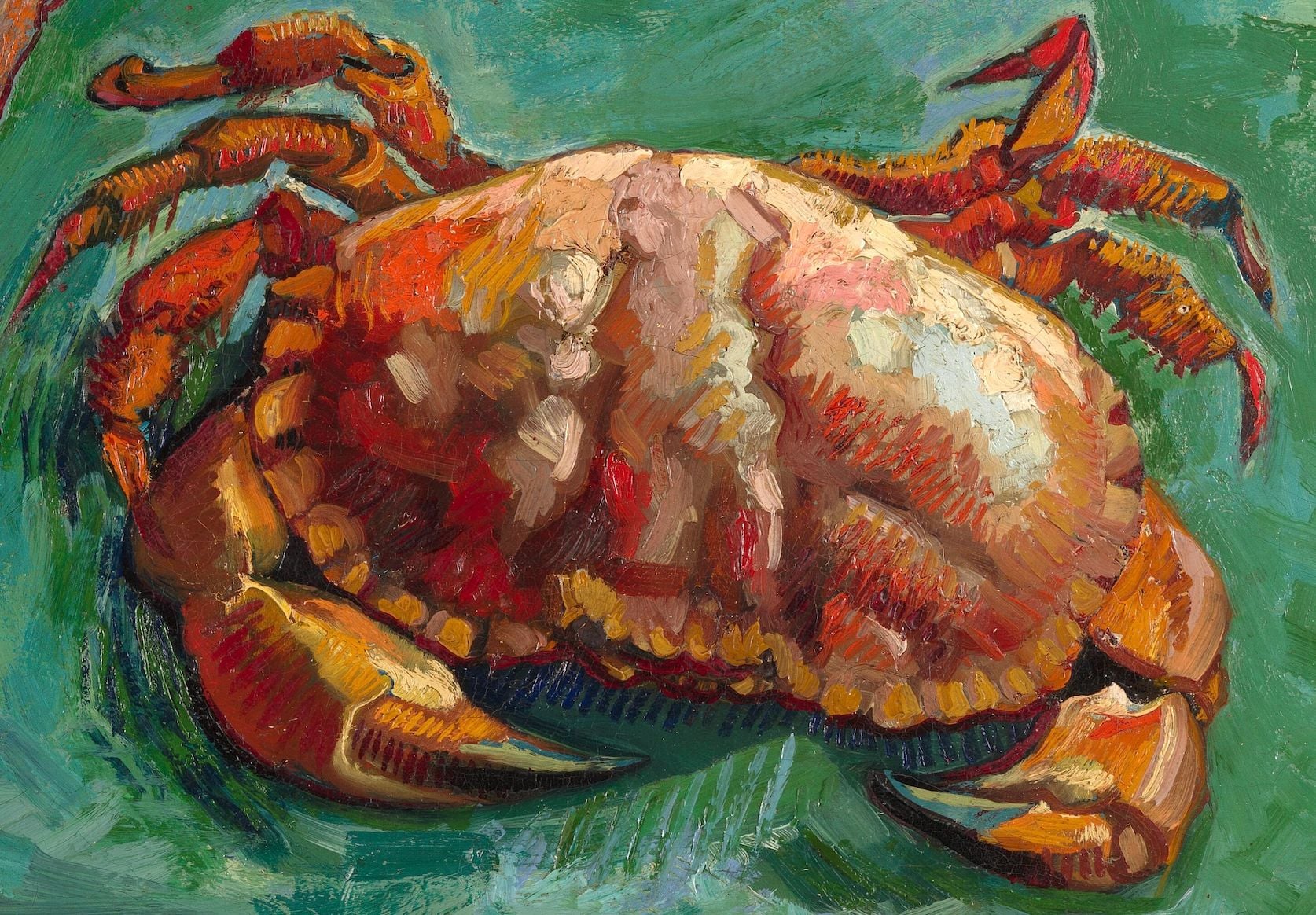
When I look back now, I can see that my visual imagination originated first in line-based drawing and digitised animation, and a focus on mass-produced flatness, both in print and on screen. When I looked at European Impressionist paintings like Van Gogh’s, they expanded my visual thinking about the textured materiality of the paint layers that were not designed to be reproduceable like an animation still.
“When you look closely enough, you can see cathedrals in crustacean shells”
“Poetry is not a luxury,” as Audre Lorde argues. Growing up, I never believed that painting was a bourgeois activity. It didn’t feel at odds with my own working-class experience and life, but something I later learned is deliberately distorted into a rarefied notion of culture by people who believe elitism equals prestige. I read various theorists who helped me to develop a vocabulary to frame this misconception as one ultimately about power and control. Michel Foucault speaks to this in his conception of “regimes of truth”, whereby he argues that knowledge and truth are produced by the power structures of society. My reading of Foucault was shaped by Antonio Gramsci’s earlier theory of “cultural hegemony” and Edward Bernays’ writings on advertising.
There is a case for free access to art in these stories. But nowadays I try not to speak in ways that centre art in institutions, which, while supplementing public awareness of the arts, can never own the way we look at things. The gaze is a wild animal: it prowls the homes we make and the exhibitions we see. Even then, it finds a way to outrun itself. —[O]
Main image: Vincent Van Gogh, Two Crabs (1889). Collection of the National Gallery, London. Public domain under CC0.






A respected voice in contemporary art discourse.
Focusing on ambitious storytelling and insightful art-world commentary. Ocula Magazine publishes in-depth interviews, critical essays and timely analysis on the artists, exhibitions and ideas driving the global art world.
Learn more about Ocula Magazine
Showcasing the best of the art world.
Ocula partners with galleries from around the world to highlight their artists, artworks and exhibitions. Gallery membership is by application and invitation, with each member vetted by an independent panel.
Learn more about Ocula Membership
Specialises in the sale of major artworks.
Led by a team with deep ties to the world’s leading auction houses, galleries and collectors. Ocula’s advisory team offers bespoke services to high-net-worth clients from around the world who are looking to acquire the best of contemporary and modern art.
Learn more about our team and services