





GEORGES VALMIER
1885-1937, FranceGeorges Valmier, born in Angouleme, France, in 1885, left his home city for Montmartre, Paris, France, with his family when he was five. His childhood was overwhelmed by the love of arts, especially thanks to his father who taught him painting as well as music. The young man only sketched his first artworks in 1905 when he came back from his military service.
In 1907, he discovered the artistic universe of Cezanne, considered as the postimpressionism and cubism precursor, during the retrospective dedicated to him by the Salon d’Automne. The same year, he integrated the Fine Arts School and he benefited from Luc-Olivier Merson’s teaching until 1909.
After he left the Fine Arts School, Valmier artistic style’s was evolving under Cezanne’s influence. When Cubism started to manifest itself, the painter delivered canvases with geometrical forms, simplified volumes and dynamic diagonals rhyming his compositions.
In 1913, the painter exhibited his artworks for the first time at the Salon des Indépendants. The next year, he exhibited at the same place and brought André Salmon’s attention who described his work as post-cubist.
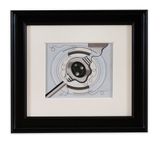
When World War I was over, Valmier met the French art dealer and publisher Léonce Rosenberg who quickly took him under contract. In 1921, Rosenberg organised for him a personal exhibition at his Galerie de l’Effort Moderne. The same year, he participated in the exhibition Les Maîtres du Cubisme. At this time, Valmier realised paintings considered as abstract, removing some details and expanded his geometric plans.
From 1922 to 1926, the painter expressed his will to experience other arts by showing interest in theatre research. Then he worked on settings and costumes for several plays such as Cyprien ou l’Amour à 18 ans from Georges Pillement (1923) or ballets such as La Farce du Pont-Neuf (1926).
From 1923 to 1927, he regularly published his artworks in the Bulletin de l’Effort Moderne, still supported by Léonce Rosenberg.
In the early 1930s, Valmier took part in numerous exhibitions in New York City, Wien, Warsaw, as well as Paris. In 1931, he became one of the members of the ‘Abstraction-Création’ group along artists’ sides such as Jean Arp. He participated in different manifestations until the group was separated in 1936.
In 1936, he chose three monumental artworks for the decoration of the cinema room of the Palais des Chemins de Fer of the 1937’s World Fair. Unfortunately, Valmier would not enjoy the end of the project because he died in March 1937, in Montmartre, Paris, France.

Explore and Follow Artists Shaping Contemporary Art
A respected voice in contemporary art discourse.
Focusing on ambitious storytelling and insightful art-world commentary. Ocula Magazine publishes in-depth interviews, critical essays and timely analysis on the artists, exhibitions and ideas driving the global art world.
Learn more about Ocula Magazine
Showcasing the best of the art world.
Ocula partners with galleries from around the world to highlight their artists, artworks and exhibitions. Gallery membership is by application and invitation, with each member vetted by an independent panel.
Learn more about Ocula Membership
Specialises in the sale of major artworks.
Led by a team with deep ties to the world’s leading auction houses, galleries and collectors. Ocula’s advisory team offers bespoke services to high-net-worth clients from around the world who are looking to acquire the best of contemporary and modern art.
Learn more about our team and services