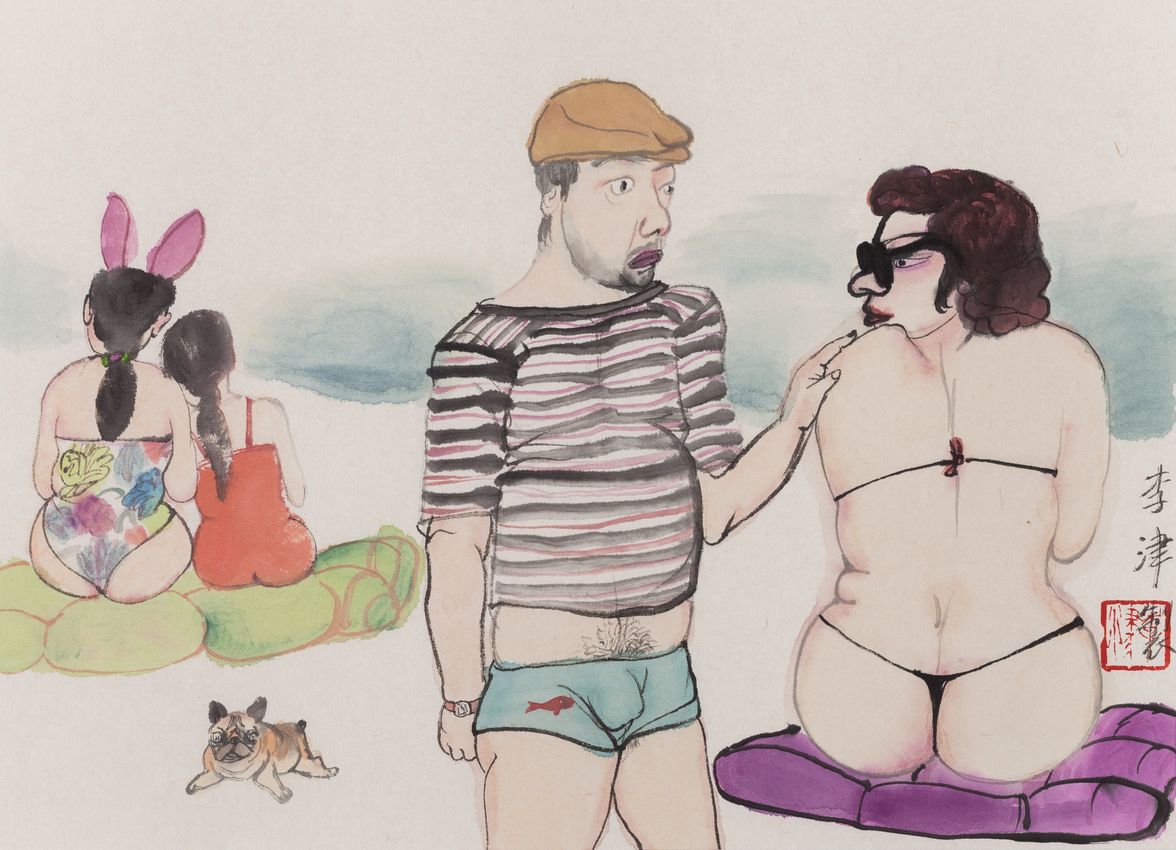
Li Jin’s style is characterised by the aesthetics of xianhuo or ‘aliveness’. Portraying a range of characters, often including the artist himself, Li Jin presents humorous, playful images of figures engaged in acts of feasting, sexual intimacy, and other quotidian aspects of life.
Banquets and Intimacy
From the beginnings of his practice, Li Jin engaged with subjects of food and intimacy. In the early 2000s, he explored familial and sexual dynamics in coloured ink vignettes, illustrated in works such as Family of Three (2004), and the raunchy ink painting, Bathing (2007).
Banquets are also a core subject of Li Jin’s oeuvre. Some of the artist’s banquet scenes are devoid of figures, focusing instead on depicting magnificent traditional banquet spreads, while others include a rich figurative tableau. In these dreamlike scenes of affluent indulgence, characters from all walks of life gather in various states of undress around tables laden with food, indulging both in eating and in sex.
In Li Jin’s whimsical Banquet No.1 (2012), the male figures are mostly based on the artist’s self-image—dressed in attire ranging from a pig suit to ancient Chinese scholar robes. His representations of voluptuous, exposed bodies embrace the imperfections of human forms.
Colourful and and caricature-like, Li Jin’s works reflect the exuberance an enthusiasm with which he paints.
Monochrome Works
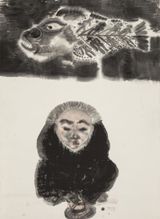
From around 2015, Li Jin began to produce ink works on paper with a more subdued or monochromatic palette in the vein of traditional Chinese ink painting.
In his ‘Arhat’ (2015) and ‘Ink Adept’ (2016) series, a shift towards a more gestural, freehand style is evident, with the artist exploring the behavioural properties of the medium and leaving some elements to chance. Around the same time, Li Jin created a series of large-scale ink paintings depicting various vegetables, such as a bok choy in Vegetable #3 (2015). The tradition of vegetable painting, and in particular those rendered in monochromatic inks, dates back to at least the 13th century in China. Li Jin’s magnification of banal everyday objects can be seen to sympathise with Buddhist values of emphasising the mundane.
Banquets and Bali
In his later practice, the Li Jin has increasingly returned to a broader use of colour, and incorporated scenes from his travels abroad—such as in Impressions of Bali (2017), a coloured ink on paper work comically depicting tourists at the beach
Reflecting the format of his earlier banquet paintings, Banquet for the times (2020) presents a series of characters including a bare-chested tattooed man, a geisha, and an anthropomorphised pig. Several of the characters are referenced from portraits of the artist in costume from different periods. At the table is a modest spread of food and drink, while the wall behind bears the Ten Great Vows of Samantabhadra Bodhisattva—a foundational Buddhist text—in Chinese calligraphy.