






WALTER DE MARIA
1935-2013, United States‘Any good work of art should have at least ten meanings.’—Walter De Maria
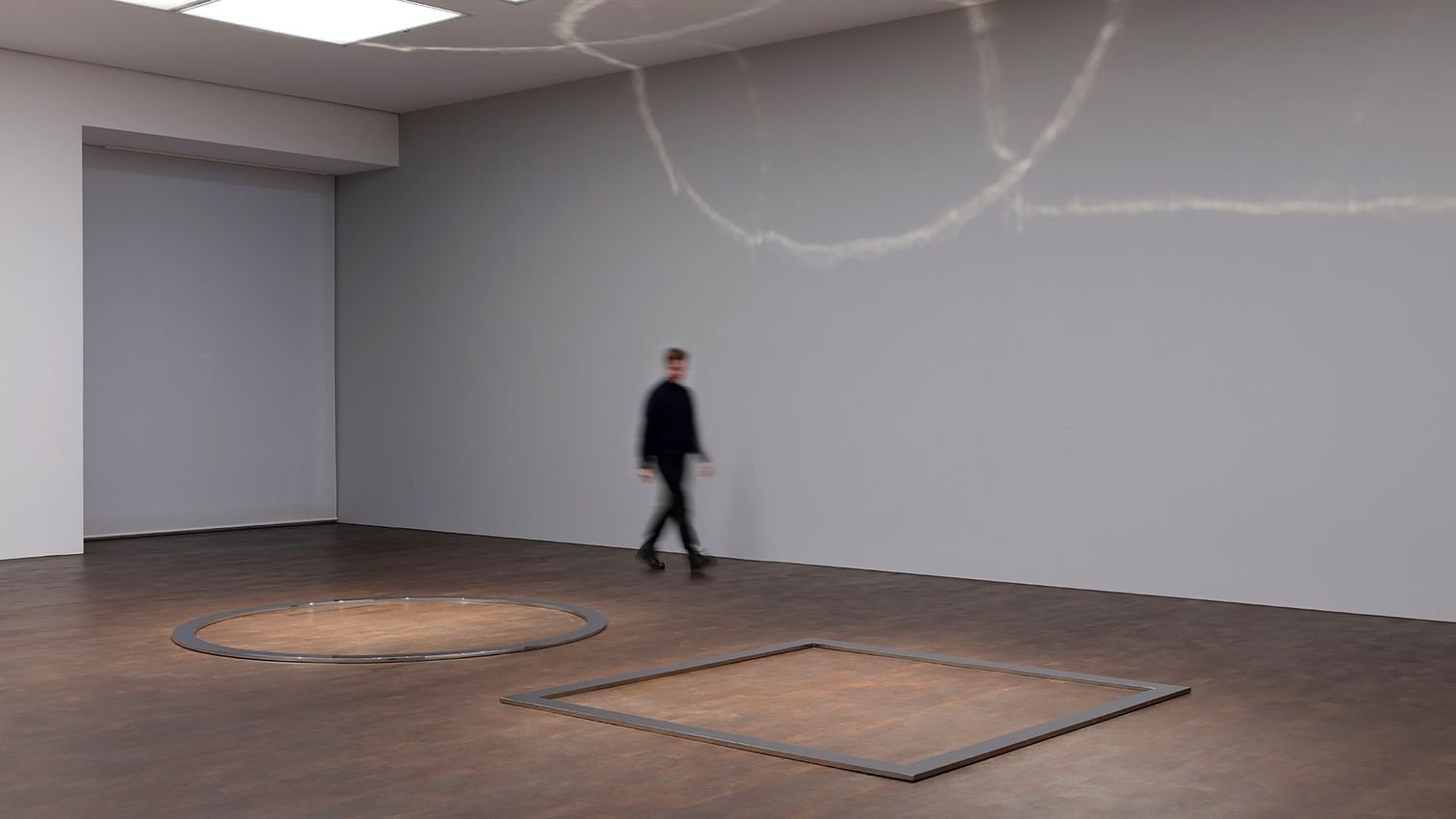
In his sculptures, land works, and installations, Walter De Maria (1935–2013) explored the relationship between the relative and the absolute, using basic geometric components to produce sublime repetitions. By arranging forms according to mathematical sequences, he worked at the intersections of Minimalism, conceptual art, and land art—drawing attention to the limits of gallery spaces, prioritising bodily awareness, and locating the content of an artwork in the viewer.
In 1960, after completing his masters degree at University of California, Berkeley, De Maria moved to New York and began to show his work at a gallery he cofounded with Robert Whitman on Great Jones Street. Influenced by his peers, including Donald Judd and Fluxus member La Monte Young, he produced serialised and numbered sculptural sets of cast and polished steel.
De Maria’s precise polygonal structures impart a sense of the absolute. 14-Sided Open Polygon (1984), a stainless steel tetradecagon containing a steel ball, is emblematic of this distillation. The Pure Polygon Series (1975–1976) is a suite of seven pencil drawings of basic geometric outlines in which a single side is added sequentially to change each shape, beginning with a triangle and ending with a heptagon. In 1977 The Lightning Field was installed in a remote area of the desert in western New Mexico. The work comprises four hundred polished stainless steel poles installed in a grid measuring one mile by one kilometre; the poles, meant to attract lightning, measure over twenty feet tall and have solid pointed tips that define a horizontal plane. The visitor both walks within the grid and views it from afar, observing it over an extended period of time and through space. Other major installations include The Broken Kilometer (1979), five hundred identical brass rods arranged in five rows, which, if placed end to end, would measure one kilometre; The New York Earth Room (1977), a white-walled SoHo loft filled with 280,000 pounds of soil; and The Vertical Earth Kilometer (1977), a one-kilometre-tall brass rod that stretches toward the sky from Friedrichsplatz Park in Kassel, Germany.
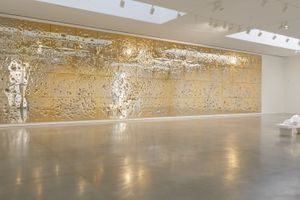
Truth/Beauty, a series of fourteen sculptures in seven pairs created in the early 1990s, was installed at Gagosian on Britannia Street in London in 2016, then at Gagosian in Le Bourget in 2016–2017. At Le Bourget, the works were visible from the gallery’s mezzanine passerelle, recalling the 1981–1982 installation of De Maria’s 360° I Ching / 64 Sculptures at Centre Georges Pompidou in Paris, where the rods were arranged within a sunken area of the museum’s lobby floor.
In 2017 the Walter De Maria Estate and the Dia Foundation collaborated to posthumously complete the artist’s final work, Truck Trilogy (2011–2017), comprising three 1950s Chevrolet pickup trucks, each stripped of all extraneous elements and fitted with three vertical stainless steel rods in its bed: one circular in section, one square, and one triangular.
Courtesy Gagosian

Recently Exhibited



Exhibiting Elsewhere





Explore and Follow Artists Shaping Contemporary Art
A respected voice in contemporary art discourse.
Focusing on ambitious storytelling and insightful art-world commentary. Ocula Magazine publishes in-depth interviews, critical essays and timely analysis on the artists, exhibitions and ideas driving the global art world.
Learn more about Ocula Magazine
Showcasing the best of the art world.
Ocula partners with galleries from around the world to highlight their artists, artworks and exhibitions. Gallery membership is by application and invitation, with each member vetted by an independent panel.
Learn more about Ocula Membership
Specialises in the sale of major artworks.
Led by a team with deep ties to the world’s leading auction houses, galleries and collectors. Ocula’s advisory team offers bespoke services to high-net-worth clients from around the world who are looking to acquire the best of contemporary and modern art.
Learn more about our team and services