Press Release

For over five decades, pioneering conceptual artist Charles Gaines has used systems to create series of works that mine the complex relationship between perception and meaning. For his first exhibition at Hauser & Wirth’s Paris gallery, Gaines will debut new Plexiglas works from his Numbers and Trees series, first conceived by the artist in 1986. Focusing on acacia trees, the nine compositions are based on photographs the artist shot during a trip to Tanzania in 2023. Gaines will also debut the latest installment from his Manifestos series, developed whilst in residence at the gallery’s Somerset location in 2025.

At the core of Gaines’ practice is a conviction as radical as it is precise: that a work of art need not originate in the artist’s intention to carry profound meaning. From his Manifestos compositions to his signature Plexiglas grids, every work that emerges from his studio is the product of a system—rule-based, self-determined and generative—that produces outcomes neither he nor the viewer can fully anticipate.

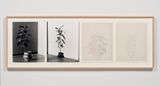
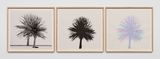
Trees have been a central motif in Gaines’ practice since the 1970s, when he first began plotting their forms on numbered grids in the Walnut Tree Orchard series (1975 – 2014). His methodical examination continues with Numbers and Trees, conceived in 1986. Following a trip to Tanzania in 2023, Gaines began a new chapter within this long-running series, initially engaging the country’s ancient baobabs. The works on view in Paris turn to the acacia, with its characteristic flat-topped crown, demonstrating how the artist continues to forge new paths within one of his most acclaimed series.

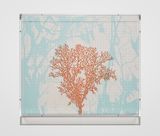
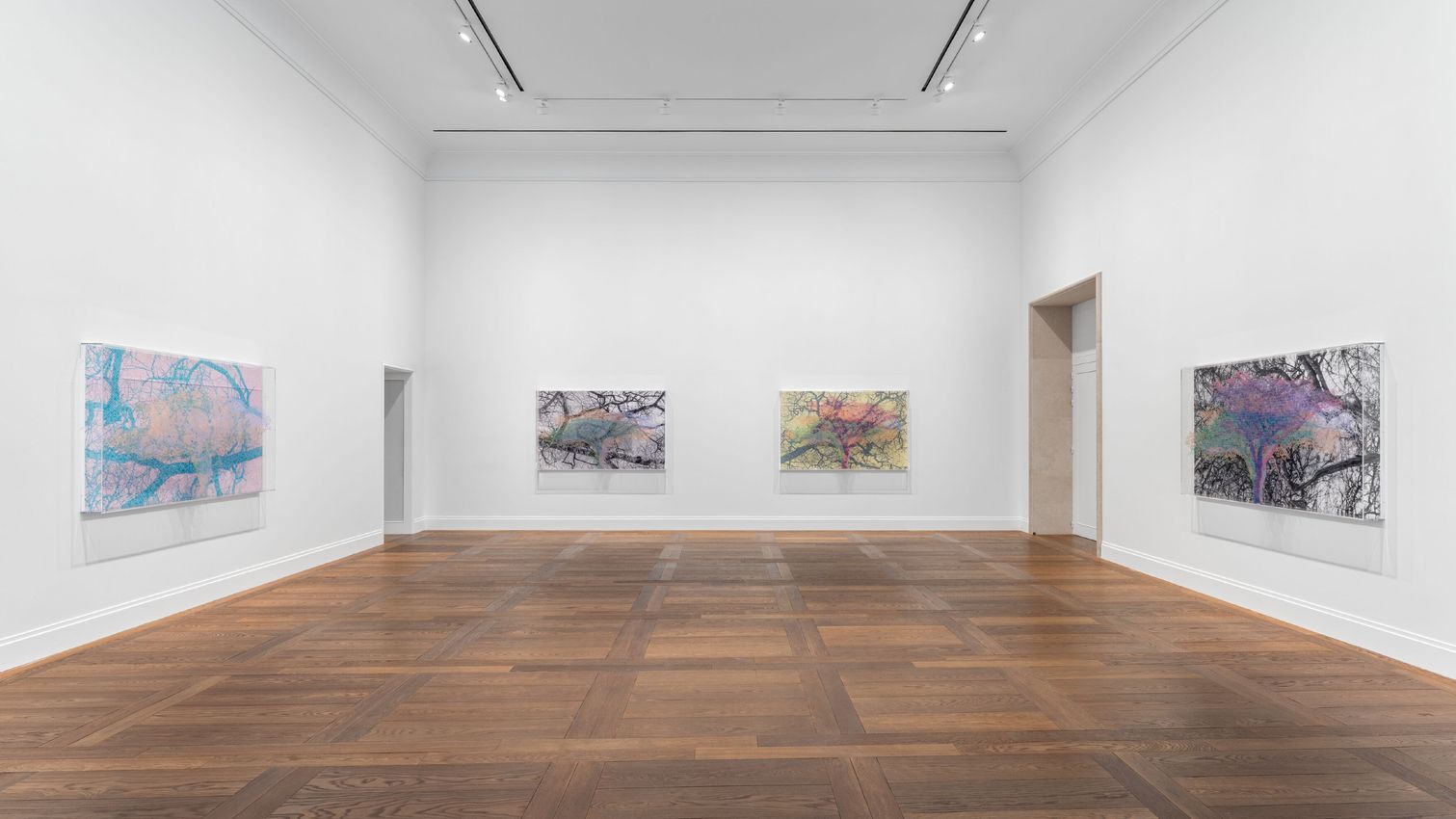
Gaines’ process begins by photographing each tree from the same distance and under identical conditions, so that when the images are layered their individuality is preserved rather than obscured. He then assigns each tree a distinctive color and breaks down the photographic composition into individual cells. Each successive work in the series is realized by overlaying the forms one at a time. The result is a rigorous system for charting similarity and difference that simultaneously challenges the dominance of subjectivity in artistic expression. These works call attention to our tendency to impose categories and suggest the arbitrary nature of other manufactured systems in our society. Viewed up close, the cohesive effect of the gridded geometry dissolves and the rule-based system is laid bare.

For the acacias on view in Paris, Gaines shifts the perspective dramatically from the preceding Tanzania series, looking up at the canopy from beneath the tree. Alternating between photographic and painted backgrounds, the detail views open onto glimpses of sky through gaps in the branches, creating a sense of airiness and light. Here, paint is applied in gestural swirls that contrast the flatness of the gridded foreground. Though his recent works have taken on an increasingly painterly quality, Gaines’ artistic approach remains firmly rooted in a conceptual logic. By formulating a system that governs how a work of art is produced without predetermining its appearance, such as the arbitrary selection of colors at the outset, a sense of genuine surprise emerges for both artist and viewer.

Gaines names each tree after a tribe from the northern portion of Tanzania, where the trees were photographed, anchoring the work in the country’s historical and cultural landscape and reflecting on the legacies of the colonial enterprise, the slave trade and personal identity. However, a profound ambiguity exists in the relationship between the ancient trees he photographed—these natural witnesses to social and evolutionary epochs—and the deliberate, systematic breakdown of their image. This gap, like the space between the Plexiglas panels of each work, invites the viewer to interpret different layers of possible meaning.

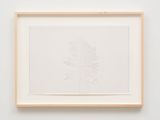
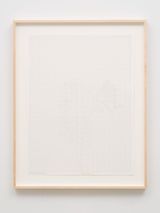
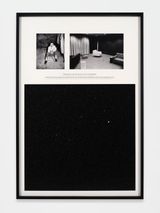
Alongside the new Plexiglas works, Gaines debuts ‘Manifestos 7’ (2026), the latest chapter in a series begun in 2008 in which the artist draws upon and disarms texts of historical authority. His subject here is the law itself: the rulings from two landmark US Supreme Court cases, Plessy v. Ferguson (1896) and Brown v. Board of Education (1954). The work takes the form of an immersive audiovisual installation, pairing a new musical composition with a video of the scrolling texts alongside five drawings that illustrate Gaines’ score. The artist begins by translating the letters A through G from the texts into their corresponding musical notes, H becomes B-flat and all remaining letters are written out as rests. What emerges is haunting and unexpected—legal language never intended to be heard musically. In subjecting these rulings to his system, Gaines unites the rational, mathematical and lyrical structures of music with the irrationality of racial violence and social injustice, pointing, as all his work does, to the disjunction between the empirical objective and the viewers’ subjective response.

Gaines will collaborate on—along with Firelei Báez and Cristina Iglesias—and contribute to ‘Directionless,’ a group exhibition organized by Rashid Johnson at Hauser & Wirth Menorca from 21 June – 25 October 2026.

Courtesy Hauser & Wirth.

Read More

Installation Views

Selected Works

Loading...
About the Artist

A pivotal figure in the field of Conceptual Art, Charles Gaines’ body of work engages formulas and systems that interrogate relationships between the objective and the subjective realms. Using a generative approach to create series of works in a variety of mediums, he has built a bridge between the early conceptual artists of the 1960s and 1970s and subsequent generations of artists pushing the limits of conceptualism today.

View Artist Profile

Also Exhibiting

Address
26 bis rue François 1er
Paris
France
(1)
Paris 26 bis rue François 1er
Hauser & Wirth
26 bis rue François 1er, Paris, France
The art world in focus