





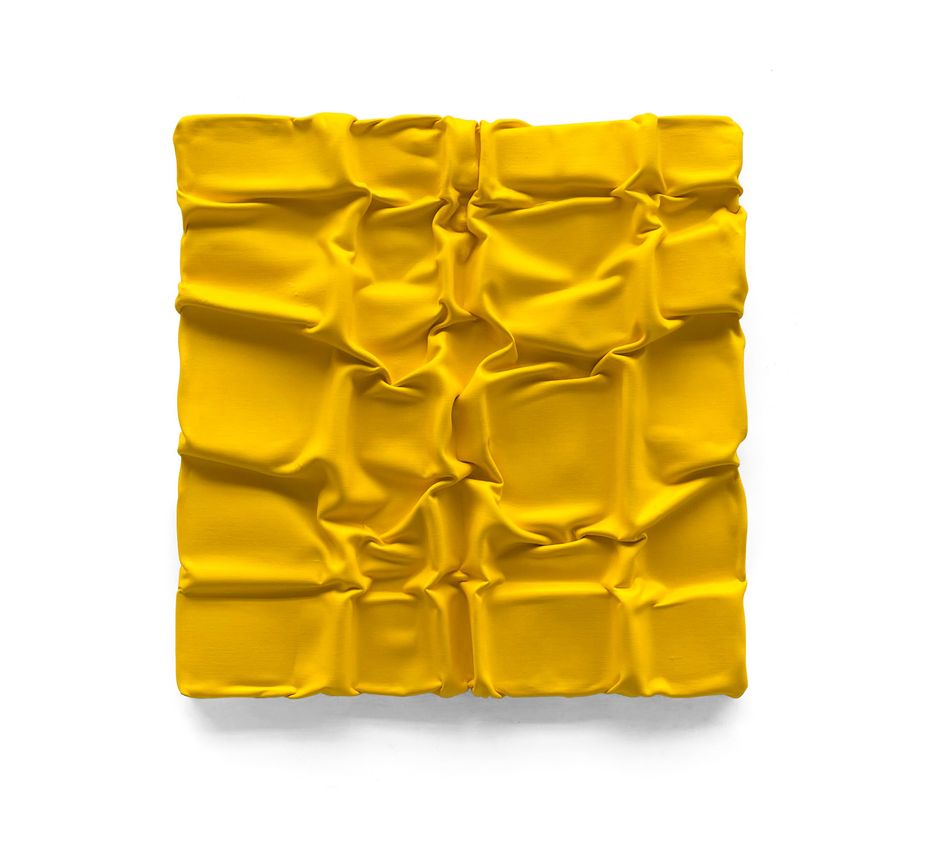
WANG XIAOSONG
b. 1964, ChinaWang Xiaosong graduated with a bachelor’s degree from the Central Academy of Arts and Design (now the Academy of Arts & Design, Tsinghua University) in 1987 and received a master’s degree from the Berlin University of the Arts in 1997. He is currently the deputy dean, professor, and doctoral supervisor of the School of Art and Archaeology at Zhejiang University and is also the director of the Institute of Contemporary Art and Design at Zhejiang University.
Wang Xiaosong has always worked in the traditional medium of oil on canvas, although through continuous practice, he has broken the visual definition of the inherent rectangular outer frame or other geometric boundaries in traditional painting to create his innovative “multidimensional paintings.” These works aim to explore the curves and wrinkles within artistic expression. Wang extends the lines, colours, composition, texture, and other variables in flat painting to a multi-dimensional level. By using a large-scale monochrome paved, concave, and convex surface, he strives to explore the relationship between forms and variables in a curved space. He constantly tries using different materials to fully reflect the commonalities and contradictions of Chinese and Western cultures in the paintings. In the multi-dimensional wrinkly space of the concave and convex canvas, it appears as if the paintings are folded. While highlighting the materiality of the media, the entire picture becomes a continuum of visual space and an actual palpable space. It also shows life and soul beyond the material form, using curved shapes as a metaphor for the anxiety, spiritual dilemmas, and variability of human nature, making the work thought-provoking.
Wang has held solo exhibitions at the Palazzo Medici Riccardi in Florence, Italy; The Ludwig Museum in Koblenz, Germany; and the Kunsthalle St. Annen Museum in Lubeck, Germany. He was also the first Chinese artist to have a solo exhibition at the Secession Building, the founding place of the Vienna Secession. His work has been collected by the Royal Family of Saudi Arabia, the Schütz Fine Art Chinese Department in Austria, Arthouse (Künstlerhaus Wien) in Austria, Barwell Art Foundation, Ludwig Museum in Germany, Kunsthalle St. Annen in Germany, the Art Museum of the Sichuan Fine Arts Institute in China, the Contemporary Art Centre of Larissa in Greece, Yinru Vihara Art Collections, the China Olympic Committee, and the China International Import Expo.
Courtesy Pearl Lam Projects


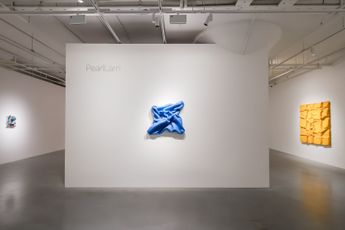

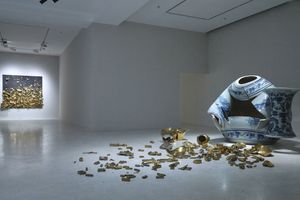
Explore and Follow Artists Shaping Contemporary Art
A respected voice in contemporary art discourse.
Focusing on ambitious storytelling and insightful art-world commentary. Ocula Magazine publishes in-depth interviews, critical essays and timely analysis on the artists, exhibitions and ideas driving the global art world.
Learn more about Ocula Magazine
Showcasing the best of the art world.
Ocula partners with galleries from around the world to highlight their artists, artworks and exhibitions. Gallery membership is by application and invitation, with each member vetted by an independent panel.
Learn more about Ocula Membership
Specialises in the sale of major artworks.
Led by a team with deep ties to the world’s leading auction houses, galleries and collectors. Ocula’s advisory team offers bespoke services to high-net-worth clients from around the world who are looking to acquire the best of contemporary and modern art.
Learn more about our team and services