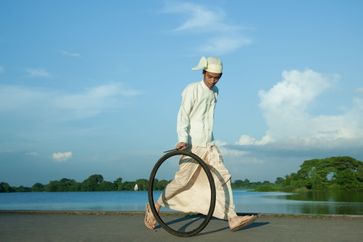
Rest the Thumbs on the Cheekbones, the first European solo exhibition by artist Moe Satt from Myanmar, brings a new commission alongside recent and early works in conversation to showcase the artist’s relentless, dynamic exploration of embodiment, identity, and political resistance. The exhibition builds on Satt’s two-year residency at Rijksakademie from 2022-2024 as well as his 2020 residency at Delfina Foundation, and extends into a collaboration with Tate on a new iteration of his performance f n’ f (face and fingers) (2008) in The Tanks.
At the forefront of a generation of artists from Myanmar that emerged in the 2000s, Moe Satt is most known for his conceptual, performance, and video works that experiment with his own body as a field of symbolism and sense making. The exhibition title is excerpted from his artist book f n’ f (face and fingers) (2024), which details how to transition through his choreography of 108 combinations of face and fingers. It also highlights Satt’s recent interest in expanding the notion of embodiment beyond his own body through instructions, participatory installations, and group performances.
Many of Moe Satt’s works draw from the social-political turbulences of Myanmar and wrestle with oppression and censorship. Satt says, “my country has gone back and forth with military rule since 1962, which is why we cannot avoid political issues in our work”. Storyline (voted/revolution/gun/thumbs down) (2024), for instance, outlines four significant political chapters in the recent history of Myanmar through four hand gestures, all symbols of collective sentiment and actions. Body Inside T-Shirt (2024) draws inspiration from a 2005 performance by the artist and comments on the current political situation in Myanmar — three distorted T-shirt plaster sculptures act as metaphors of the fact that many outside the country know something is happening inside, but are uncertain about the actual developments on the ground.
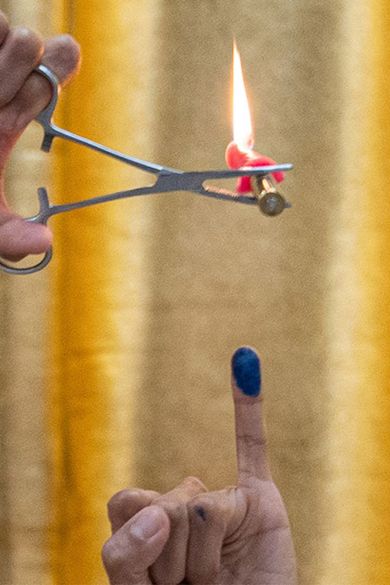
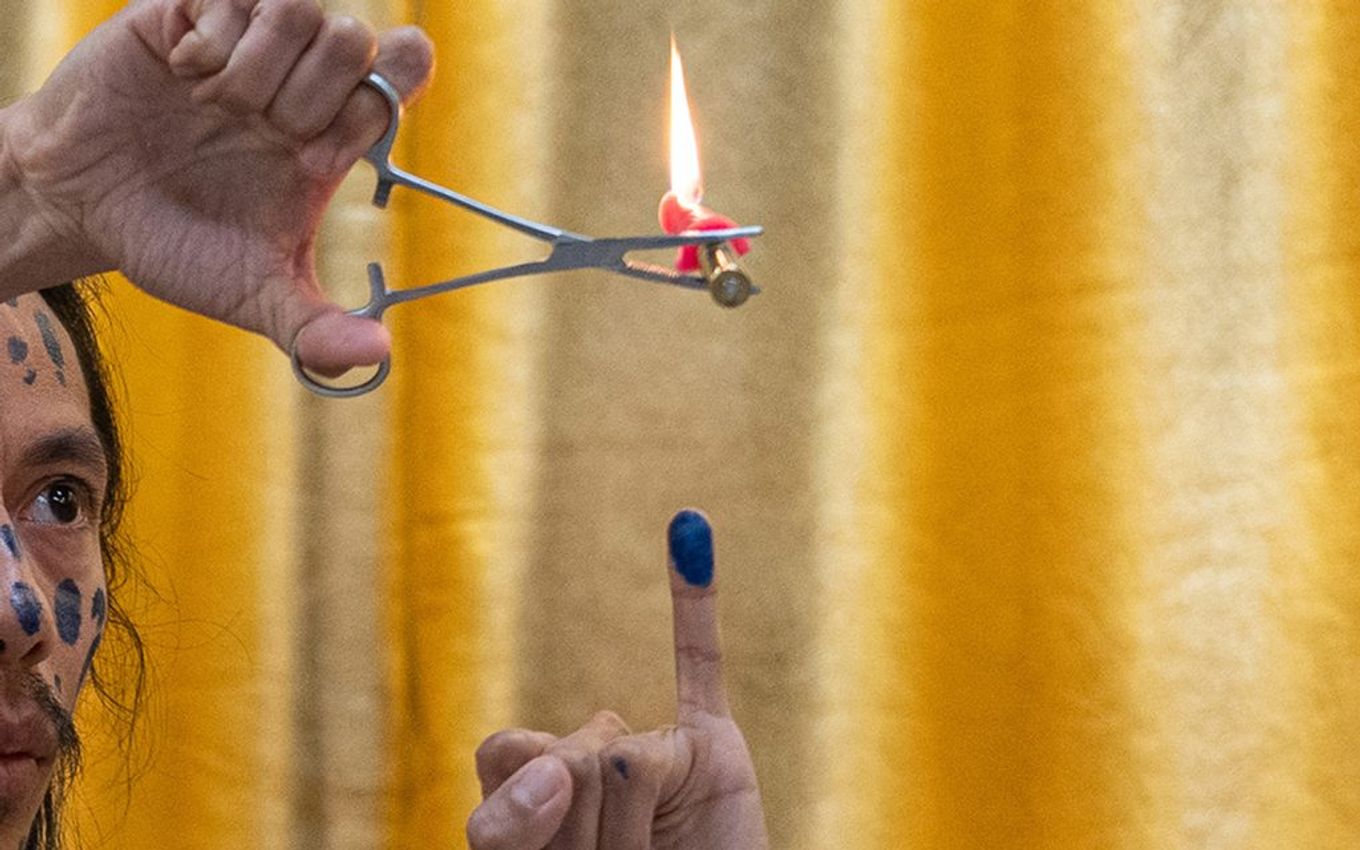
Pinky Say Something (2024) juxtaposes bullet cases with wax cast of pinky fingers in red, a sign of recent voter participation in Myanmar. Placed on a hot plate, the work evokes visceral feelings of an imminent threat and points to the erosion of civil rights. Although rooted in concerns with his homeland, the work also speaks to the wider insurgence of conflicts and violence in many other parts of the world, as Satt rethinks his identity as a diasporic artist.
Such skillful blending of critique and playfulness is even more prominent in works such as Parasol Alternative (remade in 2014) in Delfina’s courtyard. Satt poses the question, “when you put together pieces of a broken object (or a disintegrating society), can it all go back to normal?”. In creating this work, Satt tore apart a parasol and sewed zippers to bridge the gaps. Visitors are invited to zip and unzip the parasol as they wish and explore the myriad shapes it may evolve into—among them a tree, a cross, and a butterfly.
Satt’s acute observation of and reflection on everyday forms has been evident throughout his art practice over the past two decades. Hand Around In... (Yangon, Busan, Jogja) (2012-19) brings together three early videos into a video installation for the first time to offer a poetic and comparative study of ubiquitous hand movements across three Asian cities with significant meaning for Satt. His long-term study of body forms is, however, not limited to human beings. The two-channel video Nothing But Fingers (2023) takes inspiration from two books he encountered in 2006, one on Stone Age hunting culture in Africa, and the other on folk dances in Myanmar.
Subconsciously influenced by his university studies of zoology, Satt transformed his fascination with hand animal gestures in both books into a photography project in 2006, and recently this collaboration with dancer Liah Frank where they individually and collectively imitate various animal postures in a smooth sequence. The idiosyncratic choreography accentuating arm, hand, and finger movements in silence or to the rhythm of whistles create a meditative field for contemplating the relationships between human and animal, self and the Other, and survival and art.
The site-specific commission Hunting and Dancing (2024) revisits the aforementioned photographic work made in 2006—monochrome images of Satt’s hands interpreting gestures used in African hunting and Southeast Asian dancing are silkscreen printed onto window blinds at the foyer of Delfina Foundation, waving welcome to visitors.
At a time when political tensions around certain hand gestures are high (such as the German city of Bremen banning the “silent fox” gesture due to its close resemblance to the “wolf salute”, a controversial gesture given its links to a far-right political party in Turkey), the work reminds us of the often complex, multiple histories behind symbols, thus taking on new relevance. The blinds installation also plays with the dual nature of the Delfina House—usually when the blinds are up, it becomes a more public exhibition space and workplace; when the night falls and the blinds are rolled down, the house returns to a private space for the international art practitioners in residence.

Moe Satt is a visual and performance artist who uses his body to explore identity, embodiment, and political resistance. Part of a renowned generation of Burmese artists who overcame government censorship and oppression, Satt engages with history through a conceptual artistic perspective.

Founded in 2007, Delfina Foundation is a UK-based non-profit initiative promoting artistic exchange and experimentation through residencies and public programming.

A respected voice in contemporary art discourse.
Focusing on ambitious storytelling and insightful art-world commentary. Ocula Magazine publishes in-depth interviews, critical essays and timely analysis on the artists, exhibitions and ideas driving the global art world.
Learn more about Ocula Magazine
Showcasing the best of the art world.
Ocula partners with galleries from around the world to highlight their artists, artworks and exhibitions. Gallery membership is by application and invitation, with each member vetted by an independent panel.
Learn more about Ocula Membership

Specialises in the sale of major artworks.
Led by a team with deep ties to the world’s leading auction houses, galleries and collectors. Ocula’s advisory team offers bespoke services to high-net-worth clients from around the world who are looking to acquire the best of contemporary and modern art.
Learn more about our team and services