





Jean-Paul Kelly
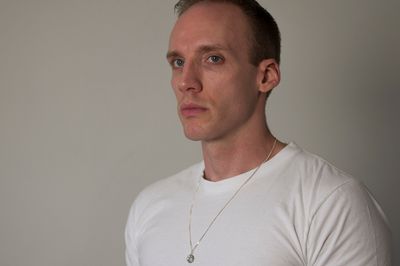
Jean-Paul Kelly. Courtesy the artist and Delfina Foundation, London.
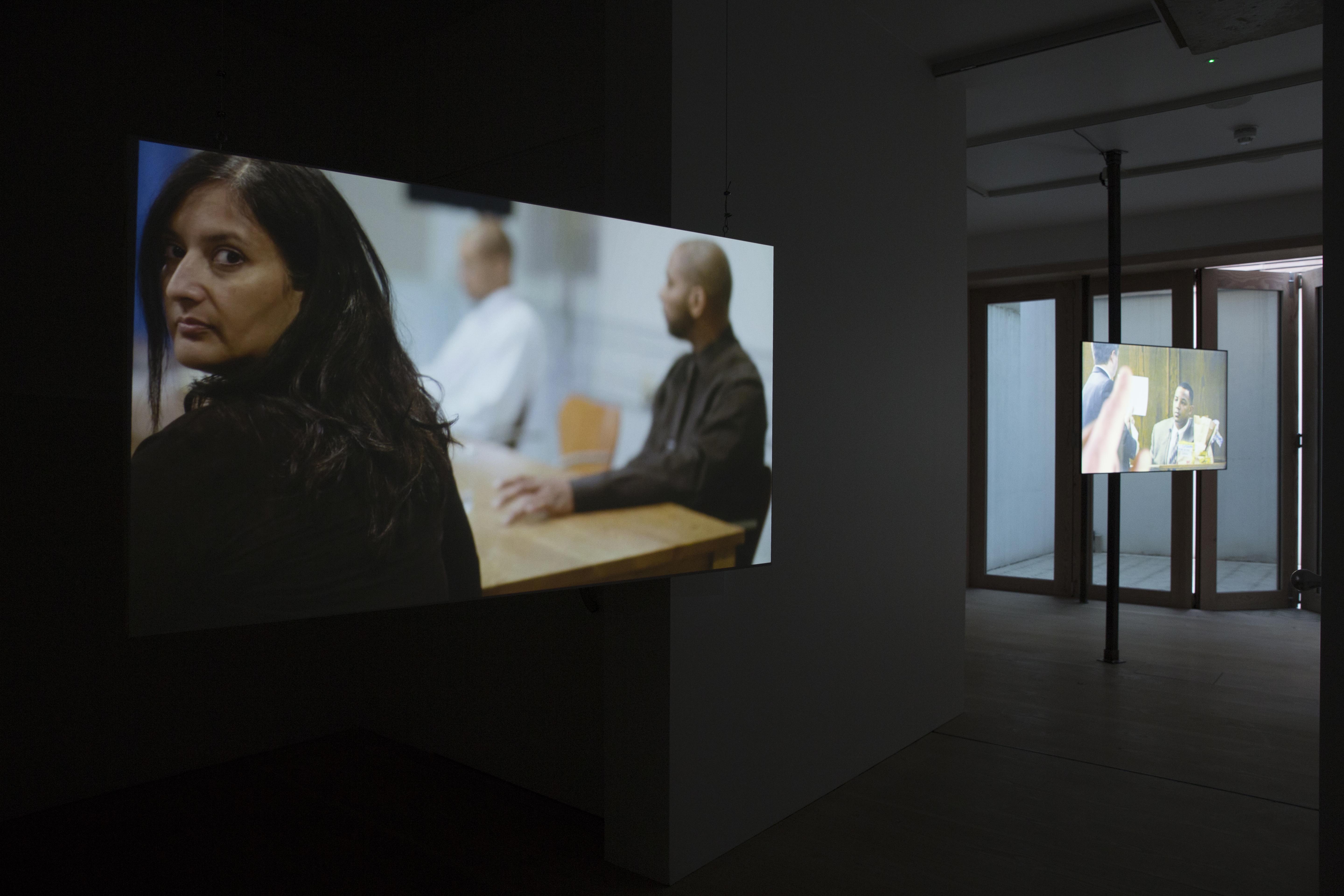
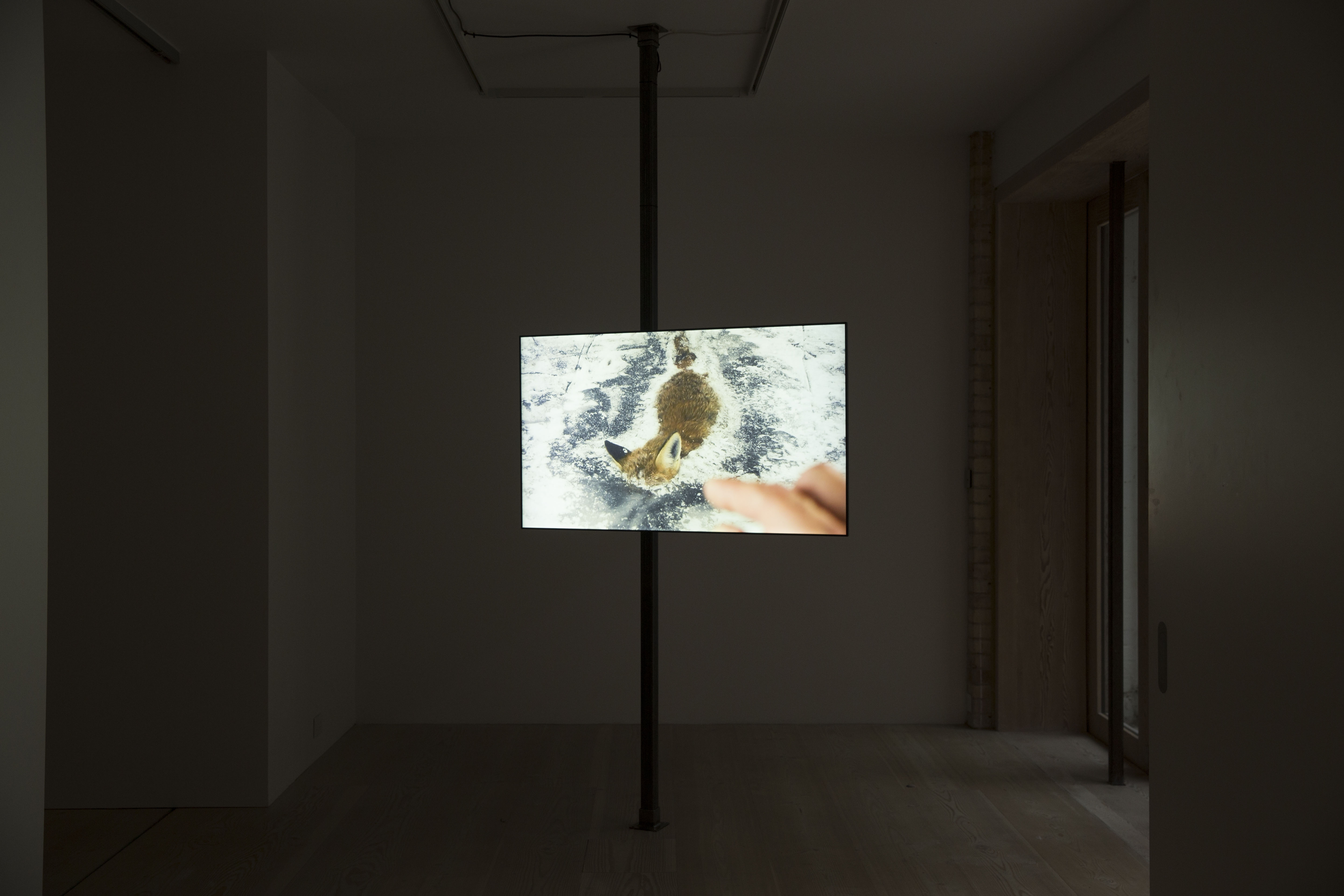
Canadian artist Jean-Paul Kelly’s primary concern is the relationship images have to both our objective and subjective world, as expressed in video works that combine the use of found images, videos and sounds taken from various sources—Hollywood, art history, and documentary filmmaking included. At the heart of this investigation is the instability of truth in the mechanisms of representation; that is, the disconnect between that which we see—and are shown—and what is actually represented. His most recent exhibition at London’s Delfina Foundation, That ends that matter (29 September — 12 November 2016) is exemplary of this approach: an eight-minute, three-channel video installation that re-constructs the courtroom hearings Kelly attended at the City of London Magistrates’ Court during the winter of 2015 during his residence at the foundation. To produce the work, Kelly used the fact that the UK’s Criminal Justice Act forbids all recording and sketching in the UK’s courtrooms, relying on his notes to reconstruct a subjective recollection of what he saw. The format builds on the artist’s overall interest in formal art history, and in particular, the history of geometric abstraction, and various other forms of representation, from documentary image making to film production.
SB: Your Delfina Foundation exhibition,That ends that matter, presents an eight-minute, three-channel video installation that re-constructs the courtroom hearings you attended at the City of London Magistrates’ Court during the winter of 2015. As an artist, you used the fact that the UK’s Criminal Justice Act forbids all recording and sketching in court as a way to create a method by which you would record your experiences. You made notes, and then used these notes as a basis upon which you would produce That ends that matter.
What led you to this process? Why did you choose to attend the Magistrates’ Court in the first place, and how did you go about choosing the one courtroom you decided to follow?
JPK: I had been working on another project, The Innocents (2014), that addressed the ‘poetic reporting’ possibilities of documentary and had been following the News of the World phone-hacking trials, with special interest in depictions of Rebekah Brooks in court. The courtroom drawings of Brooks were so wildly different; the illustrators seemed so dramatically dissimilar in their depictions of her—the only consistency in these interpretations was her hair. I was interested in these discrepancies and soon discovered the law of contempt that prevents any representation being made in court. The idea of journalists dashing out of court with only notes and memory to guide an ‘objective’ retelling of an event was fascinating. Of course, this is no different from the systems of selection and aesthetic convention with which any image is made, but here there can be no muting of authorship to the service of some sort of ill-conceived objectivity that touches journalism and documentary. I mean, all photographs and courtroom drawings that appear in papers or in online news streams are always supported by contextualising didactic text; remove that text and the persistence of an abstracting subjectivity emerges to the surface.
I chose the City of London Magistrates’ Court as it is the place where all criminal proceedings start. Initially I had intended to follow one major case, nothing violent, but rather something that involved an ‘ethical breach’, an error or folly that any of us could make. However, because of the duration of cases from arrangement to indictment, I needed a limit to guide the process; concentrating on the proceedings in one courtroom was more effective toward what I was really interested in; that is, an institutional study. Due to its geographic location in the city, City of London Magistrates’ Court sees a broad range of crimes, from petty crimes to more major offenses of embezzlement and fraud. It services a diverse public, and given that magistrates are part of that ‘common’ public—they do not have to be legally trained and are selected from the public to reflect the diversity of their needs—I was interested in participating as an observer of this field of ‘open justice’.
SB: In turn, could you talk about the way in which you reconstructed your experience visually, through the composition of the work you produced for your Delfina Foundation exhibition? These were, as the statement for the work describes: ‘photographic material from online image streams used to retell the sensed experience of those events; and a visual music animation where geometric shapes copied from these re-enactments are drawn directly onto the optical soundtrack of 16mm film to produce a score’. Could you elaborate?
JPK: From my notes and recollections from court I returned to Delfina to make illustrations most nights after visiting court. However, I found this almost ‘photo-conceptualist’ action to be too didactic, too ‘on-the-nose’, and well, though it was nice to draw and I was pleased with the drawings, far too un-compelling. The process seemed too divorced from the emotional, intellectual, and sensed-based reactions that I was having to watch in the proceedings; in a sense, the ‘directness’ of the drawings felt too contrived. When I returned to Toronto I began to use my notes as a source for further writing about these events, but again, this ‘direct’ connection to a documentary ‘source’ seemed not to fulfil the depth of what I had observed in court: its fairness and unfairness; the aid of justice to the vulnerable, and the demeaning of individuals to the requirements of case-law; my own sense of empathy or affinity or my biases and prejudices. I was particularly interested in the moments in court when defendants, magistrates, and other court functionaries would look back at me. I was often the only person in court and my presence was often at question. I was interested in the privilege of my position in the room, especially through my vision and its contradictions with the sight of others.
That ends that matter takes this inquiry into sight as a central theme. The three channels are mediated by the optics of looking. One channel is a staged re-enactment of events with actors. In this video the courtroom is stripped of its specifics and could be any institutional setting where people await judgement—it could be family court or an ethics hearing at university. Here, the waiting is elaborated by a soundtrack of ‘white-noise’. In court, the magistrates will use this static noise as a form of ‘sound masking’; if they want to speak privately without taking a full recess, they will often flip a switch and the entire room is deadened by this ‘equalising’ sound. I’ve asked the actors featured in the work to mimic the ‘looks’ that I was getting in court; when they look directly into the camera, back at us, this confrontation tends to bend the anxiousness of the video in another direction.
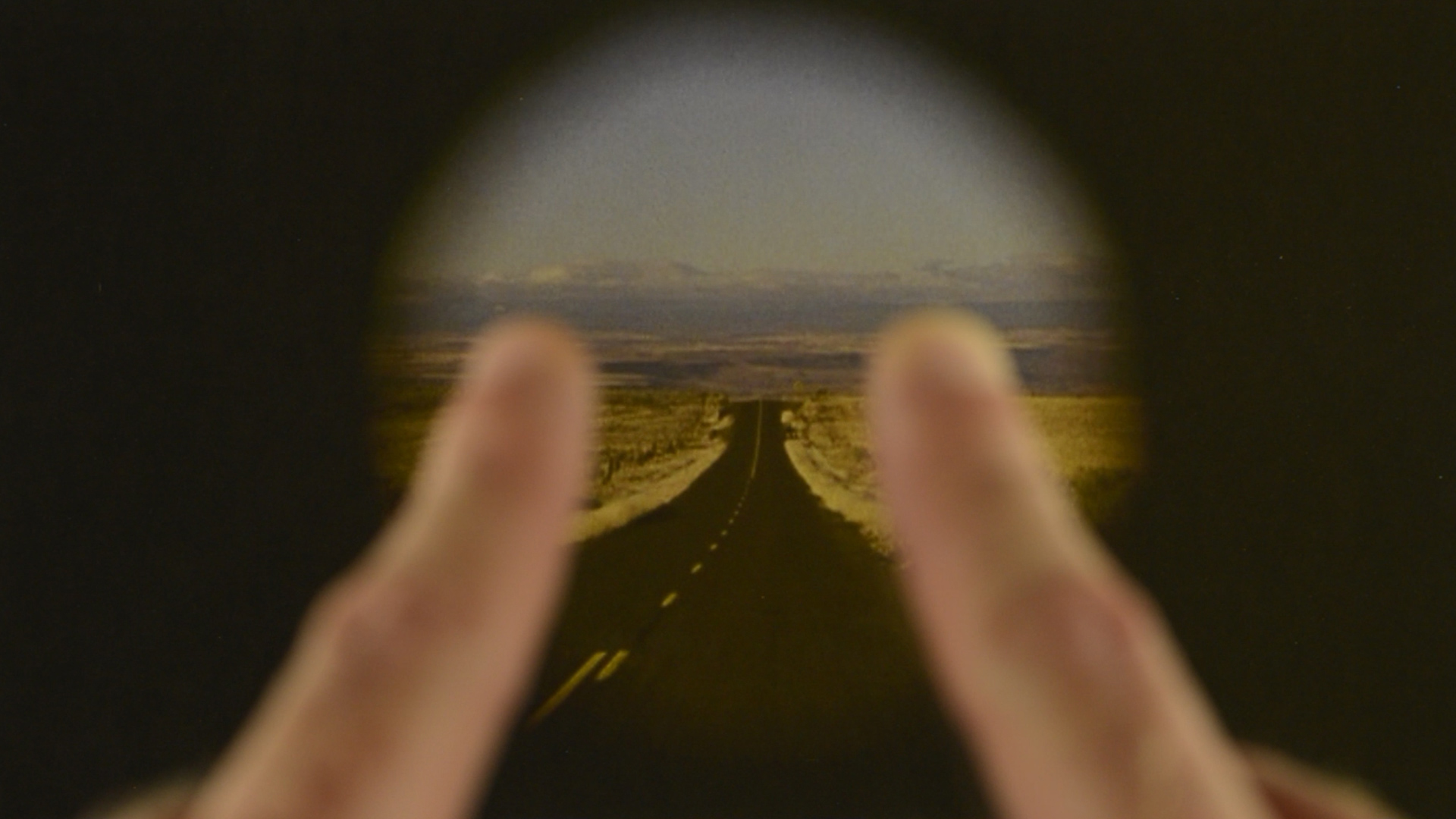
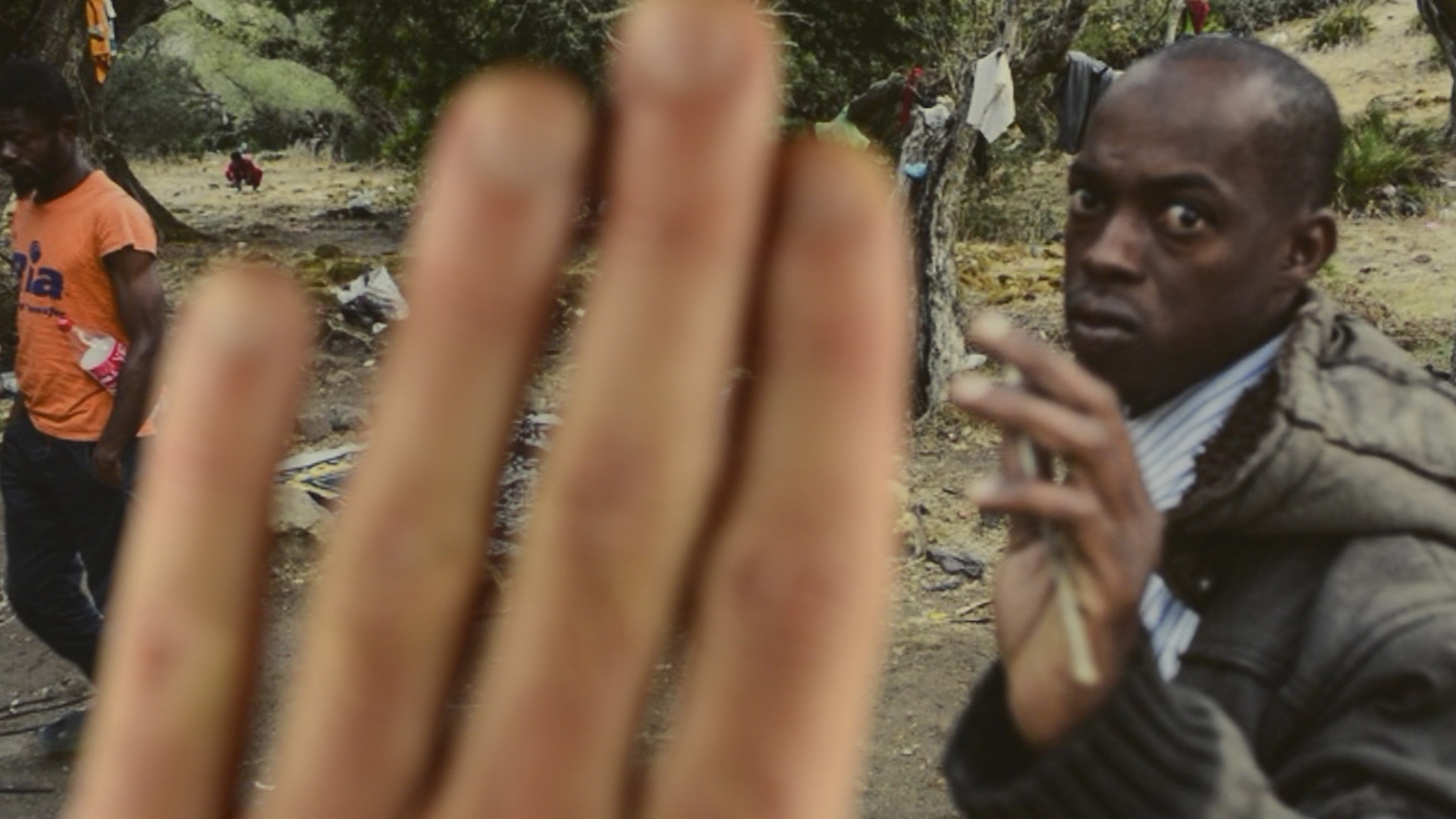
The other two channels of the works are further translations of my experiences through more abstract means. I have been interested in how online image streams—Google Images, Getty Images, or more personal micro-blogging or social-media websites such as Tumblr—allow for the production of image-based narratives that internalise the subjectivities of the user through their selection. Just as every image of photojournalism is informed and mediated by aesthetic and editorial systems, our choices, our ‘curatorial’ decisions, our individual proclivities in online image presentation, are in constant contact with those of others, including those more formalised systems of image deployment and reception. As I could not make a lens-based indexical representation in court, I wanted to see if I could narrate my experience in court—my sense of fairness or my partiality—through other images that I found online. In the video my hand marks gestural reactions onto these images.
The final channel of video features an abstract, non-objective animation that features regular shapes that track each of the movements of my hand over these found photographs. In 16mm or 35mm film, any shape reproduced in the optical soundtrack produces a specific sound. In the gallery, the noises that you hear are the shapes that you see on screen. They are an indexical mark. With a legal process that denies the indexical residue of the events in court, these sounds, through the peripatetic translation of my senses, become a sort of courtroom sketch.
SB: I wanted to talk about the installation of the three-channel video installation within the Delfina space: with curtains that resemble courtroom curtains in colour and weight, hung between the gallery and the outdoor courtyard, with small peep holes cut out of the fabric. As you have stated, this further echoes the themes of surveillance and abstraction that are inherent in the exhibition. But in this context, the surveillance is coming from you, the artist, rather than the state as such—the gaze has been turned on state apparatus itself. Is that correct?
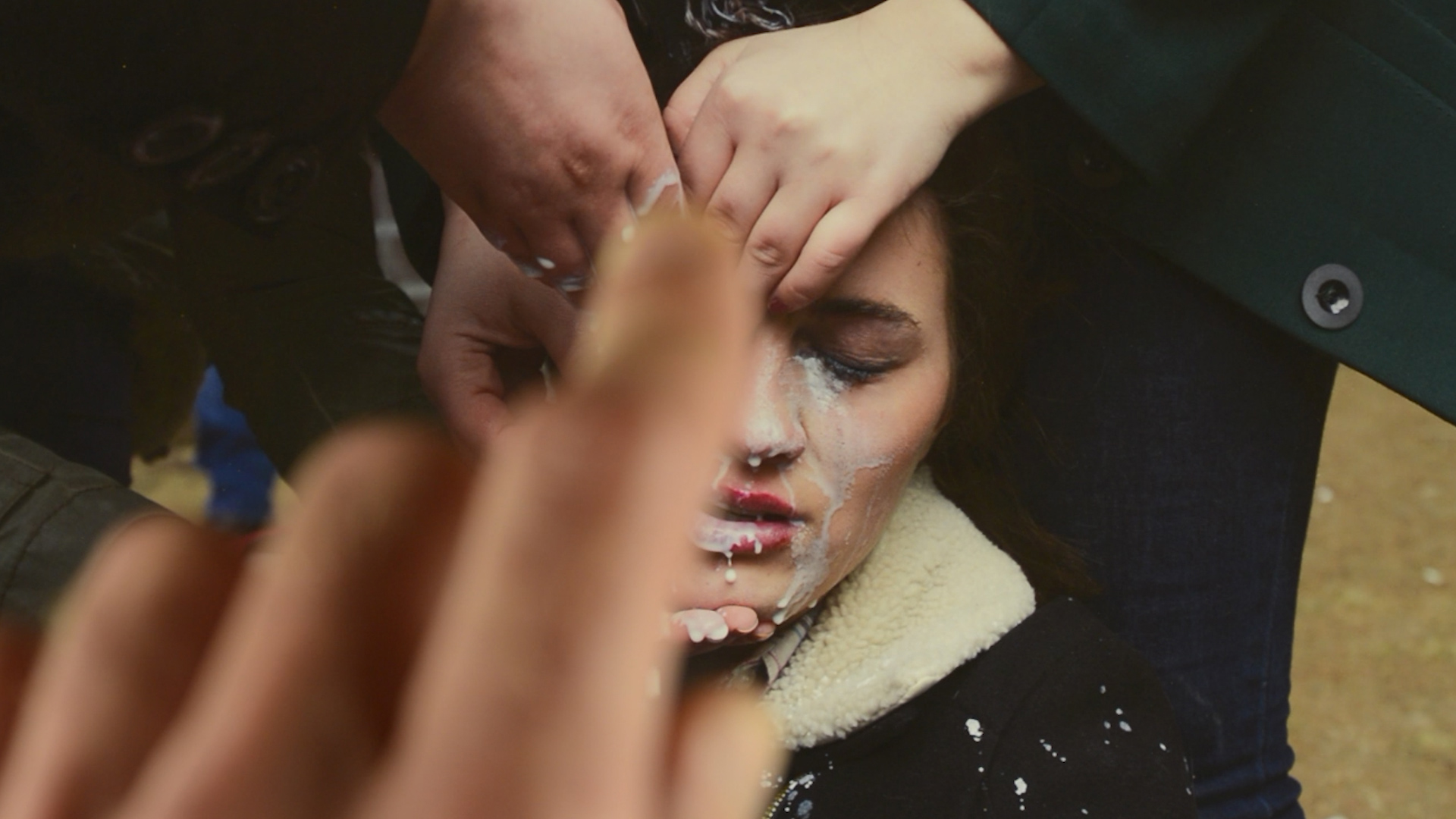
JPK: Yes. This is a consistent theme throughout the exhibition. Various forms of ‘looking’ are featured in the videos; both the confrontation of the actors’ gaze and the tracing of the movements of the hand through its abstract pairing activate an awareness of visual consumption. The assembled narrative of the appropriated photographs is directly based on questions surrounding authoritative and state-run control of sight: beginning from a passage of photographs linked to queer looking, that is, ‘cruising’ as an act that has developed its codes from the surveillance, policing, and subjugation of queer desire; to a section of photographs that explore sight as ‘proof’ or ‘evidence’; to images of people protecting their anonymity from the camera in court or entering court; to connected photographs where people pour milk into the eyes of others whom have been blinded by tear gas or pepper spray during large social protests, opening their eyes and allying themselves to counter the violent actions of state apparatuses; and finally in a segment where the look ‘turns back’—where I’ve selected images of people looking into the camera, confronting our systems of representation, reproduction, and image deployment with a sort of ‘defamiliarising’ directness.
SB: You mentioned that the primary goal of your work in general ‘is producing a fair account’ of your ‘experience of the world’. Your inquiry, you state, is ‘not related to redundant claims of indexical truth but rather to the repositioning of artifice, desire, and bias as the material source for realising the form of the work’. To this end, you see _That ends that matter _as ‘an attempt to document a certain form of subjective sense’.
Could you explain how this project sits in the wider framework of your practice in general? I ask this question thinking about certain connecting threads that run throughout your practice, predicated as it is on ingesting and regurgitating in abstracted, decontextualised form, the images that surround you. In The Innocents, for instance, you cut holes out of each image that is presented on a wooden surface as part of the film, accompanied by the music of the Quincy Jones theme song to the film version of Truman Capote’s_In Cold Blood_, which in turn recalls the holes you cut out of the curtain for That ends that matter at Delfina.
JPK: My work primarily involves asking questions about and around documentary and its deployment as a system of representational practices that rest upon codes of ethics. I am interested in analysing the aestheticisation and formalisations of affect in images and sound, especially in those instances where the construction of an image is muted by its emotional register. In The Innocents, I have an actor re-enact Truman Capote’s movements in a Maysles brother’s documentary from 1966; in these passages, Capote speaks of his aesthetic process and what he sees as the essential key to revealing the appropriate formal construction of a representation, that is, making oneself ‘completely cold’ to one’s emotions in order to reproduce them. This clinical vision of reporting is in many ways a horrific way of looking back at images, abstracting them, testing their structure, and seeing what remains from these operations. Holes are one of a series of visual strategies that are meant to both metaphorically and physically attest to this process; as they are both a tool for looking ‘through’ what has been removed to what is behind or beneath and calling attention to surface and structure through the isolation of what remains. In many ways in the new work, it is a retinal allegory—the eyes that confronted me in court were both an access point to another’s subjectivity and a laying-bare of my privilege through the same portal. This is traced throughout the videos and the curtain with the double reading of its interior and exterior sides.
SB: There is a formal logic that underpins your practice; _Figure-Ground _ (2013), for instance, presents hand painted scenes taken from photographic sources that are each associated with ‘a death associated—tangentially or directly—with financial crisis’, from the suicide of Bernie Madoff’s son to the murder of Trayvon Martin. You remove the bodies from the scene, however, and replace them with coloured squares and audio tones.
JPK: The composition recalls the early film works by Hans Richter, and the early avant-garde’s relationship to geometric abstraction and formal shapes, though it actually makes specific reference to early animators (and visual musicians) Oskar Fischinger, Norman McLaren and Mary Ellen Bute, whose work engaged in the discourses of abstraction, and who also influenced_The Innocents _ (in particular, Fischinger’s circles and squares).
The politics of _Figure-Ground _seems to point to the inherent violence encoded into the history of formal abstraction, and the obfuscation of actual content through the distillation and reduction of form, which seems to be a central concept that has directed your practice. Is that correct?
Actually it is quite the inverse of this; my concern is rather that there is an inherent violence encoded in the history of lens-based documentary and my artistic inquiry features an activation of formal abstraction as a means of elaborating not only the essential artifices of documentary, which we all know, but also to encourage a more productive, challenging, and less reductively sanguine reaction to the imagery that pervades our lives. I want to engage in a re-evaluation of neo-liberal ethical codes that call for naturalised humanist agreement and diminish the role of capitalist structures in establishing forms of ‘human rights’; and I think that the contradictions between documentary and its animation as form is a fertile ground to have this conversation.
SB: Do you remember the moment you understood that you wanted to be an artist?
JPK: My parents are both artists; it’s just what I’ve always known and I’d never thought of anything else. Except for short phases of wanting to be Dolly Parton when I was 6 and Gordon Gekko from _Wall Street _when I was 10.
But, one of the most instrumental moments I can recall was some advice my mother gave me when I was very young. I was 6 or 7 or so and had been drawing images of naked women and men, to sort of impress my friends; at an early age I could render quite well, as my parents had guided me through proportions and anatomy and it was all I ever wanted to do. These drawings weren’t exactly proportionate though: the figures were unusually well-endowed with really impossible dimensions based on some ideal comic-book-like vision of voluptuous women and brawny muscle men. While asking my mother for assistance with the proportions on one particularly vexing passage of a drawing, I asked her if it was alright to draw people having sex, she said that that was fine but that every artist must be responsible for the images that they put into the world. Of course, I didn’t have the language around the weight of that statement immediately but I did understand that the act of making was not only about the pleasures of form. —[O]
‘That ends that matter’: an installation by Jean-Paul Kelly at Delfina Foundation is open until 12 November 2016.
@DelfinaFdn
http://delfinafoundation.com/
Main image: Jean-Paul Kelly. Courtesy the artist and Delfina Foundation, London.

A respected voice in contemporary art discourse.
Focusing on ambitious storytelling and insightful art-world commentary. Ocula Magazine publishes in-depth interviews, critical essays and timely analysis on the artists, exhibitions and ideas driving the global art world.
Learn more about Ocula Magazine
Showcasing the best of the art world.
Ocula partners with galleries from around the world to highlight their artists, artworks and exhibitions. Gallery membership is by application and invitation, with each member vetted by an independent panel.
Learn more about Ocula Membership
Specialises in the sale of major artworks.
Led by a team with deep ties to the world’s leading auction houses, galleries and collectors. Ocula’s advisory team offers bespoke services to high-net-worth clients from around the world who are looking to acquire the best of contemporary and modern art.
Learn more about our team and services