





The art world in focus
Subscribe to our newsletter for news and insights on artists, galleries and exhibitions.

Christopher Samuel, The Archive of an Unseen (2022). Exhibition view: Towards New Worlds, MIMA, Middlesbrough (19 July 2024–9 February 2025). Courtesy MIMA. Photo: Rachel Deakin.
The northern English town of Middlesbrough opens up new worlds of possibility with a show that celebrates the richness in diversity with works by disabled, D/deaf, and neurodivergent artists.
‘For too long,’ Aidan Moesby commented in a recent interview, ‘art by disabled artists has been underrepresented in traditional institutional art spaces.’ Moesby is a disabled artist and curator of Towards New Worlds, a major exhibition that recently opened at Middlesbrough Institute of Modern Art (MIMA), which seeks to move beyond existing art-world narratives around disability. With work by 15 artists, Towards New Worlds is believed to be the largest U.K. exhibition of work by practitioners who are disabled, D/deaf, and/or neurodivergent.

The exhibition has developed out of a long relationship. In 2019–20, Moesby was an associate curator with MIMA as part of the Future Curators Programme run by DASH Arts. At the media preview, he spoke of MIMA’s ‘commitment to change’ in contrast to a ‘tick-box approach to diversity’. For visitors, this is evident in several ways, from the thoughtful selection of artists to the sensitive framing of their work.
“. . . it should not always fall to marginalised artists to lead the resistance . . .
Moesby spoke repeatedly of the exhibition’s ‘gentlenesss’ and, while this means audiences must look elsewhere for more viscerally assertive works by participating artists—such as RA Walden’s Notes from the Underlands (2019) or Jade de Montserrat’s Cage (2015)—it is also important to acknowledge that it should not always fall to marginalised artists to lead the resistance against the causes of marginalisation.

The exhibition eschews a single overarching framework in favour of a tissue of connections. Ecology features prominently as bodies and places leak into one another, especially in two of the exhibition’s three new commissions: Małgorzata Dawidek’s The Other Shore (2024), consisting of photographs and archival maps, which connect potassium deficiency in her body with the potash mined in Poland and northern England, and Sam Metz’s sculptural work Instability (2024), which explores histories of clay as ballast, industrial pollution of the River Tees, and stimming—a repeated bodily movement that can help regulate mood.

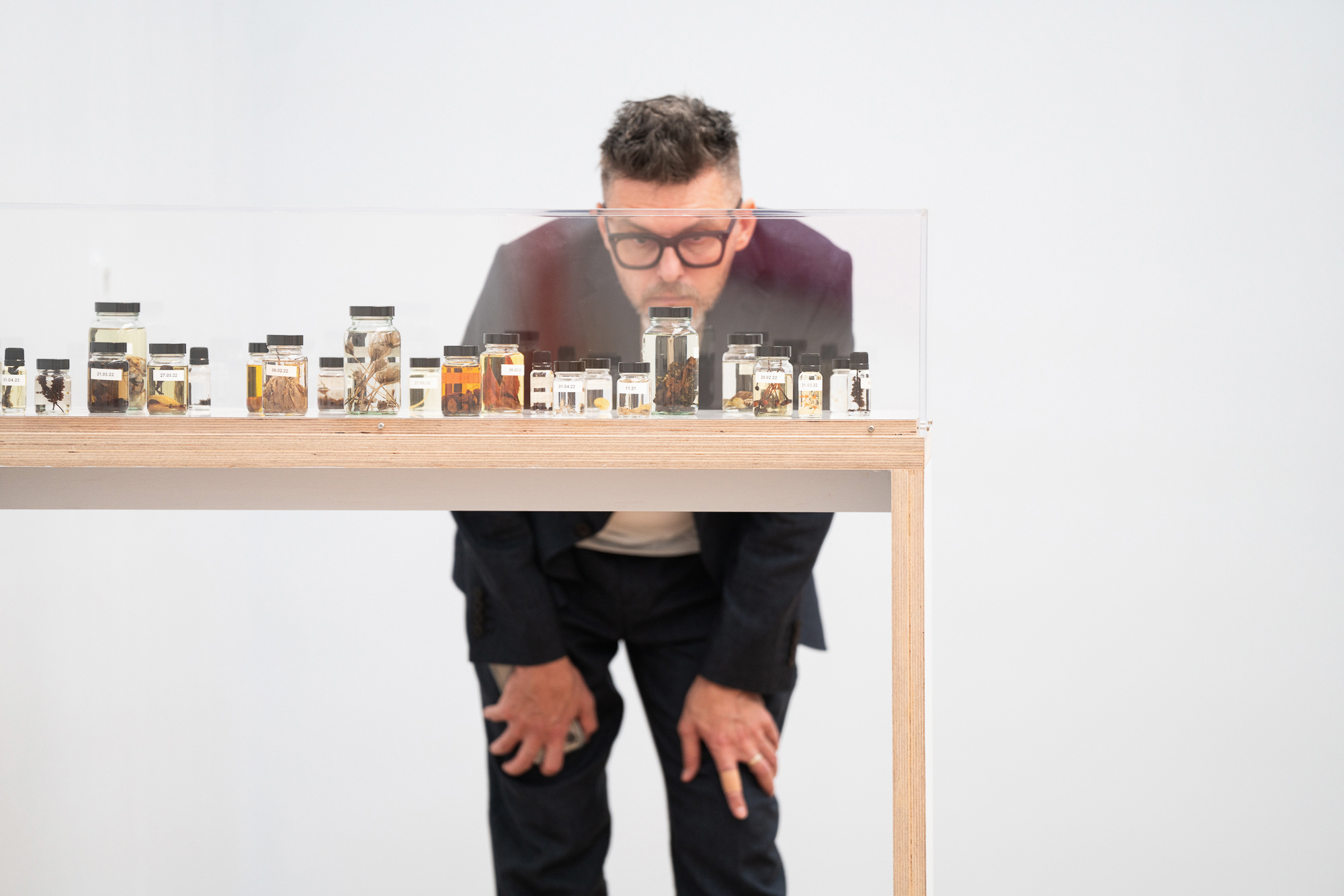
In her short film Misshapen States (2021–22), Molly Martin seeks to evoke the sensation of an epileptic seizure by performing a series of tense, shivering actions in a river in winter. Meanwhile, Walden’s quietly brilliant Crip Ecologies (2018–ongoing) consists of a series of objects, such as leaves and snail shells, preserved in glass vials and date labelled. Precisely re-appropriating the collecting strategies of nineteenth-century naturalists, which boasted of colonialism’s global reach, Walden’s work speaks instead to the limited access to the natural world experienced by disabled bodies.
Unsurprisingly, the medical profession looms large. Carrie Ravenscroft’s psychedelic, narrative-laden paintings—Sugarcoated Feminine Rage (2024)—skewer the gendered nature of a male-dominated profession that frequently minimises or ignores women’s testimonies of pain. In Jenni-Juulia Wallinheimo-Heimonen’s absurdist film about a woman with arthritis, Reflector of Living Will (2018), the young carer is a callous figure, and it is only through a reprogrammed robot that something approaching genuine care emerges.
![Sam Metz, Instability (2024) [centre]. Exhibition view: Towards New Worlds, MIMA, Middlesbrough (19 July 2024–9 February 2025).](https://files.ocula.com/anzax/Content/Features/2024/MIMA%20Towards%20New%20Worlds/MIMATNW-49.jpg)
Christopher Samuel crystallises the dilemmas of engaging with the medical profession most effectively. His episodic video installation, The Archive of an Unseen (2022), centres the artist’s recollections of growing up as a Black working-class boy with Charcot-Marie-Tooth disease, a group of nerve conditions that can cause progressive muscular weakness in arms and legs.
“The only time I ever felt seen or important was when I attended hospital appointments
Facing the viewer head-on, Samuel recalls the struggle to have his condition diagnosed, and the stigma he experienced upon diagnosis. His testimony evokes both the invisibility and hypervisibility faced by subjects of the medical gaze: ‘The only time I ever felt seen or important was when I attended hospital appointments,’ he recalls in the film.
![Seo Hye Lee, [sound of subtitles] (2021) (still). Single-channel video, colour, silent. 1 min, 38 sec (looped). Footage](https://files.ocula.com/anzax/Content/Features/2024/MIMA%20Towards%20New%20Worlds/Seo-Hye-Lee-sound-of-subtitles-2021-Single-channel-video-colour-silent-1-min-38-sec-looped1web.jpg)
In controlling his own testimony, Samuels touches upon a third key thread in the exhibition: language. Leah Clements’ film Collapse (2019) presents multiple, overlapping, yet very different accounts from people with narcolepsy, while in its elegant simplicity, Seo Hye Lee’s single-channel looped film [sound of subtitles] (2021) is one of the exhibition’s highlights. The work shows archival footage of hands moulding clay at a pottery wheel. Each segment is shown in triplicate with different subtitled descriptions: to the left, the action on screen; to the right, conventional audio descriptions; and, in the centre, more emotional or suggestive descriptions, such as ‘sound of shaping context’ or ‘sound of worlds colliding’.
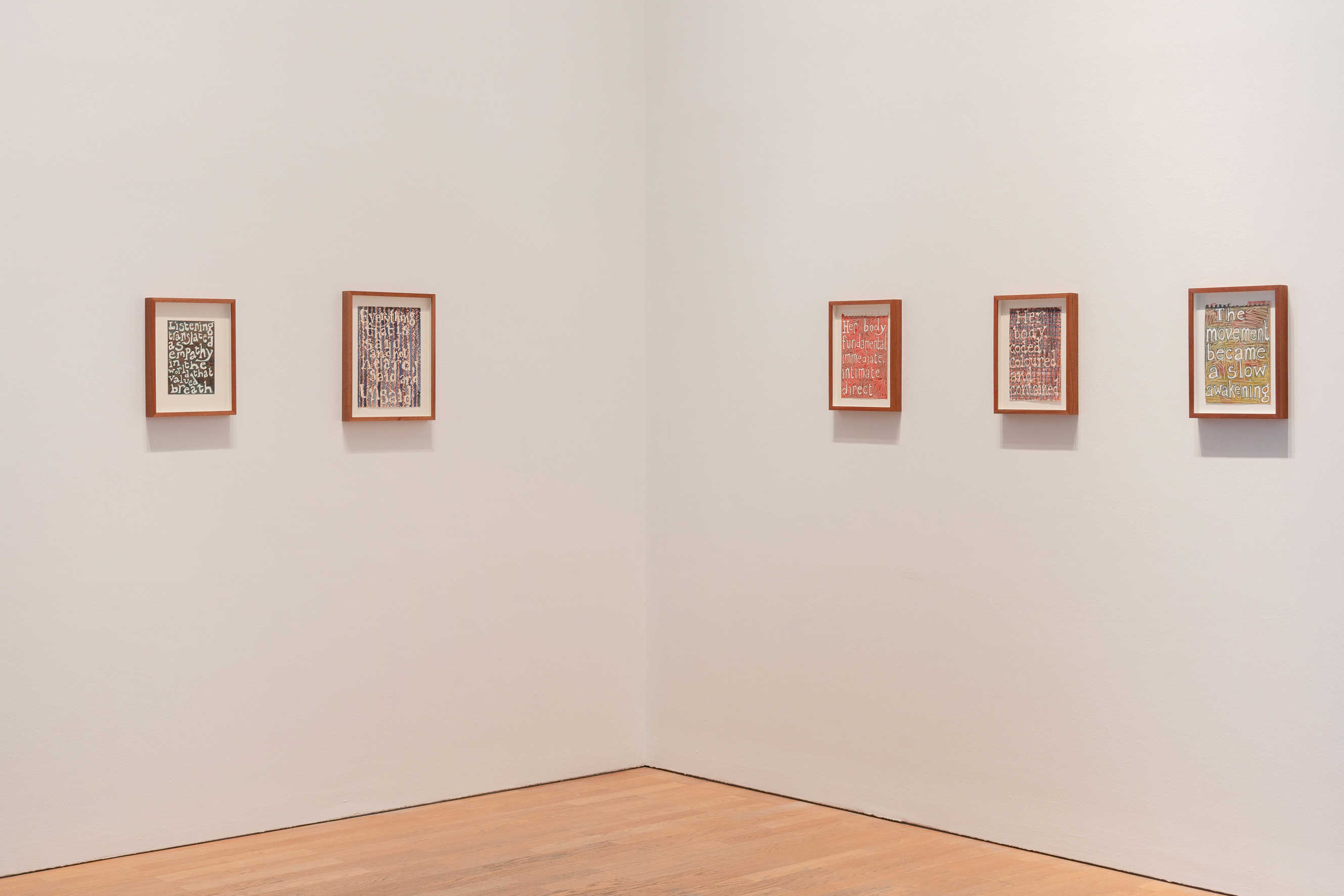
Elsewhere, Jade de Montserrat’s text works, such as Listening translated as empathy in the world that valued breath (2021) incorporate the title phrases against highly worked watercolour backgrounds to speak to questions of race, gender, and language. While Samuel shows the importance of being listened to, heard, and understood, de Montserrat suggests the right to opacity, to speak words whose meaning might shift over time, require work to untangle, or resist the drive for transparency.
Nearly a quarter of the U.K. population is disabled, with able-bodiedness only ever a temporary condition for most people. Yet, it took the Covid-19 pandemic for many to start listening to what disabled artists and activists have been saying for years. In its engagement with multiple intersecting identities, Towards New Worlds never asks artists to speak on behalf of or ‘represent’ a community. Instead, the exhibition not only addresses but embodies, in multiple senses, its rigorous engagement with questions of justice, ecology, community, and care. —[O]
A respected voice in contemporary art discourse.
Focusing on ambitious storytelling and insightful art-world commentary. Ocula Magazine publishes in-depth interviews, critical essays and timely analysis on the artists, exhibitions and ideas driving the global art world.
Learn more about Ocula Magazine
Showcasing the best of the art world.
Ocula partners with galleries from around the world to highlight their artists, artworks and exhibitions. Gallery membership is by application and invitation, with each member vetted by an independent panel.
Learn more about Ocula Membership
Specialises in the sale of major artworks.
Led by a team with deep ties to the world’s leading auction houses, galleries and collectors. Ocula’s advisory team offers bespoke services to high-net-worth clients from around the world who are looking to acquire the best of contemporary and modern art.
Learn more about our team and services
