



EMILY KAM KNGWARRAY
1914-1996, AustraliaAboriginal and Torres Strait Islander readers are advised that this profile contains the name of a person who has passed away.
Emily Kam Kngwarray (also spelled Emily Kame Kngwarreye) only began painting late in life but became one of Australia’s most celebrated artists. Her abstract works drew inspiration and creativity from the Indigenous philosophy the Dreaming, which focuses on the relationships between the land and those inhabiting it.
Early Years
Emily Kam Kngwarray was born in around 1910 on Alhalker Country in Australia’s Northern Territory into the Anmatyerr community. By the late 1930s, the land had been appropriated by white cattle ranchers and the 2,000-square-kilometre area renamed Utopia. Emily Kam Kngwarray worked at Utopia, looking after animals, cooking food and providing childcare for settlers. Her personal name was Kam, referring to the seeds and pods of the yam, but it is likely that the settlers gave her the name Emily. She worked in batik in the 1970s, but in the late 1980s, canvases were delivered to Utopia and—aged around 78—Emily Kam Kngwarray began painting in acrylics.
Emily Kam Kngwarray: Artworks
Emily Kam Kngwarray’s artistic practice was rooted in the beliefs of the Anmatyerr community and the wider Indigenous philosophy, the Dreaming, a framework that explains and structures the way communities, ancestors, spirits and the land co-exist. She became an elder in the community and played roles in ceremonial traditions that included painting bodies with natural materials including ochre and charcoal.
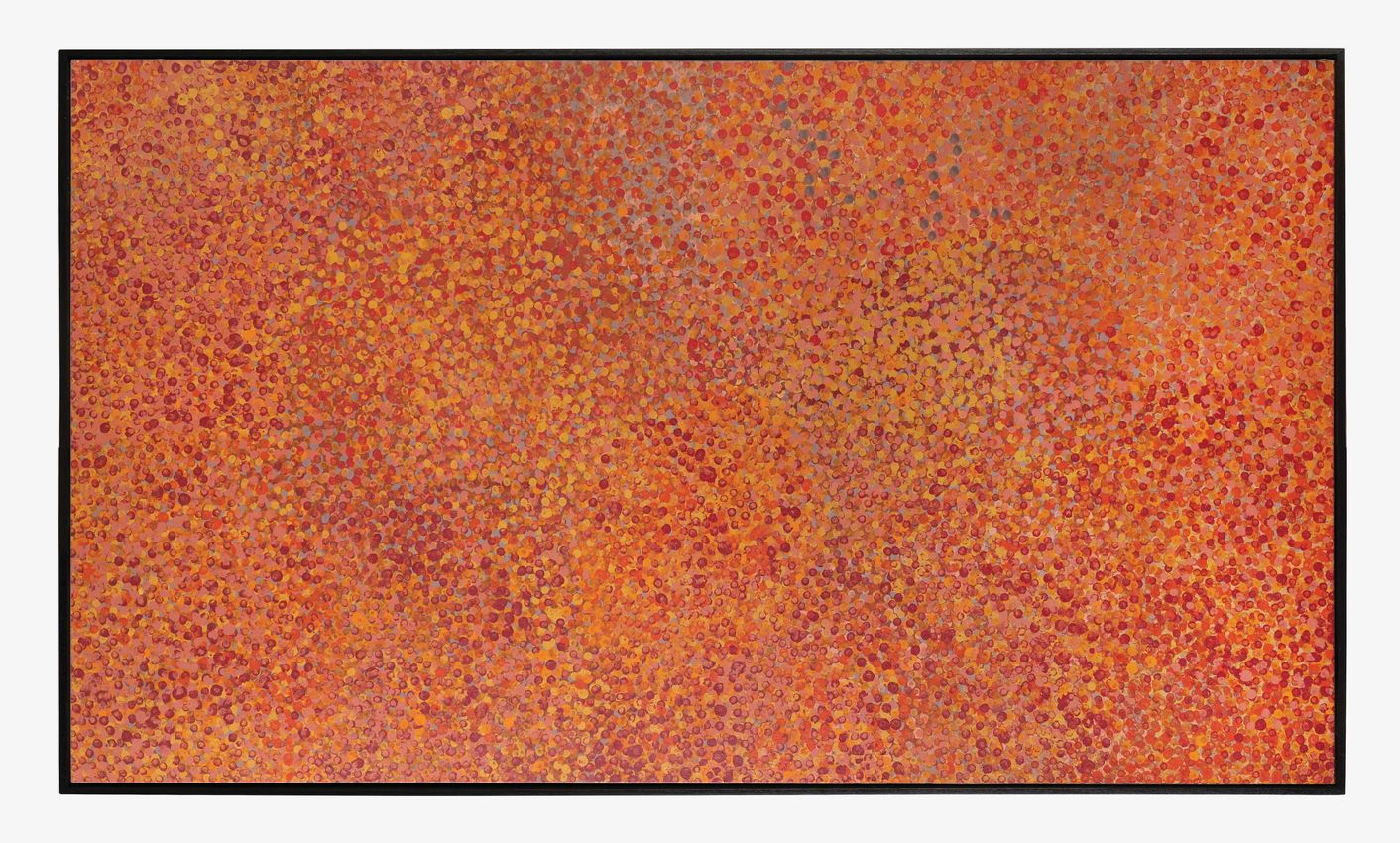
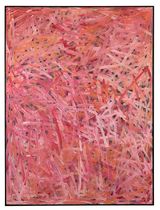
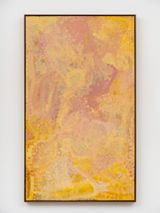
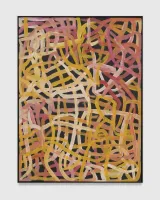
Kngwarray’s art allows viewers to glimpse the remote landscapes where she lived and also to understand more about transgenerational knowledge and stories. Her layered acrylic on canvas works included landscape elements such as seeds, lizards, emus and vines. She began painting in dots, which grew in stature. She later filled her canvases with stripes, lines and finally, abstract blocks that continued to represent the spirituality of the land.
- Emu Woman (1988), Emily Kam Kngwarray’s first painting, depicted the rib cage of the emu, a significant inhabitant of Alhalker country. She used dots and lines of acrylic on canvas in earthy tones of ochre, red-brown, white and black.
- Kngwarray made Ntang Dreaming (1989), with her fingers. The work is all about the landscape after the rain and the ntang plant, whose seeds are crushed to make colourful body paint. After its exhibition in Sydney in 1989, the painting was acquired by the National Gallery of Australia.
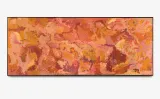
- 1994’s Untitled clearly demonstrates Kngwarray’s interest in stripe motifs. Bold lines of red-brown and orange-yellow cut across the canvas horizontally.
Emily Kam Kngwarray: Select Exhibitions
Select Solo Exhibitions
- Emily Kam Kngwarray: The Turning Season, Pace, New York City (2026)
- Emily Kam Kngwarray: My Country, Pace, London (2025)
- Emily Kam Kngwarray, Tate Modern (2025)
- The Hicks Collection: Emily Kam Kngwarray, D Lan, New York City (2024)
- Emily: Desert Painter, Gagosian, Paris (2023)
- Emily Kam Kngwarray, National Gallery of Australia, Canberra (2023)
- Emily Kam Kngwarray,Rebecca Hossack Gallery, London (1996)
- Emily Kam Kngwarray, Utopia Art, Sydney (1990)
Select Group Exhibitions
- 56th Venice Biennale (2015)
- Alhalkere, Paintings from Utopia, National Gallery of Australia (1999) (and touring)
- 47th Venice Biennale (1997)
- Aboriginal Art: The Continuing Tradition, National Gallery of Australia (1989)
Further Reading
- 2025 profile and exhibition review from Ocula
- Artist profile at Unit London
- 2026 article from the Sydney Morning Herald
- Artist profile page at D Lan Galleries
Emily Kam Kngwarray FAQs
How was Emily Kam Kngwarray discovered?
During the Australian bicentennial in 1988, gallerist Christopher Hodges was horrified to see no Indigenous representation and thought it was time he should redress this balance in the art world. He persuaded James Mollison, the founding director of the Australian National Gallery (later to become the National Gallery of Australia), to accompany him to Alice Springs—Mollison bought the third painting Kngwarray ever made. She was, Mollison said, “one of the finest abstract expressionists” he had ever encountered.
How many paintings did Emily Kam Kngwarray make?
During the eight years she painted, until her death in 1996, Kngwarray made almost 3,000 paintings—around one work every day.
How significant was Emily Kam Kngwarray in putting Indigenous art on the map in Australia?
Andew Bailey, author of Emily: Emily Kame Kngwarreye, the artist who changed Australia (2026) argues in the book that the art world’s recognition of Kngwarray’s work sparked the modern First Nations art movement and that her pieces were correctly perceived as abstract art that should be viewed in galleries. “She changed the art world so much, both Indigenous and mainstream,” Bailey said to the Sydney Morning Herald in 2026, “and then became a catalyst for profound national cultural change as well.”
What is Emily Kam Kngwarray’s most famous work?
Perhaps her most significant piece, bringing together the spiritual and the physical, is her 1995 painting Anwerlarr Anganenty (Big Yam Dreaming). Measuring around 8 metres x 3 metres, the painting is a continuous white line, which swirls around the canvas. The line is reminiscent of her early batik work, but also awely, women’s ceremonial body paint, and the lines in the Earth where yams break through.
Ocula















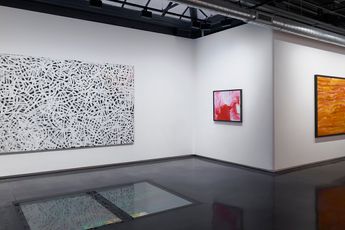
Explore Emily Kam Kngwarray's Exhibitions











Explore and Follow Artists Shaping Contemporary Art
A respected voice in contemporary art discourse.
Focusing on ambitious storytelling and insightful art-world commentary. Ocula Magazine publishes in-depth interviews, critical essays and timely analysis on the artists, exhibitions and ideas driving the global art world.
Learn more about Ocula Magazine
Showcasing the best of the art world.
Ocula partners with galleries from around the world to highlight their artists, artworks and exhibitions. Gallery membership is by application and invitation, with each member vetted by an independent panel.
Learn more about Ocula Membership
Specialises in the sale of major artworks.
Led by a team with deep ties to the world’s leading auction houses, galleries and collectors. Ocula’s advisory team offers bespoke services to high-net-worth clients from around the world who are looking to acquire the best of contemporary and modern art.
Learn more about our team and services