
Press Release

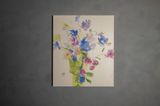
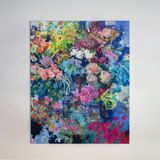
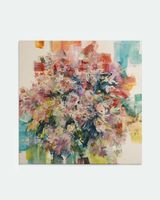
When the canvas is filled with an air of ambiguity, I feel at ease, and lay down my brush.

In the places I encounter on my travels, there are colours and shapes that belong to that landscape alone.

With time, they begin to blur. Yet together with their scents and their warmth, they remain somewhere within me.

One by one, I leave traces of them in my works.

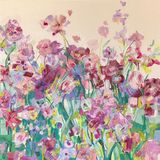
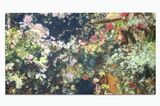
Flowers always appear.

Familiar, yet sacred, they hold within them beauty and the grotesque, sorrow and tenderness.

I place upon them something ambiguous that exists within me.

And when that ambiguity gathers and fi lls the canvas, until at last it becomes a work, I come to know myself.

The unconscious becomes conscious.

And then, once again, it fades into ambiguity.

To paint—perhaps it is my attachment, my inability to let go of the path I have travelled thus far.

Or perhaps it is something more urgent: a means of holding fast to who I really am.

- Ayane Mikagi

The Flowers of Ambiguity

Wahei Aoyama, Founder of A Lighthouse called Kanata

The rain continues to linger. And after a summer bereft of light, as the seasons quietly turn toward early autumn and the singing of bell crickets, the Nihonga painter Ayane Mikagi continues to paint—day and night. A succession of unforeseen circumstances has left her with precious little time before her second solo exhibition at Kanata. Yet from her unrelenting labour, one beautiful work after another springs into being. Enthralled, I find myself simply holding my breath.

These works I had never seen before, yet amid the vividness of their colours and the freshness of their forms, there lies a strangely familiar scent, an ambience that lingers. A nostalgia for the warmth of another human being. A faint sorrow hidden within happiness. As though wandering back and forth along that invisible threshold between joy and mourning. And as I traced these works, one by one, something began to stir within me. Not quite an emotion. Not quite a thought. Only the faintest semblance of something I had never felt before in Mikagi’s work. If I were compelled to give it a name, perhaps it would become the theme of this particular exhibition: Ambiguity.

I am told that Mikagi has long harboured a particular affection for the notion of ambiguity. I have known her for more than eleven years, yet this was something I had never heard before.

In the West, ambiguity—the state of being unresolved or uncertain—and ambivalence—the simultaneous pull of opposing emotions—often carry a faintly negative resonance. Something indecisive. Something unsettled. Something that ought, perhaps, to be resolved. Black or white. Yes or no.

The West has long sought to understand the world by separating one thing from another, by naming it, articulating it, defining it. But we Japanese are different. We know that between black and white lie infinite shades of grey. Light and shadow. Life and death. Joy and sorrow. Rather than choosing one over the other, we have, since ancient times, cherished those nameless emotions that drift somewhere along the threshold between the two. This is not indecision. It is an aesthetic sensibility that understands that what cannot be put into words need not be forced into them.

There is, after all, a beautiful Japanese word:

awai

—the space in-between.

Ambiguity is not an empty place. Quite the opposite.

It is there, perhaps, that an infinity of emotions comes into bloom.

As a child, I grew up not knowing the existence of flowers. It was suburban Chicago in the 1980s. The winters then were long and dark. And a world without flowers was also a world without colour. Neither my father nor my mother ever brought flowers home or kept them. To my young mind, flowers were simply things that bloomed in somebody else’s garden. Then the winter snows would begin to melt. A gentle spring would finally descend upon the suburban gray, and the flowers would begin to bloom. Brilliant colours emerged from what was once a monochrome world, a beacon of light to a young child like me.

Drawn toward that light, the innocence of a Japanese boy raised in the American suburbia—with little refinement, even less discipline. And it was in broad daylight that he would sneak into his neighbour’s garden to pluck one by one the beautiful flowers blooming from their vines and put them in his pockets, while devouring as many scarlet strawberries and raspberries as his mouth could hold. Needless to say, our neighbours quickly noticed that something was amiss in their garden. Their suspicions immediately fell upon the five-year-old boy who had arrived from a foreign land. Both my mother and I were thoroughly scolded. Yet I still fondly remember the beauty of those flowers I had adored as a child next door.

And if there is a painter who understands, perhaps better than anyone, both their allure and their strange enchantment, I believe it is Ayane Mikagi. For flowers are not merely beautiful. They are vessels for the countless colours of human emotion. They are like pools of still water in which the heart catches sight of itself. Transcending time and language, beyond race and religion, flowers have always remained beside us. They speak for the human soul when words cannot: in happiness and in sorrow, in celebration and farewell, mirroring even the most delicate stirrings of the human heart, encapturing the subtle movements of what we hold dear.

Even her unusual family name seems to carry a story within it: Mikagi, written with the ancient characters for “three keys.” Descended from a family entrusted with guarding the sacred treasures of the Ise Shrine, Mikagi strikes me as an uncommon painter. Gifted with an instinctive, visceral sense of colour, she nevertheless spent five years attempting to gain admission to art university before finally entering Tama Art University. Nothing came easily. Mikagi did not race effortlessly up some staircase toward success. She built herself slowly. Step by step. And then another step.

Through quiet, persistent labour and that extraordinary tenacity particular to her, the artist we know today gradually came into being. And yet, looking at her work, one senses not the slightest trace of the hardship she endured. Quite the contrary. So much of Mikagi’s work possesses an almost boundless brightness, and moreover, an affirmation of life itself. The more one comes to know the artist herself, the more perfectly this makes sense. Mikagi is extraordinarily positive. She possesses a resilience and tenacity far beyond the ordinary, and I can only bow my head before the sheer strength of her patience and unwavering spirit.

And when one looks at one of her paintings, it is as if one have been suddenly handed a beautiful bouquet of flowers by someone you truly care for. It is a warm and special feeling. Even in the deepest depths of winter, a work by Mikagi can quickly illuminate the heart, as though one had stepped into the gentleness of sunlight. It makes us brighter. Warmer. And perhaps a little more tender toward the world. There is strength in Mikagi’s work that makes people happy. And perhaps such should come as no surprise. For, like water rising from a spring, Mikagi’s extraordinary humanity seems simply to overflow from everything she creates.

For this exhibition, Mikagi had written an introduction in her own distinct prose. As I read her beautiful words, the scattered fragments of something I had never quite understood within myself suddenly seemed to come together.

Who cares what anyone may say. Ambiguity can sit right with me. And perhaps, answers are unnecessary in the grander scheme of things.

Scents Infused, Mikagi’s second solo exhibition at Kanata, reveals the quiet determination of a painter who has grown immeasurably through years of relentless work. Flowers are not merely beautiful. Nor are they simply radiant things that cheer us and give us hope. A flower is, in fact, most vibrant just before it begins to wither. Just as death waits beside life, there are, in truth, no boundaries between things. The grammatical “period” did not even exist in the Japanese language for some time. And perhaps, in Mikagi’s painting of flowers, there survives something beyond abstraction, beyond figuration, beyond decoration— something ancient, buried deep within human memory, passed silently from one soul to another.

Scents means fragrance. Aroma. Ambiance. The invisible trace of something that remains after its source has disappeared. And behind this word, I cannot help but sense Mikagi’s own spirit of ambiguity. Something inhabits these paintings that cannot simply be dismissed as beautiful. It is something difficult to name. Something that resists explanation.

Something that can perhaps only be called the ambiguous. And there is no need to place it into words. For Mikagi, her flowers that bloom for us become the keys to that hidden door. And with them, the door to ambiguity quietly opens before our very eyes.

Read More

Selected Works

Loading...
About the Gallery
A Lighthouse called Kanata pursues the reevaluation of contemporary Japanese art in the 21st century, thereby expanding the boundaries of contemporary art from a diversified, multi-ethnic perspective. Through the innovation of aesthetic traditions, Kanata focuses on abstract paintings and sculptures by both Japanese and international artists, reimagining beauty through an emphasis on materiality and technical excellence. The Tokyo gallery hosts multiple exhibitions as well as participating at major fairs throughout the world, while further enriching its program with publications that capture both emerging and established artists. Kanata also partners with leading international institutions such as the Metropolitan Museum (NY), the V&A (London), and the Rockbund and Long Museums (Shanghai), among others, creating critical platforms for the recognition of the gallery’s aesthetic. Kanata has moved into its own dedicated 4-story building in October 2025 designed by Yoshiyuki Moriyama, with interiors conceived by the rising design duo I IN.
View Gallery Profile
Address
3-5-7 Jingumae
Shibuya-ku
Tokyo
Japan
Opening Hours
Tuesday - Saturday
11am - 6pm and by Appointment

Closed Sundays, Mondays and National Holidays.
(1)
Tokyo 3-5-7 Jingumae, Shibuya-ku
A Lighthouse called Kanata
3-5-7 Jingumae, Shibuya-ku, Tokyo, Japan

Opening hours
Tuesday - Saturday
11am - 6pm and by Appointment

Closed Sundays, Mondays and National Holidays.
The art world in focus