



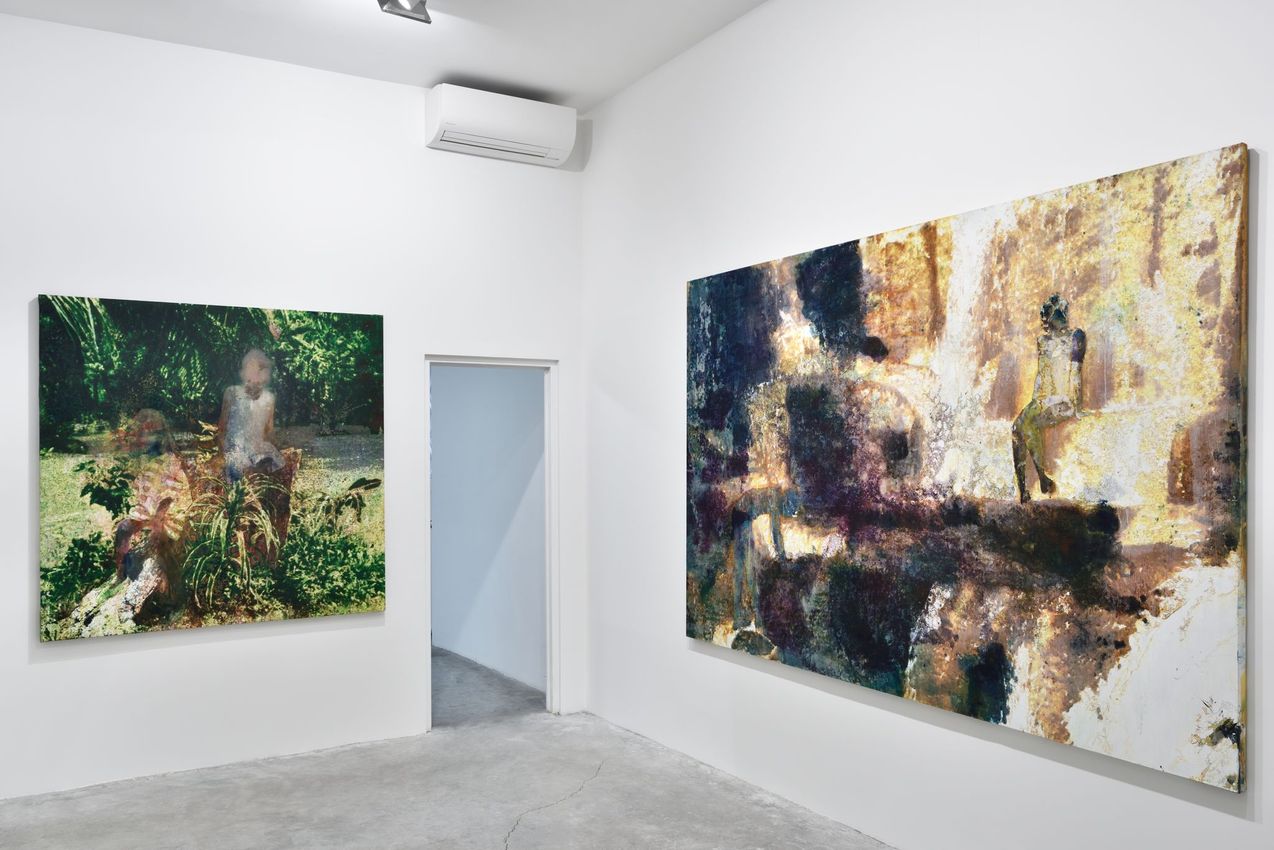
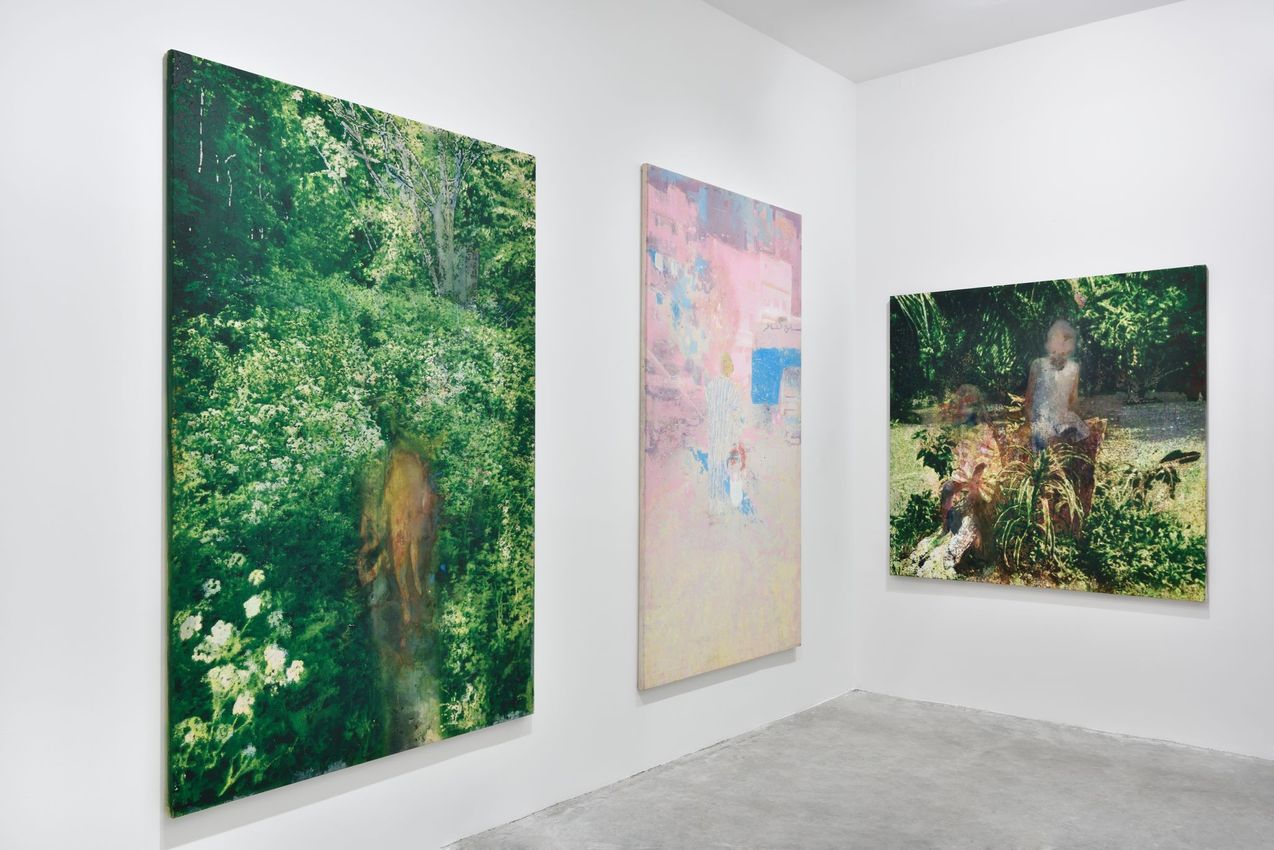
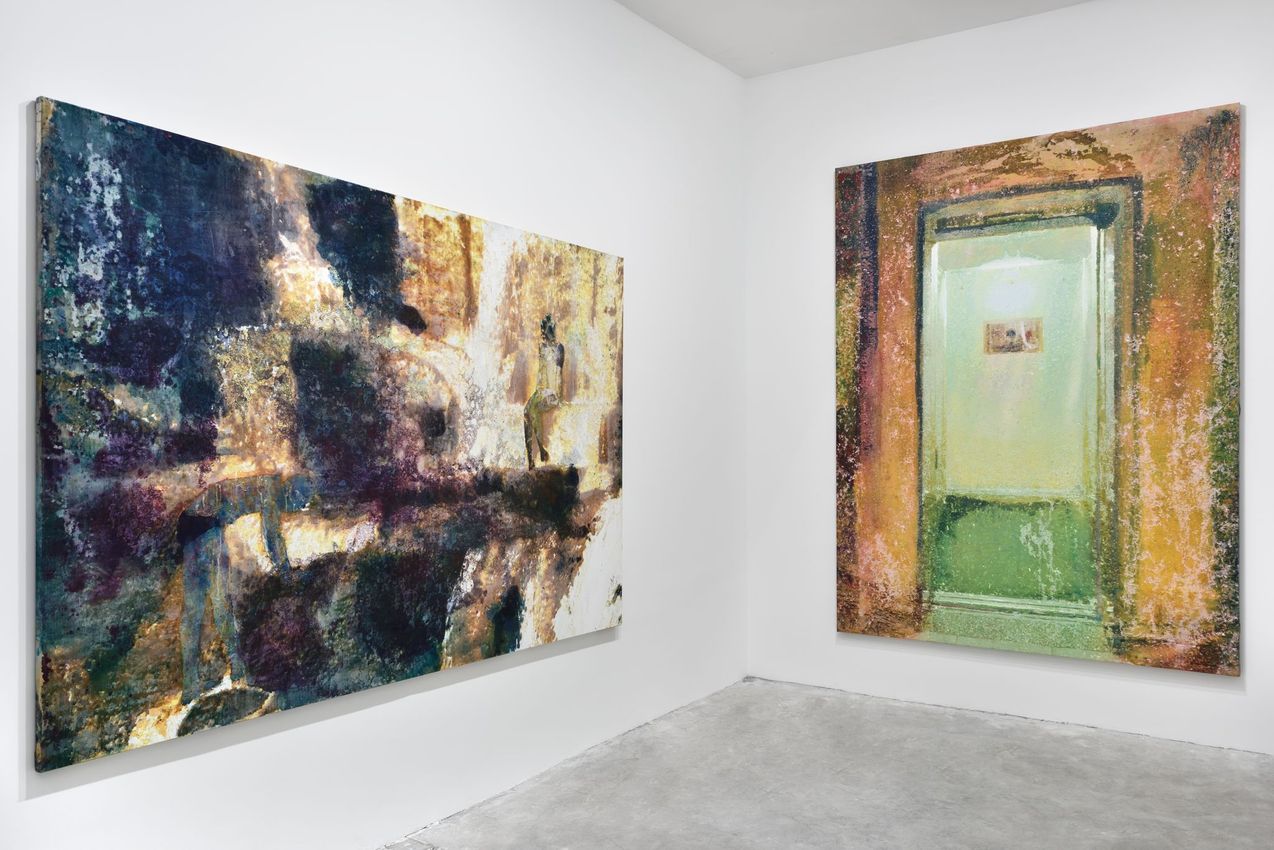
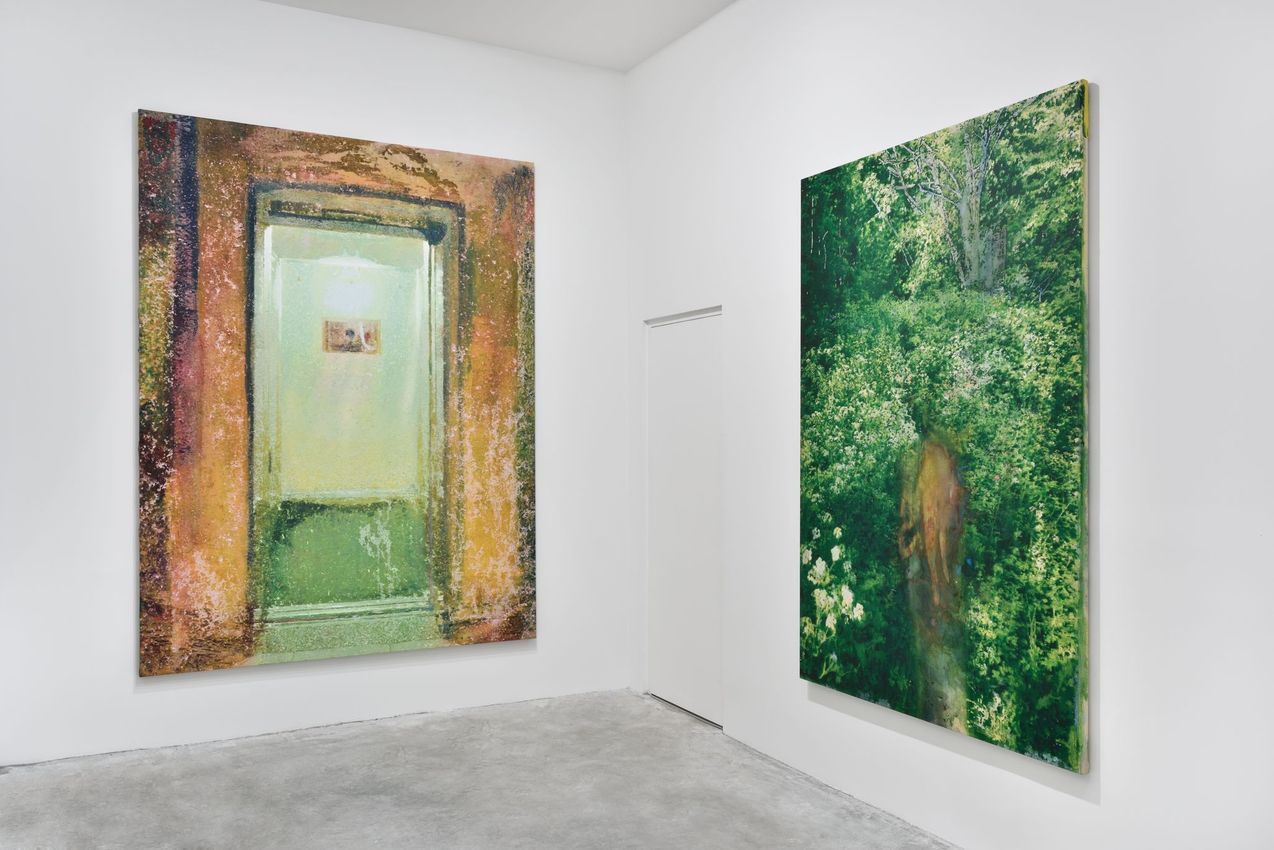
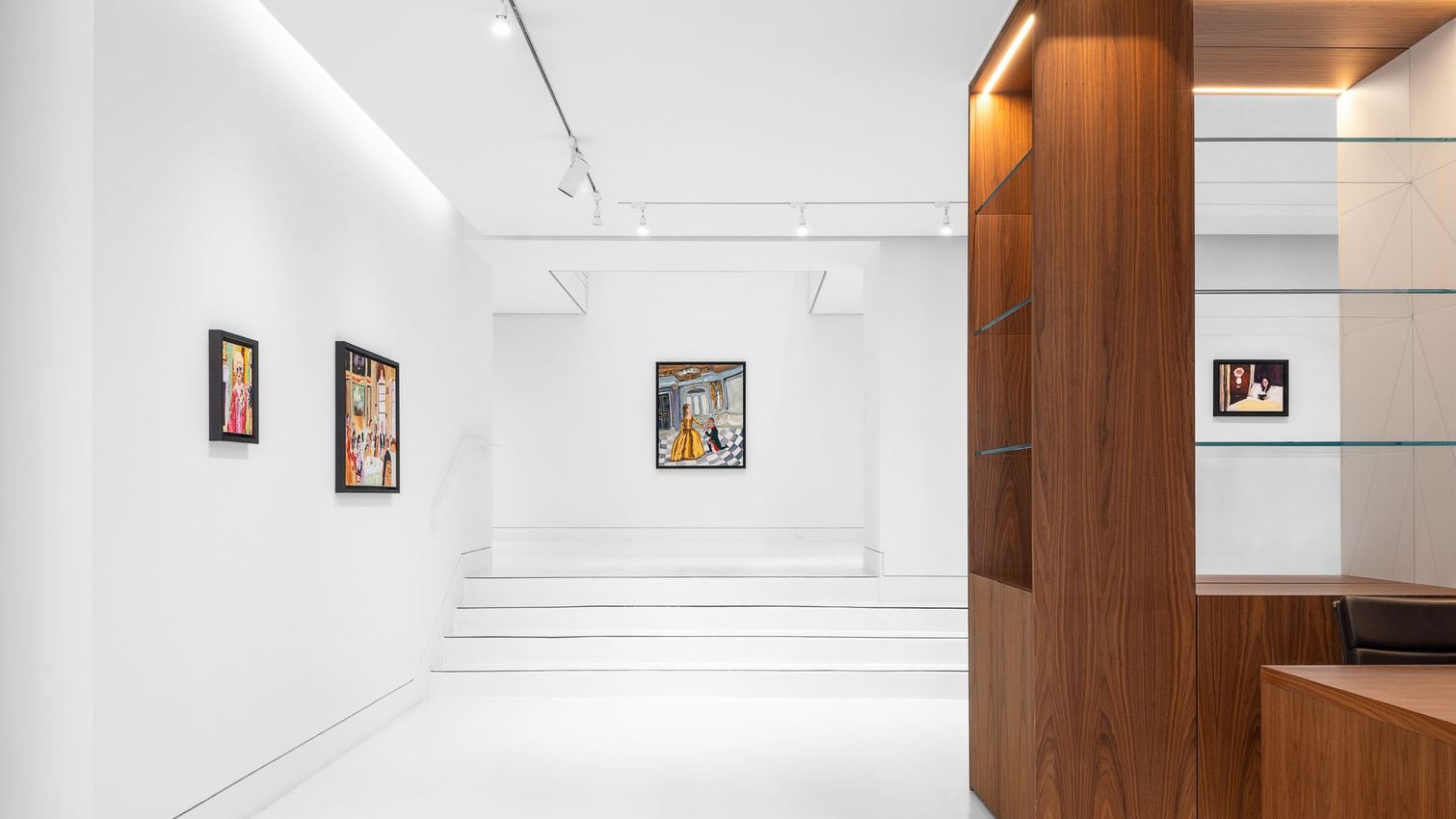
Alexandre Lenoir expresses himself exclusively through the medium of painting, which he uses to oscillate between realism and texture effects. He explores the visual relationship with his canvas head-on, but also views it as a conceptual tool, often questioning the legitimacy of his endeavour. ‘Do I have the right to be a painter?’ ‘Am I entitled to use and reuse this technique?’ ‘How can a canvas exist?’ ‘Must I create a balanced work?’ The answers have never appeared to him very clearly–not that he really needs them, though, as his constant production has gradually allowed him to develop an intimate relationship with painting and his vision of what it means.
Lenoir’s canvases can take several months to come into existence, as he is always keen to fine-tune the effect, although some sections of the work may only have taken him a couple of days. His subjects are chosen at random; he fishes out an image from his personal photographic archive and projects it on the wall. ‘I’m not trying to achieve a realistic rendering’, he explains. ‘In fact, I work in the dark, with masking materials. I use masking tape, layer paint washes, and when I remove the tape, I discover my work. The process is reminiscent of photography: there is latency in the image, it emerges gradually.’ The artist’s vocabulary makes references to revelation, chance and acceptance of what the canvas can produce almost of its own accord. Here, Lenoir’s life experiences and intimate moments are not necessarily identifiable; what they can do is trigger the beholder’s own personal memories, and the artist enjoys the diversity of interpretations. You can identify landscapes, often lush; disparate assemblages, bodies, hypnotic presences, but also interiors. When focusing on his canvas, almost meditatively, he raises questions of balance and opposition. The paint wash’s liquidity contrasts with the accumulation of layers; the glossy with the dull; the bright colours with the browns, ochres and blacks; a narrative effect with a simple abstract composition… Taken as a whole, his work talks of memories, personal and collective: it unearths the remains of a past that may not have existed at all. To him, what is crucial is that the elements should collide to form a body of work which he readily describes as silent, or ‘monk’. The rules and framework he imposes upon himself are the starting point of his work’s autonomy: he retains control but lets it live its own life. He accepts the randomness, while finding his place between technique and what must appear. In other words, he influences a form of process in the making to construct a painting.
Alexandre Lenoir may have studied at the Beaux-Arts de Paris, but he very much preferred to conduct his apprenticeship on his own to avoid the influence of others. He developed his own culture, with equal love for Fra Angelico’s embodied subjects and Niele Toroni’s suggestion that one should ‘work on a painting to let it blossom on its own.’
There was also Eugène Leroy, ‘who made a thousand gestures to produce just one,’ Marc Couturier, who ‘caused excess and withdrawal,’ or Qiu Shihua, ‘whose paintings look white, but are in fact hyperrealistic.’ In his approach of a painting’s capillarity, or when he tears down whole sections of walls (from which he harvests his materials), one cannot fail to think of the poster art in Nouveau réalisme. ‘Not really,’ says Lenoir, ‘but this process of moving towards an analysis of the canvas in relation to the frame, and the painting that comes with it, creates a certain kinship with Supports/Surfaces, although I only started looking into the movement after someone told me about it. My pieces always originate in intuition and empathy for what I am trying to depict, the place I’m at and the technique that will butt in and exist. I’m not even sure the word technique is appropriate: it’s a manner of doing things in which I am taking risks with my subject. It must be linked to an incarnation and, when evoking my desire to represent something, I don’t conceive it literally. Instead, I think about the heart or the belly of the canvas.’ A vital force is conveyed, and the artist almost requires performative movement from the viewer when creating very real three dimensional effects that can be perceived several metres away from his paintings, or when disjoining them to force the eye to explore a variety of materials and apparitions.
Countless hours spent in the studio are his reason to try to describe ‘the painting, this extremely ambiguous object which belongs to multiple realities’ and accept that the eye is indeed what brings a painting into existence. Starting with his own, as his only light source when painting is the projector; his canvas only becomes discernible to him once he has finished making it. Beyond the image, the painting propels us into its heart and materiality while also encouraging us to view a representation, thus intellectualised by our brain. Alexandre Lenoir is developing a constant back and forth movement between these two concepts.
Marie Maertens
Representing landscapes of luxurious vegetation, interiors and buildings, Lenoir’s works often include characters as ephemeral as memories. Like flashbacks or dreamscapes, an ambiguous hedonism inhabits these visions, drawing on the multiple identities of the artist himself: one of Caribbean ancestry from his Guadalupian mother and where he lived during his youth; to Morocco and his formative artistic years; and finally to the industrial neighbourhood of Paris where today his studio is located.


Almine Rech opened its doors on April 1st, 1997 in the 13th arrondissement in Paris. The gallery was founded on an axis of California Minimal, Perceptual art and Conceptual art, representing artists such as James Turrell, John McCracken and Joseph Kosuth.

A respected voice in contemporary art discourse.
Focusing on ambitious storytelling and insightful art-world commentary. Ocula Magazine publishes in-depth interviews, critical essays and timely analysis on the artists, exhibitions and ideas driving the global art world.
Learn more about Ocula Magazine
Showcasing the best of the art world.
Ocula partners with galleries from around the world to highlight their artists, artworks and exhibitions. Gallery membership is by application and invitation, with each member vetted by an independent panel.
Learn more about Ocula Membership

Specialises in the sale of major artworks.
Led by a team with deep ties to the world’s leading auction houses, galleries and collectors. Ocula’s advisory team offers bespoke services to high-net-worth clients from around the world who are looking to acquire the best of contemporary and modern art.
Learn more about our team and services