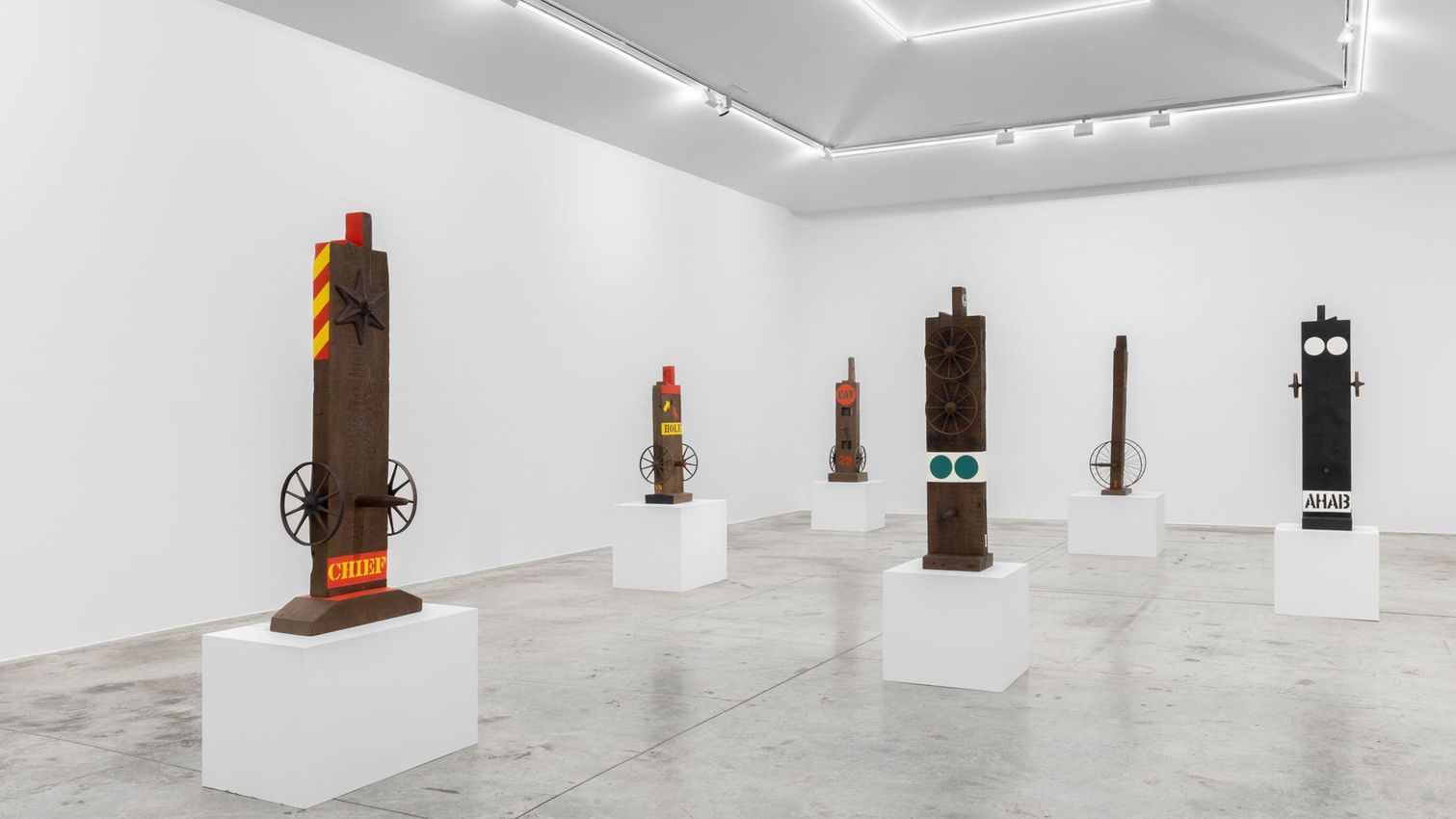
Almine Rech Paris is pleased to present Robert Indiana’s first monographic exhibition with the gallery, organized in collaboration with The Robert Indiana Legacy Initiative, on view from October 17, 2026 to January 23, 2027. Concurrent with the exhibition, a monumental LOVE sculpture (LOVE WALL, 1966 - 2016) by the artist will be on view as part of Art Basel Paris’ public program.
Robert Indiana: From the Neglected into the Wanted
The technique, if successful, is that happy transmutation of the lost into the found, junk into art, the neglected into the wanted, the unloved into the loved, dross into gold, hence: alchemy.
— Robert Indiana, 1961¹
Robert Indiana’s work is rooted in acts of transformation. From the weathered wood, rusted wheels, discarded architectural elements, and commercial stencils he found around Coenties Slip to the hard-edge paintings and monumental word sculptures for which he became known, Indiana repeatedly converted the overlooked and the ordinary into highly charged artistic form. His own description of this process as the transmutation of ‘the lost into the found, junk into art, the neglected into the wanted, the unloved into the loved, dross into gold’ provides a key to understanding the material, formal, and symbolic logic of his work. What emerges is an art in which found objects, signs, language, memory, and personal history are continually transformed—an artistic process that Indiana himself defined as ‘alchemy.’ In the following, the material qualities of paint, the support, and the sculptures will be analyzed as signs of modernism in the sense of Monika Wagner’s material-based “other history of modernism.”² Wagner refers to William Turner as a key artist in a line of development that she traces, where Turner marks the starting point, continuing through Gustave Courbet, Jean Dubuffet and culminating with Claes Oldenburg and Joseph Beuys in the second half of the twentieth century.
[...]
William Katz describes Indiana’s artistic vocabulary as that of a formalist, a geometer, and a poet: “Geometry, Identity, Memory, and the encircling unity of these three.”³ The found wood bears the written word of a poet that condenses to a spiritual sign. Every element here asserts its “thingness”: nothing is other than itself, the word is not a stand-in for the thing, but the thing itself, for the “word became image.”⁴ In his works, the materiality of the found exists in a productive tension with the perfect surfaces of the hard-edge paintings and the LOVE sculptures. Between found materials, words, numbers, signs, and forms, an artistic oeuvre emerges that is borne by contradiction and marked by continuing significance. The artistic technique that allows these elements to be transformed is the alchemy Indiana identified in 1961: during the New York building boom, trash became art, the neglected became wanted, and the unloved became loved—a process rooted in its moment of emergence but extending into our present and a still unwritten future.⁵
— Extract from “Robert Indiana: From the Neglected into the Wanted,” essay by Dieter Buchhart, art historian and curator.
¹ Robert Indiana, “Artist Questionnaire Museum of Modern Art, New York, December 11, 1961”; available online: “Artist’s Statements/Writings,” Robert Indiana Catalogue Raisonné, www.ricatalogueraisonne.org/section/?id=artists%20statement (viewed July 25, 2026). ² Monika Wagner, Das Material der Kunst: Eine andere Geschichte der Moderne (Munich: C. H. Beck, 2001). ³ Katz, “Polychrome Polygonals,” 20. Katz derives the triad geometry, identity, memory and the circle around it from the painting The Geography of the Memory, a compass rose that Indiana painted when he was a close neighbor of Agnes Martin over what was a county canvas (Brown County, Red County, Green County), and defines Indiana in essence as a formalist, geometer, and poet. He supports the autonomy of each visual element (in the essay: “thingness”) with a turn of phrase used by Indiana in a conversation from 1975 and with Donald Sutherland’s Epigraph in Robert Creeley, Presences: A Text for Marisol (New York: Scribner, 1976); see Gertrude Stein, What Are Masterpieces (Los Angeles: The Confe-rence Press, 1940), and Everybody’s Autobiography (New York: Random House, 1937). ⁴ Goodall, “Introduction,” 7 ff. ⁵ Indiana, artist’s questionnaire on the work Moon.
Courtesy Almine Rech.


Robert Indiana created his Pop Art pieces by adapting the American Dream iconography of adverts, logos and neon signs. Inspired by poetry as well as this commercial landscape, his bold-coloured works bordered hard-edge painting yet were also highly accessible.


Almine Rech opened its doors on April 1st, 1997 in the 13th arrondissement in Paris. The gallery was founded on an axis of California Minimal, Perceptual art and Conceptual art, representing artists such as James Turrell, John McCracken and Joseph Kosuth.

A respected voice in contemporary art discourse.
Focusing on ambitious storytelling and insightful art-world commentary. Ocula Magazine publishes in-depth interviews, critical essays and timely analysis on the artists, exhibitions and ideas driving the global art world.
Learn more about Ocula Magazine
Showcasing the best of the art world.
Ocula partners with galleries from around the world to highlight their artists, artworks and exhibitions. Gallery membership is by application and invitation, with each member vetted by an independent panel.
Learn more about Ocula Membership

Specialises in the sale of major artworks.
Led by a team with deep ties to the world’s leading auction houses, galleries and collectors. Ocula’s advisory team offers bespoke services to high-net-worth clients from around the world who are looking to acquire the best of contemporary and modern art.
Learn more about our team and services