Press Release

ARARIO GALLERY SHANGHAI is pleased to announce Chinese artist Zheng Huan’s solo exhibition Fair Play after a four-year hiatus. The exhibition will run from February 28th to May 5th, 2019. Zheng Huan’s previous conceptual practice has been presented in installations, for this exhibition, the artist will present entirely new works. Although what consistent remains are the artist’s way of thinking accumulated over time and his concerns for everyday life and social realities.

The title of the exhibition, Fair Play originally referred to the sportsmanship of fair competition, which was later on introduced into social life by the British capitalist class, that equality should become the virtue for social interaction. The terminology ‘fair play’ was brought into China during the May 4th New Culture Movement and adopted as a basis for self-perception as the nation confronted the West with dignity and pride. Mr. Lu Xun has transliterated the term in his 1925 essay, ‘Fair Play should be slowed down’, where he pointed out the phenomenon of the mass Chinese consciousness disconnected from the remnants of feudal society.

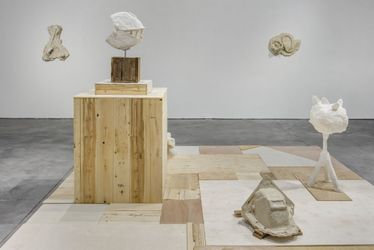
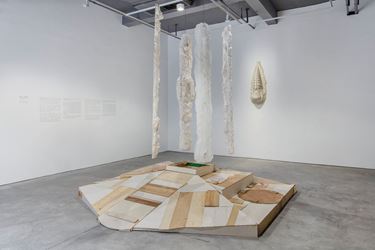
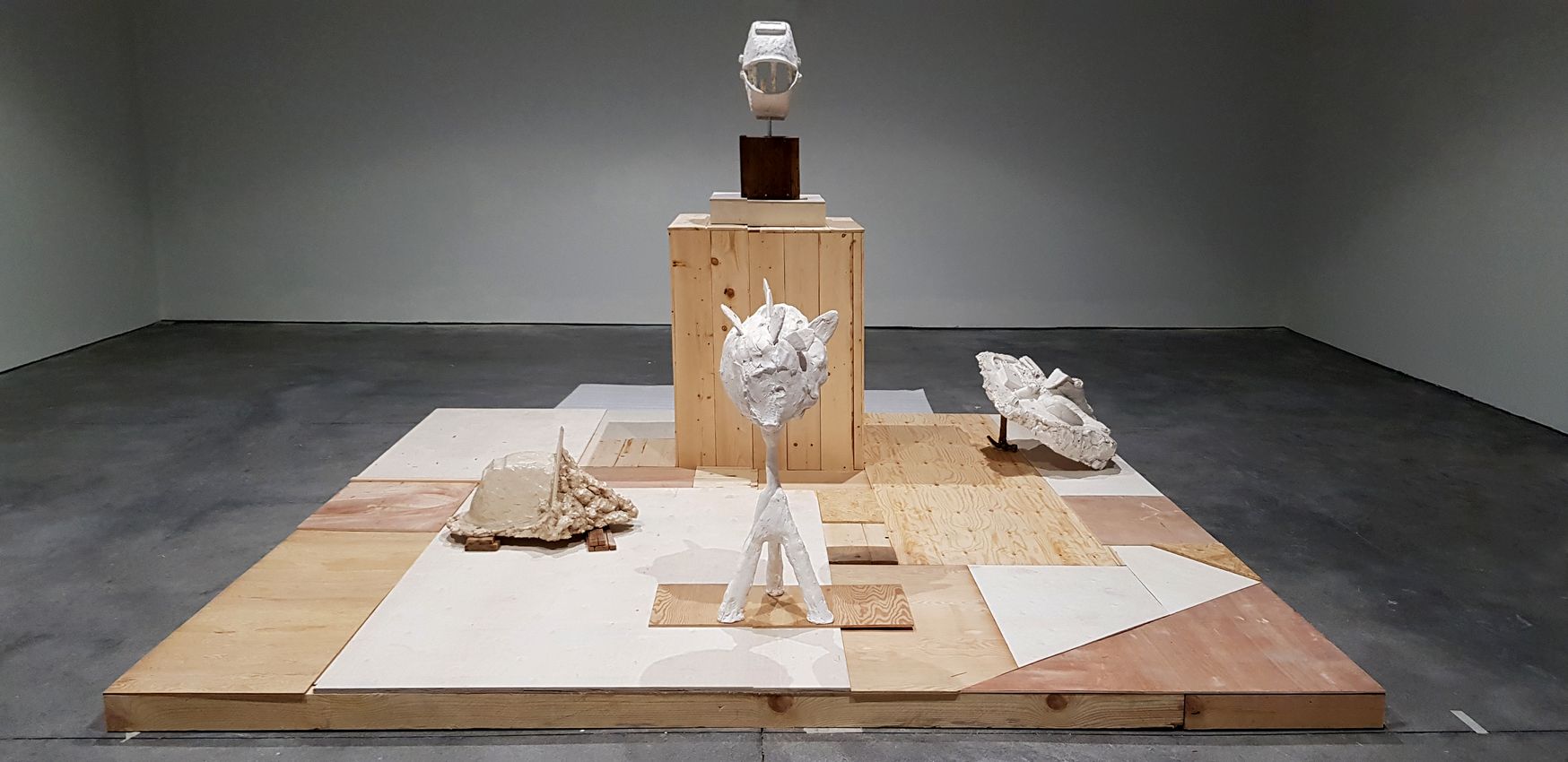
Zheng Huan reinterprets the implications of equality and fairness as well as the Western critical conscience from what Mr. Lu Xun suggested in the notion of ‘fair play’ in an art historical context. What Zheng emphasises can be construed as through alienated integration of everyday objects to attain some kind of ‘balance’. For which, the artist adopts the fragments or shapes of the ubiquitous, useful and abandoned objects from everyday life and turns them into unique relief sculptures. Zheng Huan’s artistic approach puts his physical energy and patience to the test. To make a mold, the artist uses selected objects and clay to shape the basis of a relief first. And then he smears a layer of plaster mixed with synthetic fibre on the surface, the mould would come out when the synthetic plaster solidified. For the final relief, the artist pours liquid plaster into the mold. By pouring liquid plaster, all of the selected objects, whose the original colours of would fade as they are white washed on the relief, while their shapes are juxtaposed one next to another.

Unlike a representational art that does not necessarily to restore an objects’ actual scale, each object Zheng Huan has selected is presented as a plaster relief. Hence, a sculptural syntax has been created according to the juxtaposition of the objects and dissolution of their inherent connections and relations. The same syntax cannot be defined in any paintings.

The other characteristic of Zheng Huan’s sculpture is the creases left on the surface of the sculptures marking the traces of his artistic process. The artist leaves slits or hammering and molding marks on the surface of the clay, as unsophisticated these hand gestures may inevitably be, they generate arich sense of rhythm. And with these gestures, the ‘differences’ between the elements of the essential and the non-essential repeat continuously, that eventually shape into the relief that completely covers its former essential characteristics. This is the outcome Zheng Huan achieves from devoting physical labor and time.

Modernism has painted straight lines, while Baroque bent them and turned into fluid curves. In French philosopher Gilles Deleuze’s view, folding and compressing even objects can be understood as ‘the Baroque impulse’, however Zheng Huan could be considered the young Chinese artist who has further elucidated the Baroque passion, what the artist hopes to visualise is not necessarily the violence of every day, but a response to the Baroque attitude erupted since the end of the 1970s economic reforms. What this attitude refers to is the cohabited reality once alienated elements penetrated into everyday life.

Through Zheng Huan’s practice and reshaping, these everyday items embodying personal significances towers as the totems that unite the everydayness of modern civilisation.

This exhibition is conceived as a brand new start for Zheng Huan. In an art world that tries to pursue the sophistication of the West, Zheng Huan’s works returned to the rawness created from the hands of the laborers, and where the layers of creases he had left on the surface would lead to, will be something we look forward to.

Read More

Installation Views

Also Exhibiting at Arario Gallery

About the Gallery
ARARIO GALLERY opened its first Chinese branch in 2005 in the Jiu Chang Art District, Beijing. The Beijing space, which operated successfully for over seven years, closed its doors in 2012. In 2014, ARARIO GALLERY SHANGHAI opened in Xujiahui, Shanghai, operating until June 2017. It then relocated to West Bund, Shanghai, from July 2017 to August 2020, and once again within the West Bund from October 2022 to April 2024. The gallery has played a significant role in introducing the works of not only Korean artists but also a diverse range of Asian artists from Japan, India, China, the Philippines, and Indonesia to the Chinese art scene. Building on decades of experience and expertise, ARARIO GALLERY SHANGHAI reopens its new space in Jing’an District, Shanghai, in March 2025. As the oldest Korean gallery in China, ARARIO GALLERY SHANGHAI is firmly established and continues to provide a sustainable foundation for Asian artists through the continuous discovery of emerging talents and the creation of advanced exhibition opportunities.
View Gallery Profile
Address
2F-205
30 Wen'an Road
Jing'an District
Shanghai
China
Opening Hours
Tuesday – Saturday
11am – 6pm
(1)
Shanghai 2F-205, 30 Wen'an Road
Arario Gallery
2F-205, 30 Wen'an Road, Jing'an District, Shanghai, China
+86 21 5424 9220
http://www.arariogallery.com

Opening hours
Tuesday – Saturday
11am – 6pm
The art world in focus