





Leisure’s Labours Lost
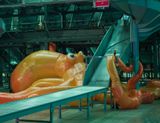
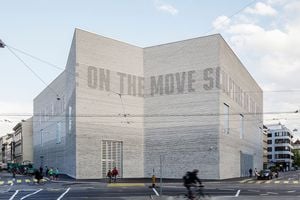
Commerce, society and relationships are increasingly shaped by digital capitalism, but Cao Fei’s installations find a wry humour in labour, as a survey of her work demonstrates. Save to My OculaAt Cao Fei’s solo exhibition Testimonies to the Near Future at the Kunstmuseum in Basel, I spotted the multimedia artist on the third floor, jumping gleefully for a photoshoot in the pink-and-blue ball pit area. I spotted her again later, this time dancing with an inflatable matryoshka doll, part of another installation.
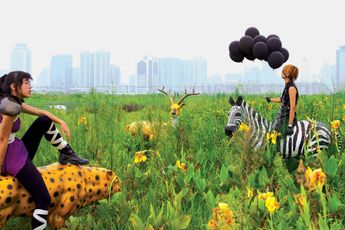
Though Cao’s primary subject—the rapid changes in labour and technology in China across the past three decades—is sprawling and difficult, much of her work operates with this same performative charge. One of her early videos, Cosplayers (2004), on show as part of the exhibition, sees young men and women dress as their anime idols against a backdrop of sprawling urban development, while her recent Hip Hop project features screens hovering above skate ramps with people dancing to hip hop in public spaces. “During the 1990s, promotional advertising became really popular in China, so I became an actress in adverts, where I learned to dance and perform,” Cao says. She is dressed in an oversized suit; her hair, with its distinctive shaved sides, grazes her shoulders. She is incisive but playful, and quick to laugh as we speak across both Mandarin and English. “At the time, MTV was also booming and brought in the new format of music videos, which hugely influenced me.” For the Hip Hop series, she tells me, she learned to shoot in the now-prevalent vertical format, thinking through “these resonances from the past to the present. People still need this form of self-expression”.
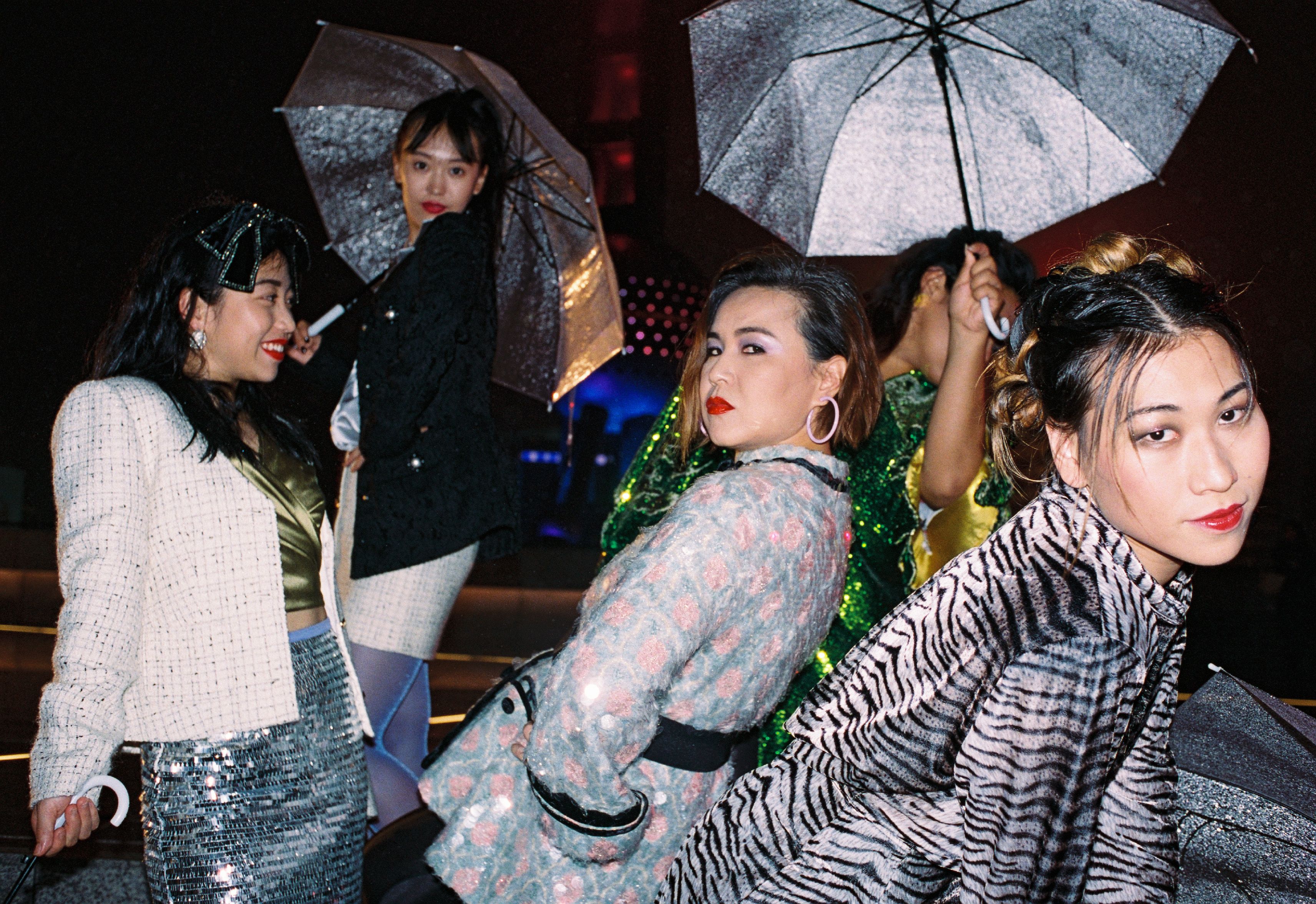
The Basel exhibition, Cao’s largest European survey to date, spans 30 years of the artist’s work. It traces her prismatic visual style, which encompasses video, writing, digital and virtual-reality simulations. For Cao, it is a meditation on her homeland. “I see my work as an archive, tracing all the rapid changes which have completely transformed China.”
Born in 1978 to sculptor parents in the southern Chinese city of Guangzhou, Cao is one of the key figures in a generation of Chinese artists that emerged in the late 1990s. Largely defined by underground movements, the cohort experimented with new mediums including performance, conceptual art, film and photography, all underscored by a sense of cynicism following the 1989 Democracy Movement (in which hundreds of pro-democracy protestors in Beijing were killed by the military).

“I see my work as an archive, tracing all the changes which have transformed China”
Even though her parents were artists, Cao sought to push the conventions of fine art, exploring instead the critical potential of new technologies during a period marked by the optimism of the reforms that opened up China, the influx of Western and Hong Kong pop music and visual culture, accelerating globalisation, and metastasising technological and urban transformations. In 2003, only two years after graduating from the Guangzhou Fine Arts Academy, she exhibited at the Venice Biennale. In 2021, she had a major solo exhibition at UCCA Centre for Contemporary Art in Beijing and was named one of Time magazine’s “100 Most Influential People of 2026”.
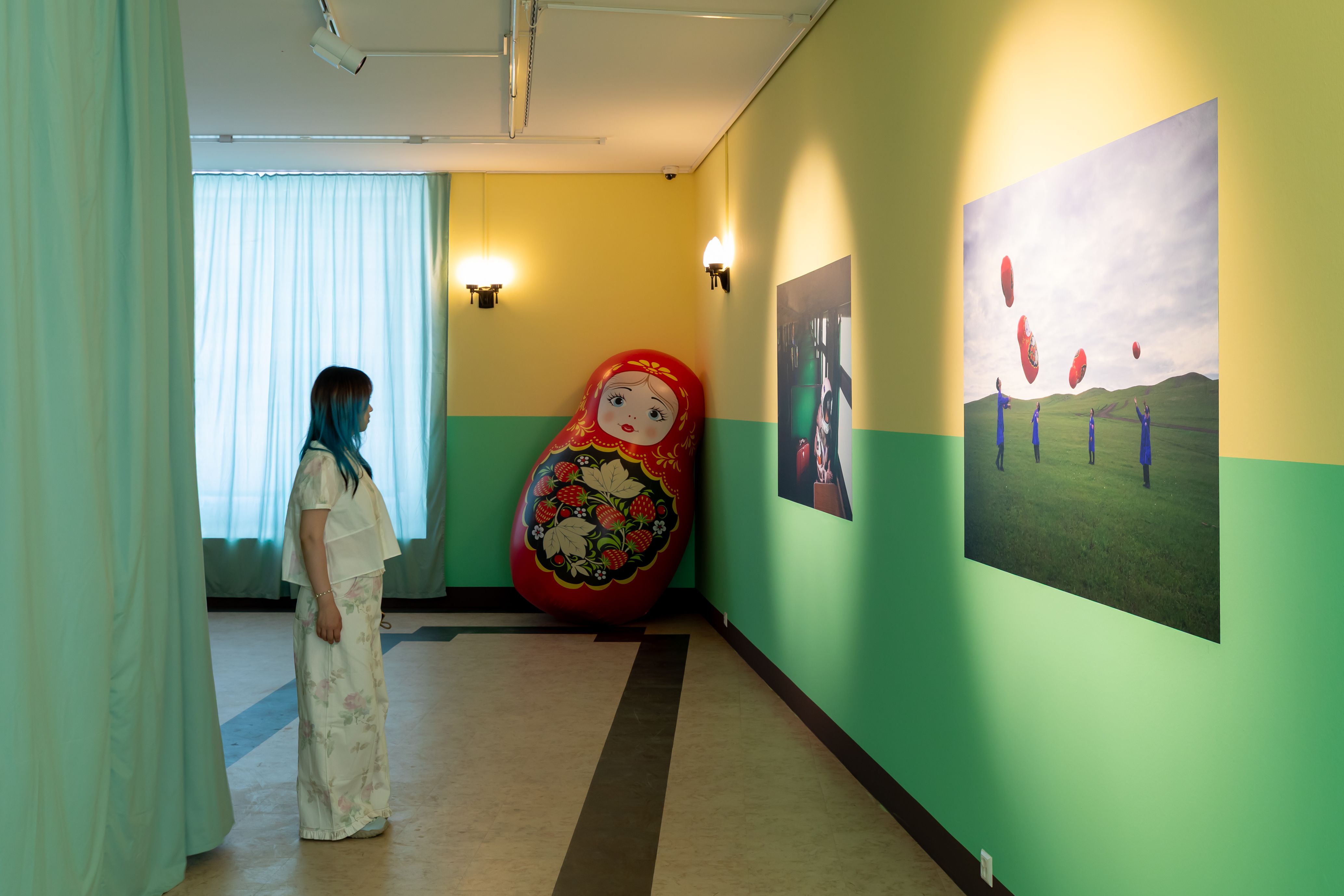
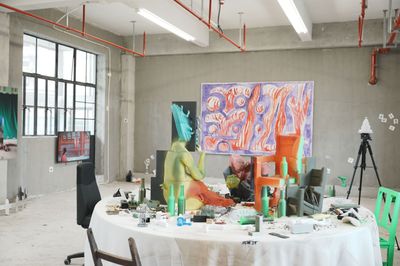
The Basel exhibition, which Cao helped to design, is conceived as a phantasmagorical city, sprawling across four floors of the Gegenwart building, its spaces divided into the collective sites that shape our intertwined relationships with labour and leisure: The Park, The Street, The Factories, The Cinema, The Playground, The Office, The Shelter, and the Artist’s Archive. “My work deals with a lot of different themes that take place within public spaces, from labour—symbolised by the Factories and Office—to ideas around history, which is symbolised by the Cinema,” she says.

Her breakthrough piece Whose Utopia (2006), on display in The Factories section, set out her interest in how changes in labour culture affect workers and established her form as docu-fiction film. Whose Utopia uses footage of the relentless repetition of labour in a lightbulb factory, which then gives way to something more fantastical. During the final sequence, the workers perform their ambitions on the factory floor: as a peacock dancer; a ballerina. “I observed and filmed for a period of six months, staging participatory workshops with the workers, and interviews in which I asked them about their dreams and hopes, which I deliberately chose not to show.”
Through this fictional coda, a sense of yearning breaks through the documentary surface, a feeling that pervades much of Cao’s work and shapes her exploration of the individual’s potential to imagine, if not fully transform, their own reality. The artist recalls that the woman who dreamed of being a peacock dancer “felt really inspired by my work, quit the factory and is now a successful businesswoman”. Cao adds: “She called me the other day to talk about expanding her business. Her Chinese Dream came true.” When I ask if she thinks that mobility is still possible, after China’s consolidation of a free-market economy, she responds, “it is, but it’s much harder. Many of the people I interviewed for 11.11 have stayed in this same job for years.”
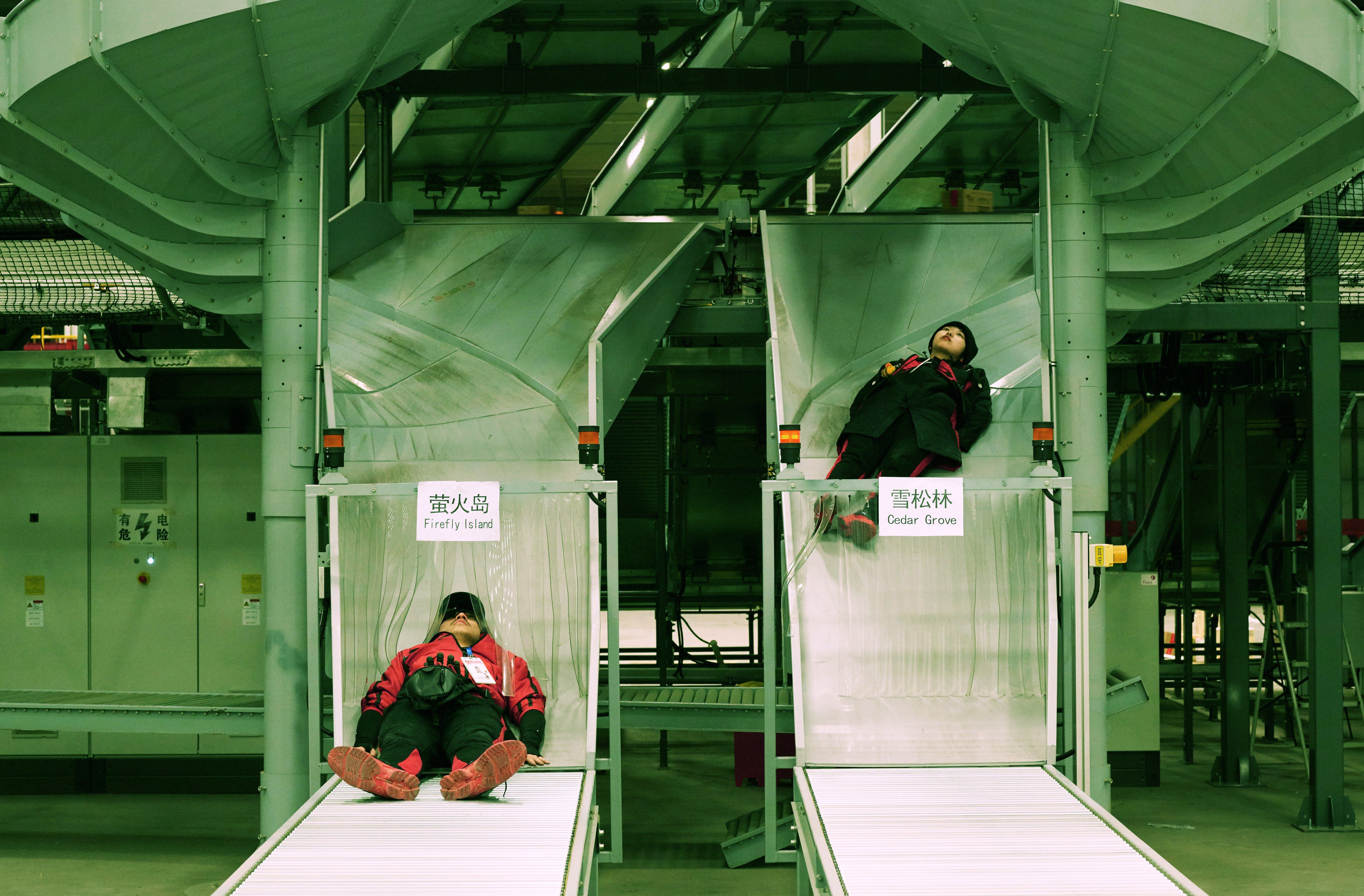
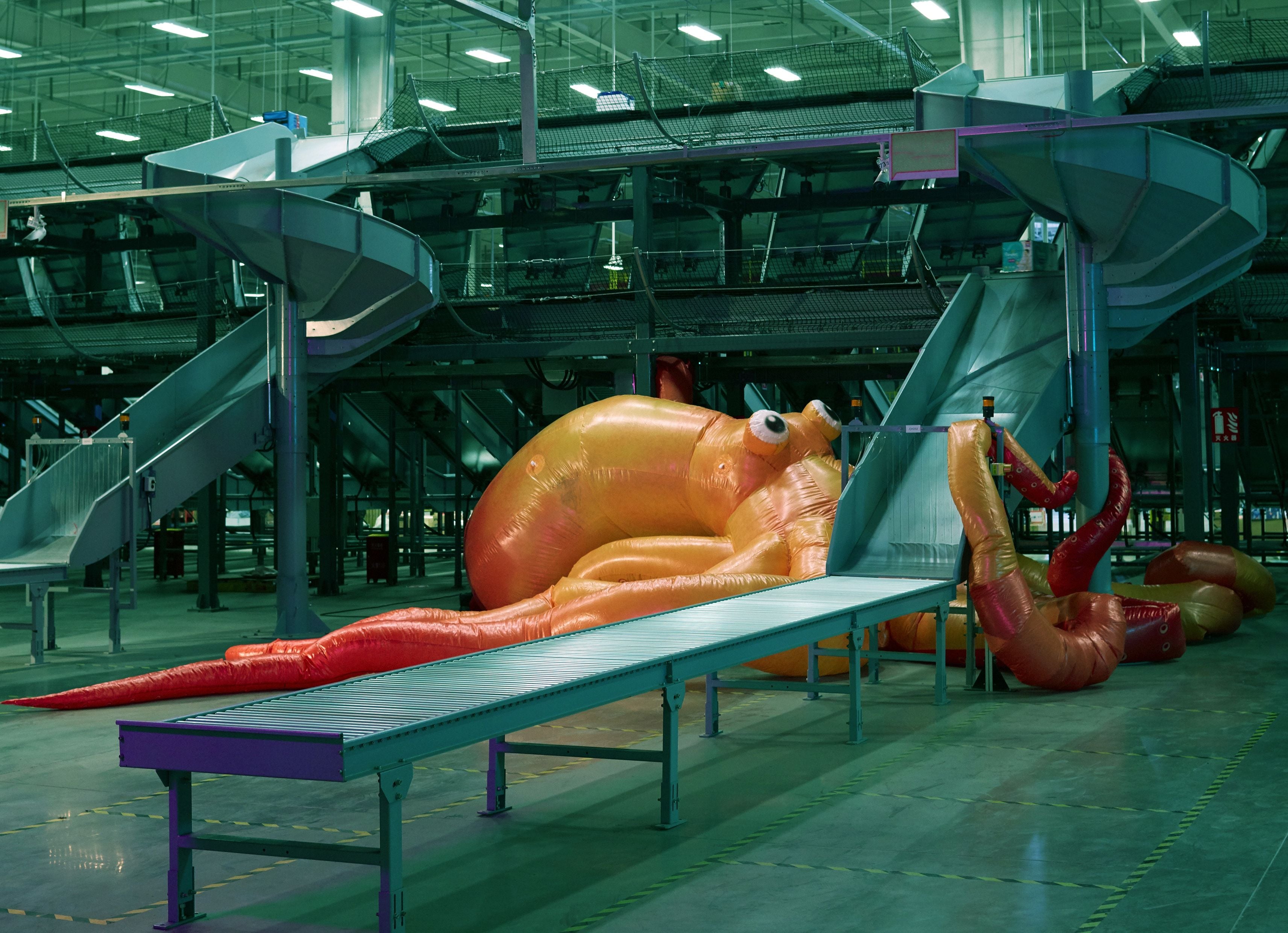
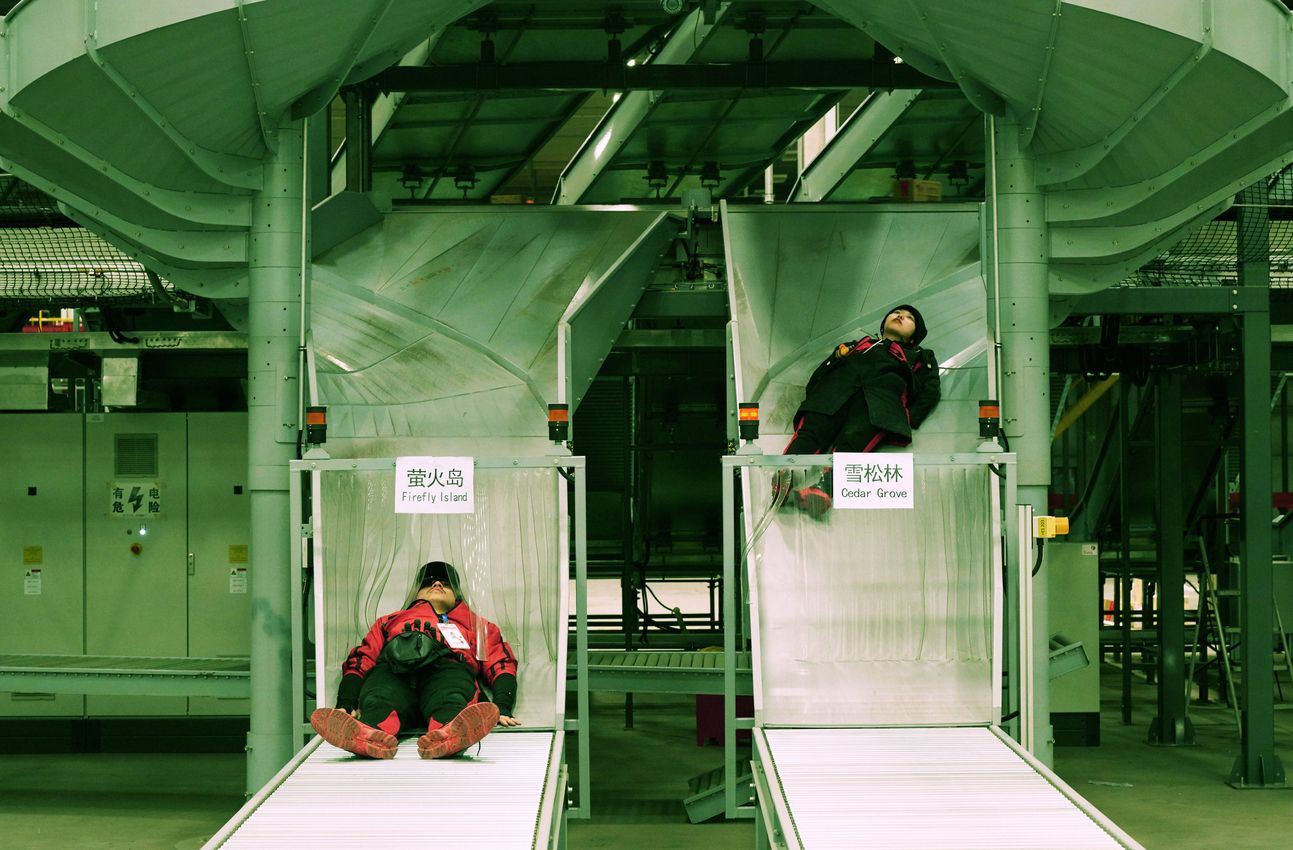
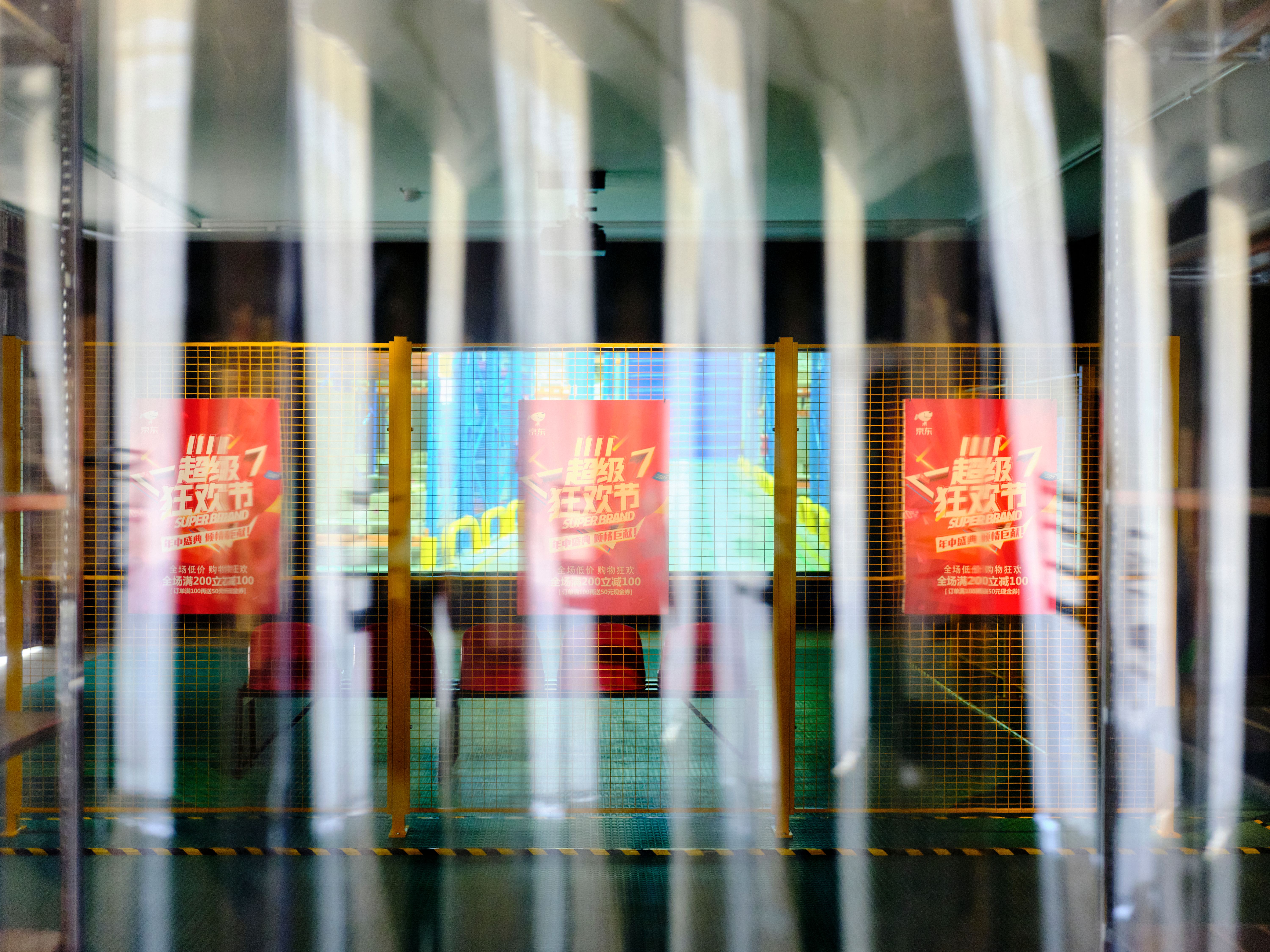
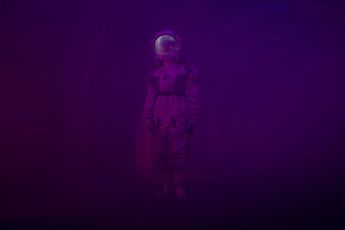
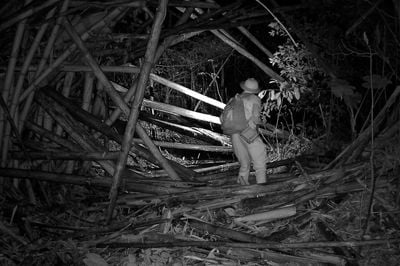
More than a decade later, she made a loose sequel to Whose Utopia with Asia One (2018) and 11.11 (2018). All three works are displayed within The Factories space of the exhibition, surrounded by the material traces of labour-workers: delivery-driver uniforms, JD-branded metal dividers, and the smell of new plastic hanging in the air. Asia One is a speculative fiction film set in the near future (filmed in 2017, set in 2021) in which two workers fall in love in an otherwise fully automated factory, their relationship mediated by a cute, petite robot. Shot primarily at a warehouse operated by JD.com (a huge Chinese e-commerce company), the two lone characters drift, largely alone and silent, until they start to defy the rhythms of the workday and the efficiency of the machines. At one point, Cao stages a surreal dance sequence with workers dressed in a pastiche of Mao-era revolutionary opera under the banner “Human and machines, hand in hand” as a sly critique of sinofuturism. Seen through Cao’s characteristic wry, macabre gaze, the factory appears more like a steel playground than a workplace.
11.11 is Cao’s most direct documentary work, which interviews and follows delivery workers during the chaos of Singles Day (also known as Double Eleven Shopping Day), the Chinese equivalent of Black Friday. “Over this past decade, the conditions of low-waged labour have radically changed. In factory work, workers stay fixed to different points along the production line,” she says. “For delivery workers, there appears to be more mobility, as they move across the city, yet they remain tethered to isolating digital systems.”
“I grew up with the texture of mud”
Cao’s work has similarly shifted in its perspective. She started out during the techno-optimism of the early 2000s. Playing with the Cinderella-like anonymity offered by early virtual world platforms such as Second Life, Cao crafted an unconventional romance in the film i.Mirror (2007). Her avatar, China Tracy, embarks on a whirlwind relationship with another avatar, Hug Yue, who she later discovers is in fact a 65-year-old American man. But this revelation does little to dispel their play-pretend. Watching it, I remembered rushing home as a tween for the thrill of romance on Club Penguin before I had even had my first kiss. It was the best form of make-believe. “Back then, the internet was still so experimental,” she says. “You could make an avatar; you didn’t have to know who you were exactly. There was romance and imagination. Now, everyone has Tinder or social media. It’s all very transparent now.” When I ask Cao how she feels about the future, she returns to this question: “How do we balance the relationship between humans and technology in society?”
Of course, even despite her growing ambivalence towards accelerating technologies, Cao’s work is too funny and playful to be read so simply as a mere turn to techno-pessimism; instead, she continues to delight with an absurdist imagination. One of the most striking works in the exhibition is Screen Autobiography (2023). Set in a green-room studio populated by blinding ring lights and vertical screens, we see multiple short videos of individuals, often against a natural landscape (the beach, by a tree), struggling to fold collapsible green screens on which we see projections of grainy analogue 1980s films and music videos. Cao herself, dressed as a boxer in one video, positions the screen as her opponent. She quips that she has been taking jiu jitsu and Muay Thai classes, and she is attempting to use these newfound skills to “fight the image”.
“How do we balance the relationship between humans and technology”
For Cao, the screen refers to both traditional Chinese physical room dividers and something that literally “blocks us from other things around us”, she explains. Here, it also facilitates a new kind of labour: a studio green-room in which influencers edit, film and produce never-ending content for a ravenous attention economy. Leisure time is slowly subsumed.
Her children, she says, “are 14 and 17, and they already feel scared of the future, of AI destroying the world, and they are turning towards the past”. She adds: “They constantly ask me about the 1990s and 2000s, and they dress in vintage Carhartt, and listen to the music I grew up with. For them, maybe it feels more real. I grew up with the texture of mud, so perhaps this is their attempt to feel more grounded. This was why I wanted to project these 1980s videos on to the surfaces, as a kind of desire to return.” Even in a work of seemingly impenetrable surfaces, Cao finds a kernel of yearning. Some critics have written about her work as naïve or uncritical, but perhaps it’s more accurate to say that if capitalism seeks to grind us down, Cao seeks to find within it some absurd vestige of romance beyond the blight of reality. —[O]
Cao Fei, Testimonies to the Near Future (until 11 October) at Kunstmuseum, Basel
Main image: Cao Fei, Asia One 02 (from Asia One series) (2018). Commissioned by the Solomon R. Guggenheim Museum, New York, for The Robert H. N. Ho Family Foundation Chinese Art Initiative. Courtesy of the artist, Vitamin Creative Space and Sprüth Magers.















A respected voice in contemporary art discourse.
Focusing on ambitious storytelling and insightful art-world commentary. Ocula Magazine publishes in-depth interviews, critical essays and timely analysis on the artists, exhibitions and ideas driving the global art world.
Learn more about Ocula Magazine
Showcasing the best of the art world.
Ocula partners with galleries from around the world to highlight their artists, artworks and exhibitions. Gallery membership is by application and invitation, with each member vetted by an independent panel.
Learn more about Ocula Membership
Specialises in the sale of major artworks.
Led by a team with deep ties to the world’s leading auction houses, galleries and collectors. Ocula’s advisory team offers bespoke services to high-net-worth clients from around the world who are looking to acquire the best of contemporary and modern art.
Learn more about our team and services