Beijing Commune is pleased to announce the opening of Shang Yixin’s second solo exhibition ’— —’ at the gallery on 20 October 2016. The exhibition will continue until 3 December 2016.
Shang Yixin’s practice traverses painting and installation, and is especially marked by his persistent attempts to employ varied mediums to convey artistic ideas. The upcoming exhibition is comprised of the artist’s three latest installation works, all of which were produced after he turned to light and several other new mediums as sources for experimentation in 2008. The mutually dependent, mutually molding, and mutually transforming relationships between light, matter, and shadow constitute a motif that has always interested the artist. Through a constantly self-adjusting practice, Shang addresses and examines the relationships between viewing and being viewed, individual and community, and logic and cognition.
The exhibition opens with —, one of the three installation works with symbolic titles that make up the exhibition. A set of flashlights ‘observe’ a wire from a distance. Hung at different angles and swinging back and forth, the mode of ‘observation’of the flashlights incises the shadow of the wire, projecting its fragments onto the wall behind it on a parallel plane. Specks of light and shattered pieces of shadows overlay, divorce, and intersperse in repetition.
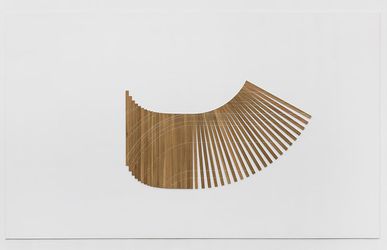
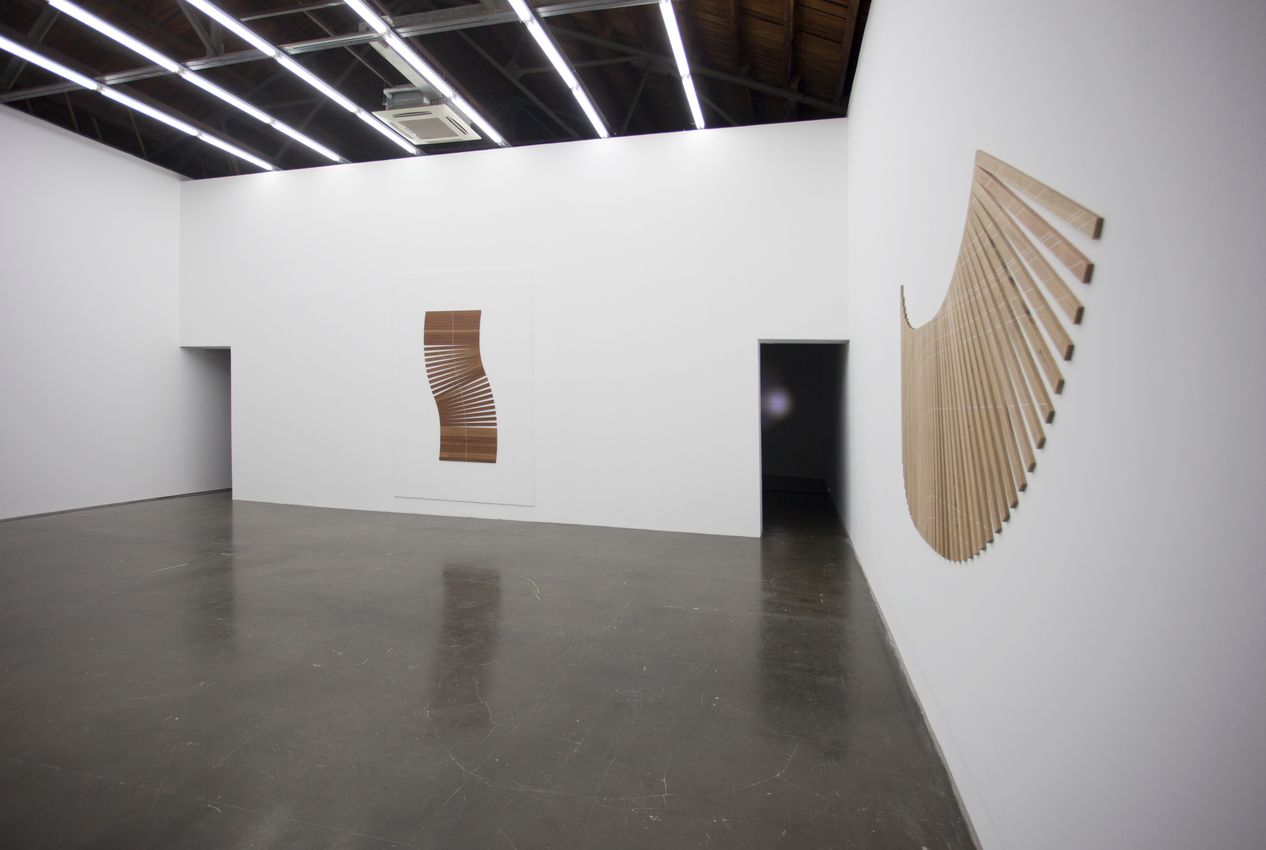
The transformation of the light and the shadow produced by the moving light source and the static wire releases an uncertainty and a state of flux from their dialectic. In 1&N, the artist arranges wood strips of uniform size into a particular form, then uses a technique that resembles a carpenter marking an ink line to leave a straight line on the woodwork. The line is soon after reconfigured, curved and severed following a game-like logic, and as the straight line moves and changes its shape, the original form of the wood strips also alters. After that, the form of the wood strips is in turn reconfigured in the same fashion: as the wood strips move closer to or further away from each other, they reassemble into other forms, and the shape of the original straight line also shifts accordingly.
In the other light installation +, several flashlights are focused on the same point on a wall, leaving a large, overlapping halo on it. A thin metal sheet over the head of each flashlight closes and opens at a regular rhythm. The split second when all metal sheets close, the focal point on the wall disappears and disperses into several points; when they open, the points will then converge back into a single focal point. Repeating in a loop, this blink-like motion is at once a shift of focal points in space and a rhythmic incision. It blurs the boundary between being and nothingness, inside and outside, real and illusory, individual and group, and certainty and ambivalence. The three works present a repetitive mode of ‘observation’ that casts a kind of certainty into an ambivalent and ever-changing condition, providing the audience with a viewing experience open to interpretation.
Shang Yixin was born in 1980 in Wenzhou, Zhejiang province. In 2007 he graduated from the China Academy of Art Department of Oil Painting. Currently he lives and works in Hangzhou. His works have been exhibited in How Art Museum’s group show 28°00′N 120°42′E (Wenzhou, 2015), Rubell Family Collection show of collected works by Chinese artists 28 Chinese (Miami, 2013), ON | OFF:China’s Young Artists in Concept and Practice at the Ullens Center for Contemporary Art (Beijing, 2013), and Daily of Concept: A Practice of Life—The Fifth Shanghai Duolun Youth Art Exhibition at the Shanghai Duolun Musuem of Modern Art (Shanghai, 2012), etc.

Shang Yixin was born in 1980 in Wenzhou, Zhejiang province. In 2007 he graduated from the China Academy of Art Department with an MFA in Oil Painting. Currently he lives and works in Hangzhou. His works have been exhibited in Mingsheng Art Museum, Beijing (2017); How Art Museum, Wenzhou (2015); San Antonio Museum of Art, Texas, U.S. (2015); Asian Art Museum, San Francisco, U.S. (2015); Art Museum of Nanjing University of the Arts, Nanjing (2013); Rubell Family Collection and Contemporary Arts Foundation, Miami, U.S. (2013); Central Acaedmy of Fine Arts Art Museum, Beijing (2012); Ullens Center for Contemporary Art, Beijing (2013); The Gallery of China Academy of Art, Hangzhou (2011); Times Art Museum, Beijing (2010); Medium Art Centre, Beijing (2009); Liu Haisu Art Museum, Shanghai (2006); Zendai Museum of Modern Art, Shanghai (2006), etc.
Founded in 2004, Beijing Commune is now located in 798 Art Factory, Beijing. Its initial programs were mainly group shows exploring various currents in contemporary art while now it primarily focuses on solo shows to carry on the in-depth research.

A respected voice in contemporary art discourse.
Focusing on ambitious storytelling and insightful art-world commentary. Ocula Magazine publishes in-depth interviews, critical essays and timely analysis on the artists, exhibitions and ideas driving the global art world.
Learn more about Ocula Magazine
Showcasing the best of the art world.
Ocula partners with galleries from around the world to highlight their artists, artworks and exhibitions. Gallery membership is by application and invitation, with each member vetted by an independent panel.
Learn more about Ocula Membership

Specialises in the sale of major artworks.
Led by a team with deep ties to the world’s leading auction houses, galleries and collectors. Ocula’s advisory team offers bespoke services to high-net-worth clients from around the world who are looking to acquire the best of contemporary and modern art.
Learn more about our team and services