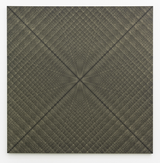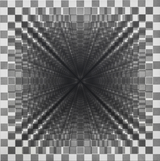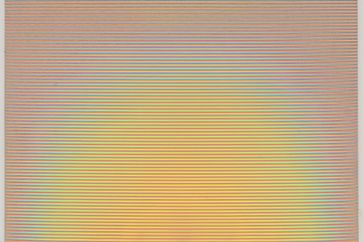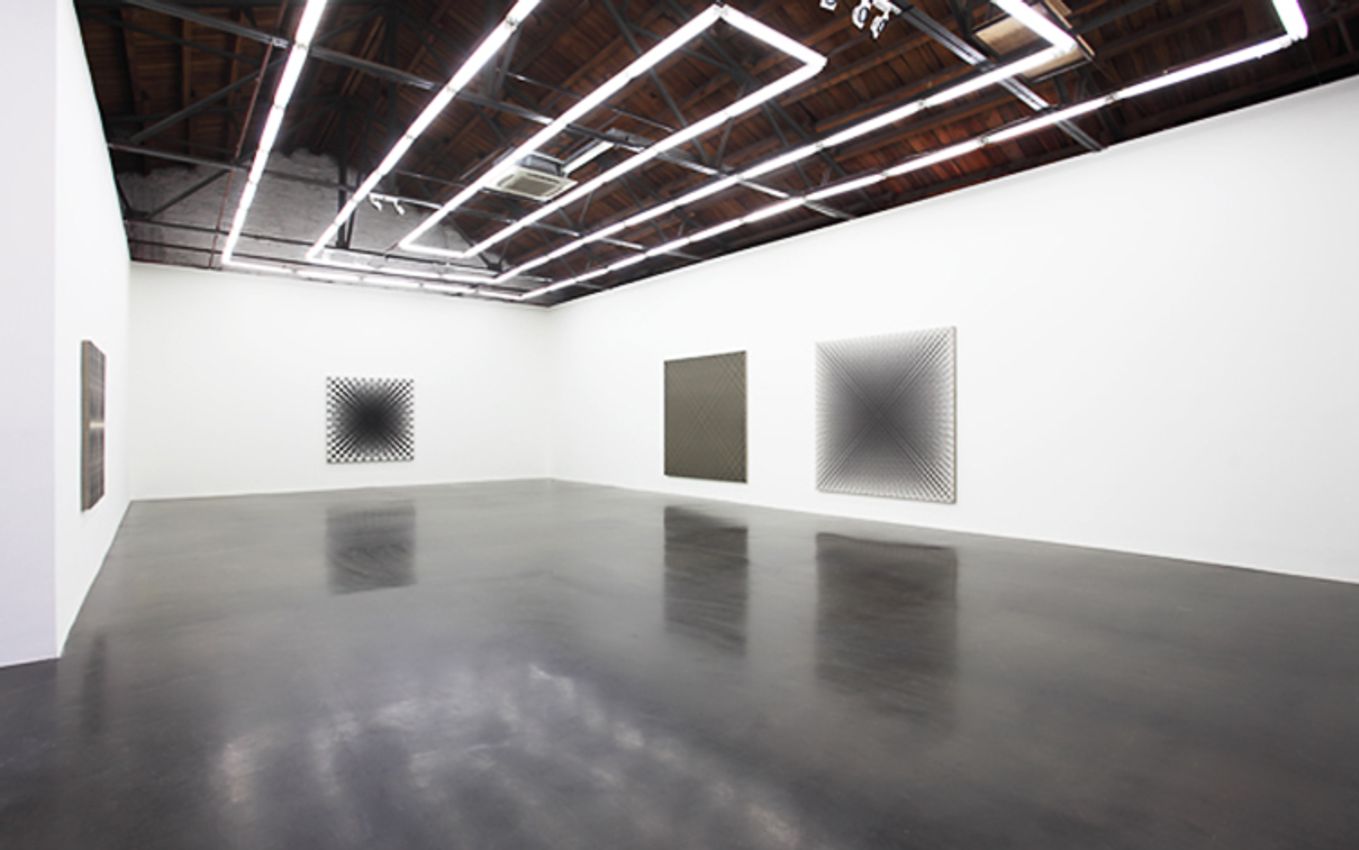
Beijing Commune is proud to announce the exhibition of Shang Yixin opening on November 19th, 2013. The show is young artist Shang Yixin’s first solo exhibition at Beijing Commune. The exhibition will continue until January 4th, 2014.
Since 2008, Shang Yixin has searched for a new medium to express his thinking. From 2008 to 2011, Shang created a series of light installations on the mutually constraining relationship between light source, object, and shadow. This group of artworks directly influenced Shang’s work on canvas. He has reduced the elements on the canvas down to the most simple–the square. In 2011, Shang chose the square as the sole element in his creative practice. In his works, squares have been reduplicated into a matrix. Their interconnections form a structure, a totalising organistion. Each work is the result of multiple layers of overlayed square matrices. As Shang says, ‘I control each square matrix in both the opacity and saturation I desire. Each layer’s overlay, the square matrix altered--enlarged, shrunk, shifted, comprising a half-translucent overlay--according to certain rules, disrupts the order produced and established by the previous layer while also building a new order. The form of the square matrices gradually becomes hazy and dissolves within the picture plane, becoming indeterminable. What emerges and replaces it is the ‘trajectory’ of this change, which gradually becomes stronger and more prominent. Each action enacted upon the square matrices influences the form of this ‘trajectory’ and is subsumed within it.’
In his 2013 works, Shang makes these experiments more precise and emphasizes the intensity of the artwork. The result is a static tension that is produced within the structure of the arrangements, a dialectic of stillness and movement. This ‘tension’ is brought about by various orders, rules, and rhythms. In 1013-4-2500, 13945-90-2500, and other works in the exhibition, squares are tightly arranged on the canvas. The artist hopes that through the juxtaposition and interconnection of these elements, he might incorporate his original reflections on visual logic into a broader mode of thinking that is meaningless yet contains an accumulation of operations.
In these new works, Shang Yixin also reduces their colour to black and white, or black and yellowish white. This makes his experiments more targeted, focusing on the different visual intensities produced by layers of greyscale and the final black and white contrast. His works thereby regain a sort of post-expansion sense of harmony within this new order. He uses carving software to produce adhesive tape for the square matrix he desires, which he affixes to the canvas. He then uses pressurised sprays to distribute blended acrylic or concentrated ink onto the adhesive tape, which has been affixed to the canvas in different proportions. The artist’s control over the tone and saturation of the pigment is rooted in his constant experimentation. As a result, in the course of rationally, consciously arranging and planning the work, its ‘trajectory’ is slowly generated. In other words, Shang’s practice does not engage cultural phenomena or emotional expression; rather, it is a rational appeal achieved through a process of sensorial experimentation.
Shang Yixin was born in 1980. He graduated from China Academy of Art (MFA) in 2007 and currently lives and works in Hangzhou. As one of emerging young artists, his works recently have been shown in many group exhibitions, such as Daily of Concept: A Practice of Life - The Fifth Shanghai Duolun Youth Art Exhibition at Shanghai Duolun Museum of Modern Art in Shanghai (2012), and ON | OFF: China’s Young Artists in Concept and Practice at Ullens Center for Contemporary Art in Beijing (2013). His works will also be included in Rubell family collection new exhibition 28 Chinese, Miami (December 4th, 2013 - August 1st, 2014).
Shang Yixin was born in 1980 in Wenzhou, Zhejiang province. In 2007 he graduated from the China Academy of Art Department with an MFA in Oil Painting. Currently he lives and works in Hangzhou. His works have been exhibited in Mingsheng Art Museum, Beijing (2017); How Art Museum, Wenzhou (2015); San Antonio Museum of Art, Texas, U.S. (2015); Asian Art Museum, San Francisco, U.S. (2015); Art Museum of Nanjing University of the Arts, Nanjing (2013); Rubell Family Collection and Contemporary Arts Foundation, Miami, U.S. (2013); Central Acaedmy of Fine Arts Art Museum, Beijing (2012); Ullens Center for Contemporary Art, Beijing (2013); The Gallery of China Academy of Art, Hangzhou (2011); Times Art Museum, Beijing (2010); Medium Art Centre, Beijing (2009); Liu Haisu Art Museum, Shanghai (2006); Zendai Museum of Modern Art, Shanghai (2006), etc.
Founded in 2004, Beijing Commune is now located in 798 Art Factory, Beijing. Its initial programs were mainly group shows exploring various currents in contemporary art while now it primarily focuses on solo shows to carry on the in-depth research.

A respected voice in contemporary art discourse.
Focusing on ambitious storytelling and insightful art-world commentary. Ocula Magazine publishes in-depth interviews, critical essays and timely analysis on the artists, exhibitions and ideas driving the global art world.
Learn more about Ocula Magazine
Showcasing the best of the art world.
Ocula partners with galleries from around the world to highlight their artists, artworks and exhibitions. Gallery membership is by application and invitation, with each member vetted by an independent panel.
Learn more about Ocula Membership

Specialises in the sale of major artworks.
Led by a team with deep ties to the world’s leading auction houses, galleries and collectors. Ocula’s advisory team offers bespoke services to high-net-worth clients from around the world who are looking to acquire the best of contemporary and modern art.
Learn more about our team and services