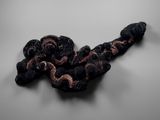
Galerie Lelong & Co. is pleased to present Having Gone I Will Return, a solo exhibition of new and recent work by Petah Coyne. In her first solo exhibition in New York in nearly a decade, Coyne conceives ambitious tableaux that evoke cross-cultural themes of vanity, grief, and tragedy.
Her richly layered, deeply psychological sculptures evince a long-standing interest in literature and literary figures, from Bruno Schulz to Joan Didion, and Japanese literature and film in particular. The exhibition title, Having Gone I Will Return, is an English translation of two Japanese terms for saying goodbye taken from Richard Lloyd Parry’s Ghosts of the Tsunami. Coyne often ties these tales to her own personal narratives of family and friends lost.
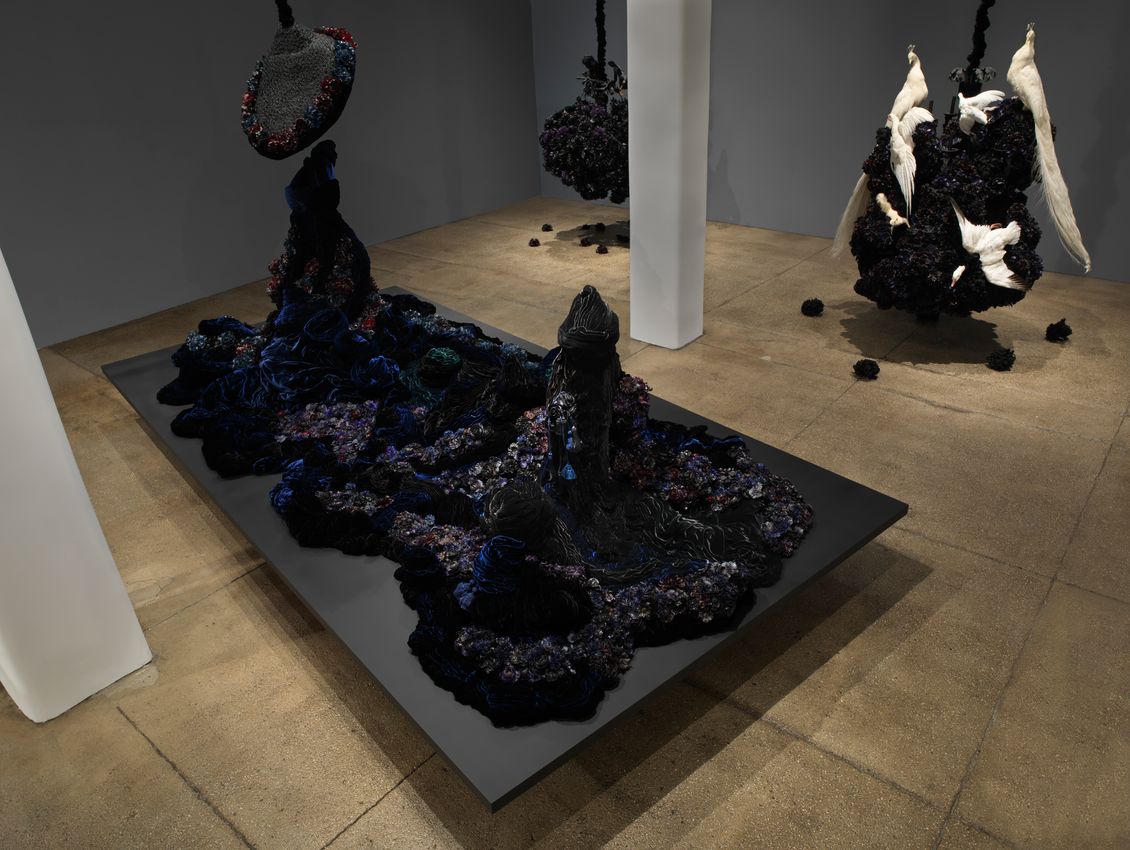
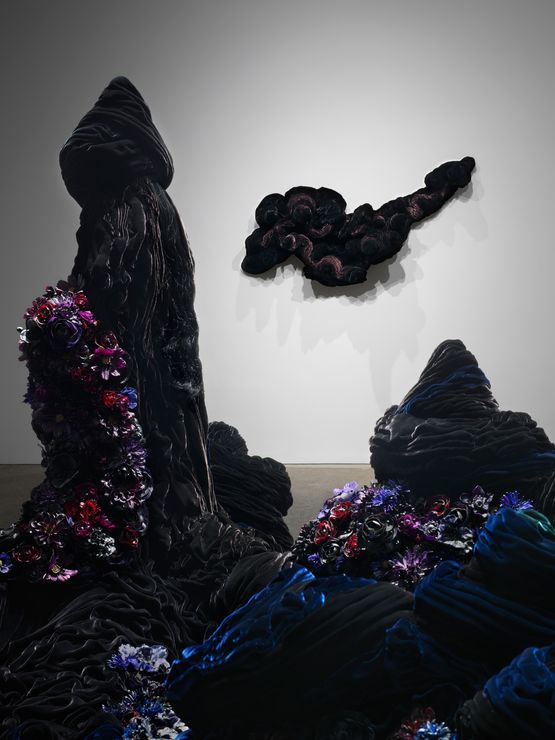
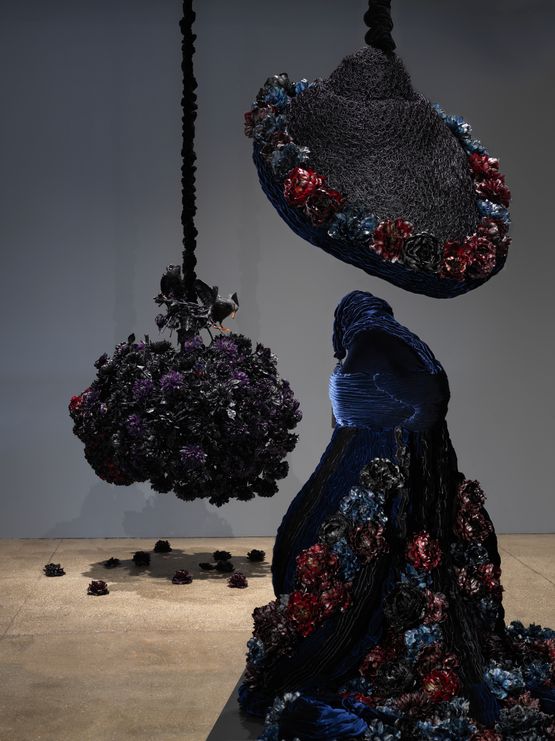
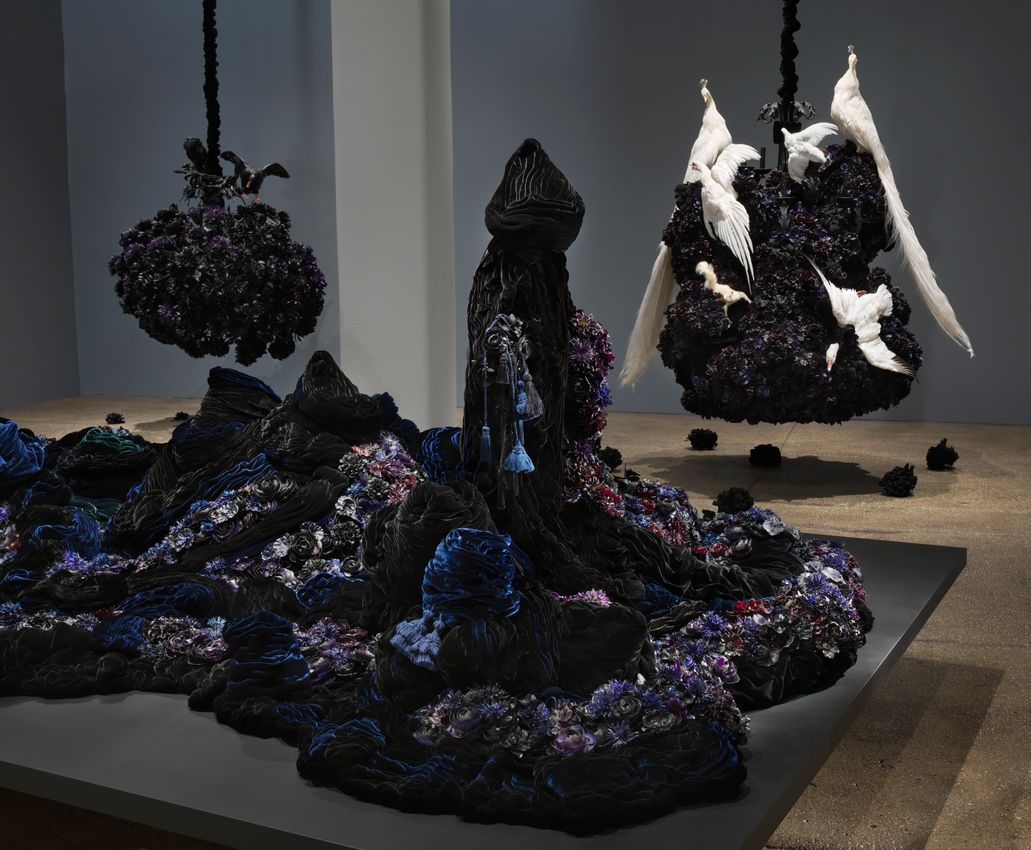
The centerpiece of the exhibition, Untitled #1379 (The Doctor’s Wife) (1997-2018), is a sprawling sculptural landscape composed of handsewn Venetian velvet, silk flowers dipped in wax, a hanging structure, and cast statuary enshrouded in fabric. For the first time, a special viewing platform will allow viewers to gaze downward onto Coyne’s work from above. The work recalls the novel The Doctor’s Wife by Sawako Ariyoshi, one of the most renowned Japanese women writers. It spins a twisted tale inspired by Hanaoka Seishū, a real-life Japanese surgeon, the first to successfully utilise general anesthesia. Invoking the melodrama between his mother and young wife, The Doctor’s Wife forewarns against competition among women, the kind that ultimately keeps men in power.
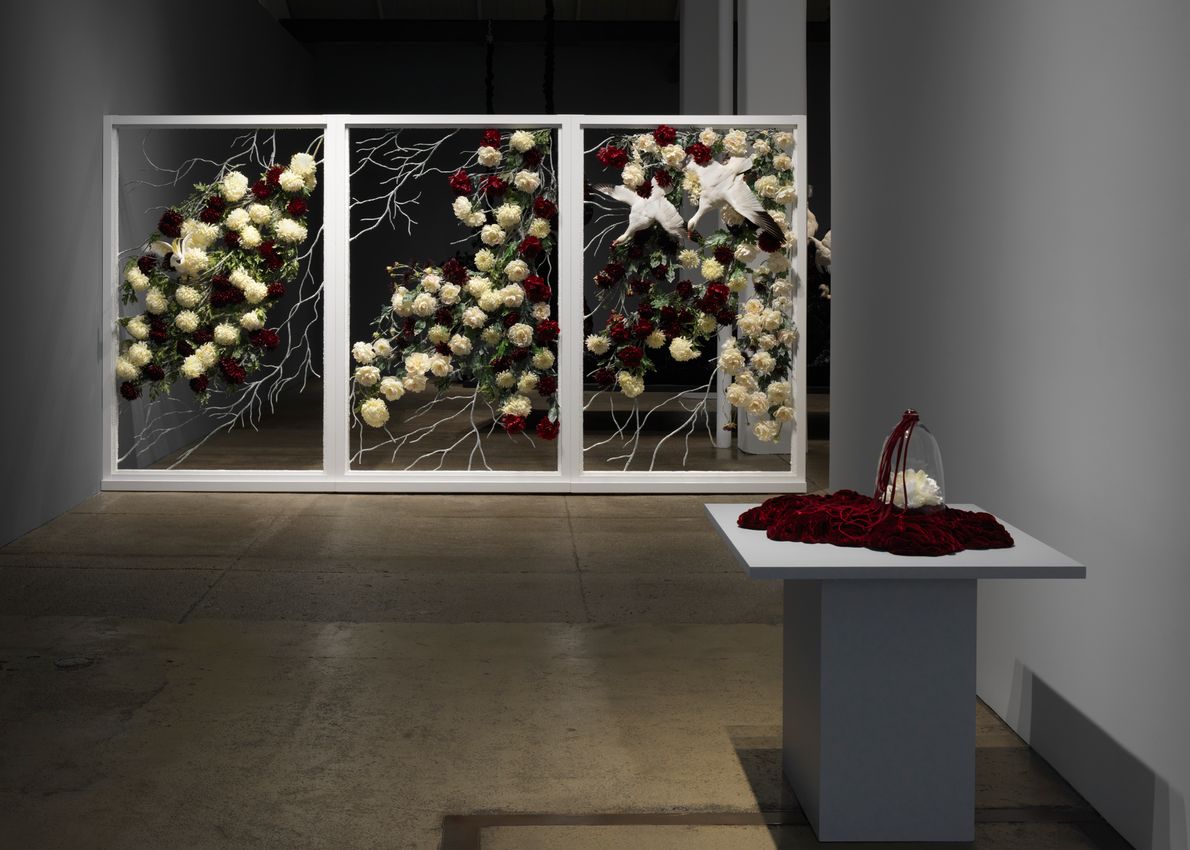
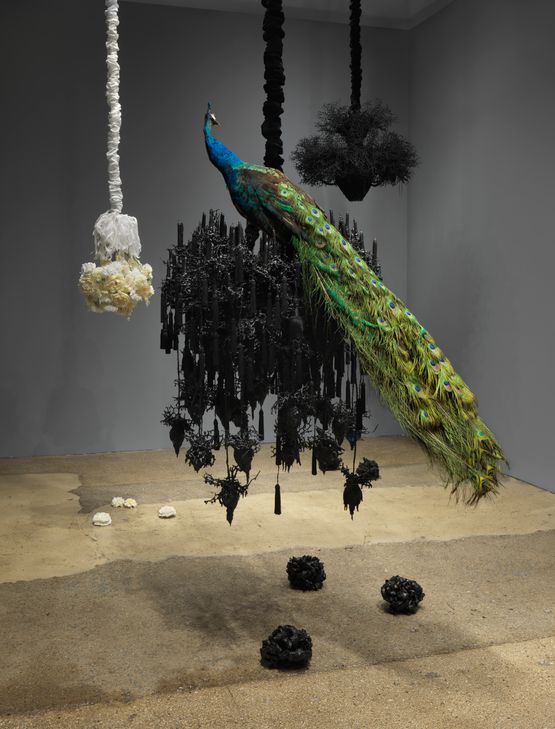
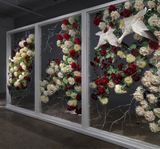
Coyne’s work takes the form of richly adorned gates in Untitled #1388 (The Unconsoled) (2013-2014), which is influenced by three Japanese authors and their writings: Kazuo Ishiguro’s The Unconsoled, Haruki Murakami’s The Wind-Up Bird Chronicle, and Kōbō Abe’s The Woman in the Dunes. Like the novels, the birds of Coyne’s sculptures seem to take an enthralling plunge into the dark depths between inescapable knowledge and uncertainty.
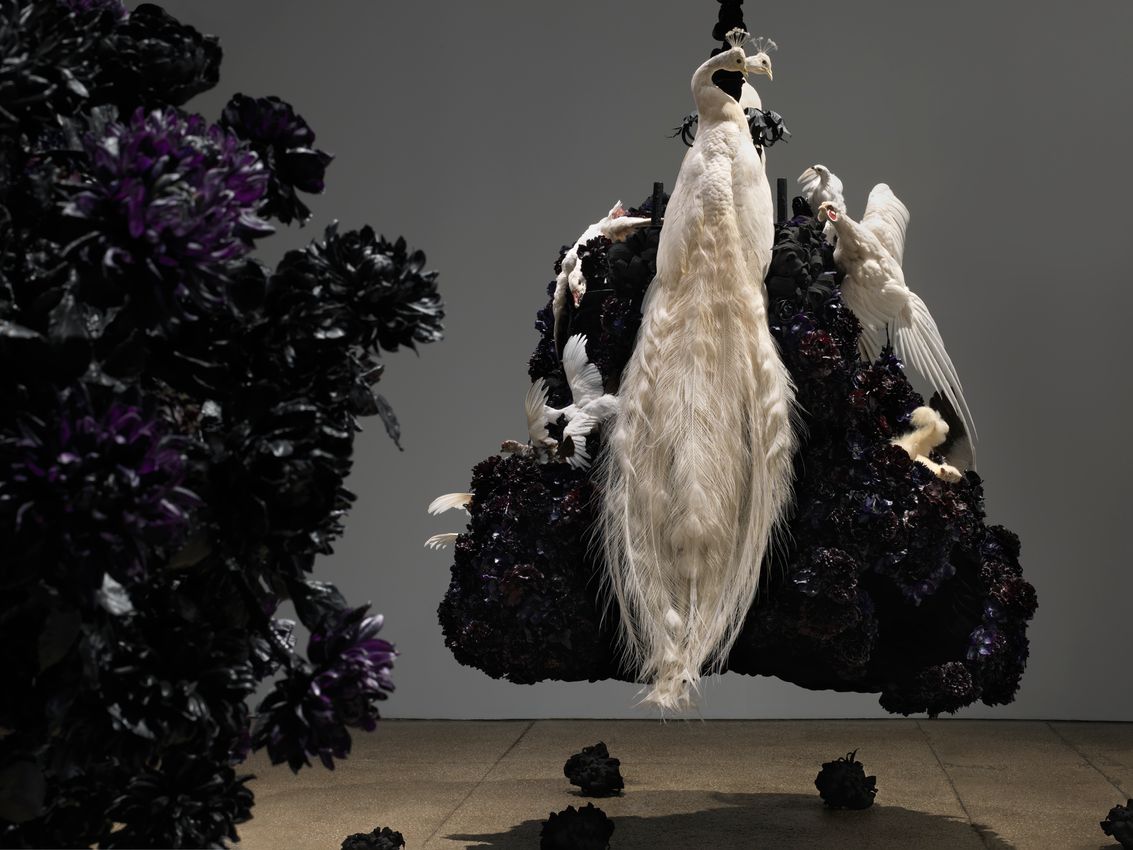
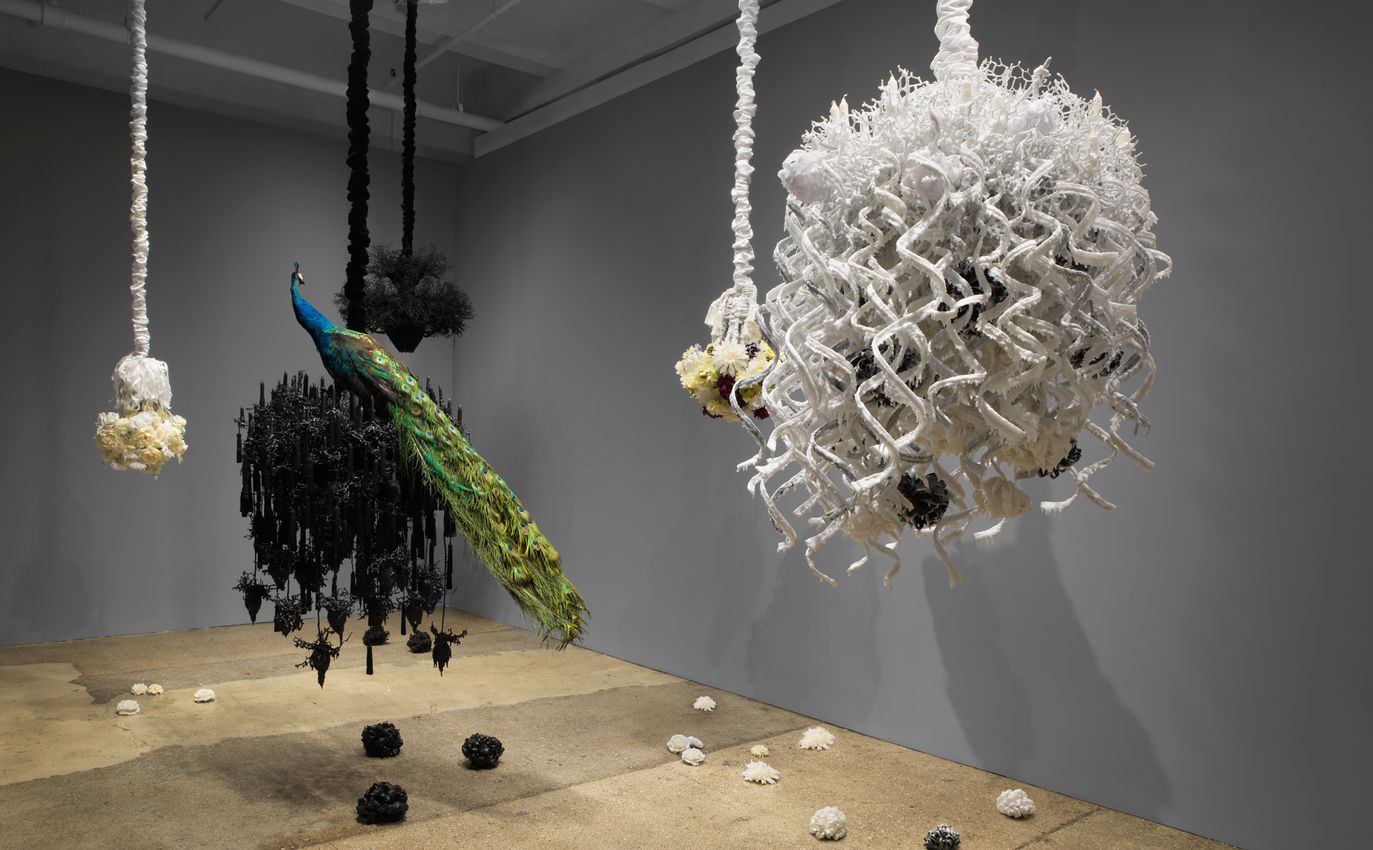
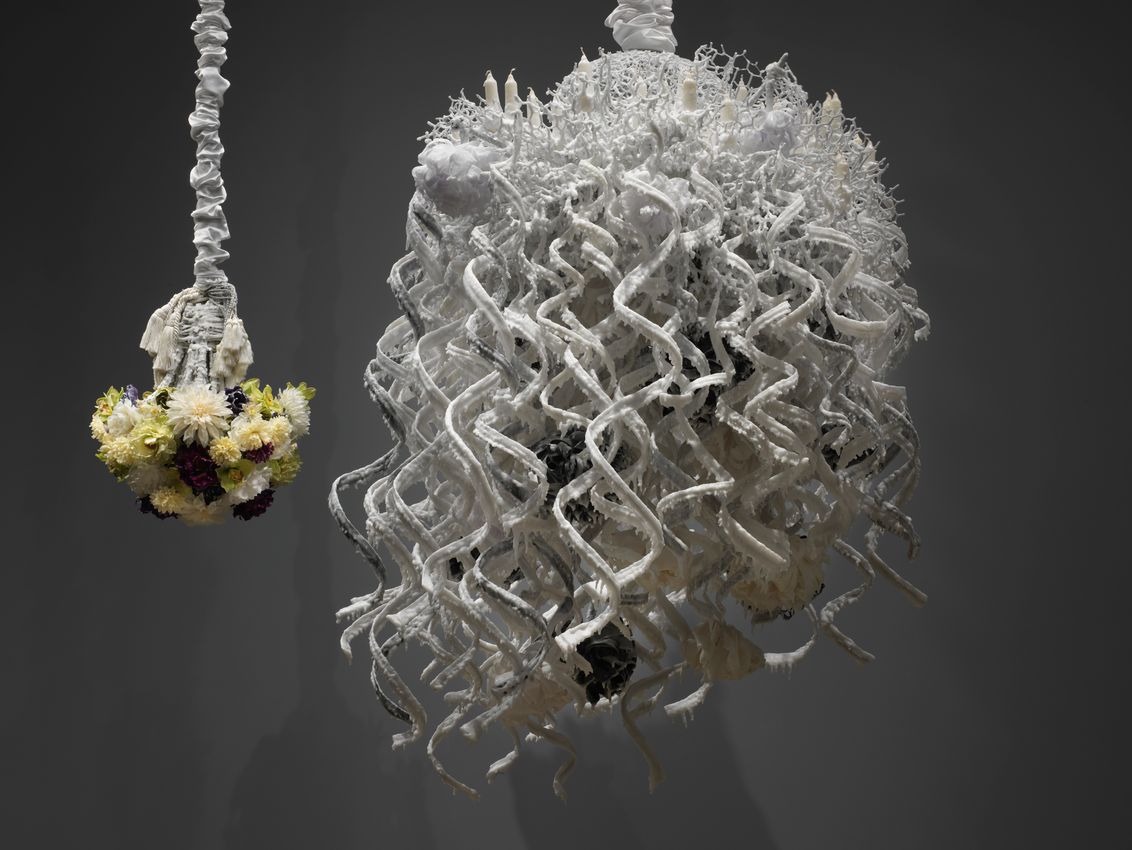
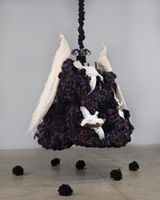
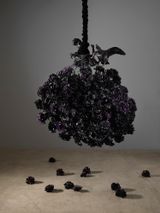
The smaller gallery will feature a site-specific installation of several sculptures suspended from the ceiling. Untitled #1242 (Black Snowflake) (2007-2012) refers to Masuji Ibuse’s novel Black Rain. The fallout from the bombing of Hiroshima, which stained the skin and especially ostracised women who bore its mark, is expressed as a chandelier-like structure from which mysterious jewels appear to sprout. This is offset by works in white, such as Untitled #1410 (Mishima’s Spring Snow) (2015-2016), whose height allows viewers to look upward into the sculpture’s wintry bowels, a mixture of materials that conflate the sartorial (ribbons, silk Duchesse satin, thread) with the industrial (wire, cable, steel).
A catalogue will be published in conjunction with the exhibition, featuring an essay by Jenni Sorkin, Associate Professor, History of Art & Architecture, University of California, Santa Barbara.
Since the 1980s, Coyne has received acclaim for sculptures with intense emotional content composed of intricate, unorthodox material such as shredded vehicles and chandeliers often dripping and covered in wax. Coyne has recently been featured in the Nevada Museum of Art, Reno; Smithsonian American Art Museum, Washington, D.C.; and Glasstress Gotika, a collateral event of the 56th Venice Biennale. Select solo exhibitions include: Mass MoCA, North Adams, Massachusetts; Albright-Knox Art Gallery, Buffalo, New York; Corcoran Gallery of Art, Washington, D.C.; Cincinnati Art Museum, Cincinnati, Ohio; The Sculpture Center, New York, New York; and the Kemper Museum of Contemporary Art, Kansas City, Missouri. Coyne’s works can be found in over 40 permanent museum collections, including the Museum of Modern Art, New York; Metropolitan Museum of Art, New York; Solomon R. Guggenheim Museum, New York; Whitney Museum of American Art, New York; Brooklyn Museum, Brooklyn; Philadelphia Museum of Art, Philadelphia; SFMOMA, San Francisco; Hirshhorn Museum and Sculpture Garden, Smithsonian Institution, Washington, D.C.; Museum of Fine Arts, Boston; Kemper Museum of Contemporary Art, Kansas City; Cincinnati Art Museum, Cincinnati; and the Museum of Contemporary Art Kiasma, Finland, among others.
Petah Coyne is a contemporary American sculptor and photographer. Described as the ‘queen of mixed media’ in Artforum magazine, she interweaves disparate and unorthodox materials–trees, human hair, scrap metal, silk flowers, religious statuary, and taxidermy–to create sculptures that are both precise in their attention to detail and baroque in their emotional range. Literature, film art history and the depths of an individual’s soul are all springboards for Coyne’s incessant and unrelenting imagination. In Coyne’s hands, materials, like our lived experiences, are endlessly re-purposed and reborn into something new.
Galerie Lelong & Co. represents prominent contemporary artists and estates from the United States, Latin America, Europe, Asia, and Australia. This uniquely diverse group includes mid-career and established artists at the forefront of the international art world working across all media.

A respected voice in contemporary art discourse.
Focusing on ambitious storytelling and insightful art-world commentary. Ocula Magazine publishes in-depth interviews, critical essays and timely analysis on the artists, exhibitions and ideas driving the global art world.
Learn more about Ocula Magazine
Showcasing the best of the art world.
Ocula partners with galleries from around the world to highlight their artists, artworks and exhibitions. Gallery membership is by application and invitation, with each member vetted by an independent panel.
Learn more about Ocula Membership

Specialises in the sale of major artworks.
Led by a team with deep ties to the world’s leading auction houses, galleries and collectors. Ocula’s advisory team offers bespoke services to high-net-worth clients from around the world who are looking to acquire the best of contemporary and modern art.
Learn more about our team and services