

The art world in focus
Subscribe to our newsletter for news and insights on artists, galleries and exhibitions.

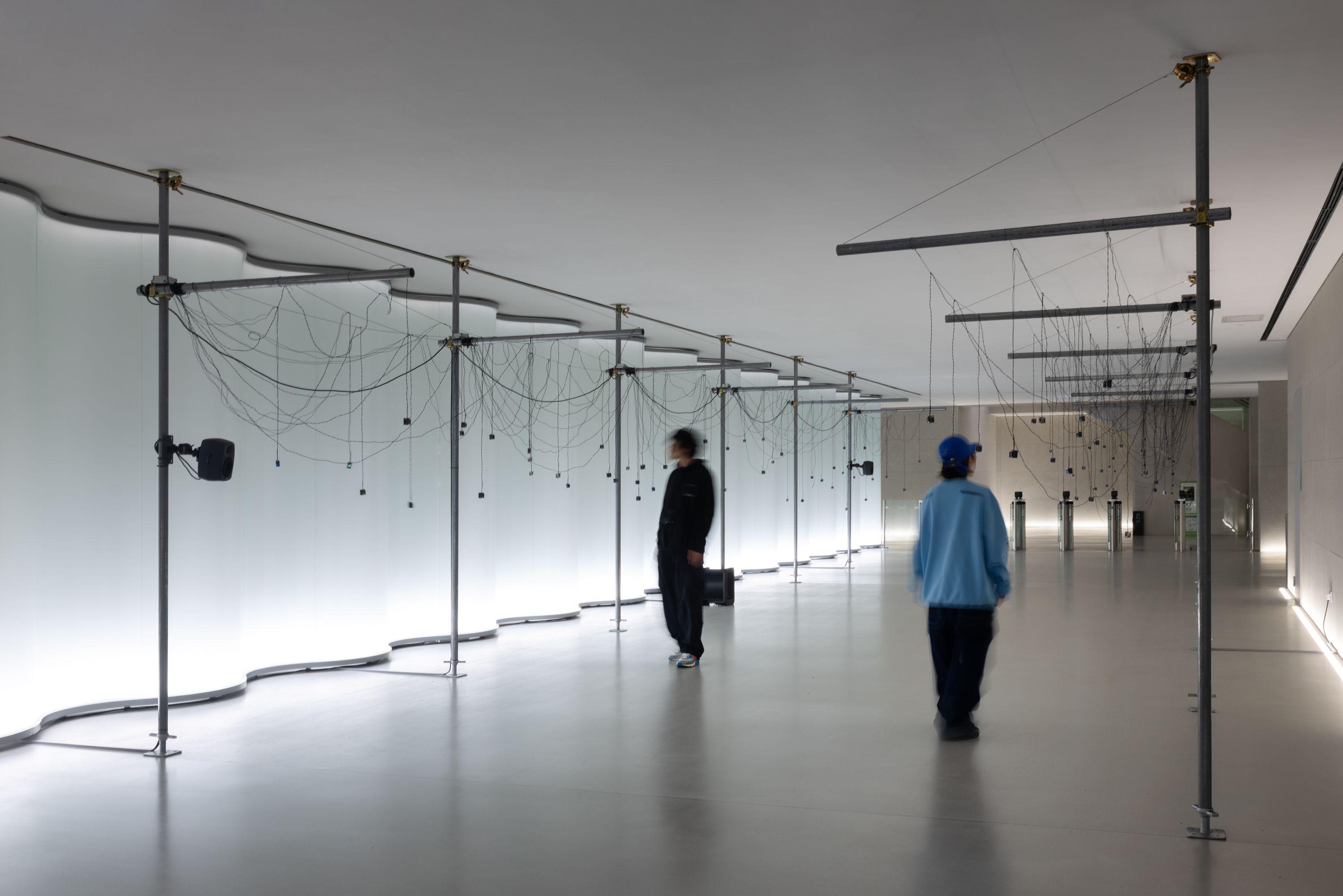
As _____ As Possible, Anthropic Research Salon. Courtesy Centre Pompidou Hanwha.
Anthropic, the AI giant behind large language model Claude, has backed five new art commissions at Seoul’s Centre Pompidou Hanwha, bringing the US corporation’s AI research into a museum setting and marking its first such venture in South Korea.
On view until 13 November, As _____ As Possible presents new commissions by MinOhrichar, Inhwa Yeom, Ubac Studio, Kahee Jeong and Mirim Chu and is organised by the Hanwha Foundation of Culture, with production funding and access to Claude provided by Anthropic.
The collaboration began with the Seoul Research Salon, a forum exploring how AI systems work, and was later expanded to include the five commissions. Jieun Seo, senior curator at Hanwha Foundation of Culture, told Ocula that the project “was conceived not as an exhibition intended to demonstrate or promote the capabilities of a particular technology, but as an art commission supporting artists in developing their own artistic inquiries”.
Seo continued: “One of the most meaningful aspects of this art commission was that it provided artists with the production resources and support needed to pursue technically ambitious, large-scale works and new forms of experimentation that might otherwise have been difficult to realise.”
The exhibition’s framework draws on interpretability—understanding how AI systems arrive at their outputs—and alignment, which concerns whether systems act in accordance with human intentions and values. Through video, sound, installation and interactive environments, the artists consider what AI systems make intelligible and what escapes their categories.
“The exhibition does not seek to take a definitive position for or against AI; nor does it attempt to provide clear-cut answers to the challenges posed by technology,” Seo explained. “Instead, it aims to create an open space in which artists and audiences can reflect on what technology makes possible, what it reveals or excludes, and which aspects of human experience may remain beyond the reach of technological systems.”
Chu takes her cue from the ways in-car satellite navigation systems recalculate when a driver leaves a suggested route. In Searching for a New Route (2026), she applies this idea to animation software, using Claude to investigate how the software’s “shape tween” function morphs two forms into a new shape. By changing the order and timing of connections, she allows the animation to take a different route, producing shapes beyond the programme’s initial calculations.
The work extends Chu’s longstanding interest in the relationship between digital environments and physical space. Here, AI helps her to intervene in the software through which she makes images, opening its apparently automatic decisions to artistic manipulation.
Other commissions include 103 Early Hints (2026), Jeong’s installation of 103 miniature displays and speakers, and Ubac Studio’s 32-screen environment Body, Still, Moving (2026), which changes with viewers’ movements.
Seo pointed to Yeom’s exploration of neurodiversity through AI and extended reality, and MinOhrichar’s use of Monopoly to question whose interests a system’s rules serve, as examples of how artists can examine technology’s underlying assumptions. These technologies, the curator said, “should not be exempt from critical examination”.
The commissions extend Anthropic’s involvement with museums in Asia. Following its collaboration with Tokyo’s Mori Art Museum on the 2025 exhibition Machine Love, the company expanded its partnership to include the institution’s triennial Roppongi Crossing show in the same year, providing technical support through Claude for works by AA Murakami and Tomo Kihara. Further collaborations are planned through learning programmes and events.
Anthropic’s first cultural partnership in South Korea comes amid growing concerns surrounding the company’s acquisition of Korean books. According to recent local media reports, at least 15 Korean authors are eligible for compensation at $3,000 per title, following the $1.5 billion settlement of a class action lawsuit brought by a group of authors who accused Anthropic of misusing their books to train Claude.

A respected voice in contemporary art discourse.
Focusing on ambitious storytelling and insightful art-world commentary. Ocula Magazine publishes in-depth interviews, critical essays and timely analysis on the artists, exhibitions and ideas driving the global art world.
Learn more about Ocula Magazine
Showcasing the best of the art world.
Ocula partners with galleries from around the world to highlight their artists, artworks and exhibitions. Gallery membership is by application and invitation, with each member vetted by an independent panel.
Learn more about Ocula Membership
Specialises in the sale of major artworks.
Led by a team with deep ties to the world’s leading auction houses, galleries and collectors. Ocula’s advisory team offers bespoke services to high-net-worth clients from around the world who are looking to acquire the best of contemporary and modern art.
Learn more about our team and services