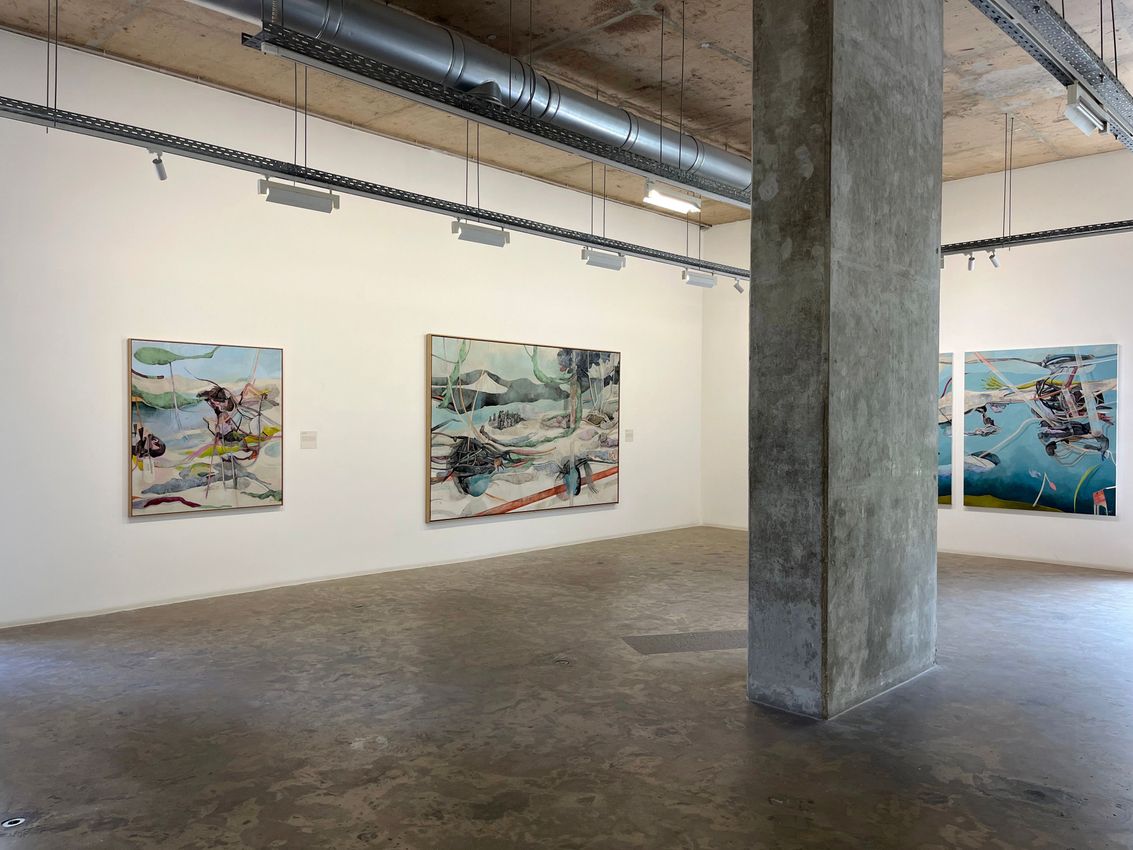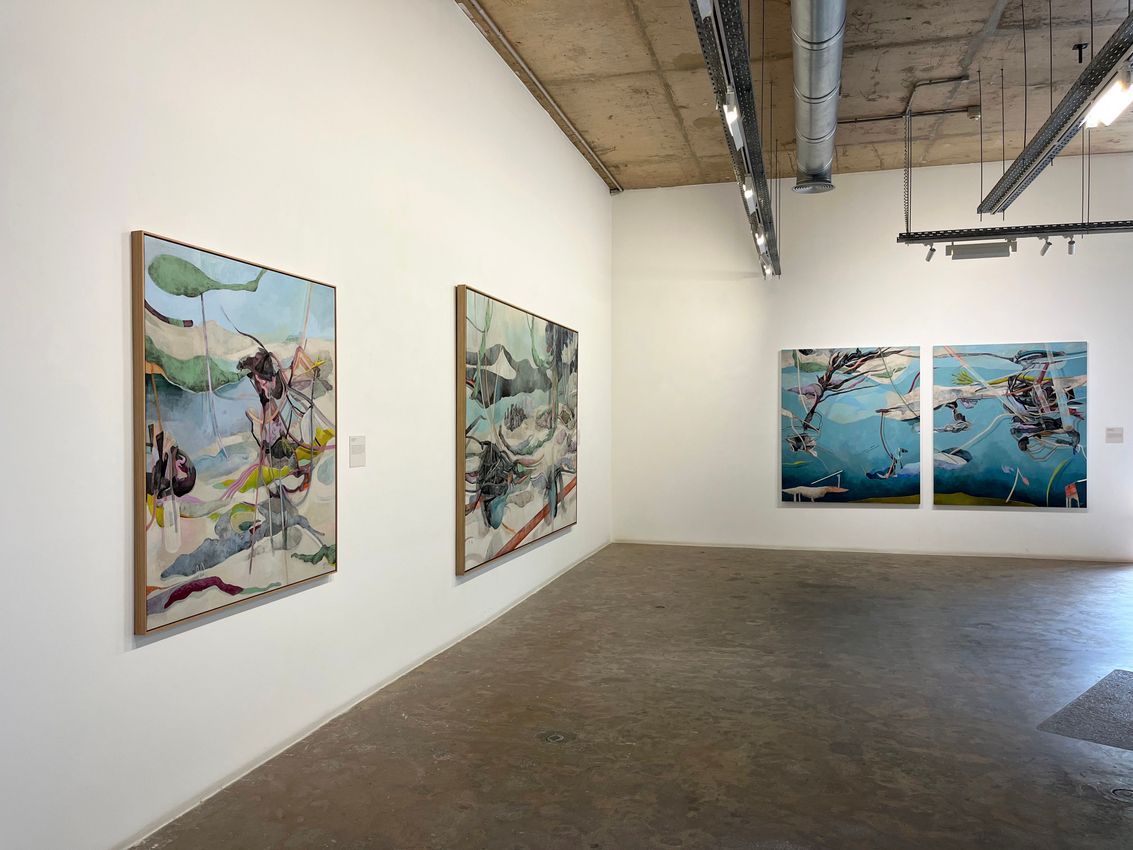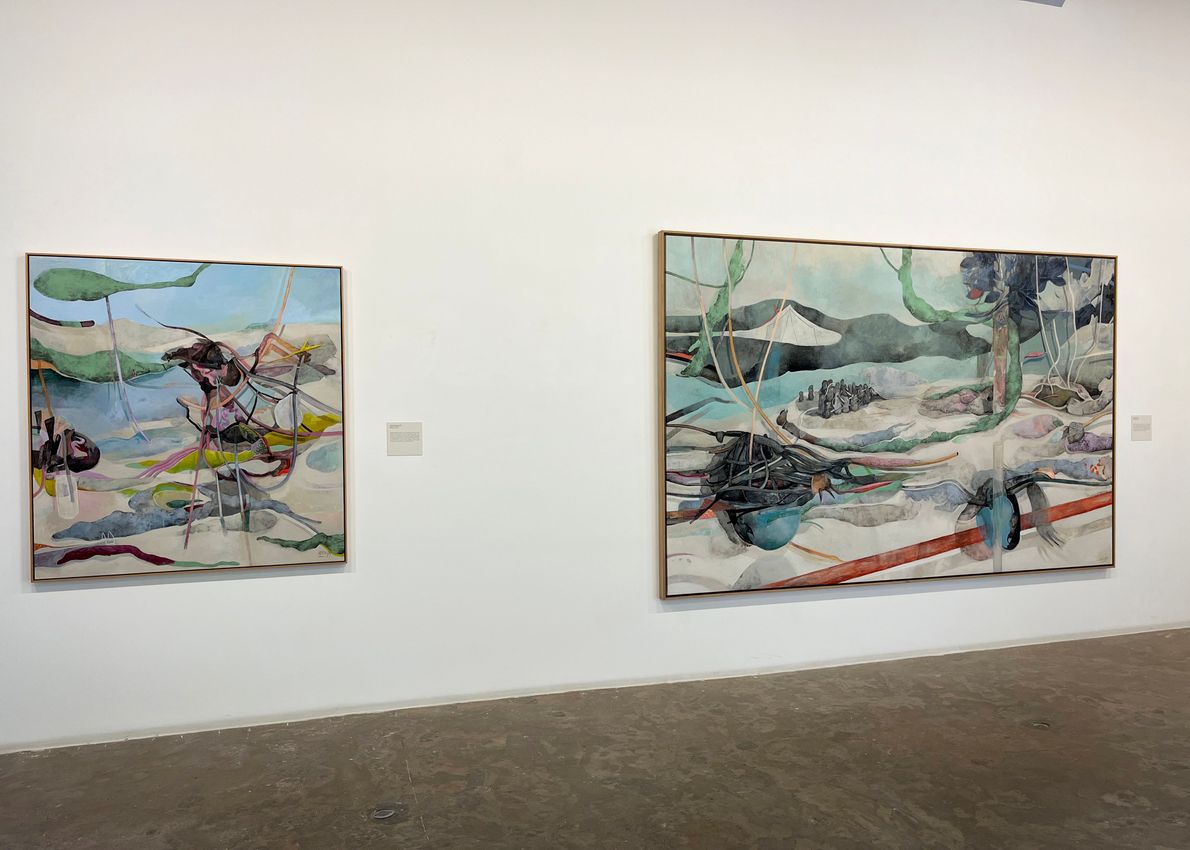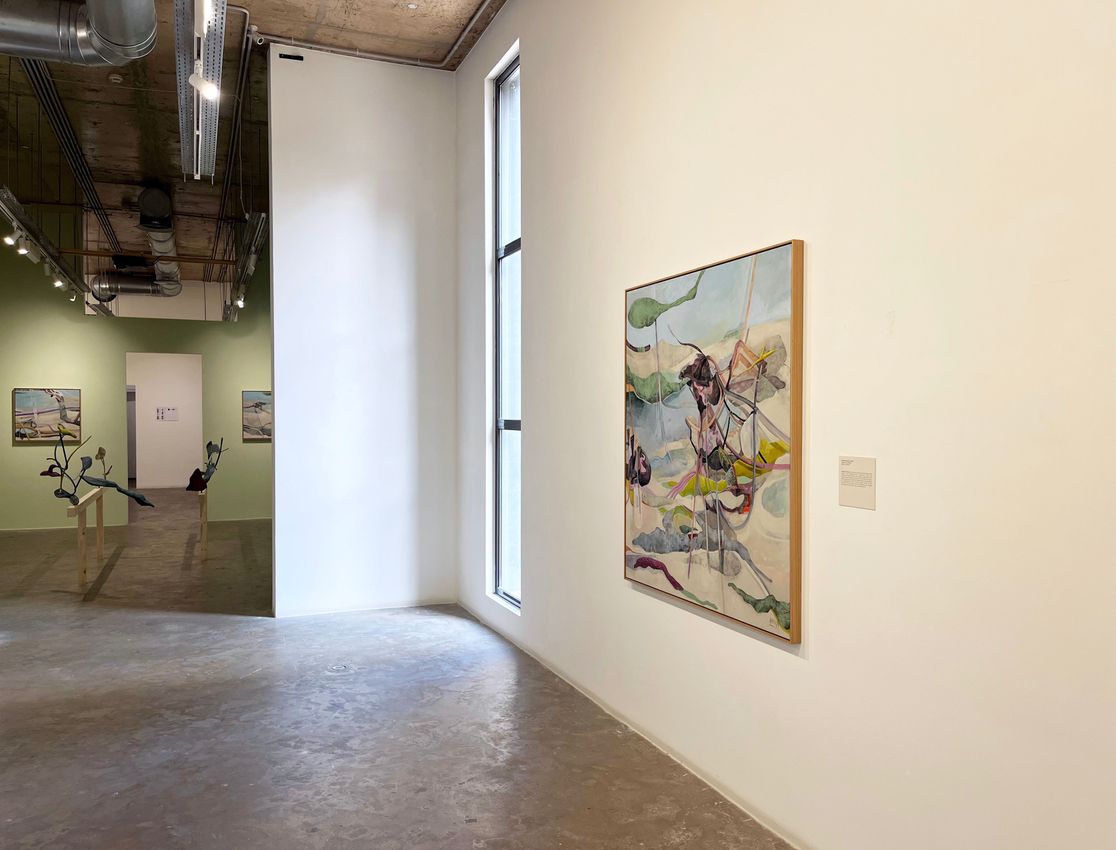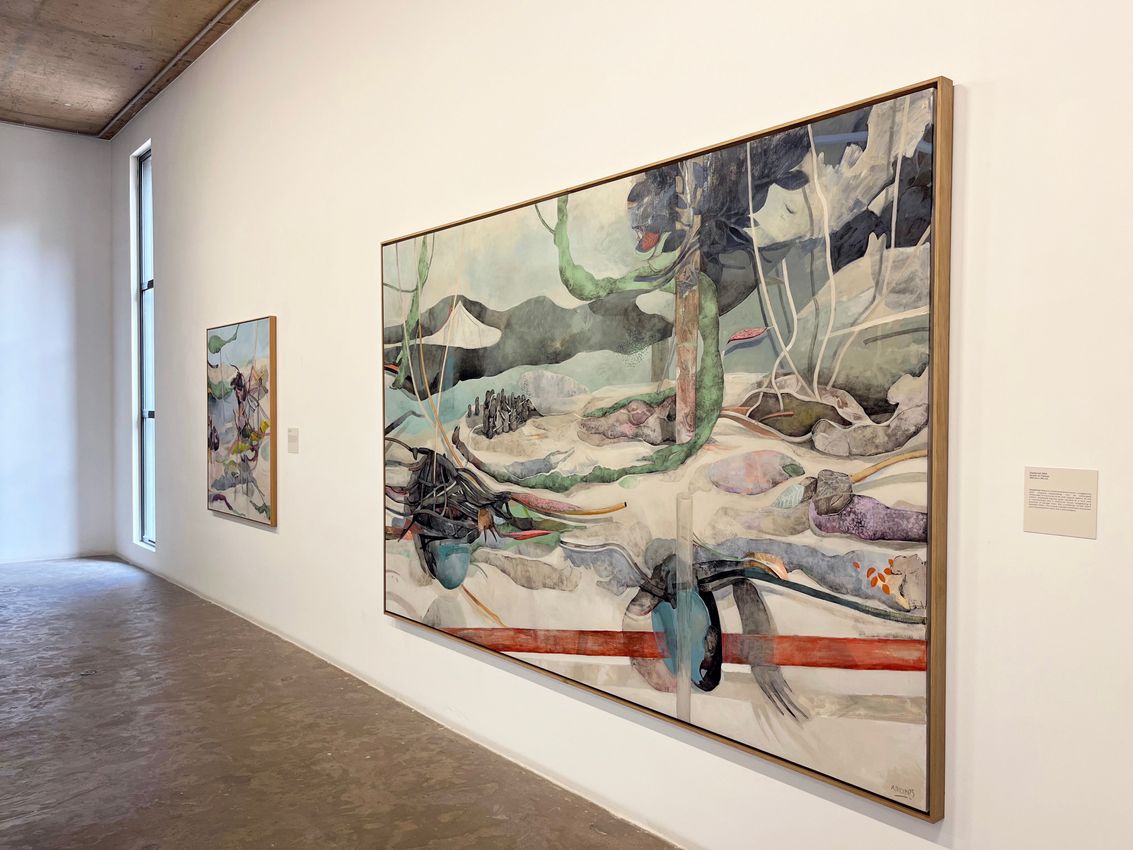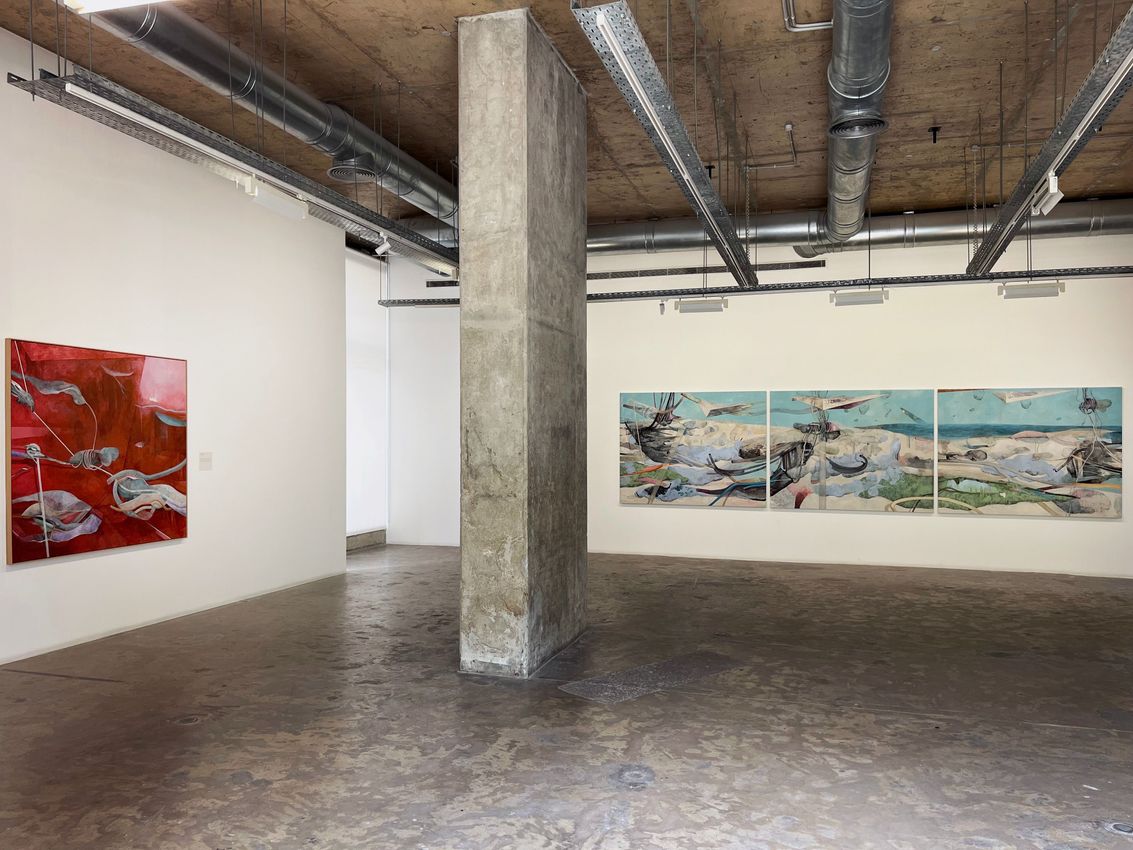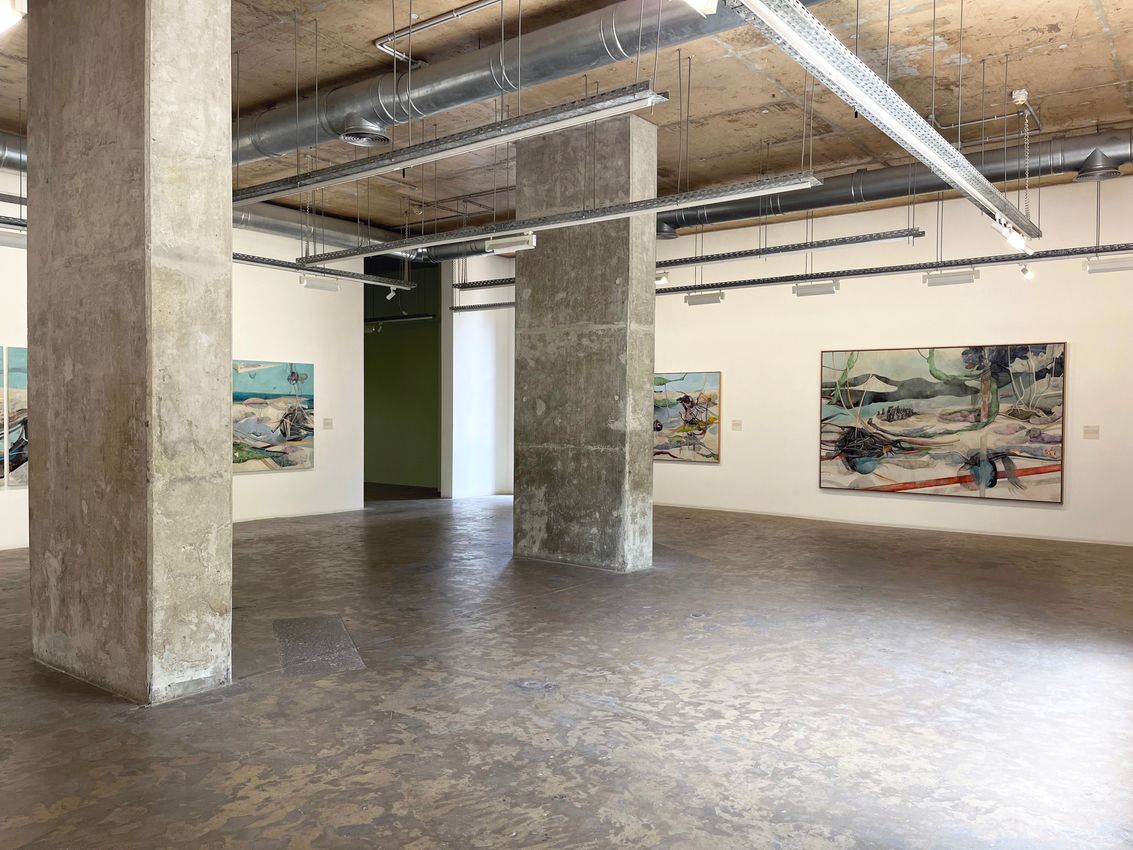




In an era defined by violence, displacement and environmental crisis, the question of what survives catastrophe has become increasingly urgent. Through this new body of work, Adel Abidin returns to painting to investigate how trauma inscribes itself upon landscape, memory, and collective consciousness. Throughout these distinct works, the horizon line emerges as a constant yet mutable presence—sometimes a stark divider, elsewhere a blurred boundary—guiding viewers through varied territories of loss and persistence.
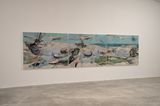
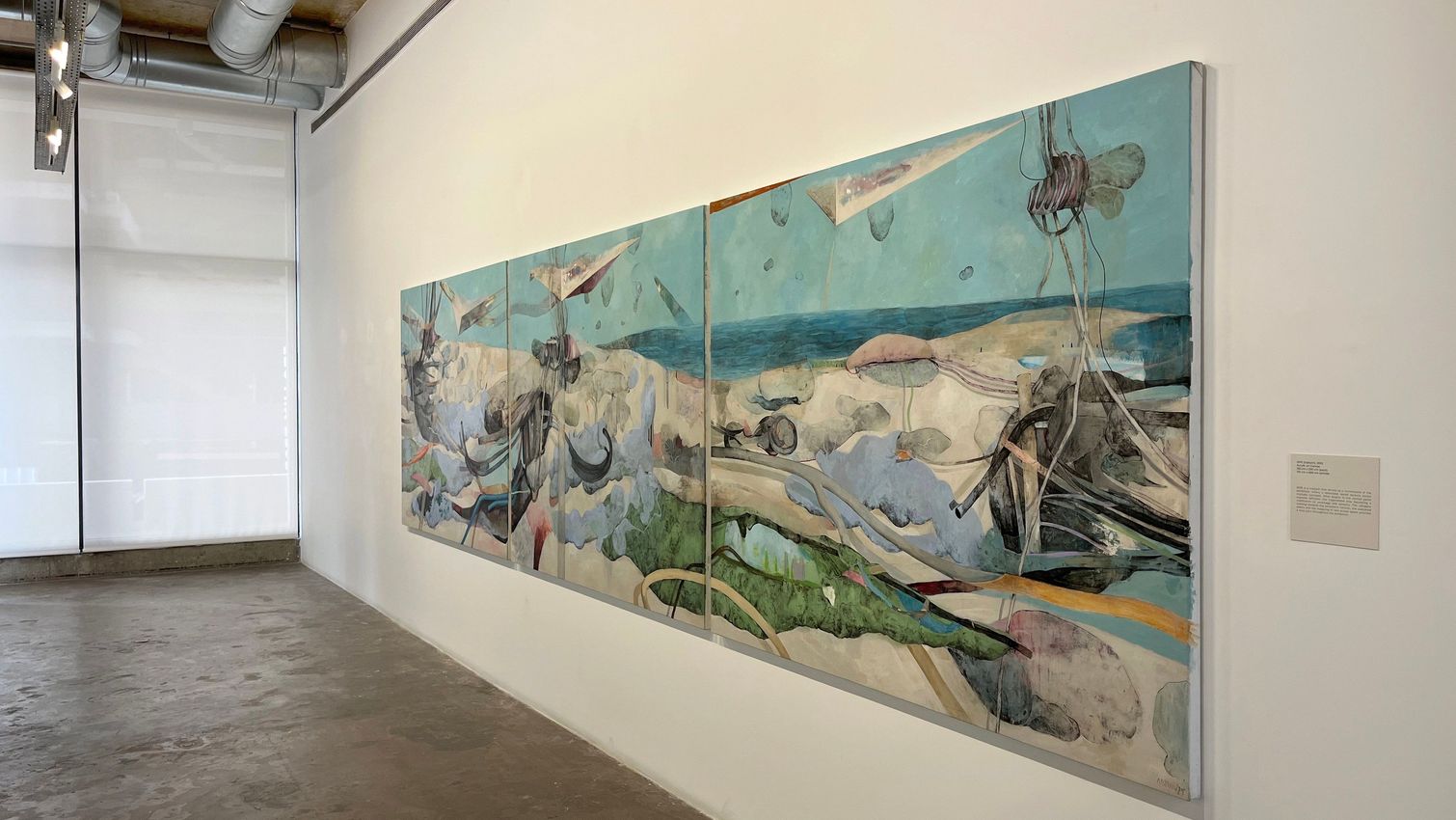
The triptych Drift serves as a cornerstone of the exhibition, where a destroyed vessel sprawls across multiple canvases. What begins in the central panel expands leftward, the fragmented ship becoming a meditation on wreckage and remains. As refugees walk towards the persistent horizon, the scattered debris and mapping of loss across space prove foundational to the series, establishing both formal and thematic elements that echo throughout the exhibition.
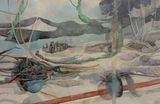
In the painting Displaced, two ethereal blue forms—suggesting alien engines—descend into an entangled landscape of fractured lines and organic debris. At the center, displaced figures gaze upward at a tent that is transformed into a luminous cloud—suggesting a promise of escape from the crumbling ruined Earth beneath them. This scene merges mankind’s expulsion and dispossession with the transcendent.
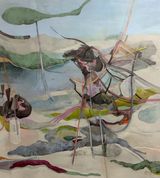
Metamorphosis is a meditation on displacement and survival, where traces of the natural and the human are transformed into shapes that speak to memory, loss, and endurance. It unfolds as a shifting landscape where organic and abstract forms intertwine. Lines and fragments spread across the surface, dissolving clear horizons and creating a sense of movement between disintegration and renewal.
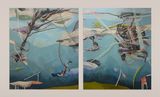
Aquarium is a diptych that explores the idea of contained catastrophe through its distinct aquatic environment, where fragments of industrial remnants and organic forms drift in an aqueous atmosphere suggesting both submersion and isolation. The work reflects on how tragedy becomes spectacle, and how containment shapes our perception and relationship to catastrophic events.
Above the Abyss offers a hesitantly hopeful vision: a spectral vessel glows in the upper right while figures hover at the edge of a vast void. Suspended between escape and peril, they exist in a space neither ground nor sky—a terrain so profoundly altered that it resembles an artificial spaceship more than natural landscape.
While these landscapes and seascapes possess a deliberate universality—they could be anywhere displacement and loss have left their mark—nevertheless, they are also deeply informed by Abidin’s formative years in Iraq. The quality of light, the relationship between water and land, the specific texture of destruction—all carry echoes of Iraqi terrain, though transformed through memory and artistic vision into spaces that speak to global experiences of destruction and loss.
Each painting offers its own meditation on displacement, united by the horizon’s role as both geographical marker and psychological opening. Whileone canvas might present the horizon as a wound across a fractured landscape, another transforms it into a liminal space where mechanical debris and human figures hover between existence and erasure. These distinct approaches to the horizon create a dialogue between works, speaking to different aspects of dislocation and survival.
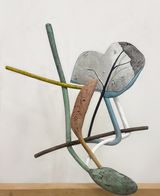
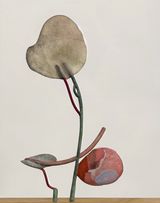
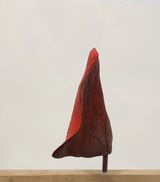
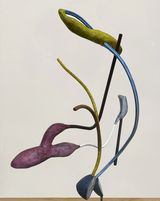
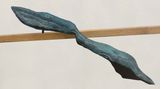
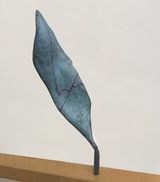
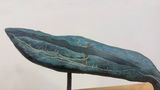
The composite sculptural work What Remains, stands as a physical manifestation of Abidin’s painted territories of loss and persistence. Like preserved ruins that tell stories of both destruction and endurance, this work transforms the exhibition’s painted testimonies into three-dimensional form. Mounted on parallel wooden beams that echo the fractured horizons of his paintings, the installation’s components seem to float between two worlds, where mechanical debris and fractured landscapes hover between existence and erasure.
The power of these works resonates with poignant meditations on cultural collapse throughout history. Like the preserved ruins of Pompeii, where an entire civilization stands frozen in ash, these paintings capture moments suspended between existence and obliteration. In their stark horizons and fractured landscapes, they echo T.S. Eliot’s poem, The Wasteland, a modernist vision of a world of broken images and fallen towers, where mountains appear and disappear in the brown fog of a desolate terrain. Abidin’s paintings, like Eliot’s verses, reveal how desert visions and mirages can speak truth about trauma and chaos.
Drawing from his position as a diaspora artist working between cultures, Abidin transforms the condition of dislocation into a universal meditation on survival and renewal. His return to painting amid our current global crises proves particularly resonant—the medium itself becomes a way of preservingand processing collective trauma, much as ruins continue to tell stories of both destruction and persistence.
What Remains ultimately asks us to consider what persists when the familiar falls away. In these painted testimonies, memory becomes a repository of loss but also a source of regeneration. Through these works, we witness how remembrance itself can become an act of resistance, transforming apocalyptic ruins of the past into foundations for imagining new futures.
Press release courtesy Galerie Tanit, Beyrouth/Munich. Text: Dr. Tamara Chalabi, August, 2025.


Adel Abidin was born in Baghdad (1973) and currently resides between Helsinki and Amman. He received a B.A. in painting from the Academy of Fine Arts in Baghdad (2000) and an M.F.A from the Academy of Fine Arts in Time and Space Art in Helsinki (2005). Since his representation of Finland at the Nordic Pavilion in the 52nd Venice Biennale (2007), his work has been the subject of major exhibitions worldwide including Van- haerents Art Collection, Brussels (2015), 56th Venice Biennale in the Iranian Pavilion (2015), The Glasstress-Gotika, 56th Venice Biennale, International Exhibition, Palazzo Franchetti (2015), 5th Guangzhou Triennial, The Guang- dong Museum of Art, Guangzhou (2015), The Pera Museum, Istanbul (2015), Aga Khan Museum, Toronto, Canada (2015), Gwangju Museum of Art, South Korea (2014), The Jerusa- lem Show VII, Jerusalem (2014), Louisiana Museum of Modern Art, Denmark (2014), MACRO-Museum of Contemporary Art, Rome (2014), Mori Art Museum, Tokyo, Japan (2013-2012), 54th Venice Biennale, Iraq Pavilion (2011), 10th Sharjah Biennale, UAE (2011), MOCCA, Toronto (2011), Mathaf: Arab Museum of Modern Art, Doha, Qatar (2010), 17th Biennale of Sydney, Sydney (2010), MAP, Mobile Art Production, Stockholm, Sweden (2009), 11th Cairo Biennial, Cairo (2008), Screening at MoMA, Museum of Modern Art, New York (2008), Art Paris, Grand Palais, Paris (2008), Espace Galley of Contemporary Art, Louis Vuitton, Paris (2008), The Mildred Lane Kemper Art Museum, St. Louis, USA (2008) and The 4th Gothenburg Biennale, Sweden (2007).


A respected voice in contemporary art discourse.
Focusing on ambitious storytelling and insightful art-world commentary. Ocula Magazine publishes in-depth interviews, critical essays and timely analysis on the artists, exhibitions and ideas driving the global art world.
Learn more about Ocula Magazine
Showcasing the best of the art world.
Ocula partners with galleries from around the world to highlight their artists, artworks and exhibitions. Gallery membership is by application and invitation, with each member vetted by an independent panel.
Learn more about Ocula Membership

Specialises in the sale of major artworks.
Led by a team with deep ties to the world’s leading auction houses, galleries and collectors. Ocula’s advisory team offers bespoke services to high-net-worth clients from around the world who are looking to acquire the best of contemporary and modern art.
Learn more about our team and services