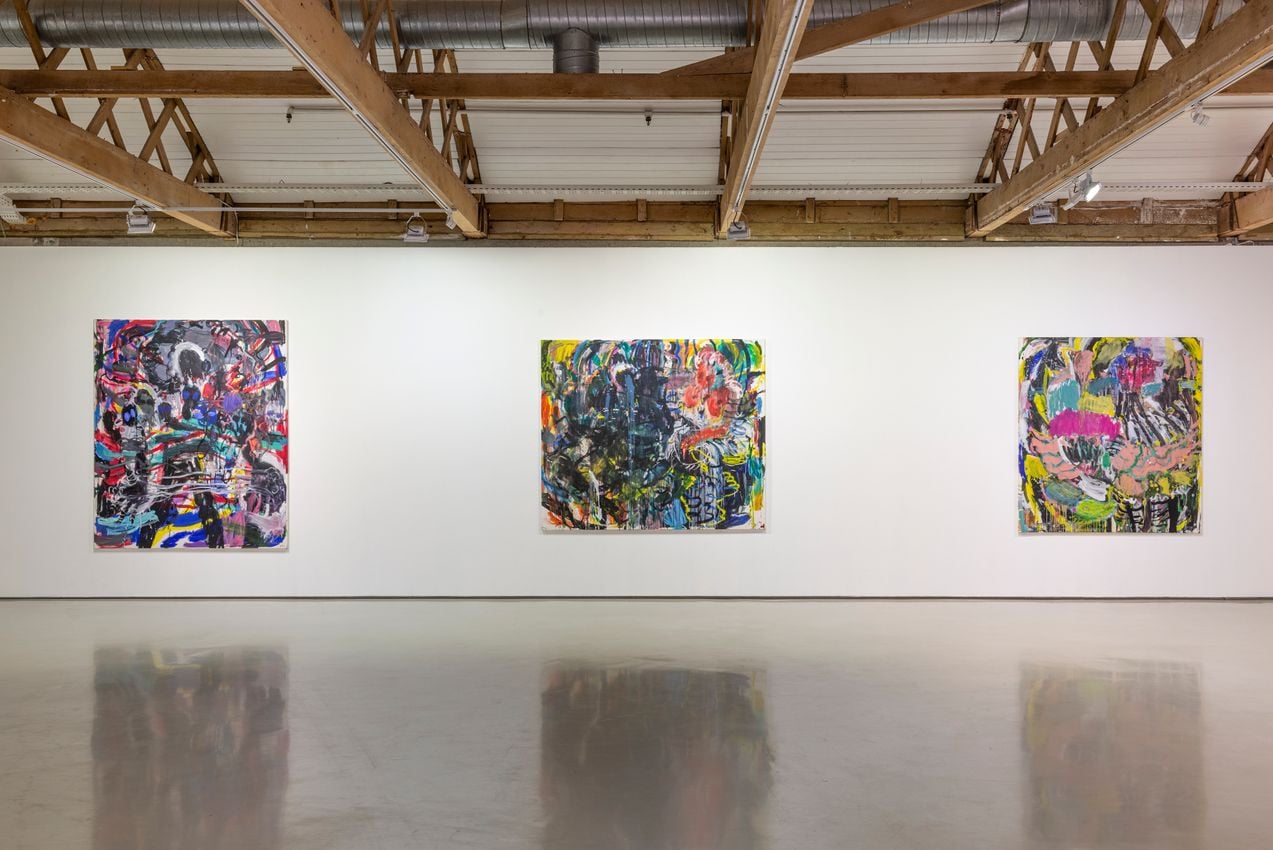
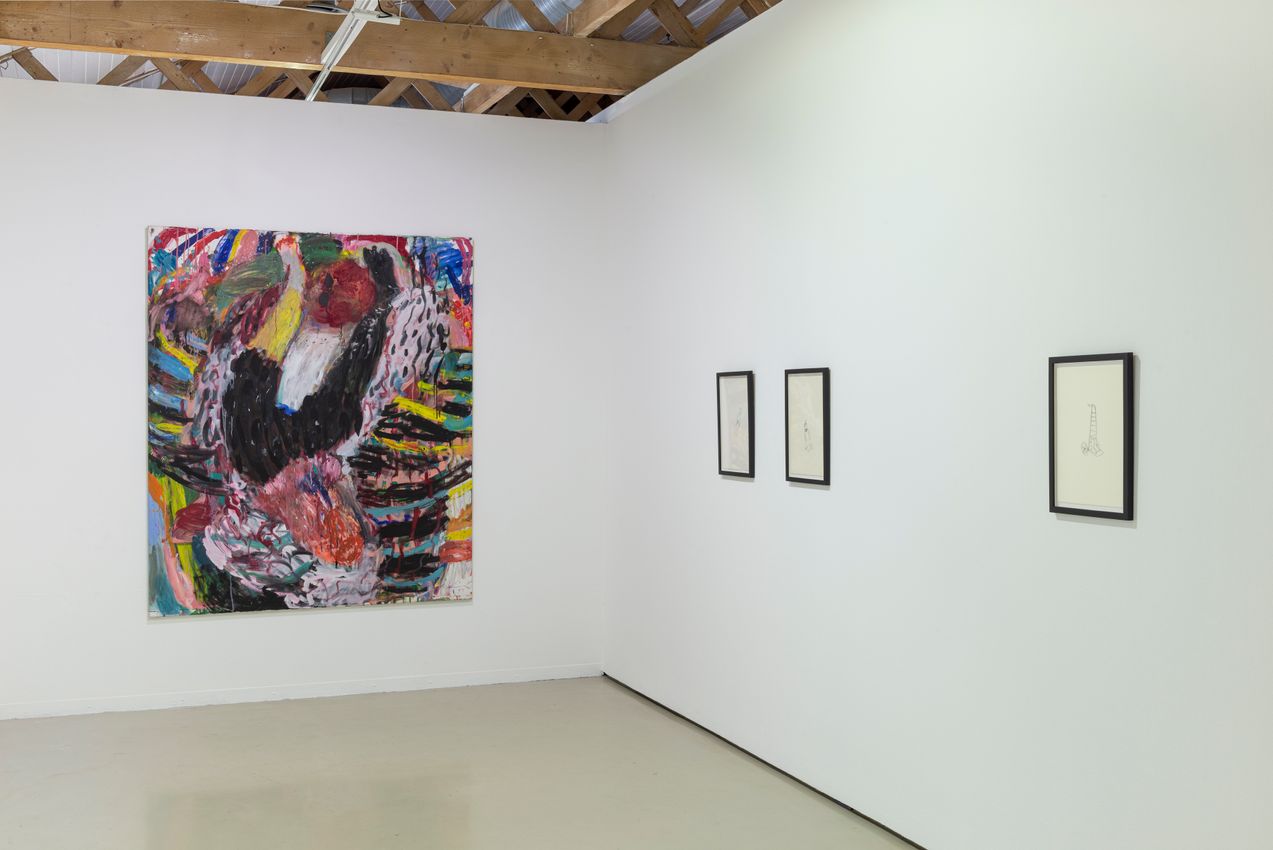
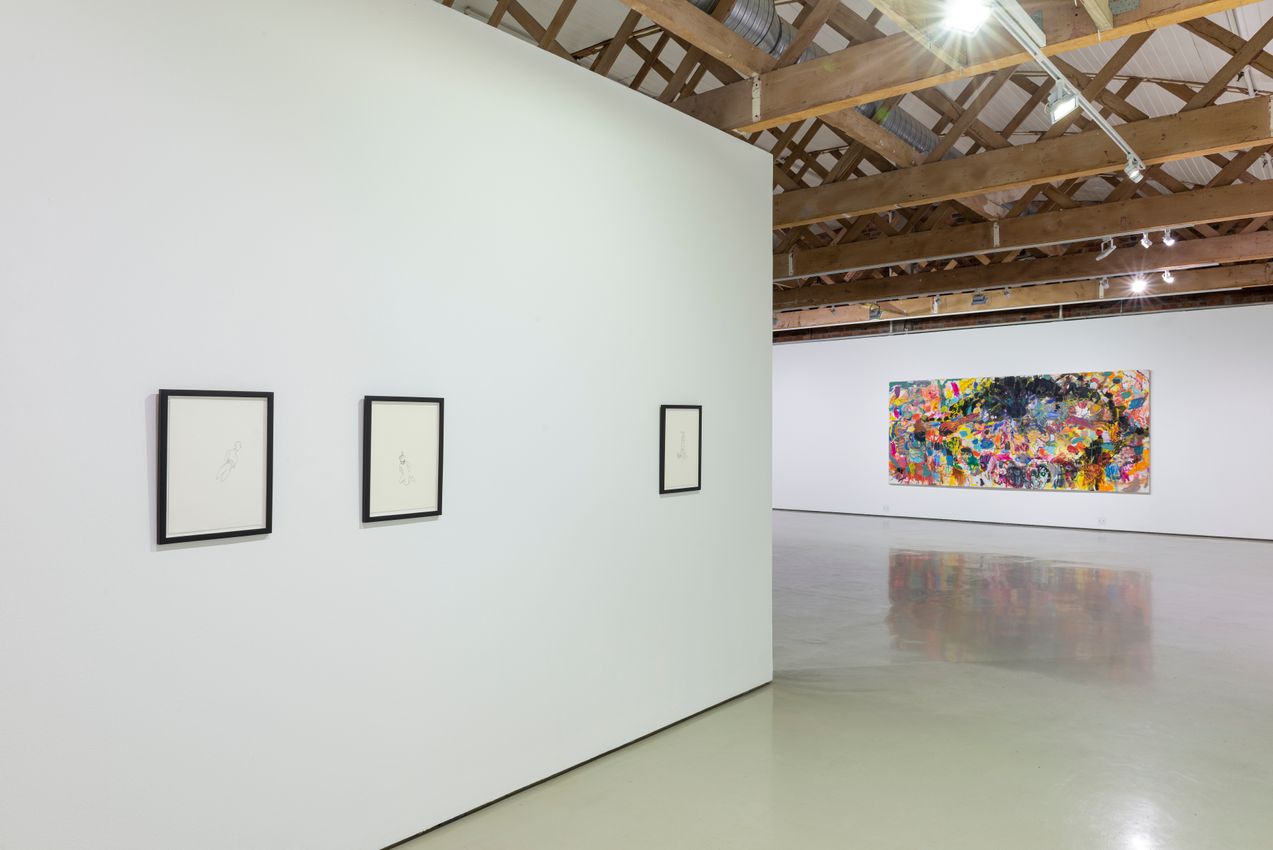
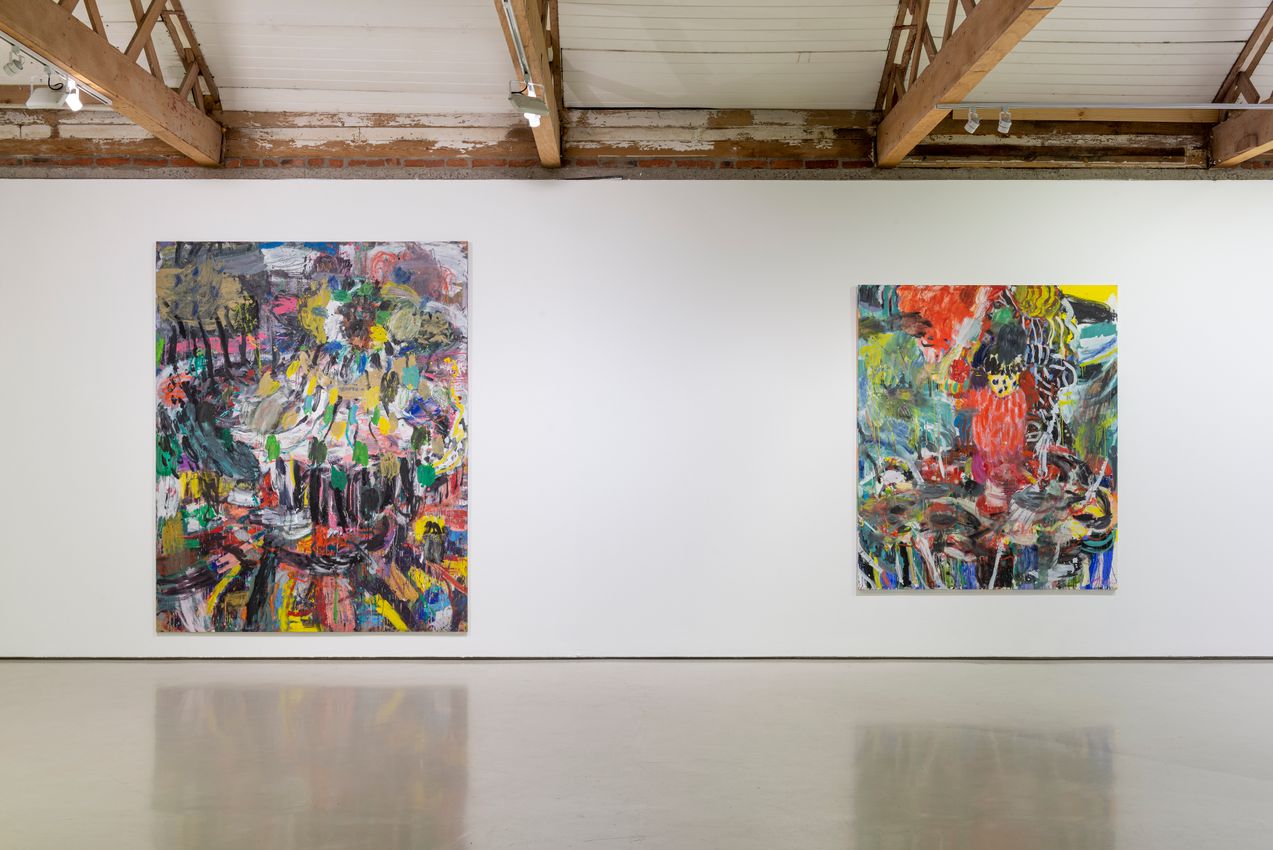
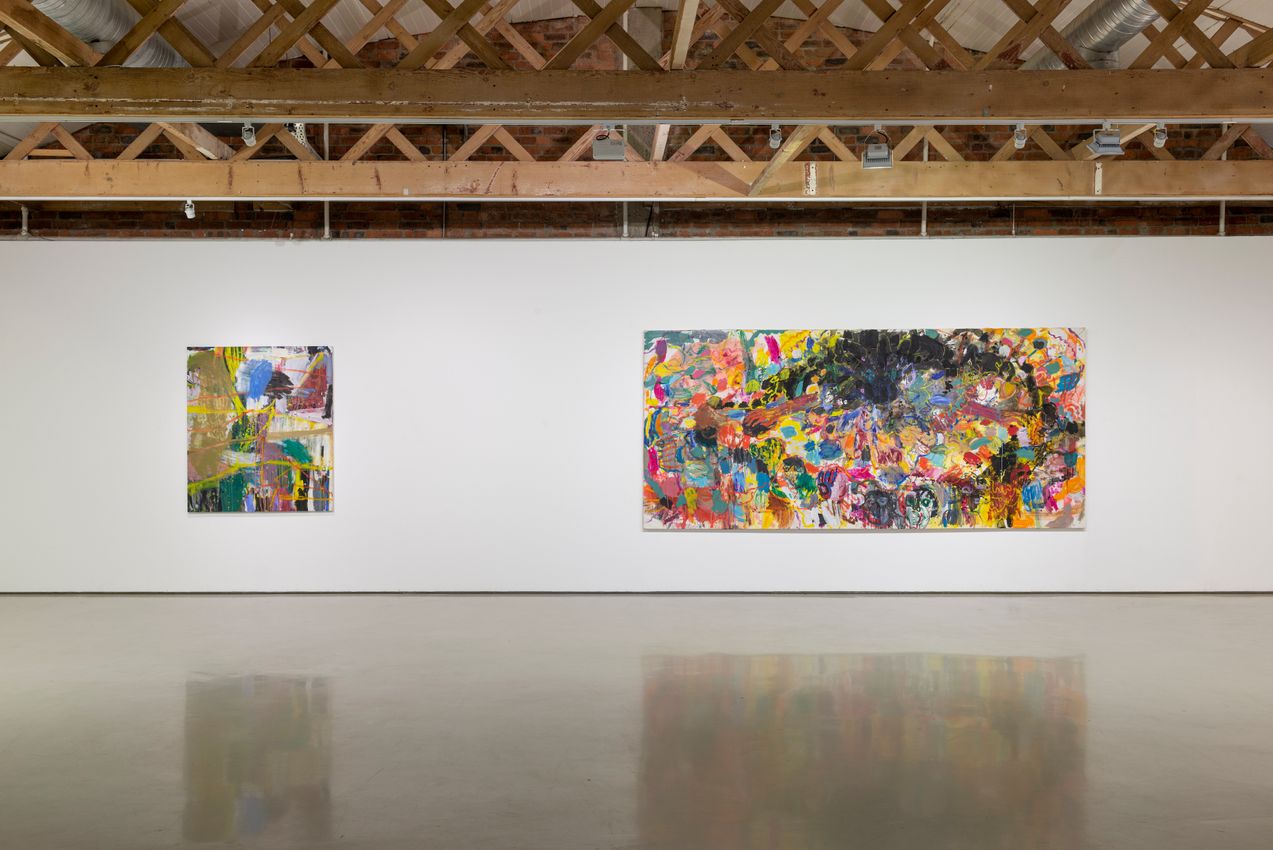
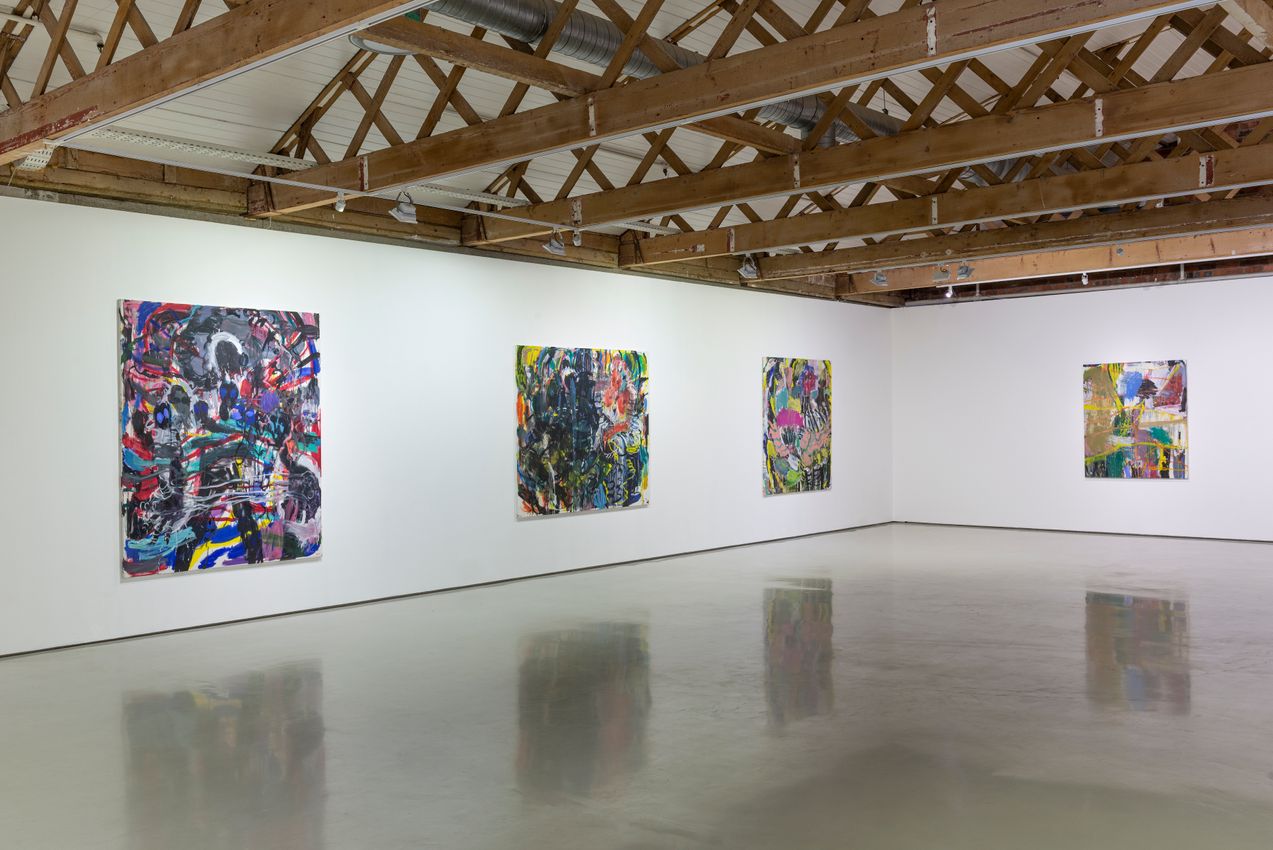
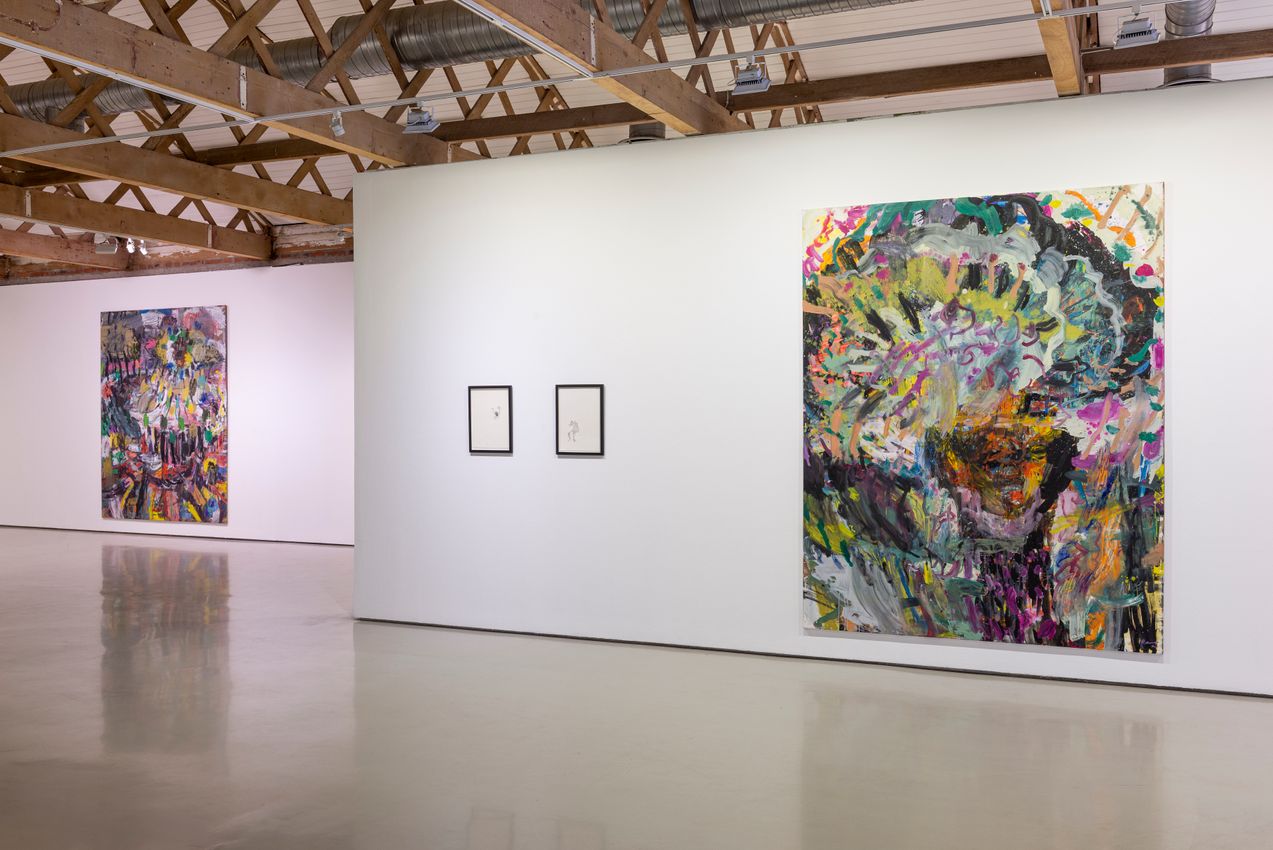
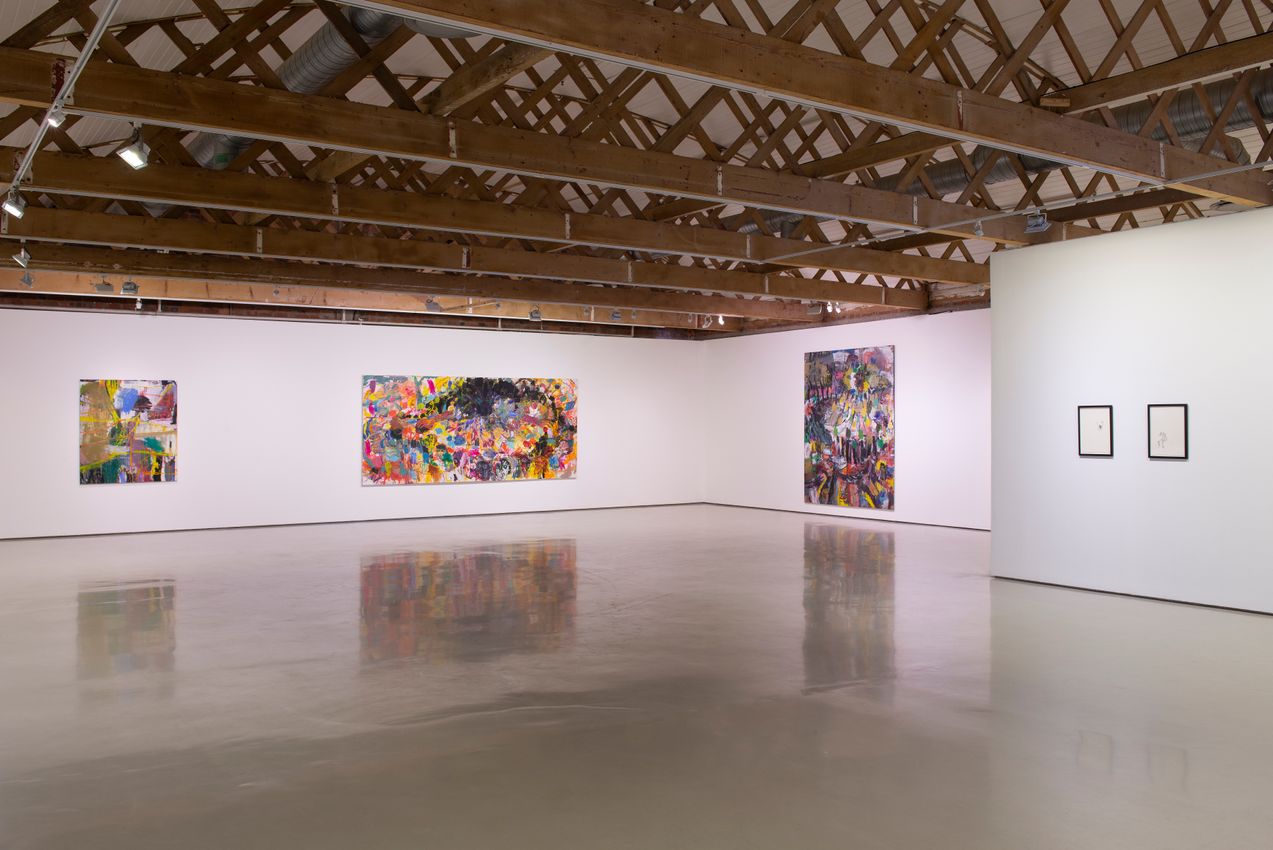
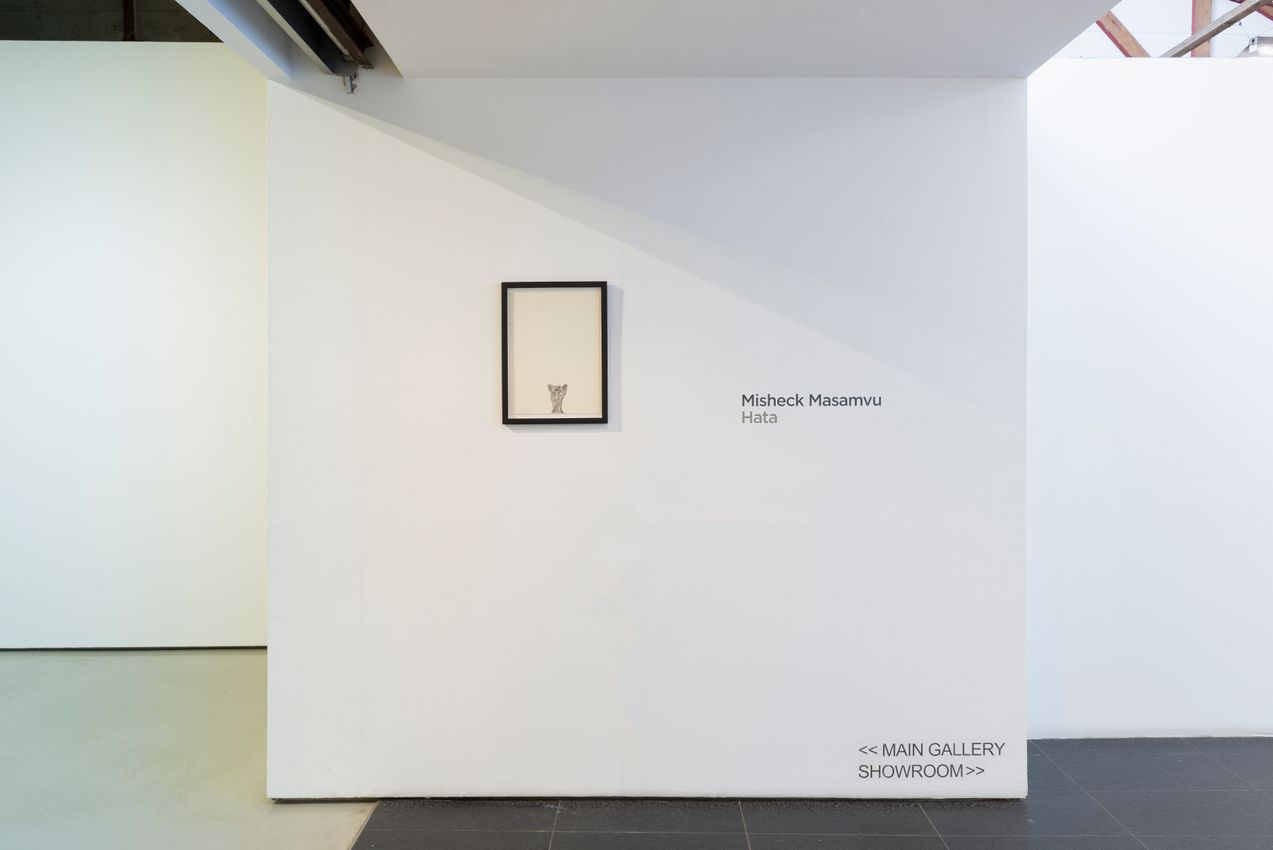
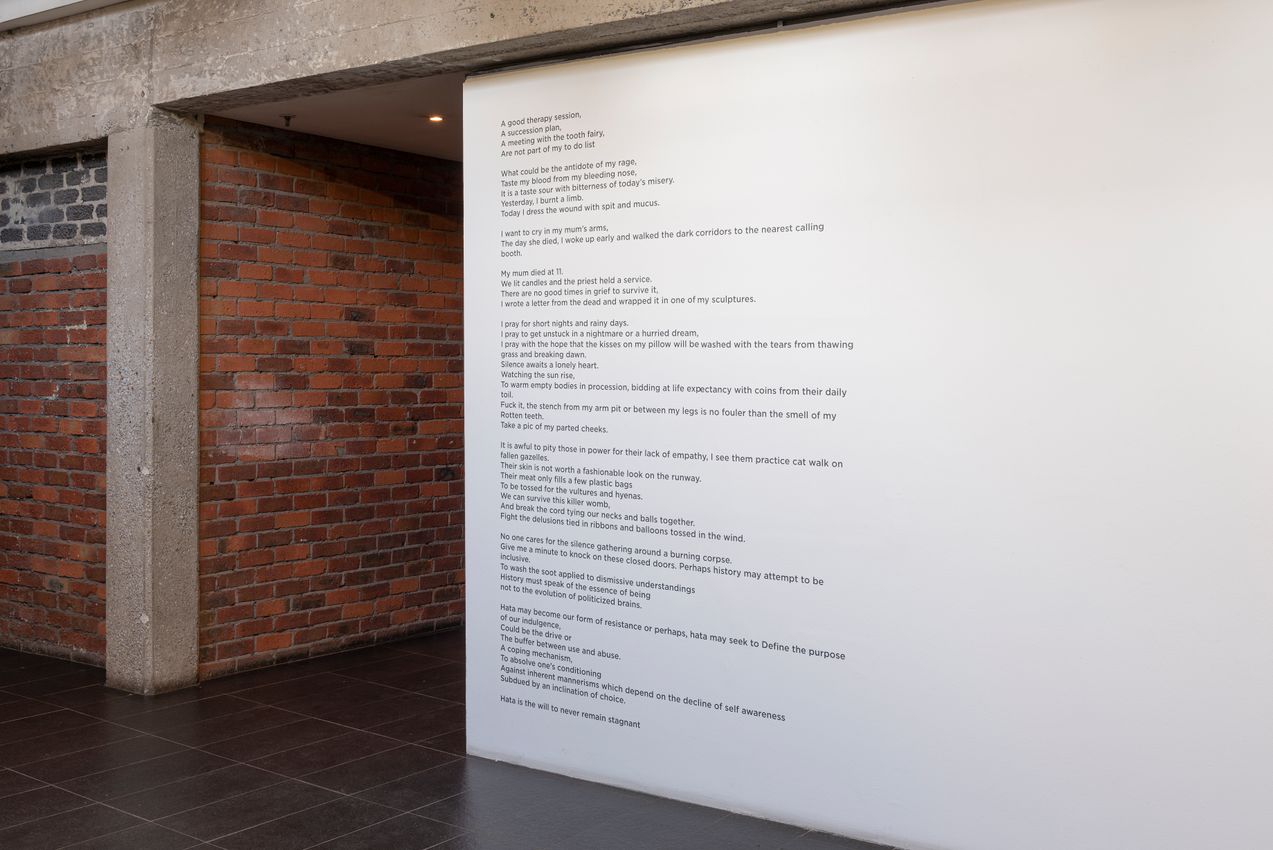
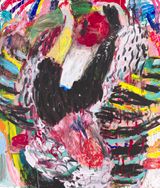
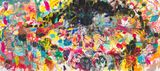
Goodman Gallery is pleased to present Hata, a new series of paintings and drawings by Misheck Masamvu, his third solo exhibition with the gallery.
Taken from Shona, the word Hata commonly refers to a cushion used to soften the load atop one’s head. In a broader sense, Hata stands as a coping mechanism for the burdens we bear, be they literal objects or our thoughts, emotions and ideas.
For this exhibition, Masamvu uses painting as a hata-like device for processing our relationship to history. This position relies on thinking of the history we are burdened with as an opportunity for further education and growth. Drawing on personal tragedies, Masamvu looks at how he overcame these challenges in his life by turning to lessons gained from history.
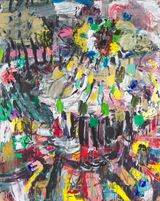
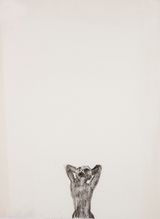
Visually, Hata transforms into Hakata—a contraption to delineate a probable outcome or becomes a grammar of expressive brushwork, chaotic compositions and perpetually altered or mutated figures often depicted between states of animal and human. The inclusion of these figures in the midst of transformation celebrates the determination of the human spirit and the pragmatic purpose of trying to understand our environment and social consequences.
‘When you look at a body there’s a story,’ says Masamvu. In times of great sadness or joy these stories manifest in physical expressions such as laughter or tears. In his paintings, Masamvu attempts to ‘collect the moments of that struggle, awareness or realisation’, condensing these expressions into images which reference the ‘weight, the emotion of the spiritual connection, or intellectual space’. Masamvu’s use of figuration further helps the artist ‘harvest hidden emotions coming from the subconscious’. The effect allows viewers to emotionally connect to Masamvu’s work through their own experience.
Masamvu describes his process as an ‘emotional dance’, which carries a message. ‘In Hata its a celebration and a violent dance. It’s not something you’re giving without risking yourself. It’s how you are reaching out to someone in a tragic moment, but when you’re in that moment of rescue you’re risking your life. That point of sacrifice is what I’m trying to show. As much as we are fragile, through this fragility there’s an element where we can become much stronger and give or harvest more through that sacrifice.’
The exhibition is accompanied by a monograph, also titled Hata, edited by curator Gabi Ngcobo. The publication will be launched alongside a listening session between Ngcobo and Masamvu at 11H30 on 20 July.
Part of Zimbabwe’s ‘born-free generation’, Misheck Masamvu (b. 1980 in Penhalonga, Zimbabwe) explores and comments on the socio-political setting of post-independence Zimbabwe, and draws attention to the impact of economic policies that sustain political mayhem. Masamvu raises questions and ideas around the state of ‘being’ and the preservation of dignity. His practice encompasses drawing, painting and sculpture.
Misheck Masamvu studied at Atelier Delta and Kunste Akademie in Munich, where he initially specialised in the realist style, and later developed a more avant-garde expressionist mode of representation with dramatic and graphic brushstrokes. His work deliberately uses this expressionist depiction, in conjunction with controversial subject matter, to push his audience to levels of visceral discomfort with the purpose of accurately capturing the plight, political turmoil and concerns of his Zimbabwean subjects and their experiences. His works serve as a reminder that the artist is constantly socially-engaged and is tasked with being a voice to give shape and form to a humane sociological topography.
Masamvu’s work has been well-received and exhibited in numerous shows around the world, including Armory Show 2018, Art Basel 2018, Basel Miami Beach 2017, 1-54 Contemporary African Art Fair New York 2016, São Paulo Biennale 2016, and the Venice Biennale, Zimbabwe Pavillion 2011. In 2018 work by Masaamvu was featured on group exhibitions at the Braunsfelder Family Collection and Zeitz MOCAA
Part of Zimbabwe’s ‘born-free generation’, Misheck Masamvu (b. 1980 in Penhalonga, Zimbabwe) explores and comments on the socio-political setting of post-independence Zimbabwe, and draws attention to the impact of economic policies that sustain political mayhem. Masamvu raises questions and ideas around the state of ‘being’ and the preservation of dignity. His practice encompasses drawing, painting and sculpture.


Goodman Gallery is an international contemporary art gallery with locations in Johannesburg, Cape Town and London. The gallery represents artists whose work confronts entrenched power structures and inspires social change.

A respected voice in contemporary art discourse.
Focusing on ambitious storytelling and insightful art-world commentary. Ocula Magazine publishes in-depth interviews, critical essays and timely analysis on the artists, exhibitions and ideas driving the global art world.
Learn more about Ocula Magazine
Showcasing the best of the art world.
Ocula partners with galleries from around the world to highlight their artists, artworks and exhibitions. Gallery membership is by application and invitation, with each member vetted by an independent panel.
Learn more about Ocula Membership

Specialises in the sale of major artworks.
Led by a team with deep ties to the world’s leading auction houses, galleries and collectors. Ocula’s advisory team offers bespoke services to high-net-worth clients from around the world who are looking to acquire the best of contemporary and modern art.
Learn more about our team and services