




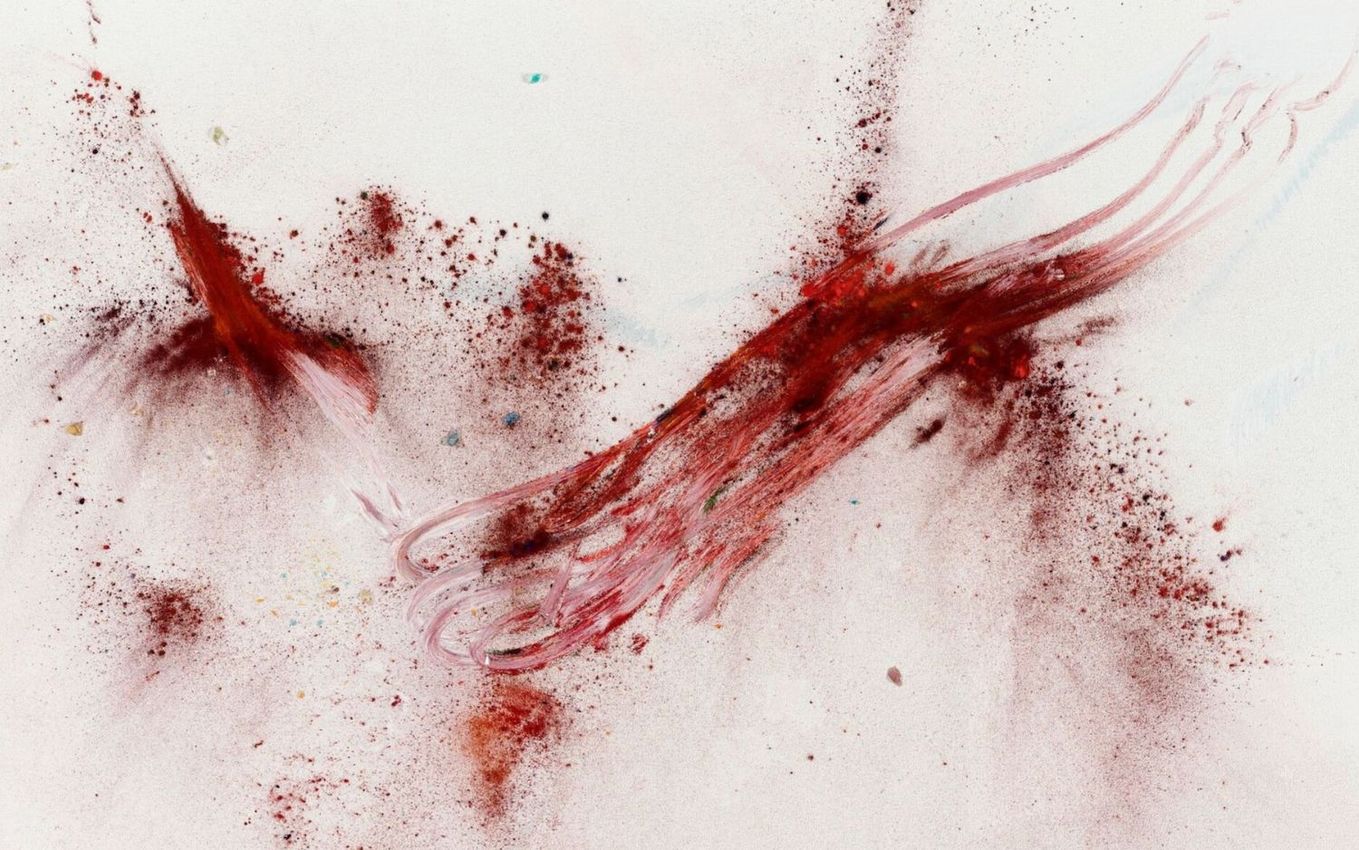
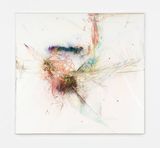
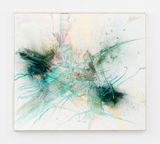
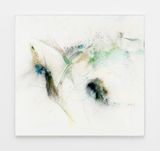
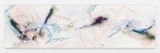
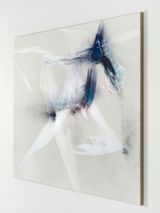
A white square picture plane above which a pigment explosion has takenplace. If we described the German artist Thilo Heinzmann’s painting in onesentence, this is how it looks like at first sight. When Robert Rauschenbergpainted his canvas entirely white in 1951, he famously said that the whitepainting was the runway for light and shadow. In a parallel comparison,Heinzmann’s series of paintings on white canvases with dashes of pigmentcould be defined as runways for bursts of color. The micro-dust of colourdancing in the air eventually lands on the canvas and sticks to its surface,leaving us viewers wondering what it is we are seeing and how it is made ...
For the past several decades Thilo Heinzmann has been creating paintingsthat visually challenge the viewers and conceptually question the natureand raison d’etre of this ancient art form in our contemporary society. Anunaccomplished mission in which his contemporaries have investigatedand experimented in painting’s expanded fields. Heinzmann’s professor,Thomas Bayrle, contributed by reinterpreting patterned images frommass-media sources to create repeating rhythms on flat surfaces; andMartin Kippenberger, whom Heinzmann assisted during his time at theStädelschule in Frankfurt, both mocked and enchanted the medium’sresurgence.
Heinzmann’s early work Malerei (Painting, 1994) was painted directly ontochipboard. By applying white paint in varying gradations of thickness, theartist recreated a soft edge that paralleled the rough-edged chipboard.Heinzmann’s work already redefines several elements of painting here: themedium, the material, and the process. The result is a serene white spacecontaining natural rawness and artificial softness formed by artistic labor and
the artist’s mind. As far as his working process is concerned, Heinzmannhas combined Arte Povera’s poetic embodiment in the everyday object,post-minimalism’s highlighting of painting’s physicality, and a kind of neo-Dada action in his artistic research. From 2000 on, more materials began toappear on his paintings: polystyrene foam, epoxy resin, and crushed colouredglass invite the viewers to interact with his paintings in multiple ways. WhenI asked how his works were made, he quoted his professor Thomas Bayrle’sadvice, ‘A good piece of art should have at least 7% of science in it, or itwill fail.’ He laughed at the specification of the percentage and added, ‘9%works too.’ A typically German humour: funny, witty, and right to the point.
So where is the science in Heinzmann’s art? The seemingly tracelesschalk-white surface or background of his painting is prepared with whitepaint mixed with a carefully measured oil applied to the surface withbrushes of various sizes. Even at this stage the artist has calculated howthe adhesiveness of the paint’s sophisticated structures will affect the finalpainting. Then it is time to move the canvas to the garden outside his studioin Berlin and start painting. Why outside? Heinzmann’s painting is notaccomplished by fixing the canvas to a static easel. The process is highlymobile. Heinzmann works with his two painter-assistants, who move thecanvas to different angles and install it in various hanging systems in thegarden, high and low, leaning forward and reclining backward, tilting andstraightening. Heinzmann has to apply the pigments hastily according to thepre-planned composition, or all in one go. The living, adhesive quality of thewhite paint drying in the air leaves no room for error correction. The 18th-century Chinese master painter Zheng Banqiao left a legacy about ‘paintingthe mind image of a bamboo’ when he impressed his connoisseurs bydepicting a bamboo in one smooth action without looking at the bambooforest, because he already had the image of the bamboo in his mind.Needless to say, Heinzmann’s pigment paintings have gone through such amind-mapping before he starts painting.
There are some evident paradoxes in Heinzmann’s art that intrigue theviewers: the spontaneous formations of pigment dust caught on the canvasas opposed to the artist’s pre-designed patterns; a scientifically calculatedsuspension between white background and colourful pigment as opposedto an unexpected storm or sudden gust of wind that could alter everything.The element of chance, an important legacy of Dadaism to contemporaryart, is transposed to the physical experiences of the viewers rather than themaker. Unlike the American post-war artists, such as Jackson Pollock andRichard Serra, whose machismo approach to art-making helped to build uptheir heroic personas, Heinzmann resists the temptation of the performativequality in his working process, focusing instead on establishing theauthenticity of art-making in the classical way. Indeed, the act itself containsanswers to his restless enquiry into the primal condition of painting.
For his Shanghai gallery exhibition,15 pigment paintings have beenselected, all entitled O. T., the initials of the German ‘ohne Titel’ (lit.without title), meaning no objective representations—or the O could standfor word ‘optical,’ the visual effect imbued in his paintings, a pun thatreveals Heinzmann’s admiration of Marcel Duchamp. The Duchampianhomage is also there in the use of the box-like acrylic glass cover. Duringour conversation about the Shanghai exhibition, Heinzmann said that hewas considering removing the glass cover so as to invite the natural dust tobecome part of his art. This is another Duchampian act, as dust is one of thematerials in the enigmatic The Big Glass (1912–1923).
In one of the exhibited pieces, O.T. 2021, the viewers encounter a largewhite pictorial field, measuring 195 x 217 x 11 cm, against which clusters ofblack pigment are superimposed on green, red, and blue. One can feel theforceful action of applying the pigment to the canvas, by which a ripple ofpigment overflowed to the side. While much action occurs in the centre ofthe canvas, the rest is left untouched, except by splinters of coloured glass.
How would a local visitor react to such a painting? The smudging dizzyeffect of the scattered pigment on the white background, the explosivegesture of the pigment, the sensory traces of its movement, and the largearea of whiteness left as a void—such impressions would easily remindsomeone with an Asian cultural background of the ink-and-paper-basedtraditional Chinese painting. In Chinese landscape painting the rhythm of inkabsorbed by the rice paper moves poetically, soothing the mind. Althoughmetaphysical experience is not his primary intention, Heinzmann welcomesdifferent responses to his own reflection and action. Now that his paintingshave left his studio and are here with us in Shanghai, it is his joyousnessin making a painting that fascinates us viewers—and the significance of anartist’s studio, as presented by Matisse in The Red Studio, from 1911: hereis me, my art, and my world. We are delighted to take a part of Heinzmann’sworld and to show it to our viewers here in Shanghai.
Press release courtesy Perrotin. Text: Kaimei Olsson Wang.
Thilo Heinzmann, born in Berlin in 1969, attended Städelschule in Frankfurt from the early 1990s in the class of Thomas Bayrle. During that time he also assisted Martin Kippenberger. A significant voice in a generation of German painters scrutinising the medium and its history, his inventive, precise works are driven by an inquiry into what painting can be today. Using chipboard, styrofoam, nail polish, resin, pigment, fur, cotton wool, porcelain, aluminium and hessian, Heinzmann has for the last twenty-five years worked on developing new paths and an unique visual language in his practice. He is interested in the presence that each work creates, which is further enhanced by his paintings’ powerful tactile qualities. It invites the viewer to notions on some essentials: composition, surface, form, colour, light, texture, and time. In 2018 he was appointed professor of painting at Universität der Künste in Berlin.


A respected voice in contemporary art discourse.
Focusing on ambitious storytelling and insightful art-world commentary. Ocula Magazine publishes in-depth interviews, critical essays and timely analysis on the artists, exhibitions and ideas driving the global art world.
Learn more about Ocula Magazine
Showcasing the best of the art world.
Ocula partners with galleries from around the world to highlight their artists, artworks and exhibitions. Gallery membership is by application and invitation, with each member vetted by an independent panel.
Learn more about Ocula Membership

Specialises in the sale of major artworks.
Led by a team with deep ties to the world’s leading auction houses, galleries and collectors. Ocula’s advisory team offers bespoke services to high-net-worth clients from around the world who are looking to acquire the best of contemporary and modern art.
Learn more about our team and services