Press Release

Perrotin Shanghai is pleased to present Trilla, the first solo exhibition in mainland China by Chilean artist Christiane Pooley, offering a close look at her recent explorations. Known for paintings shaped by historical undercurrents, Christiane Pooley approaches landscape as both physical terrain and interior space, opening onto the complex ties between identity, land, personal memory, collective narratives, and art history.

The Amber Building, where Perrotin Shanghai is located, was built in 1937 and once functioned as a wartime warehouse for precious objects. For Pooley, this history called to mind the farm granaries of her native Araucanía in southern Chile. What was once called “Chile’s granary” carries a more troubled past, one shaped by military conquest, settler expansion, and contested land.

From the mid-nineteenth century onward, driven by rising global demand for wheat and the project of national consolidation, the Chilean state absorbed the southern territories long controlled by the Indigenous Mapuche people. Most Mapuche communities were displaced, and the region’s ancient forests were felled. With the influx of settlers, the construction of the railway, and the introduction of modern agricultural machinery, Araucanía was reshaped into vast, productive wheat fields. Scholars have read this history as a rupture. The region gained economic significance as an agricultural base, yet its land was profoundly transformed, Indigenous ways of life were uprooted or marginalized, and the unresolved tensions of conquest and dispossession continue to lie beneath the soil. This is the land into which Pooley’s family history has been inscribed. In her work, Araucanía appears at once sublime and shadowed by melancholy.

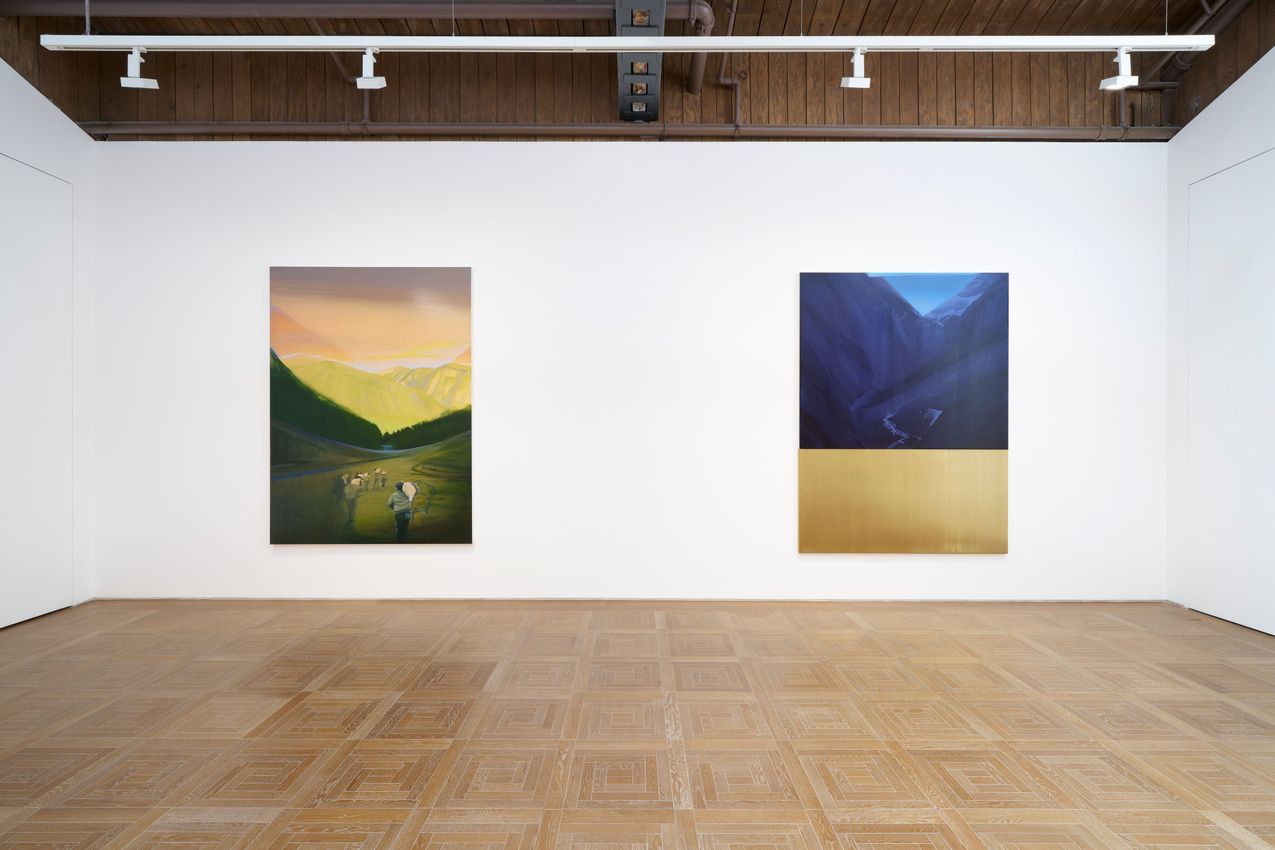
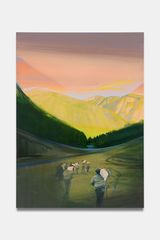
The tension between what has been and what remains finds a concrete expression in One Grain. A group of sack-laden figures advances from near to far, moving toward the depths of the forest and valley. In the distance, the mountains rise in a wash of chartreuse light, their slopes caught in the intensity of the highland sun, setting them apart from the shadowy expanse occupied by the figures below. Farther still, the sky burns with bands of orange and violet, casting an uncanny glow over the valley. Carrying their loads, these figures recede into the distance toward what might be a promised land, or a home forever beyond reach.

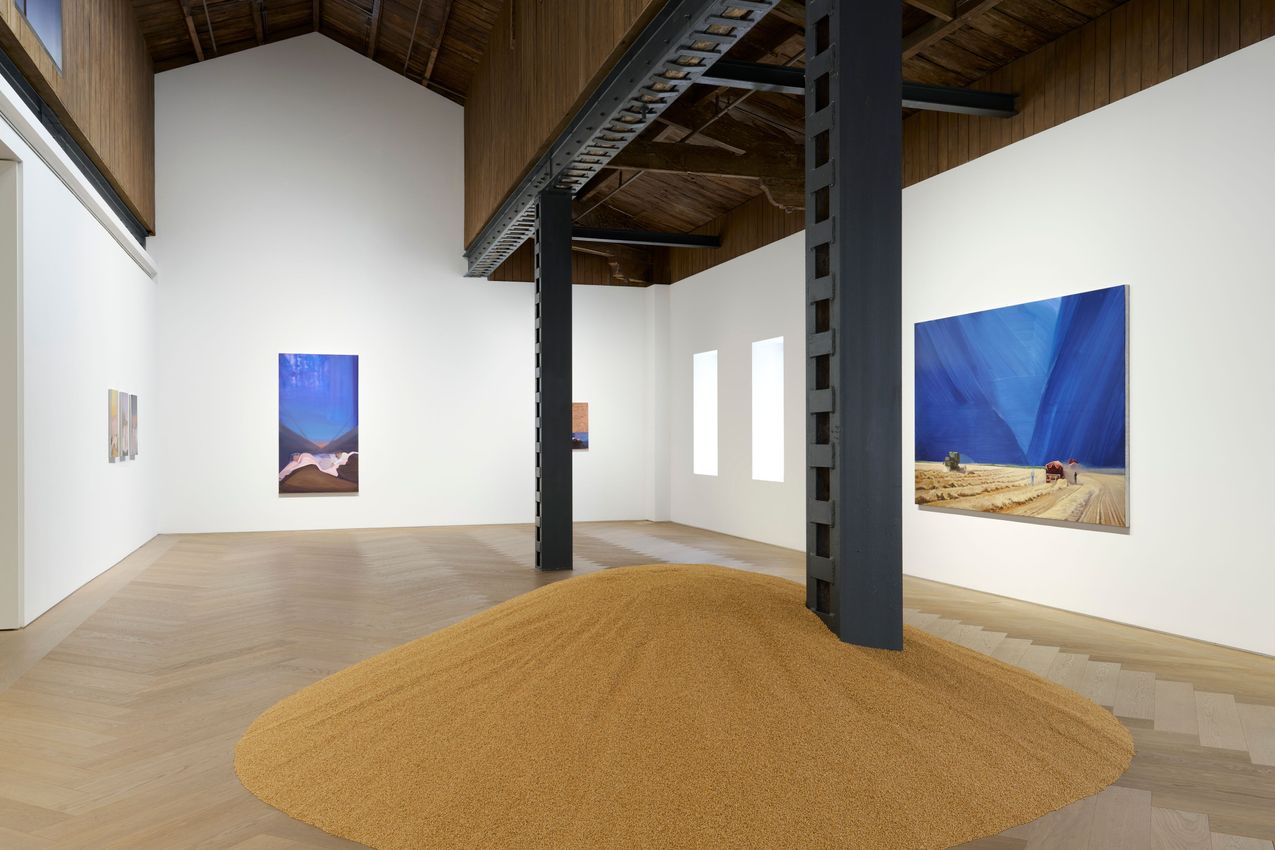
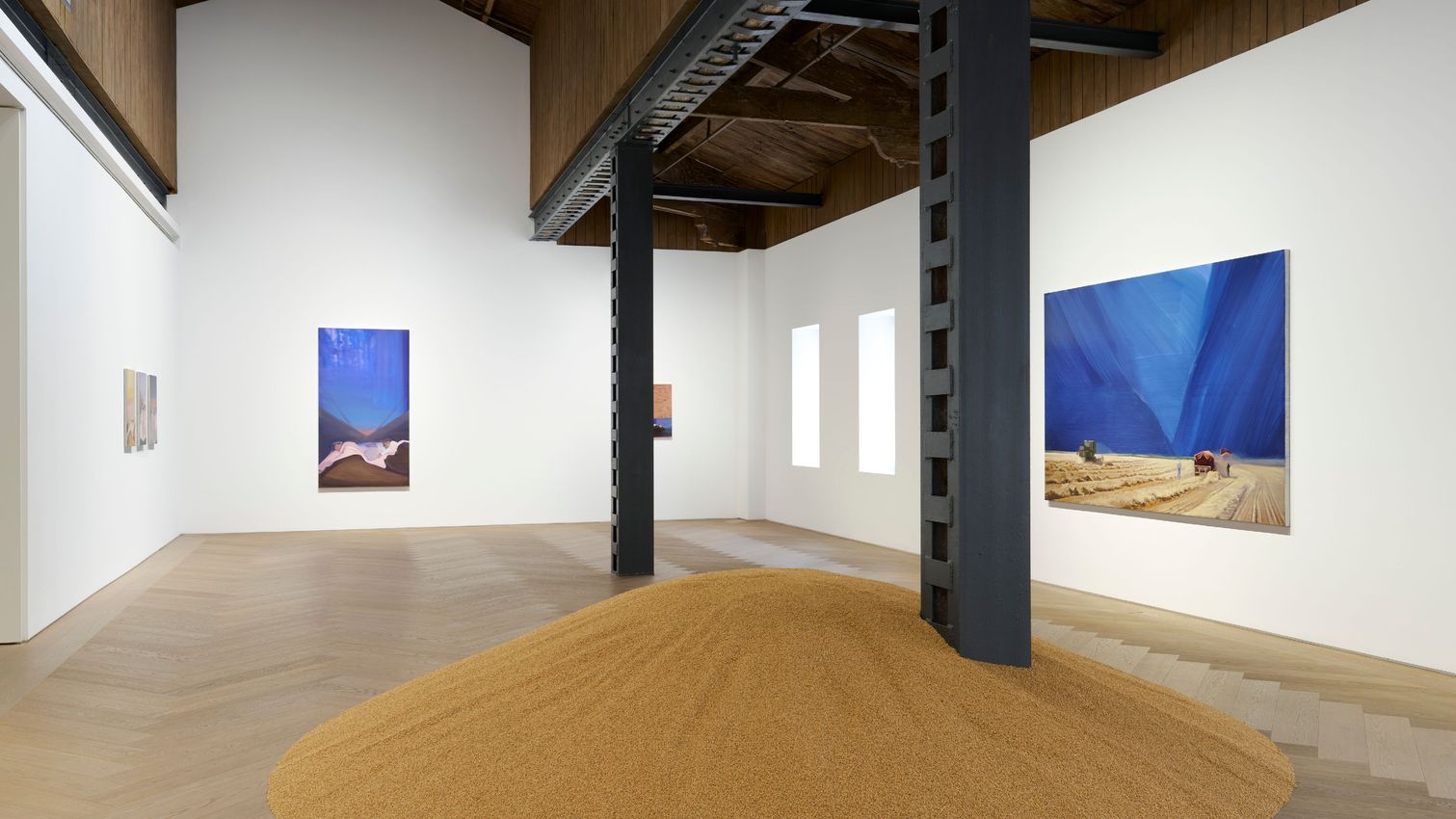
In Field, the artist stages a scene that borders on the surreal. A large combine harvester cuts through an expanse of golden wheat; to the right, several figures walk beside two trucks loaded with crops, while deep ruts score the ground beneath them. Behind them, a massive mountain range is assembled from broad, visibly worked passages of color, enveloping the scene like a dark blue drape. Through the sweeping, fluid brushwork characteristic of her work, Pooley renders the vast landscapes of southern Chile, whose contours bear the imprint of modern agriculture’s reshaping of Araucanía. Between subject matter and painterly approach exists a sustained tension: what first appears as a straightforward narrative gives way to a past kept indistinct and unresolved.

In recent years, Pooley has begun experimenting with painting on metal, specifically on brass and copper. In To That Rock I Called Home, a group of figures guides horses through water along the lower edge, while golden tones dominate much of the composition. The metal surface, transformed by touch through engraving, sanding, and paint, gives off an unstable sheen, turning the image into a vision of movement without arrival, of wandering carried on indefinitely. For Pooley, herself a fifth-generation descendant of settlers, the horse is a point of hybridity and union. It belongs not only to the rural world of her own memory but also to the history of the Mapuche, who developed a semi-pastoral way of life and became formidable riders, resisting Spanish and later Chilean campaigns across several centuries. It was the firepower of the modern nation-state that ultimately overwhelmed these mounted warriors, bringing their southern homeland under Chilean rule.

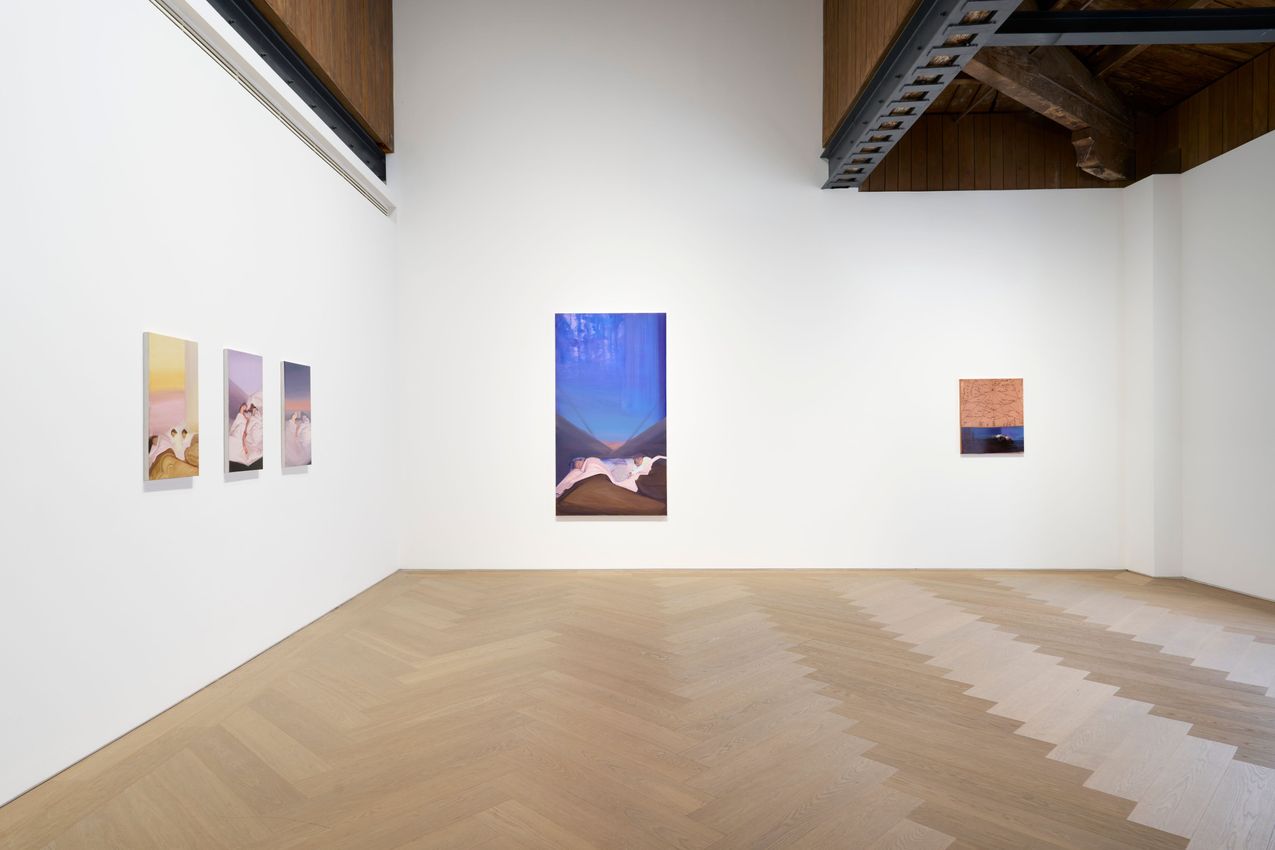
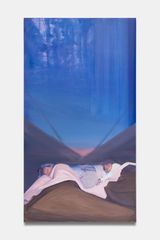
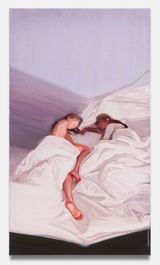
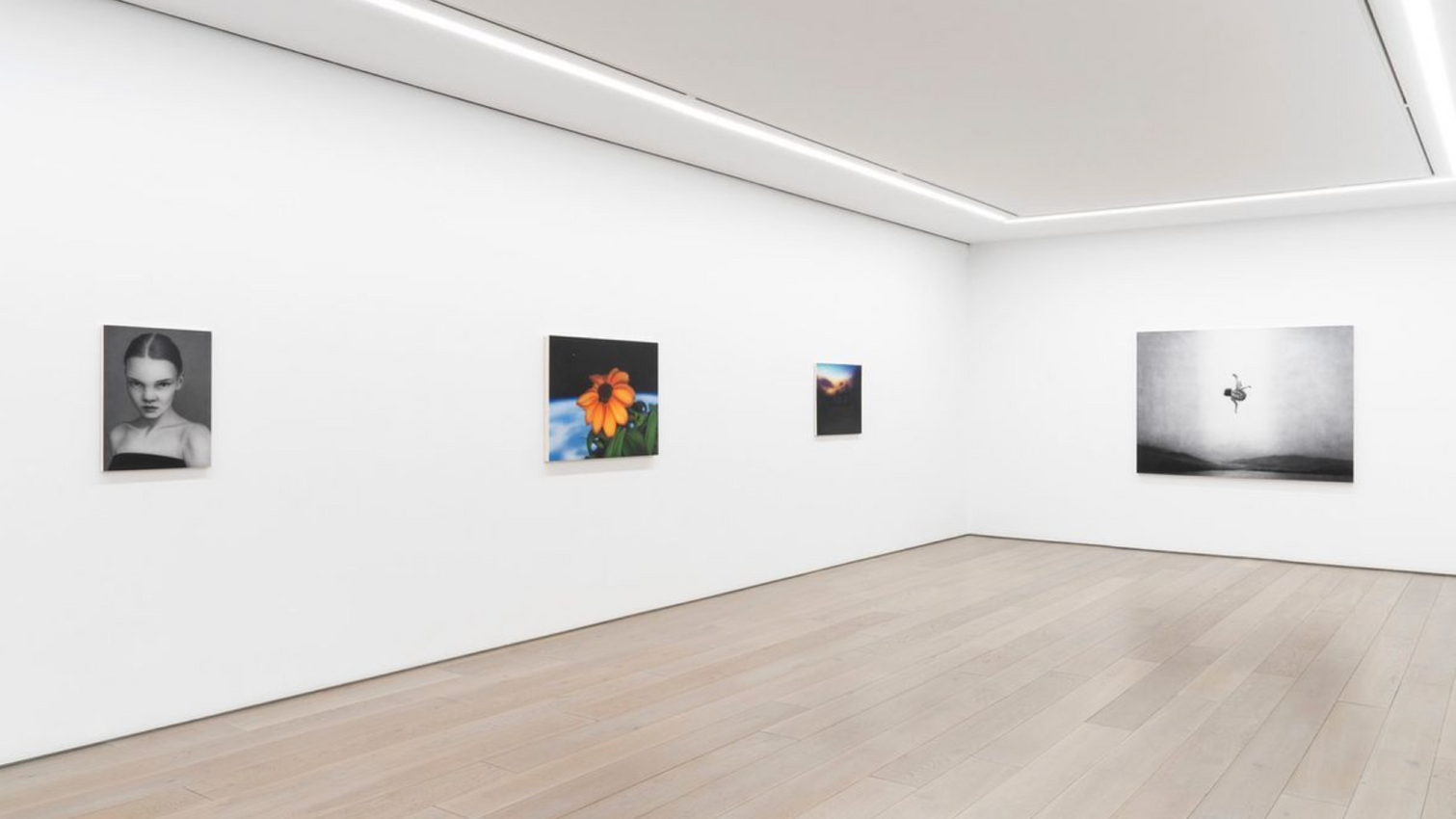
The exhibition also includes an important group of more intimate works, centered on children or adolescents curled within soft, billowing bedding. For Pooley, these paintings recall not the historical narratives inscribed in a shared territory, but the memory the body keeps — the silent language of affects and protection received in earliest childhood. They are interior landscapes, where body and terrain fold into one another, shaped by touch and its absence. Asleep, their bodies appear at once relaxed and vulnerable. Light as apparitions, the figures hover between mountains, wasteland, and sky. Their faces are obscured or wiped away, as if they had drifted beyond the reach of memory, consciousness, and selfhood.

Pooley’s practice may be read alongside French philosopher Henri Bergson’s reflections on memory. In Matter and Memory, Bergson suggests that memory is less a precise recovery of the past than a form of inner duration, or durée, through which the past continues to live within the present. The past does not disappear; it endures within the present as a latent force. Though such memories may elude rational grasp, they nevertheless shape our instinctive sense of belonging. Pooley’s paintings give visual form to this duration. Through translucent fields of color, memory appears in overlapping layers; with remarkable restraint, the artist allows the vastness and resilience of Araucanía to impress itself upon the viewer’s senses.

At the exhibition, a large circular mound of wheat will occupy the heart of the main gallery. Its scent lingers, gently drawing the Amber Building’s former life as a warehouse into the present. As a material, wheat suggests storage and exchange; as a process, threshing evokes an act of separation, a loosening of what the body holds across generations. Similar conical stacks used for drying grain can be found beyond Araucanía, from parts of Europe and the Andes to northern China. Here, the form brings a distant landscape closer through a familiar image of working the land. Storage and memory fold into one another, creating an interior space removed from the immediacy of the physical world.

Courtesy Perrotin.

Read More

Installation Views

Also Exhibiting at Perrotin

About the Gallery
Emmanuel Perrotin founded his first gallery in 1989 at the age of 21. He has opened since then over 17 different spaces, with the aim of continuing to offer increasingly vibrant and creative environments to experience artists work. He has worked closely with his roster of artists, some since more than 25 years, to help fulfil their ambitious dreams and projects. The gallery is now based in New York, Paris, Hong Kong, Seoul, Tokyo, and participates in all the significant worldwide art fairs each year (Art Basel (Hong Kong, Miami, Basel), Frieze (London, New York), FIAC (Paris), Dallas Art Fair, Art Cologne, Art Stage Jakarta, Expo Chicago, Art021 & West Bund Art & Design, Shanghai, Zona Maco Mexico, amongst others).
View Gallery Profile
Address
3/F, 27 Huqiu Road
Huangpu District
Shanghai
China
Opening Hours
Tuesday – Saturday
11am – 7pm
(1)
Shanghai 3/F, 27 Huqiu Road, Huangpu District
Perrotin
3/F, 27 Huqiu Road, Huangpu District, Shanghai, China
+86 216 321 1234
http://www.perrotin.com

Opening hours
Tuesday – Saturday
11am – 7pm
The art world in focus