





SANYA KANTAROVSKY
b. 1982, RussiaBlending figuration, satire, and psychological nuance, contemporary artist Sanya Kantarovsky creates paintings that oscillate between humour and menace, exploring the human condition with a distinctively expressive and painterly visual language.
Early Years
Born in Moscow in 1982, Sanya Kantarovsky emigrated to the United States in his early teens, settling in Rhode Island. He studied at the Rhode Island School of Design (BFA, 2004), later completing an MFA at the University of California, Los Angeles in 2011. This transnational experience underpins the artist’s nuanced examination of displacement, alienation, and identity—recurring undercurrents in his work.
Now based in New York, Kantarovsky’s practice spans painting, drawing, printmaking, and animation, often referencing literature, history, and film. His works are marked by a painterly approach that merges expressive brushwork with tightly rendered, often grotesque, figures.
Artworks
Sanya Kantarovsky’s artworks offer an incisive take on the absurdity of the human experience, combining dark humour with painterly elegance. His distinctive approach to contemporary art foregrounds expressive figuration, often infused with literary, psychological, and political undertones.
Psychological Vignettes and Satirical Observation
Kantarovsky’s early works from the late 2000s and early 2010s introduced his signature style—narrative-driven paintings filled with emotionally charged, grotesque characters. These compositions hover between the allegorical and the intimate, suggesting untold stories behind each figure’s exaggerated posture or distorted face.
In these early paintings, the artist critiques social conventions and interpersonal dynamics, while drawing influence from Eastern European illustration, Russian satire, and art historical references from Bruegel to Ensor. A prime example is No Golden Future (2013), exhibited at Casey Kaplan Gallery, New York. The painting captures a seated man mid-collapse, his anguished body curling inward while a second figure watches passively. This interplay of suffering and apathy is a recurring motif in Kantarovsky’s paintings, where empathy, discomfort, and irony constantly interweave.
‘You Are Not an Evening’: Painting as Theatre
A significant evolution in Kantarovsky’s contemporary art practice came with his solo exhibition You Are Not an Evening (2015) at Studio Voltaire, London. Inspired by the short stories of Russian writer Mikhail Bulgakov, the show presented a suite of paintings alongside a theatrical installation and animated film. The exhibition marked a turning point in the artist’s work—expanding painting beyond the canvas to function as part of a multi-sensory narrative environment.
The accompanying animation, made in collaboration with composer Egor Efremov, added a haunting aural dimension to the visual world. This immersive experience allowed viewers to feel as though they were entering the melancholic, absurdist reality of Kantarovsky’s characters. The exhibition earned widespread attention for merging the psychological intimacy of painting with the performative temporality of theatre, and remains one of the artist’s most celebrated bodies of work.
Bodies, Touch, and Intimacy in Later Works
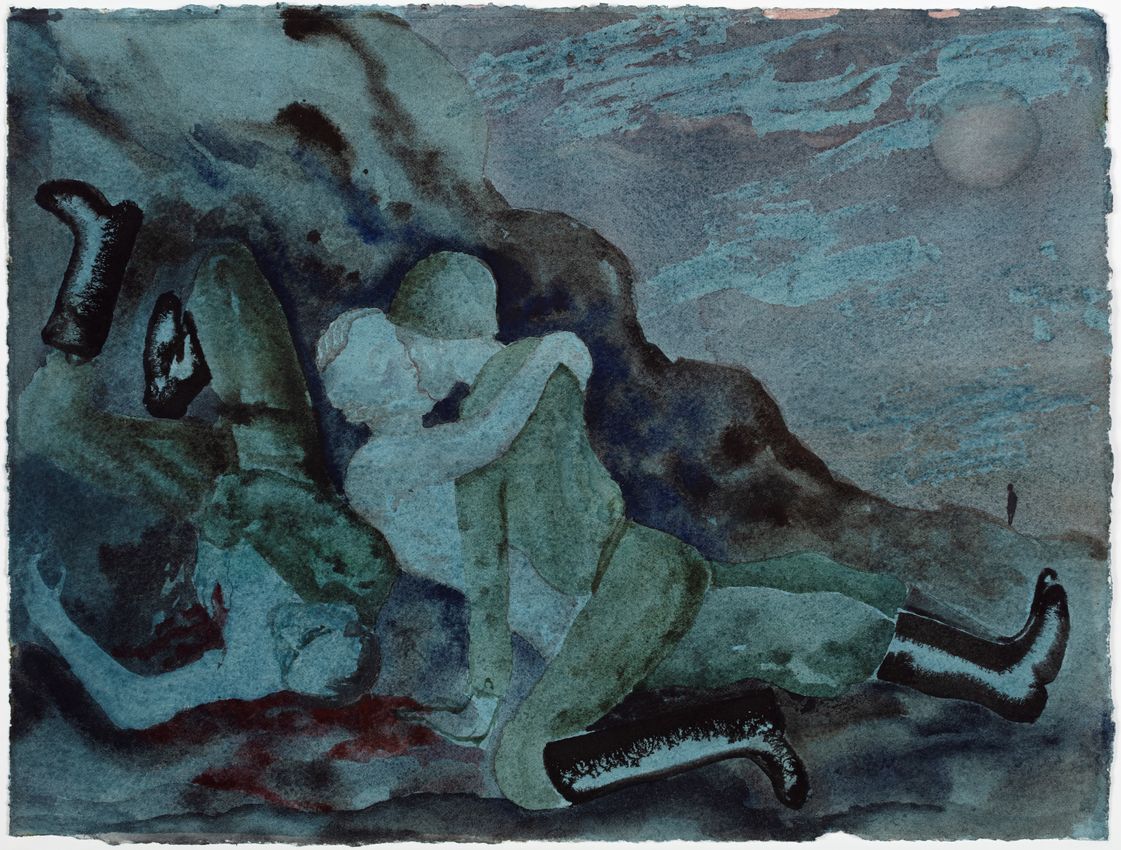
Kantarovsky’s later paintings embrace a looser, more visceral application of paint, and a deeper focus on physical touch and vulnerability. His 2020 exhibition On Them at Luhring Augustine, Brooklyn, presented canvases where bodies sag, collapse, and merge—evoking postures of exhaustion, eroticism, or surrender. The artworks are filled with symbolic details: peeled skin, contorted limbs, or hands lingering over wounds. Here, the figure becomes a site of both tenderness and violence.
A similarly intense exploration of human fragility appeared in A Solid House (2022) at Kunsthalle Basel. The paintings, installed with architectural sensitivity, explored themes of home, rupture, and memory. Scenes of domesticity were disrupted by absurd or uncanny intrusions, such as a man vomiting flowers or a child gazing out of a shadowed doorway. In these works, Kantarovsky interrogates the comforts and discontents of intimacy, using the painted body as a site of drama and metaphor.
Exhibitions
Sanya Kantarovsky has been the subject of both solo exhibitions and group exhibitions at important institutions. A selection of important exhibitions are provided below.
Solo Exhibitions
- A Solid House, Aspen Art Museum, Aspen (2022)
- Disease of the Eyes, Kunsthalle Basel, Aspen (2018)
- Letdown, Fondazione Sandretto Re Rebaudengo, Turin (2017)
- Apricot Juice, with Ieva Misceviute, Studio Voltaire, London (2015)
- Little Vera, with Ella Kruglyanskaya, Kim? Contemporary Art Centre, Riga, Latvia (2014)
Group Exhibitions
- I’m Not Afraid Of Ghosts, Palazzo Tiepolo Passi, Grand Canal, Venice (2024)
- Reaching for the Stars, Fondazione Palazzo Strozzi, Florence (2023)
- My Reflection of You, The Perimeter, London (2022)
- Radical Figures: Painting in the New Millennium, Whitechapel Gallery, London (2020)
- La Vie simple – Simplement la vie / Songs of Alienation, Fondation Vincent Van Gogh, Arles (2017)
- CKTV, Cleopatra’s Inter-City Pavilions Project, 9th Shanghai Biennale, Shanghai (2012)
Website and Instagram
Sanya Kantarovsky’s website can be found here and his Instagram here.
Critical Reception
The artist’s practice has been covered in leading publications such as Frieze, Artforum, Ocula, and The New York Times.
Sanya Kantarovsky FAQs
What artistic influences shape Kantarovsky’s work?
Sanya Kantarovsky’s art is shaped by a wide range of influences, spanning historical painting, literature, and Eastern European satire. He draws from the expressive distortion of artists like James Ensor, Francisco Goya, and Philip Guston, as well as the narrative sensibilities of Russian authors such as Mikhail Bulgakov and Nikolai Gogol. His aesthetic also channels Soviet-era illustration, theatre, and animation, resulting in a distinctive visual language that blends the grotesque, the tragicomic, and the psychologically charged.
What themes recur in Sanya Kantarovsky’s art?
Kantarovsky’s artworks frequently explore alienation, social anxiety, cruelty, and vulnerability—often filtered through a theatrical or narrative lens. His paintings depict emotionally complex figures caught in moments of ambiguity or discomfort, suggesting strained relationships and existential unease. Themes of touch, bodily fragility, and moral ambiguity recur throughout his work, as do references to literature and politics. By fusing pathos with satire, Kantarovsky investigates the absurdity of the human condition, balancing empathy with emotional detachment in his unique painterly world.
Ocula | 2025


Explore Sanya Kantarovsky's Exhibitions








Explore and Follow Artists Shaping Contemporary Art
A respected voice in contemporary art discourse.
Focusing on ambitious storytelling and insightful art-world commentary. Ocula Magazine publishes in-depth interviews, critical essays and timely analysis on the artists, exhibitions and ideas driving the global art world.
Learn more about Ocula Magazine
Showcasing the best of the art world.
Ocula partners with galleries from around the world to highlight their artists, artworks and exhibitions. Gallery membership is by application and invitation, with each member vetted by an independent panel.
Learn more about Ocula Membership
Specialises in the sale of major artworks.
Led by a team with deep ties to the world’s leading auction houses, galleries and collectors. Ocula’s advisory team offers bespoke services to high-net-worth clients from around the world who are looking to acquire the best of contemporary and modern art.
Learn more about our team and services