



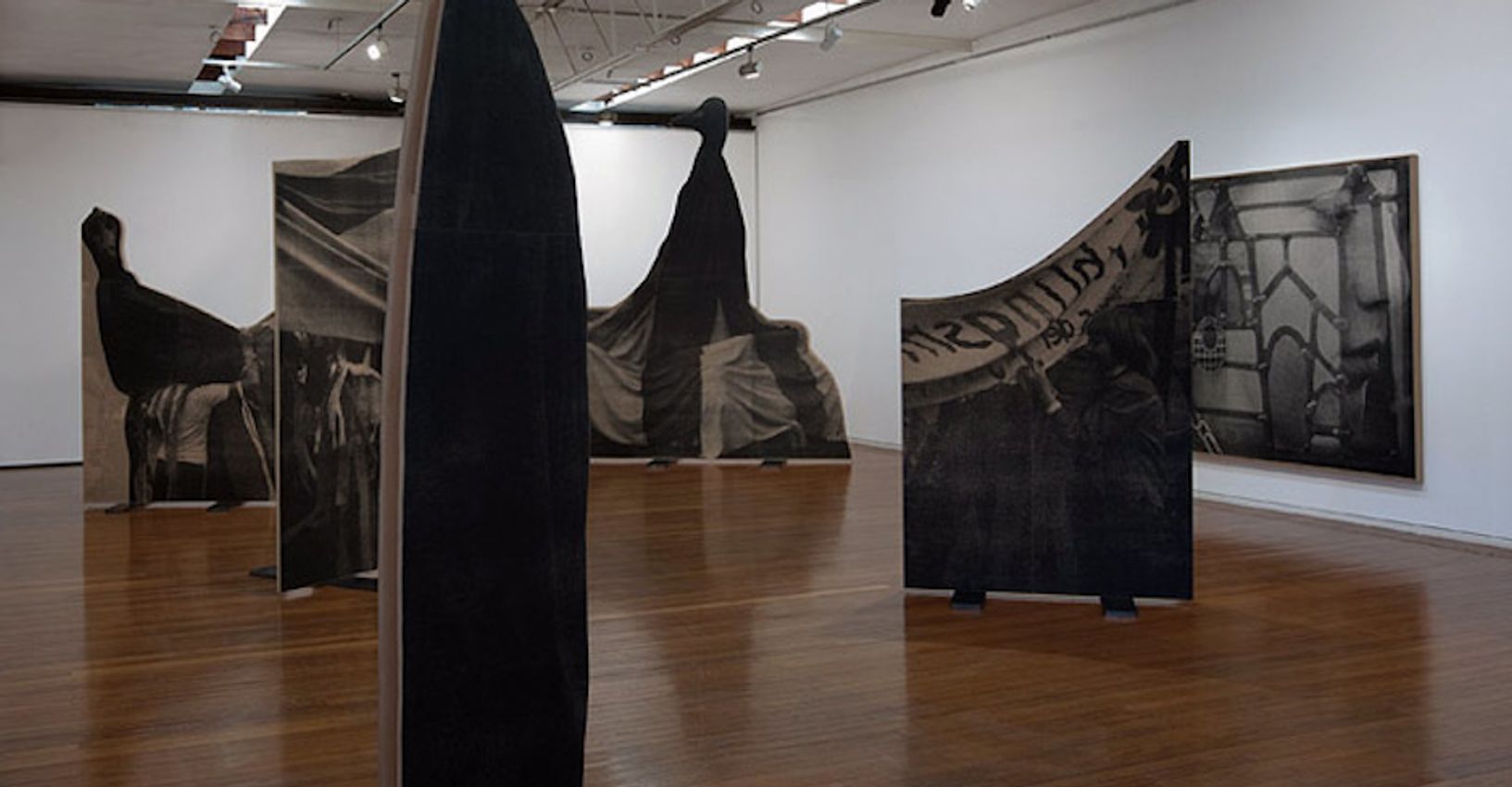
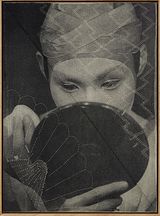
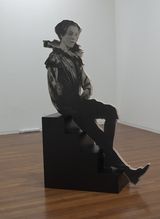
A procession of figures travels through space. Is it a parade? A communal pageant? Ribbons, flags and masks suggest ritualistic performance. David Noonan’s ambiguous sculptural scenarios exist in an ahistorical space that is rich with possibility. Screen-printed sculptures read as free-standing paintings or scenes plucked from the pictorial space. Their scale invites three-dimensional investigation. We want to walk around them, to become participants in the parade, students in the classroom, actors on the set.
Supported by steel feet, the birch plywood constructions recall room dividers or classroom props. Linen seams visible on the collaged surfaces declare the construction of the whole. Like elegant Japanese carpentry, these objects have been designed to easily fit together and lock in place. They have a capacity for disassembly and re-assembly that implies future movement and relocation. We are part of the parade now, but vaguely aware that the classroom lesson, the performance, will move on. Where to? Where from? Such questions connect us to alternative audiences and groups, removed though they may be by time and space.
The actual activities of Noonan’s characters, the origins of the images themselves, are never fully revealed. But there is an underlying sense of heightened awareness in these scenes. Noonan’s figures appear to be improvising, in that they are fully present, responding intuitively to their immediate environment and impulses. Play provides a fertile space for the creation of new structures, practices and symbols, and these sculptural snapshots seem to document such a moment of invention.
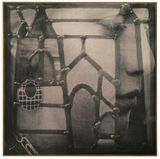
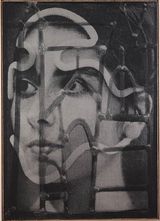
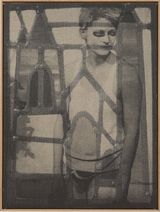
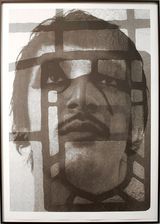
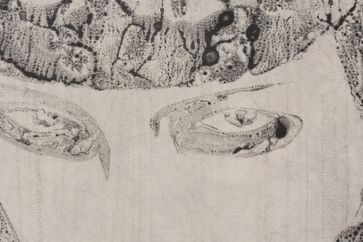
The sense of documentation arises largely from Noonan’s materials. The dot-matrix of enlarged screen-prints and the sepia tones of linen imbue the sculptures with an historical aesthetic. In contrast, Noonan’s collaged and screen-printed wall works are rendered in cooler tones. They are windows that articulate the space architecturally. Abstract images of leadlight lattice meld with, and simultaneously frame, found portraits. The resulting veiled assemblages in turn “frame” the sculptures. In contrast to the inherent flatness of the screen-print, these images are built up, subtly layered, or embossed. They are surface reliefs – the textured elements relating back to their sculptural counterparts. For Noonan, it seems, it is the dialogue that is important; the relationships and tensions that arise between figure and form, image and image, figuration and abstraction.
Olivia Sophia
Noonan has exhibited nationally and internationally for almost two decades, including solo exhibitions at the Australian Centre for Contemporary Art, Melbourne (2009), the Chisenhale Gallery in London (2008) and the Palais de Tokyo in Paris (2007).

Established in Sydney by influential Australian art dealer and gallerist Roslyn Oxley and her husband Tony Oxley in 1982, Roslyn Oxley9 Gallery is one of Australia’s leading commercial galleries.

A respected voice in contemporary art discourse.
Focusing on ambitious storytelling and insightful art-world commentary. Ocula Magazine publishes in-depth interviews, critical essays and timely analysis on the artists, exhibitions and ideas driving the global art world.
Learn more about Ocula Magazine
Showcasing the best of the art world.
Ocula partners with galleries from around the world to highlight their artists, artworks and exhibitions. Gallery membership is by application and invitation, with each member vetted by an independent panel.
Learn more about Ocula Membership

Specialises in the sale of major artworks.
Led by a team with deep ties to the world’s leading auction houses, galleries and collectors. Ocula’s advisory team offers bespoke services to high-net-worth clients from around the world who are looking to acquire the best of contemporary and modern art.
Learn more about our team and services