






Payne Zhu Thinks That the Ocean Can Teach Us About AI
The Shanghai‑based artist discusses the 16th‑century Chinese novel that inspires him, painting with “shrimp waste” and digestion as a metaphor. Save to My OculaWhat if the disorientation produced by the authoritative but factually dubious nature of AI is less a crisis of cognition than of digestion? This proposition sits at the heart of Shanghai-based artist Payne Zhu’s Anal Intelligence, which is currently on view at Spurs Gallery. The exhibition brings together two new bodies of work: an immersive video installation featuring streams of images drawn from short-video platforms such as Chinese streamer Douyin and the artist’s own night-vision footage of after-dark social scenes, and a series of paintings on algae-based leather depicting marine organisms in cycles of consumption and redistribution. Connecting these seemingly disparate works is Zhu’s interest in forms of exchange organised around surplus, excess and circulation, which he sees in both the libidinal economies of a night out in Shanghai and the ecological afterlife of what’s known as a “whale fall”, where a whale’s carcass returns nutrients across the marine ecosystem.
Born in Shanghai in 1990, Payne Zhu graduated from the city’s University of Business and Economics before finding his way into art through artist-run initiatives, where he developed a practice examining the entanglements of technology, finance, infrastructure and ecological systems. “Current debates on AI are often organised around vision and cognition,” says Zhu. For him this reflects a preoccupation with what traditional Chinese thought would call the “luminous orifices” (the eyes, ears, nostrils, and mouth). Anal Intelligence looks instead to the “turbid orifices” (the urethra and anus) through which impurities are expelled. “It proposes registers of intelligence grounded not in illumination and clarity, but in obscenity, waste and excess,” Zhu continues. “With the rise of increasingly intelligible algorithms and short-form video platforms, we are confronted with a profusion of poor images circulating at unprecedented scale.”

Zian Chen: Looking at Anal Intelligence, I was reminded of Dominic Pettman’s e-flux piece on the “closed effluvial loop”, which explored the proliferation of AI-generated books on Amazon serves as an allegory of intellectual labour that increasingly feeds on its own waste.
Payne Zhu: To begin with, the exhibition actually starts with an earlier work, Make Bad Cookies (2016–2026), in which I first explored what might be described as an effluvial loop. The project collected the strange responses generated by major search engines when bots were introduced into systems designed to predict human behaviour. The resulting chain-like sentences and algorithmic non-sequiturs appear on the gallery wall. Looking back, I realised that many of my works orbit a handful of technology companies that have shaped contemporary life. While each focuses on a different platform or paradigm, together they trace a broader story of technological entanglement and rivalry between China and the United States.

ZC: The titular work forms the centrepiece of the exhibition. What were some of the ideas and materials that informed its development?
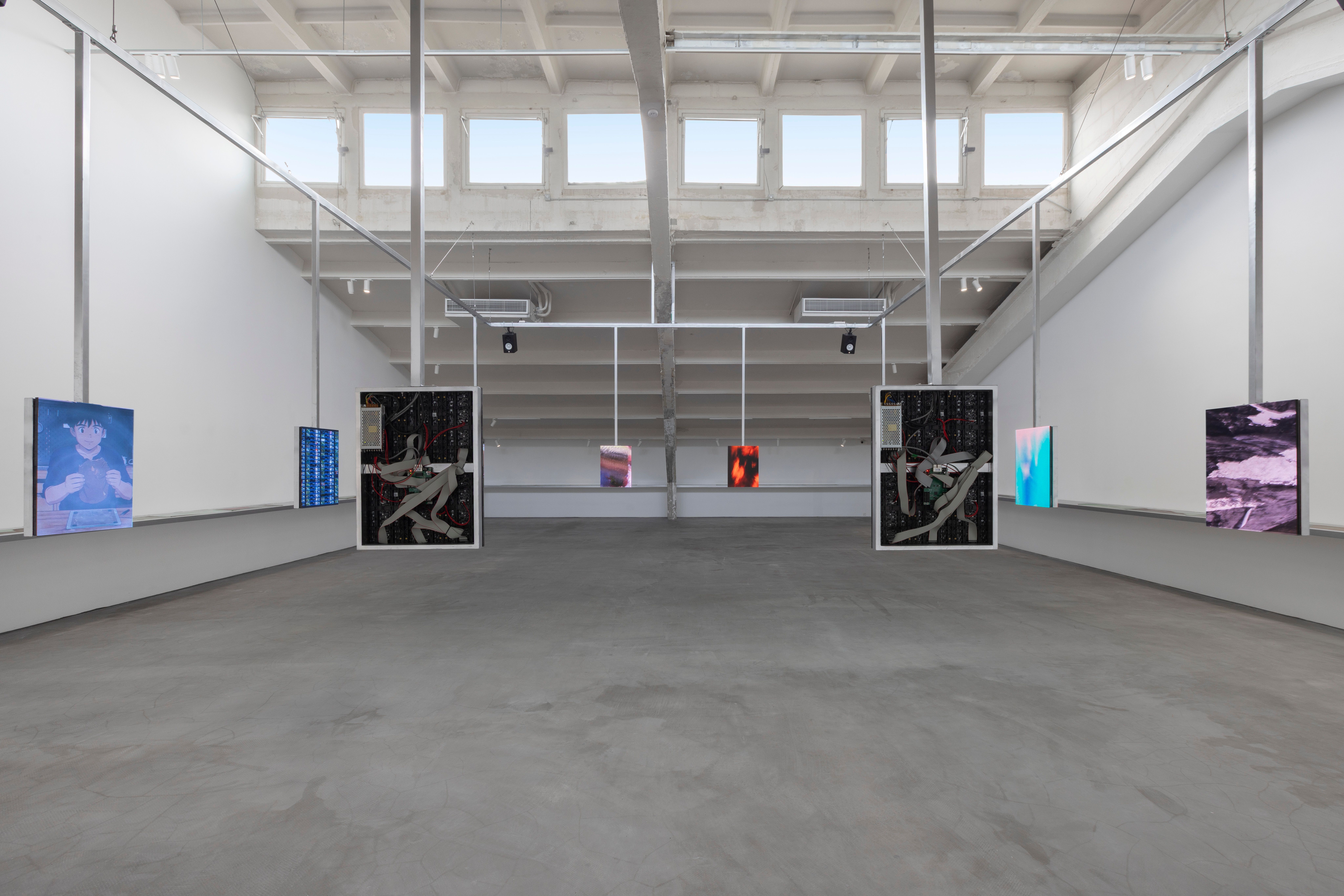
PZ: The titular work immerses viewers within a 12-screen environment animated by a constantly shifting stream of images—mukbang videos, dance clips, gaming streams and idol broadcasts—drawn from a database assembled from various short-video platforms. Algorithms would pair and recombine these clips across the screens, foregrounding the ways bodies are trained by platform infrastructures: the dexterity of gamers, the proliferation of hand gestures, and the new habits that emerge as users learn to navigate recommendation systems. Retaining the hypnotic rhythms of algorithmic feedback loops, these image streams are punctuated by footage I have gathered over many years using night-vision cameras. Some document nightlife as a field of desire; others expose otherwise invisible infrastructures of capture, from the infrared emissions of electric vehicles to the infrared points projected by smartphones each time they unlock to scan a face.

“Looking back, I realised that many of my works orbit a handful of technology companies that have shaped contemporary life”
ZC: Some of the exhibition’s most literal depictions of bodily openings appear in the algae-based leather paintings of marine creatures. How do these works connect to your broader concerns?
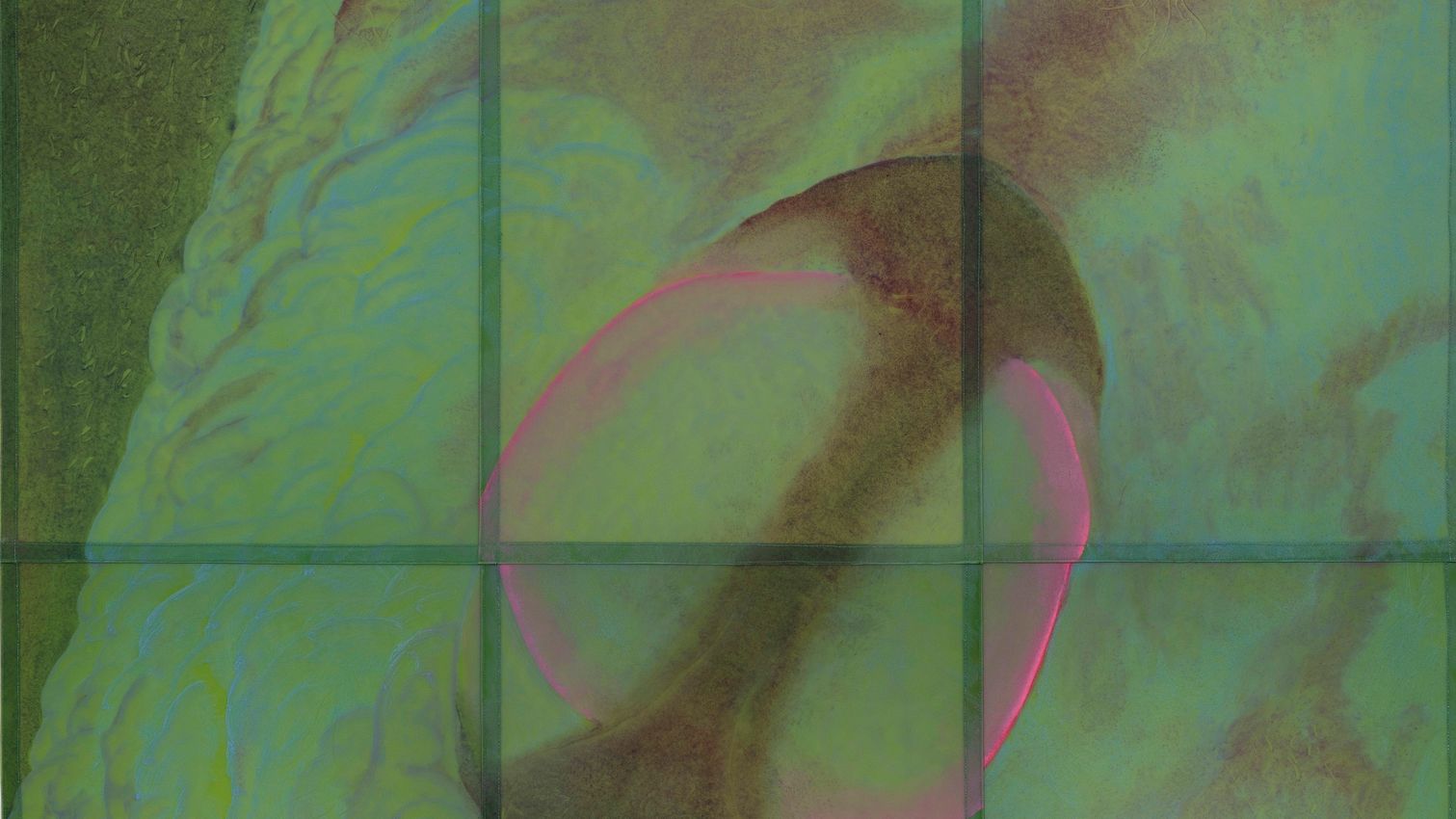
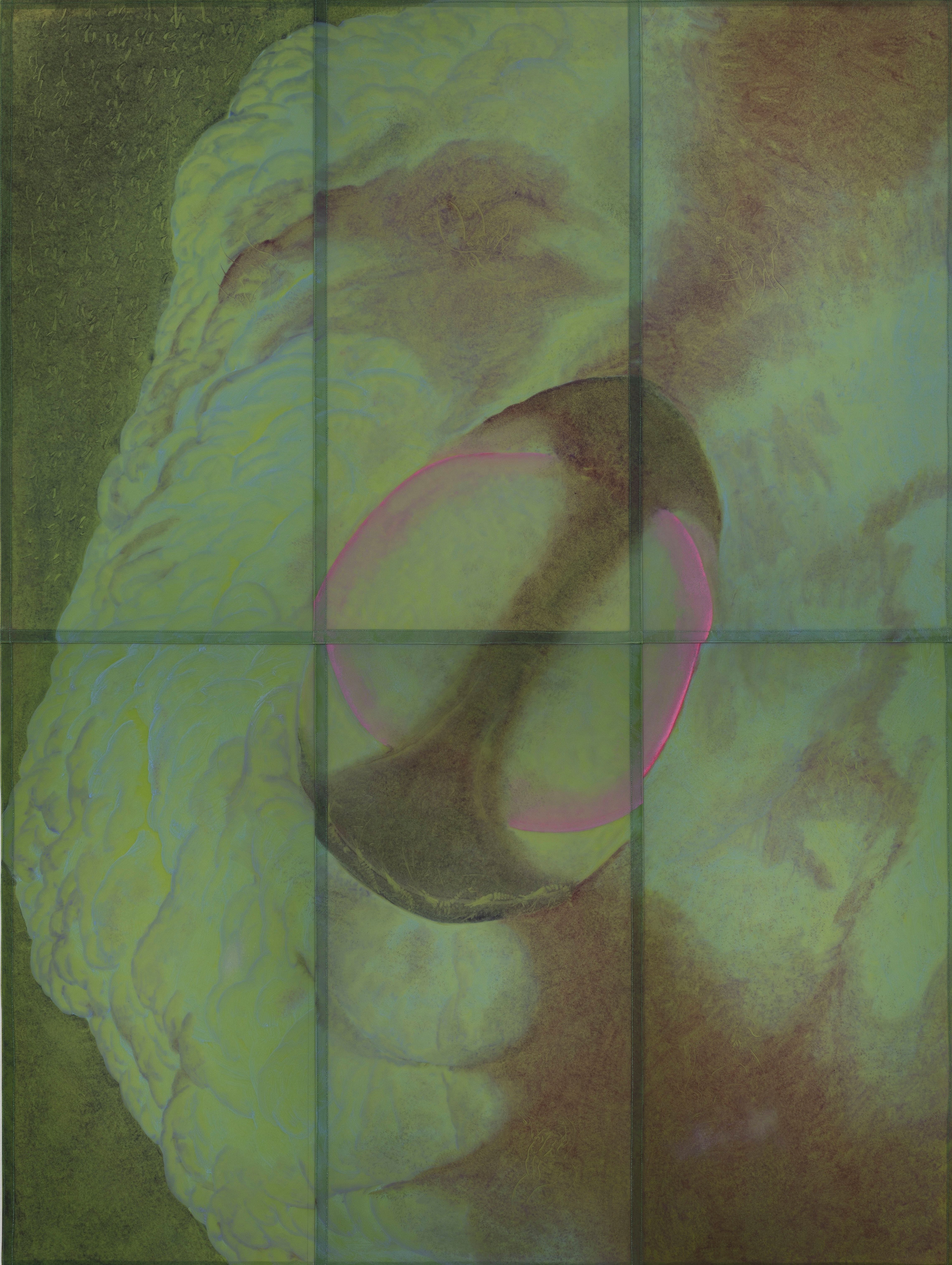
PZ: The paintings you mentioned, each centred on a solitary eye, began with a scene that lingered in my mind: leaked energy coalescing into an eye on the surface of the sea. They belong to a longer project through which I’ve been thinking about marine ecology, circulation and the limits of financial value. One point of departure was the notion of blue carbon—the way oceans store the waste generated by human activity. One of the first paintings imagines the spermaceti’s ecological cycle: consuming squid and octopuses in life, then sustaining micro-organisms and countless other species through its death. They are depicted on algae-based leather derived from seaweed and painted with organic pigments, including oils rendered from marine by-products such as squid, fish, crab and shrimp waste. I’ve come to think of the whale as a better-than-human broker of ecological redistribution. Rather than accumulating value, it continues to nourish entire ecosystems through the redistribution of its own body after death.


“I’ve come to think of the whale as a better-than-human broker of ecological redistribution”
ZC: What’s the book that has influenced you the most?
PZ: Probably The Plum in the Golden Vase, the 16th-century Chinese novel often remembered for its eroticism. For me, however, it is equally a dark and uncompromising study of corruption, desire and finance. A recurring motif in the novel is the red date, which the protagonist Ximen Qing consumes before and after taking aphrodisiacs as a kind of stimulant. There is also a striking scene in which he inserts an aphrodisiac into his urethra. —[O]
Payne Zhu, Anal Intelligence (until 28 June) at Spurs Gallery, Beijing.
Main image: Payne Zhu, Octopus Boronicus Viridis (2026). Courtesy the artist and SPURS Gallery.









A respected voice in contemporary art discourse.
Focusing on ambitious storytelling and insightful art-world commentary. Ocula Magazine publishes in-depth interviews, critical essays and timely analysis on the artists, exhibitions and ideas driving the global art world.
Learn more about Ocula Magazine
Showcasing the best of the art world.
Ocula partners with galleries from around the world to highlight their artists, artworks and exhibitions. Gallery membership is by application and invitation, with each member vetted by an independent panel.
Learn more about Ocula Membership
Specialises in the sale of major artworks.
Led by a team with deep ties to the world’s leading auction houses, galleries and collectors. Ocula’s advisory team offers bespoke services to high-net-worth clients from around the world who are looking to acquire the best of contemporary and modern art.
Learn more about our team and services