





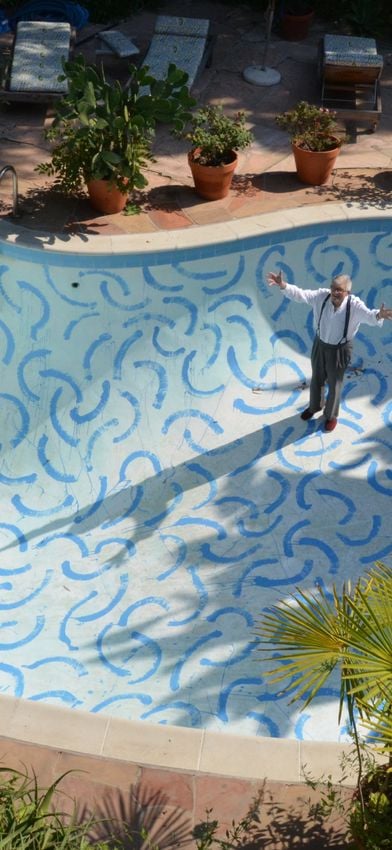
Full Colour
David Hockney maintained a fierce love of life and of painting right up until his death. The writer Arthur Lubow, who followed his career for half a century, looks back at the artist’s contribution to visual culture. Save to My OculaDavid Hockney was an enthusiast. He loved so many things (cigarettes, good-looking men, restaurants, opera, Picasso…). His great gift, and the secret to his enormous popularity, was his infectious communication of such passions, not just in conversation (he was a fabulous talker, fueled by a sly sense of humor, a wide-ranging knowledge and a curiosity about everything, including you), but in his art.
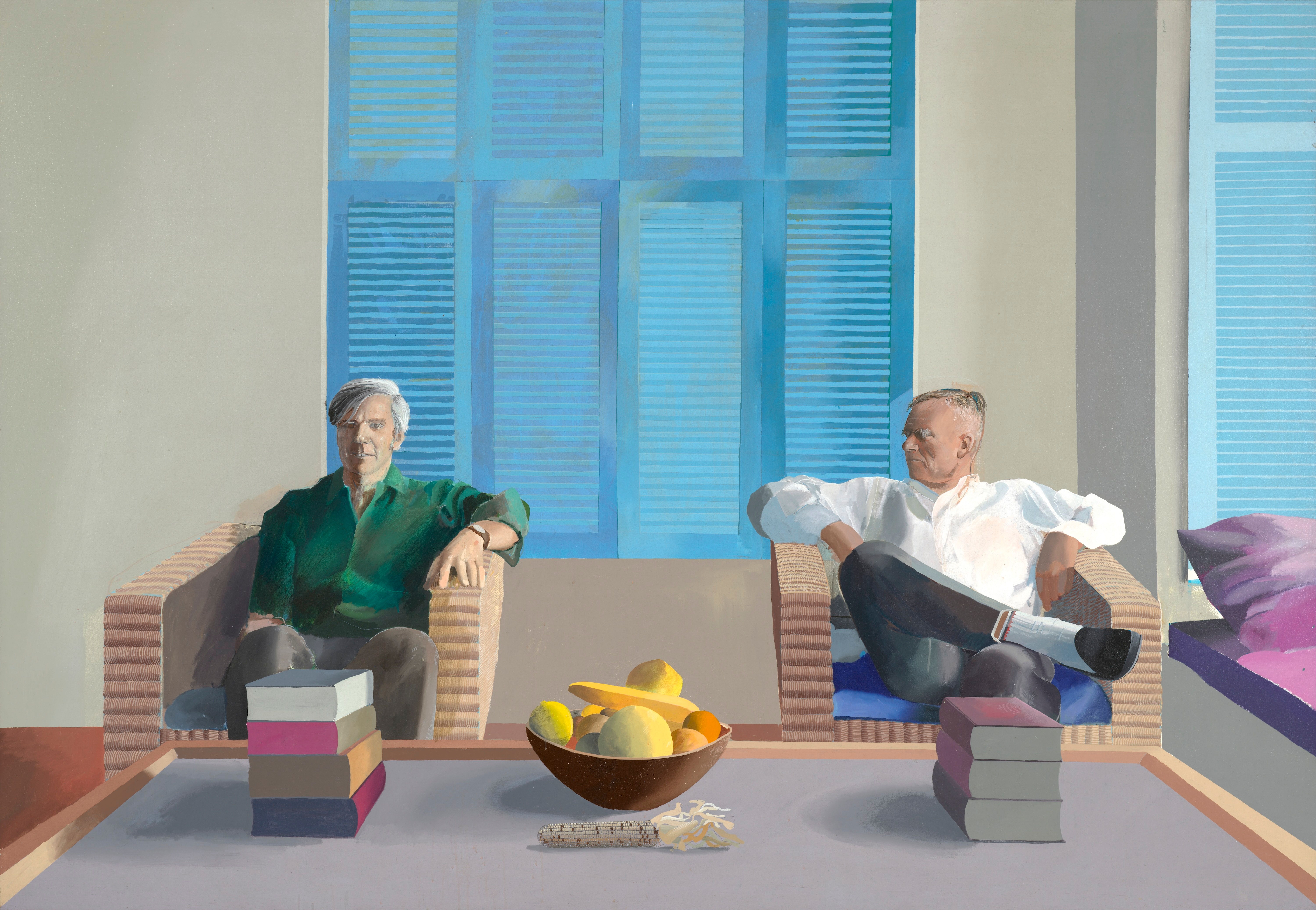
A Hockney painting is marked by immediacy. You grasp at once what he is getting at. His depictions of Southern California, which include many of his most celebrated images, were made with flat acrylic paint and they look at least as good in reproduction as in real life. He was fundamentally a graphic artist with extraordinary draughtsmanship. His acute eye missed nothing, and his sensitivity to human behaviour informed his painting, especially the dual portraits of the late 1960s and early 1970s in which he evoked the subtle dynamics that bound and distanced such couples as Ossie Clark and Celia Birtwell, and Christopher Isherwood and Don Bachardy. He caught the poignant tension between self-absorption and wariness, domination and withdrawal.
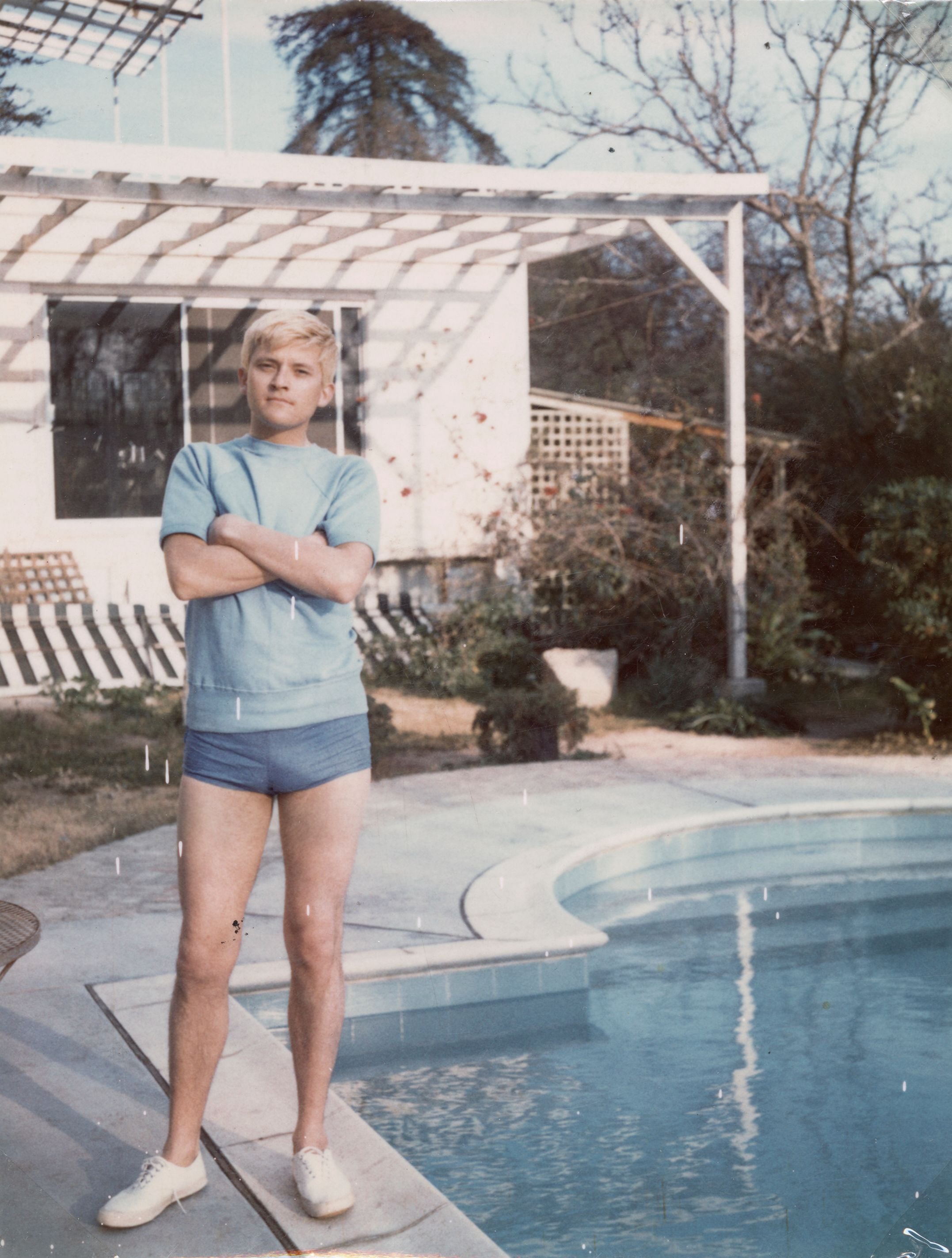
Superabundant sunlight, a rare commodity in his native Bradford, drew Hockney to live in Southern California. His love of colour may also be a reaction to the grey skies of West Yorkshire. He said that on his first visit to Los Angeles, in 1964, as the aircraft descended over the city, he saw the aquamarine shapes of the swimming pools and knew he had found his home.
But he had already formed a sensual vision of LA from California physique magazines of undressed muscular men and John Rechy’s 1963 novel about male hustlers, City of Night. At a time when homosexual acts were illegal in Britain, Hockney was insouciantly upfront about his sexual orientation. The paintings he created in his student days, which are among my favourites, often featured homoerotic themes. We Two Boys Together Clinging (1961) depicts two crudely drawn blocky figures embracing. The title comes from a poem of the same name by Walt Whitman, and the inspiration was a newspaper headline, “Two Boys Cling to Cliff All Night”, which referred to a mountain-climbing accident but which caused Hockney to think about the handsome pop singer Cliff Richard. (He was enamoured, for different reasons, with both Walt and Cliff.) At his graduation ceremony from the Royal College of Art, he wore a gold lamé jacket that matched his dyed blond hair to receive a gold medal.
“He was fundamentally a graphic artist with extraordinary draughtsmanship”
Although Hockney’s best-known scenes of LA depict the wavy arabesques of sunlight reflected in swimming pools, he also masterfully portrayed the rectangular façades of modern buildings, the palm trees jutting up from the sidewalks and the sprays of water misting from lawn sprinklers. Those paintings recorded his early impressions of his adopted home base. As he came to know the city better, he amplified his vision with a new approach that coincided with his photocollages, which departed from a one-point perspective in favour of the flattened point of view of Cubism and Chinese scroll painting.
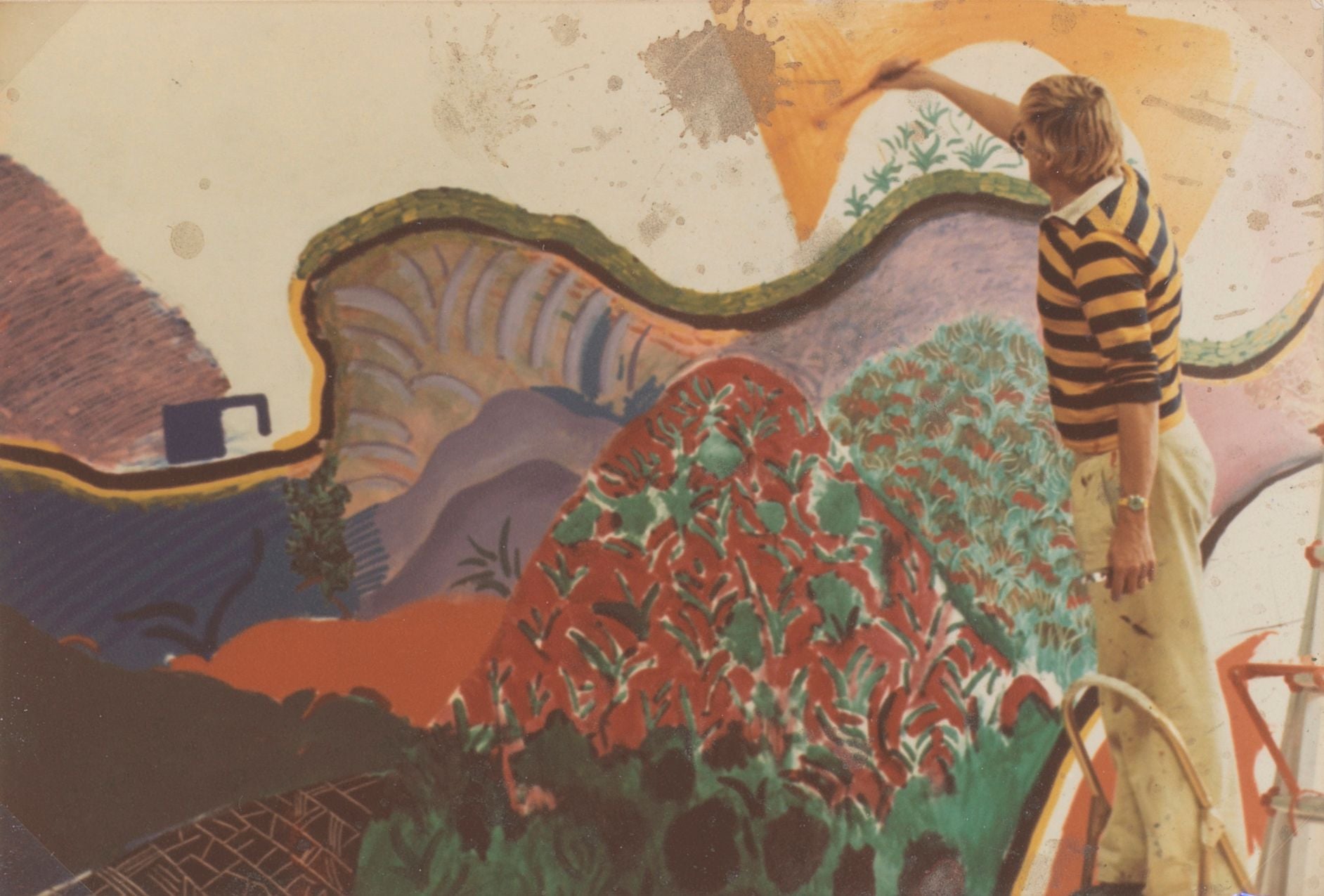
A joyful driver in a city that was built around the automobile (he loved giving visitors a road tour synchronised to a Wagner mixtape that would blare out of his car’s sound system), Hockney took on the challenge of representing his environment the way most Angelenos experience it, at 50 or 60 miles per hour. Mulholland Drive: The Road to the Studio (1980) is a 12-foot-long (6.2-metre) canvas that captures the rapid succession of hillsides, home sites, tennis courts and trees—things that Hockney would see in a passing blur as he drove along the curvy hilltop road.
Hockney relocated in 2005 to Bridlington in coastal Yorkshire, living in a house he had bought in 1989 for his mother and sister. There he rediscovered the miracle of winter changing into spring, a seasonal shift he had missed in Southern California.
Long before the iPhone came about, he was making drawings with hatching and stippling reminiscent of Van Gogh. The Apple gadget gave him a new way to make those marks. An early adopter, he started drawing on his iPhone in 2008, a year after its release, first with his thumb, using the Brushes app, and then with a stylus. He found he was able to make the hatching and stippling marks with accelerated speed, not needing to wait for the colours to dry. He moved to the iPad on its release in 2010. “When the iPad came, I was probably the first to get one in England,” he told me. It became his mainstay. He was to the iPad what the 15th-century Flemish painter Jan van Eyck was to oil paints: the artist who demonstrated the potential of a new technique.
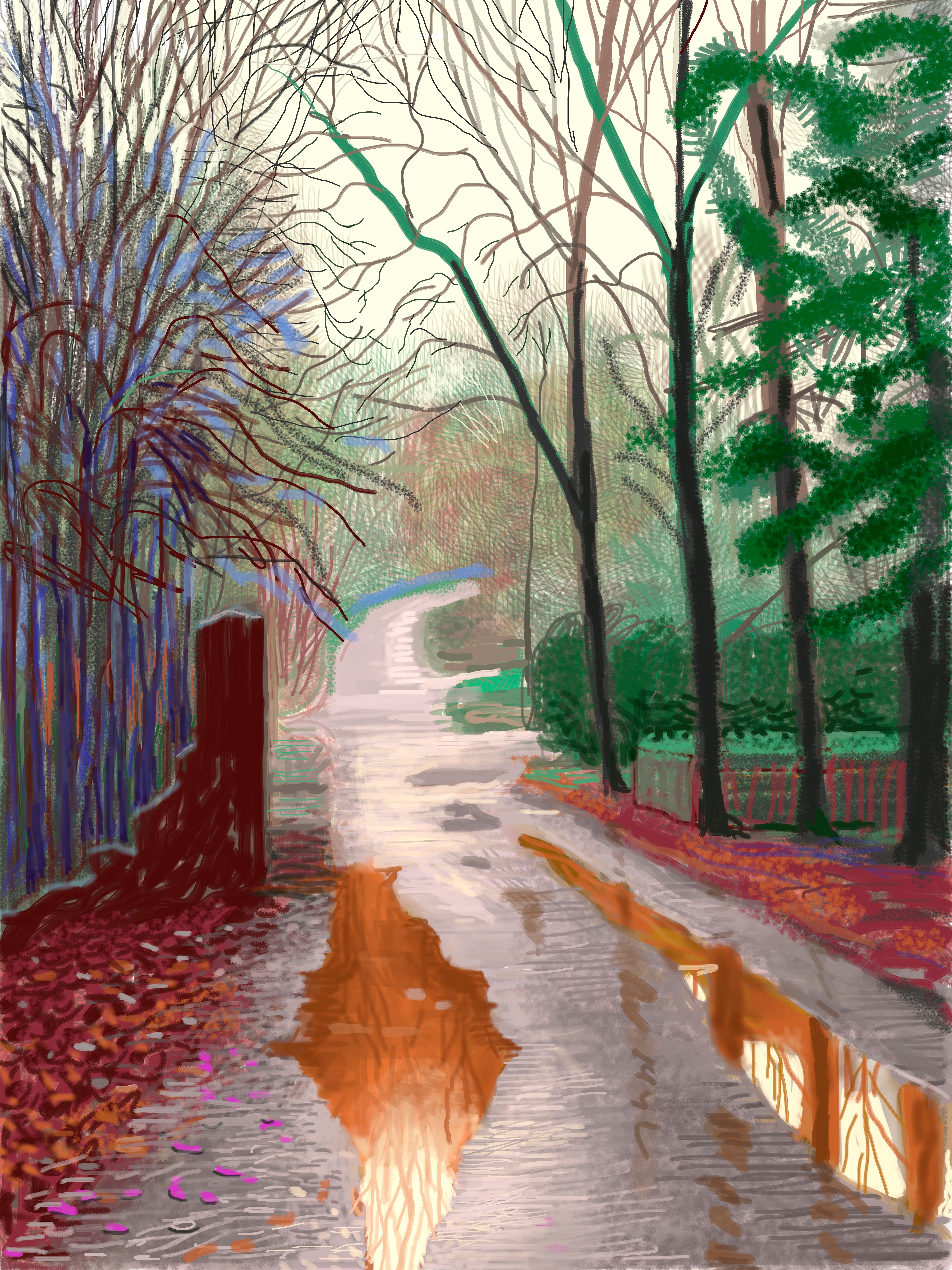
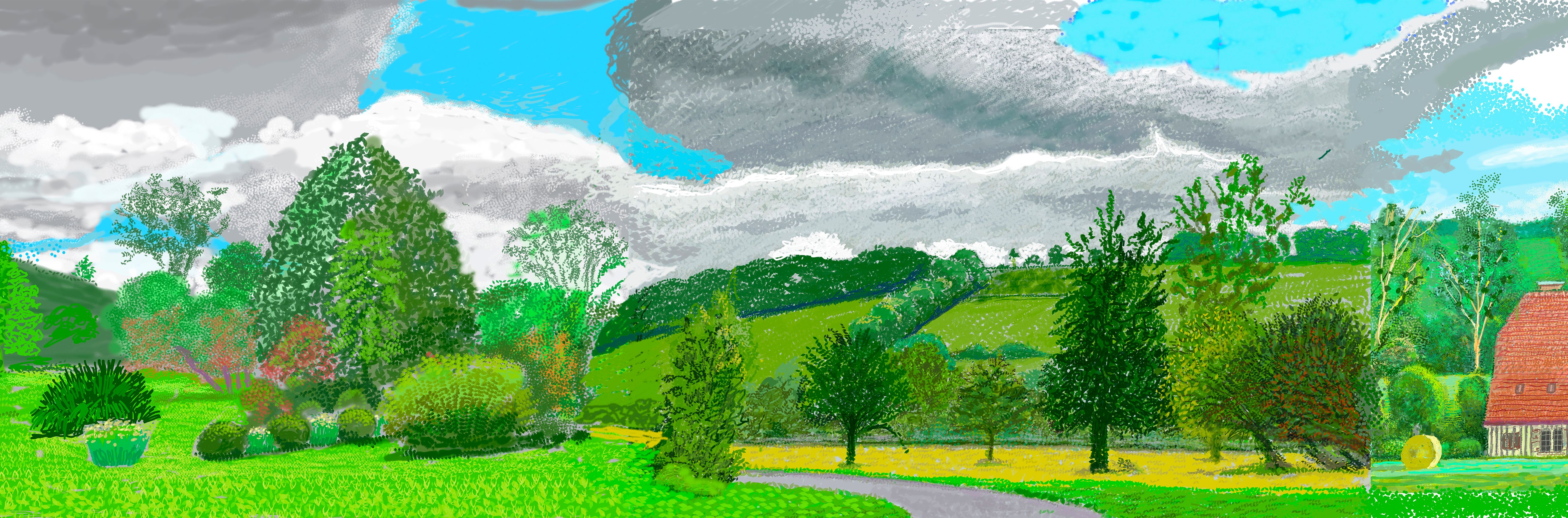
One of Hockney’s most ambitious endeavours in the genre, The Arrival of Spring in Woldgate (2011), is a suite of 51 iPad drawings (and one oil painting) that chronicles exactly what its title says. Moving once again in 2019—this time to Normandy, with his companion, JP Gonçalves de Lima—he went mano a mano with the region’s most famous artwork, the 230-foot-long (70-metre) Bayeux Tapestry, and created A Year in Normandie (2020–2021), tackling all four seasons in a frieze that is around 90 metres (almost 300 feet long). And he was already well into his eighties when he made it.
I first met Hockney in 1978, when, as a young magazine journalist, I traveled from New York to interview him (along with his close friend R.B. Kitaj and Francis Bacon) about the London School of figurative art. In our final communication in January, he was too frail to speak directly. Instead, emailed questions were read to him by an associate, who then transcribed his answers. Nevertheless, during that period, he was mustering the energy to paint for three hours on most days. Like smoking, he kept with it until the end, loving it too much to stop. It is a little hard to take in that, finally, one month shy of his 89th birthday, he has. —[O]
Main image: David Hockney in his newly repainted pool, Hollywood Hills, CA, 8 July 2017 © David Hockney. Photo: Jean-Pierre Gonçalves de Lima





A respected voice in contemporary art discourse.
Focusing on ambitious storytelling and insightful art-world commentary. Ocula Magazine publishes in-depth interviews, critical essays and timely analysis on the artists, exhibitions and ideas driving the global art world.
Learn more about Ocula Magazine
Showcasing the best of the art world.
Ocula partners with galleries from around the world to highlight their artists, artworks and exhibitions. Gallery membership is by application and invitation, with each member vetted by an independent panel.
Learn more about Ocula Membership
Specialises in the sale of major artworks.
Led by a team with deep ties to the world’s leading auction houses, galleries and collectors. Ocula’s advisory team offers bespoke services to high-net-worth clients from around the world who are looking to acquire the best of contemporary and modern art.
Learn more about our team and services