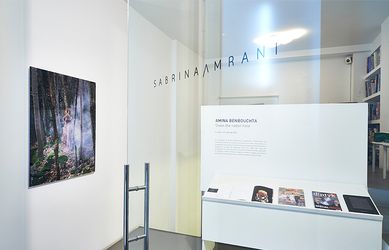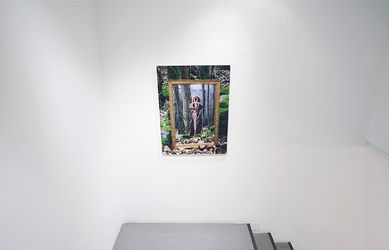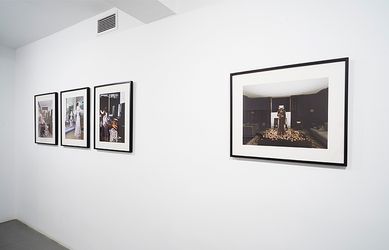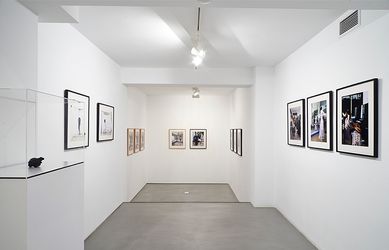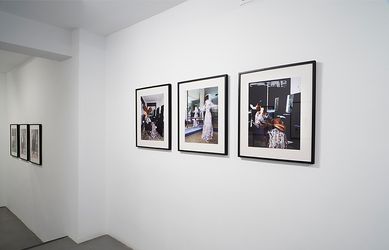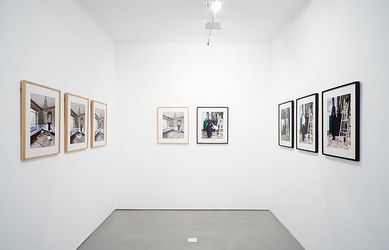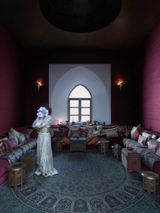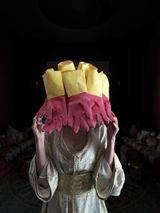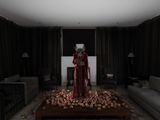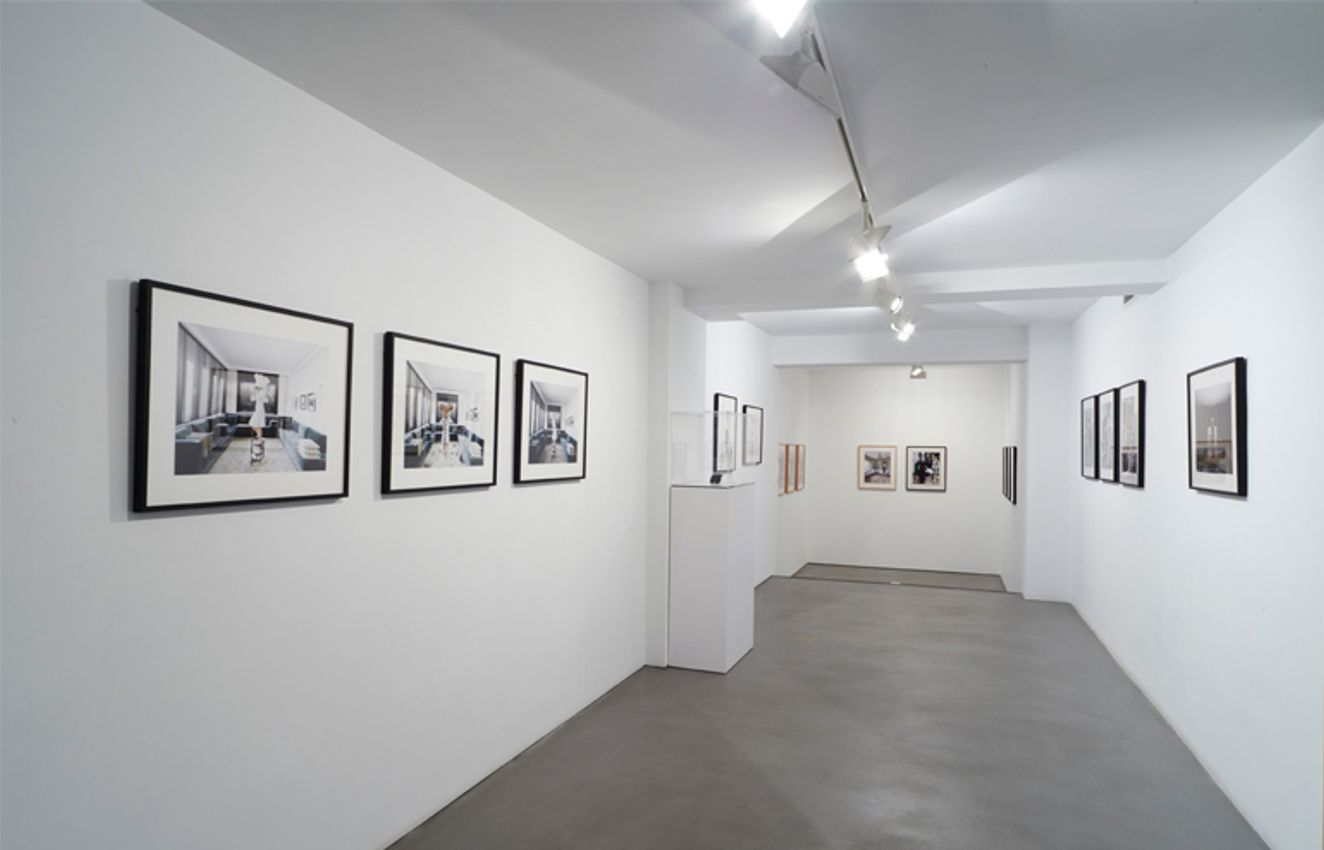
In Amina Benbouchta’s work (Casablanca, 1963) a necessary distance exists with reality, a distance that leaves free field to the imagination and poetry. This distance is of that the Moroccan artist gets hold in her series of photographies Down the rabbit hole, which transports to her pictorial universe where we can find traps, lamp screens, beds, black hearts, animals and mirrors that form part of the personal iconography of the Moroccan artist, also present in her paintings.
Not until recently, her work was exploring systems as that of the painting or the installation, where she was looking for the limits and the breaking of them. Nevertheless, nowadays we are attending in the Arabic world to a genuine interest for contemporary photography that has not been until very recently a widely mean used by the artists of the region. There are differences in the means of expression from one to another and Amina has adopted photography with mastery to express in a different way in this new stage of her extensive artistic trajectory.
With this series of photographies Amina Benbouchta obtains an excess of reality, as if her paintings had managed to make cost its excesses. It is in these elegant sets, in these familiar landscapes, where any woman can be recognized, wherever they live and whatever their condition. All those women who in some moment have been or they have felt to be an object without face, impersonal, invisible in a domestic jail of gold.
Amina is inspired by the burrow of the rabbit, as in by Lewis Carrol’s story, the psychological realities turn into objective realities, blurry borders between the interior and the exterior, like Alice, always to the limit of what is correct but forcing this limit. The women who appear in the photographs are invisible at down the rabbit hole, modern figures of an Alice that escapes through the fantasy of the imagination, through silences with strange animals and through the suppression of the passage of time.
For many women artists the important thing is to speak about the ambiguous situation of the woman, positioned in a society in which she is venerated and sacred, but at the same time diminished or in danger. Benbouchta tries to mark the contrast between the beauty of the form, the color and the materials that appear in her photographs referring to the confinement, the oppression or the submission. Silk clothes, valuable kaftans covered with golden embroideries, which turn in small wonderful cells for the body of the women but which in occasions can be unbearable shackles. It is not possible to distinguish any difference between the delicate adornments of the lamp screens and those of the garment of the woman.
Benbouchta has chosen to be the protagonist in each of her photographs, I am what I am showing, managing to overcome the artist’s condition to come closer the universal. This detail demonstrates also why photography is necessary for the artist: because of the commitment of the artist with the world and the society in whcih she lives, because of her worries on the social troubles. The force of this series of photographs is the universality of the women and their very contemporary aspiration to more freedom. A work that only could be created by photography since it reinforces the belief in the absolute equivalence of the objects and of the images, in his objectivity and truth, in spite of the fact that we could see in these scenes “of kind” a soft form of irony.


Benbouchta was born in Casablanca (Morocco) in 1963, and lives and works between Paris and Casablanca. After graduating in 1986 in Anthropology and Middle Eastern Studies at McGill University, Montreal, she attended various workshops of drawing, lithography and etching in Paris. She was also an auditor at the Ecole Nationale des Beaux Arts de Paris from 1988 to 1990. Her artistic-cultural concerns led her to run the fashion & culture magazine “Les Alignés”, during the 90’s. In 2005, she co-founded the Collectif 212, an organization dedicated to defending the emergence of a new phase of contemporary art in Morocco.

A respected voice in contemporary art discourse.
Focusing on ambitious storytelling and insightful art-world commentary. Ocula Magazine publishes in-depth interviews, critical essays and timely analysis on the artists, exhibitions and ideas driving the global art world.
Learn more about Ocula Magazine
Showcasing the best of the art world.
Ocula partners with galleries from around the world to highlight their artists, artworks and exhibitions. Gallery membership is by application and invitation, with each member vetted by an independent panel.
Learn more about Ocula Membership

Specialises in the sale of major artworks.
Led by a team with deep ties to the world’s leading auction houses, galleries and collectors. Ocula’s advisory team offers bespoke services to high-net-worth clients from around the world who are looking to acquire the best of contemporary and modern art.
Learn more about our team and services