





AMINA BENBOUCHTA
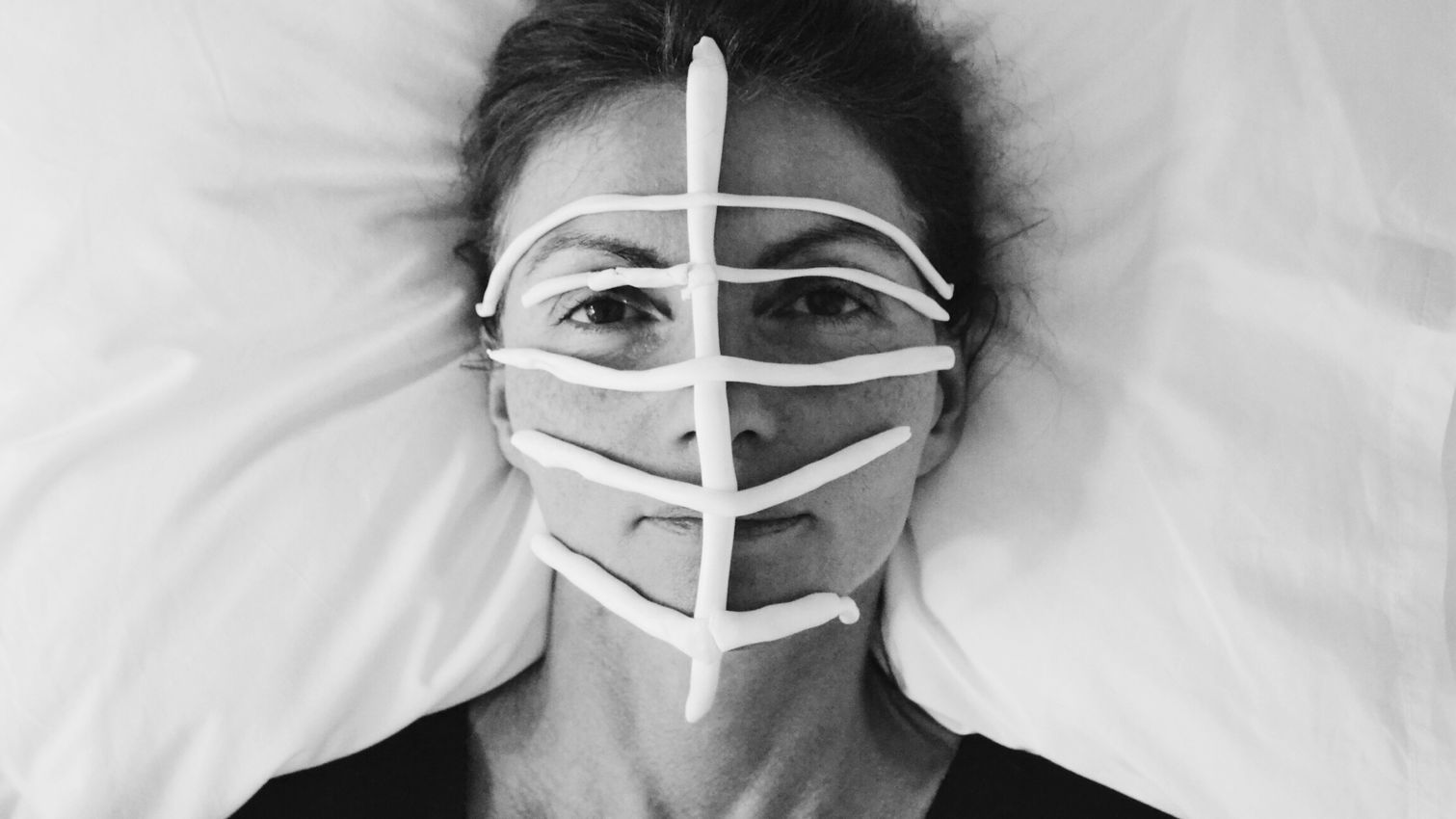
b. 1963, MoroccoAmina Benbouchta’s work—encompassing painting, sculpture, photography, video and installation—addresses the challenges of living as a woman today in public and private space. She harnesses memory to consider how human figures co-exist and interact with both their environment and objects familiar in everyday life (which often have double meanings in terms of women’s treatment in society).
Early Years
Amina Benbouchta was born in Casablanca, Morocco in 1963. She graduated from McGill University in Montreal in 1986 with a degree in anthropology and Middle Eastern studies. Moving to Paris, she studied drawing, lithography and engraving while working as an auditor at the École Nationale des Beaux-Arts de Paris. During the 1990s, she ran the fashion and culture magazine Les Alignés; in 2005, she was a co-founder of Collectif 212, an initiative designed to support contemporary Moroccan art.
Amina Benbouchta: Artworks
Writing on her profile page on Sabrina Amrani Gallery’s website, Benbouchta says: “I prefer to devote myself to a work that asks questions of the future of the human being, in a universal way, without constantly bringing back the debate to the details of origin or identity.”
As a multidisciplinary artist, Amina Benbouchta brings her interest in anthropology from her first degree to her body of work. Familiar objects reappear in different phases of her practice—for example, a crinoline, a rabbit, a sewing machine—but they are rarely in familiar contexts, instead floating out of blank parts of the canvas or becoming sculptural. The crinoline is significant as a tool for both the beautification and the enslavement of the female body
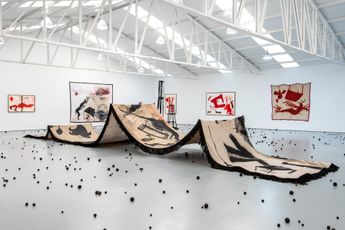
She uses a range of materials and media—charcoal, paint, photography, canvas, glossy paper, grease chalk, collage, balls of wool—and in past exhibitions has used the entire gallery space rather than merely the walls. While canvases from her mid-2020s work can appear stark, with objects seemingly suspended against a light background, later pieces reveal more use of colour and a more dreamy appearance.
Memory is a key element of Benbouchta’s work: she has said that she memories and that she looks at reality through her childhood memories.
- Gorgons (2024) saw the integration of embroidery into Benbouchta’s practice as part of an artistic dialogue between Morocco and India.
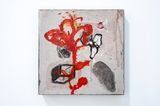
- Untitled (2023) brings vivid colour to the fore: flowers are foregrounded with arrangements of plants, yet also hinted at through bright, blurred, dreamy background imagery.
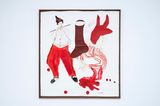
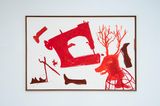
- In the Lost Paradise series of three paintings (2022), Amina Benbouchta combines oil pastel, acrylic and collage on paper. Bright tomato red and darker brown objects—a clown, pliers, socks, a human leg, monster forms—pop against the pale background.
Amina Benbouchta: Exhibitions
Select Solo Exhibitions
- The Quiet Language of Life, MRS Art, London (2026)
- Le Corps Spirituel et l’Esprit Charnel, Palais El Badii, Marrakech (2023)
- One Pound of Flesh, Ceysson & Bénétière, Lyon (2023)
- Are Angel Trumpets Poisonous? Sabrina Amrani Gallery, Madrid (2022)
- On the edge, Galerie Dar El Bacha, Marrakesh (2019)
- Down the Rabbit Hole, Sabrina Amrani Gallery, Madrid (2013)
Select Group Exhibitions
- Femmes Photographes, Musée National de la Photographie, Rabat (2022)
- Bum Bum Ba Ye, Sabrina Amrani Gallery, Madrid (2021)
- United Artists, Movenpick Hotel Mansour Eddahbi, Marrakech (2020)
Further reading
- Amina Benbouchta’s Instagram
- A 2025 interview with Judith Benhamou
- Artist profile page at Sabrina Amrani Gallery
- Collectif 212’s Instagram
Amina Benbouchta FAQs
What are Amina Benbouchta’s influences?
Amina Benbouchta’s work considers the positions of humans and their environment, and she has often referred to Lewis Carroll’s Alice’s Adventures in Wonderland (1865), giving the objects in her work unexpected sizes (see the oversized wolf or the large sewing machine in her 2022 exhibition Are Angel Trumpets Poisonous?), describing Alice as a “childhood friend” in a 2025 YouTube interview and titling a 2013 exhibition demonstrating how women can become invisible Down the Rabbit Hole.
Where does Amina Benbouchta live?
Amina Benbouchta spends time in Casablanca and Paris. She was born in Casablanca, moving to Paris after a spell at a Canadian university during the 1980s.
What are the main themes in Amina Benboutcha’s work?
Amina Benboutcha examines body, identity and memory, considering the objects and forces of soft power that shape female experience. Familiar objects become symbolic in their reappearance, and her work asks us to consider how humans interact with their environment.
Ocula

View Amina Benbouchta's Artworks












Explore Amina Benbouchta's Exhibitions



Explore and Follow Artists Shaping Contemporary Art
A respected voice in contemporary art discourse.
Focusing on ambitious storytelling and insightful art-world commentary. Ocula Magazine publishes in-depth interviews, critical essays and timely analysis on the artists, exhibitions and ideas driving the global art world.
Learn more about Ocula Magazine
Showcasing the best of the art world.
Ocula partners with galleries from around the world to highlight their artists, artworks and exhibitions. Gallery membership is by application and invitation, with each member vetted by an independent panel.
Learn more about Ocula Membership
Specialises in the sale of major artworks.
Led by a team with deep ties to the world’s leading auction houses, galleries and collectors. Ocula’s advisory team offers bespoke services to high-net-worth clients from around the world who are looking to acquire the best of contemporary and modern art.
Learn more about our team and services