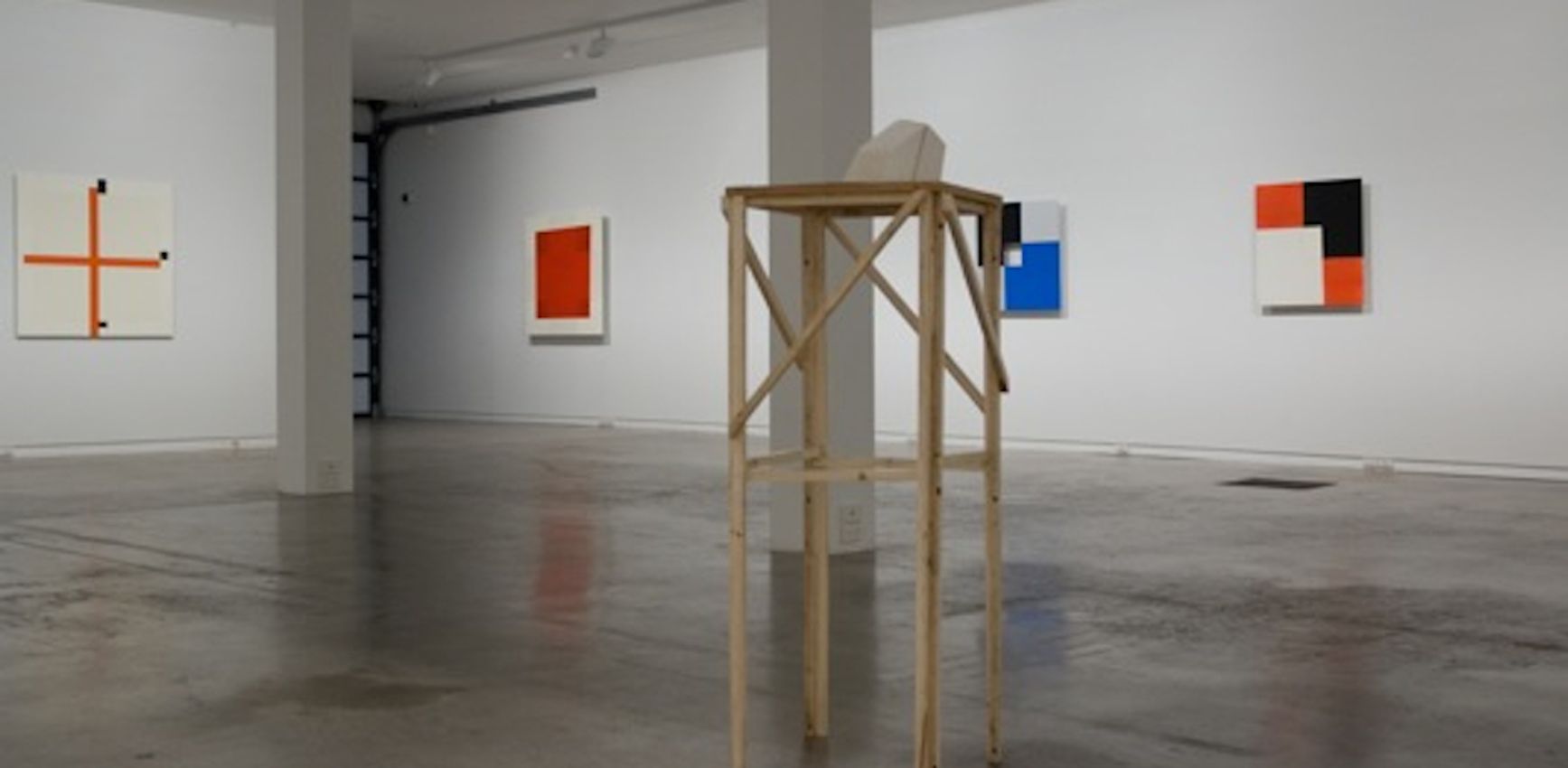
The retrospective exhibition Bambury: Works 1975-1999, curated by Wystan Curnow for City Gallery, Wellington, opens in the New Gallery in August. This exhibition gives us a chance to take in and weigh up over two decades of rigorously intelligent and aesthetically nuanced painting. Bambury’s work has an immediate visual impact; its clarity of geometric image and constructional signposting is visceral, it is passionately felt and tenaciously pursued through variation on a repeating lexicon of formats and motifs. For good reason Bambury’s art has often been understood as providing a modus vivendi between the orthodoxies of late modern formalism and the uncertainties, informalities and fluidities of the postmodern world.
Bambury’s immersion in the history of abstraction has led him toward the interior of painting, to abstraction’s intimations of depth and transcendence, as much as toward a clarification of the painting’s exterior, the material and pictorial architecture of a painting as a physical thing. To this dialogue between the inside and outside of painting Bambury brings a language of exacting ambivalence. The formal hallmarks of his strategic reticence are incomplete doublings, mirrorings, reversals, bifurcations, and slipped alignments of an iconic alphabet of primary geometric components. Bambury also undermines the purity of the self-contained icon by the richness and atmospherics of the material surface. Shimmers of mineral irridescence, organic stains, vegetal change, and the thickness of light’s passage are all conjured up through Bambury’s investigative alchemy of painting both as being and appearance.
Stephen Bambury’s productive preoccupation for over forty yearswith the square, circle and cross has yielded a body of work that mines rich seams. Unlike the rigid formalism adopted by some other artists of the same period, Bambury’s work fuses intellectual and emotional content with material form. He has stated that he has ‘always seen the paintings as a means of promoting an inner reflection and of creating a context where an experiential exchange could take place’; what he calls a painting experience. The central importance of materiality to Bambury’s practice is underpinned by comprehensive technical investigation; he has mastered the use of copper, aluminium, paper, resin, graphite, precious metal gilding, chemical patinas and rust. Sculptural elements comprised of steel, oil and burnt timbers expand the notions of a painting practice. Photography, screen prints and collaborative publications constitute another area of current investigation.


Two Rooms is a contemporary art exhibition venue located in a converted warehouse in Central Auckland, New Zealand. Opened in August 2006, Two Rooms presents a program of residencies and projects by leading International and New Zealand contemporary artists. The building houses two exhibition spaces, the Project Room and the Long Room.

A respected voice in contemporary art discourse.
Focusing on ambitious storytelling and insightful art-world commentary. Ocula Magazine publishes in-depth interviews, critical essays and timely analysis on the artists, exhibitions and ideas driving the global art world.
Learn more about Ocula Magazine
Showcasing the best of the art world.
Ocula partners with galleries from around the world to highlight their artists, artworks and exhibitions. Gallery membership is by application and invitation, with each member vetted by an independent panel.
Learn more about Ocula Membership

Specialises in the sale of major artworks.
Led by a team with deep ties to the world’s leading auction houses, galleries and collectors. Ocula’s advisory team offers bespoke services to high-net-worth clients from around the world who are looking to acquire the best of contemporary and modern art.
Learn more about our team and services