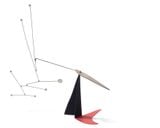
Alexander Calder is perhaps best known for his ‘mobiles’, suspended kinetic abstract sculptures, as well as his more solid, large-scale ‘stabiles’. Across his works the artist employs primary colours and abstract geometric forms.
Mobiles
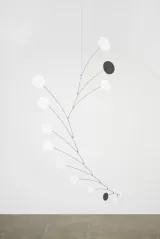
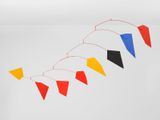
Alexander Calder’s mobiles are perhaps his most renowned inventions, comprising suspended, abstract elements that move and balance in changing harmony. Though none were intended for children, throughout his career, Calder created numerous metal mobiles in various contexts.
Early examples such as Half-circle, Quarter-circle, and Sphere (1932) and Square (1934), moved by electric motors, however Calder soon discovered he could create mobiles that moved on their own with shifting air currents. In 1939 Alexander Calder created Lobster Trap and Fish Tail, a full scale example of his early mobiles in the main stairwell of New York’s Museum of Modern Art.
During the Second World War Calder briefly utilised wood due to the scarcity of metals. After the war he reverted to using painted sheet metal, that continued to be the staple of his mobiles for much of the rest of his career. These mobiles grew in scale and complexity.
Stabiles
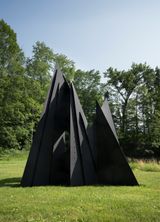
Calder also devoted himself to making outdoor sculpture on a grand scale from bolted sheet steel. Calder began experimenting with this approach in the 1930s. Alexander Calders ‘stabiles’ as Jean Arp coined them, in contrast to his ‘mobiles’ were based on the idea of ‘implied movement’ instead of actual movement.
Often monumental in scale these ‘stabiles’, occupying prominent public spaces, required the viewer to walk around them.
Today, these stately titans grace public plazas in cities throughout the world. They are popular civic icons. Arguably one of Calder’s most iconic public sculptures, La Grande Vitesse (1969) has become emblematic of the city of Grand Rapids, Michigan. Dominating the plaza in front of City Hall, the 43 foot tall, 42 tonne steel Stabile, painted in Calder’signature red, has been at the centre of civic life and culture in Grand Rapids for over 50 years.
Beyond Sculpture
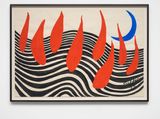
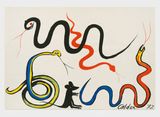
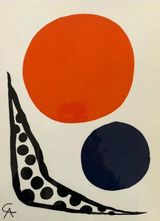
Alexander Calder’s prints, paintings, and other artworks on paper made in the 1960s and 70s are pristine examples of the influence of Joan Miró, Theo van Doesburg, Fernand Léger, and Piet Mondrian on his practice. They are colourful compositions, rendered in vivid primary colours with a focus on line and geometric forms. Some retain almost surreal figurative elements, while others are entirely abstract.
Alexander Calder also created a substantial collection of jewellery, which borrows some of the contrasting abstract elements of his sculptures.