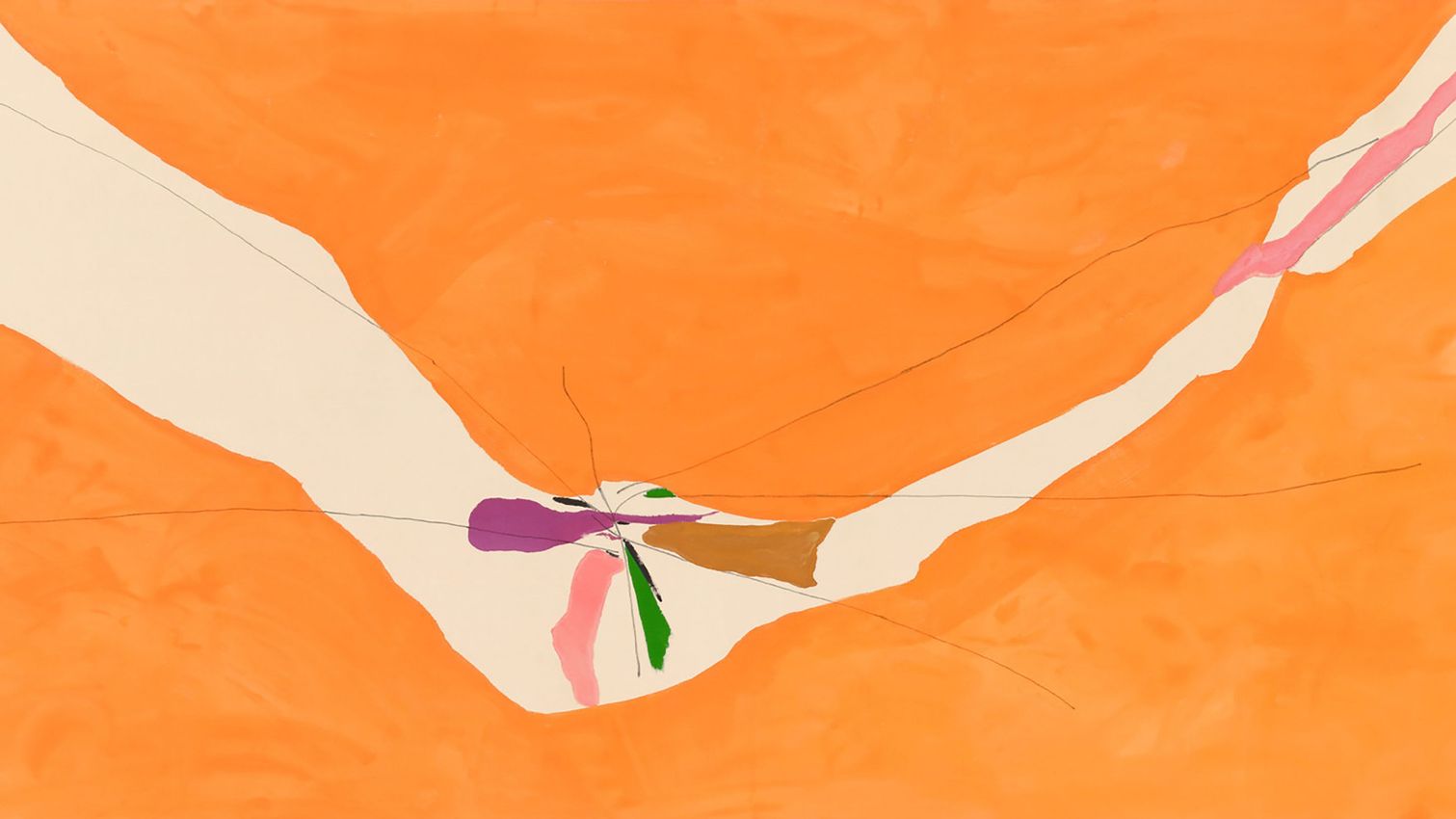
Describing her painting Chairman of the Board (1971), Helen Frankenthaler said that the work “was about a grand sweep. I had the basic idea in my head—I knew how the lines would dance in. I felt sure of myself.” This statement speaks to the artist’s ambition to paint on a monumental scale, and her confidence in doing so, two decades after her breakthrough moment in the Abstract Expressionist scene of midcentury New York. At the same time, the phrase—a grand sweep—also speaks to the expansive arc of her long career and its continuous innovations.
The paintings in this exhibition offer a succinct exploration of Frankenthaler’s ongoing experiments. In the 1950s, she developed a signature technique of pouring thinned oil paint on raw canvas and allowing the medium to soak into the support. By the early 1960s, she shifted to acrylic paint, enabling more defined edges and precipitating a new emphasis on shape. Attentive to the relationship between painting and landscape, she considered these forms in geographic terms, calling them “districts” or “territories.” By the late 1980s, these material investigations increasingly yielded moodily resonant compositions, like Toward Dark (1988), a recently acquired painting making its MoMA debut.
Ultimately, each fearless development contributes to a distinctive whole. “I’ve explored a variety of directions and themes over the years,” Frankenthaler reflected. “But I think in all my painting you can see the signature of one artist, the work of one wrist.”
Organized by Samantha Friedman, Curator, Department of Drawings and Prints, with Elizabeth Wickham, Curatorial Assistant, Department of Painting and Sculpture.
Helen Frankenthaler (1928–2011) is widely recognised as one of the great American abstract painters of the 20th century, and a pivotal figure in the transition from Abstract Expressionism to Colour Field painting. A leading member of the second generation of postwar American abstract artists, she is best known for her innovative soak-stain technique, in which she poured turpentine‑thinned paint onto unprimed canvas laid on the floor, allowing colour to soak into the fabric and create luminous, translucent fields.


The Museum of Modern Art (MoMA) is an iconic institution located in Midtown Manhattan, New York City, celebrated for its pioneering collection and innovative architecture. Renowned for housing one of the world’s most significant collections of modern and contemporary art, MoMA is a must-visit destination for art enthusiasts.

A respected voice in contemporary art discourse.
Focusing on ambitious storytelling and insightful art-world commentary. Ocula Magazine publishes in-depth interviews, critical essays and timely analysis on the artists, exhibitions and ideas driving the global art world.
Learn more about Ocula Magazine
Showcasing the best of the art world.
Ocula partners with galleries from around the world to highlight their artists, artworks and exhibitions. Gallery membership is by application and invitation, with each member vetted by an independent panel.
Learn more about Ocula Membership

Specialises in the sale of major artworks.
Led by a team with deep ties to the world’s leading auction houses, galleries and collectors. Ocula’s advisory team offers bespoke services to high-net-worth clients from around the world who are looking to acquire the best of contemporary and modern art.
Learn more about our team and services